Aokigahara: The Forest at the Base of Mt. Fuji
At Mount Fuji’s northwestern foot, a forest grows directly from a sea of hardened lava—quiet, intricate, and burdened by a reputation that has too often obscured the place itself.
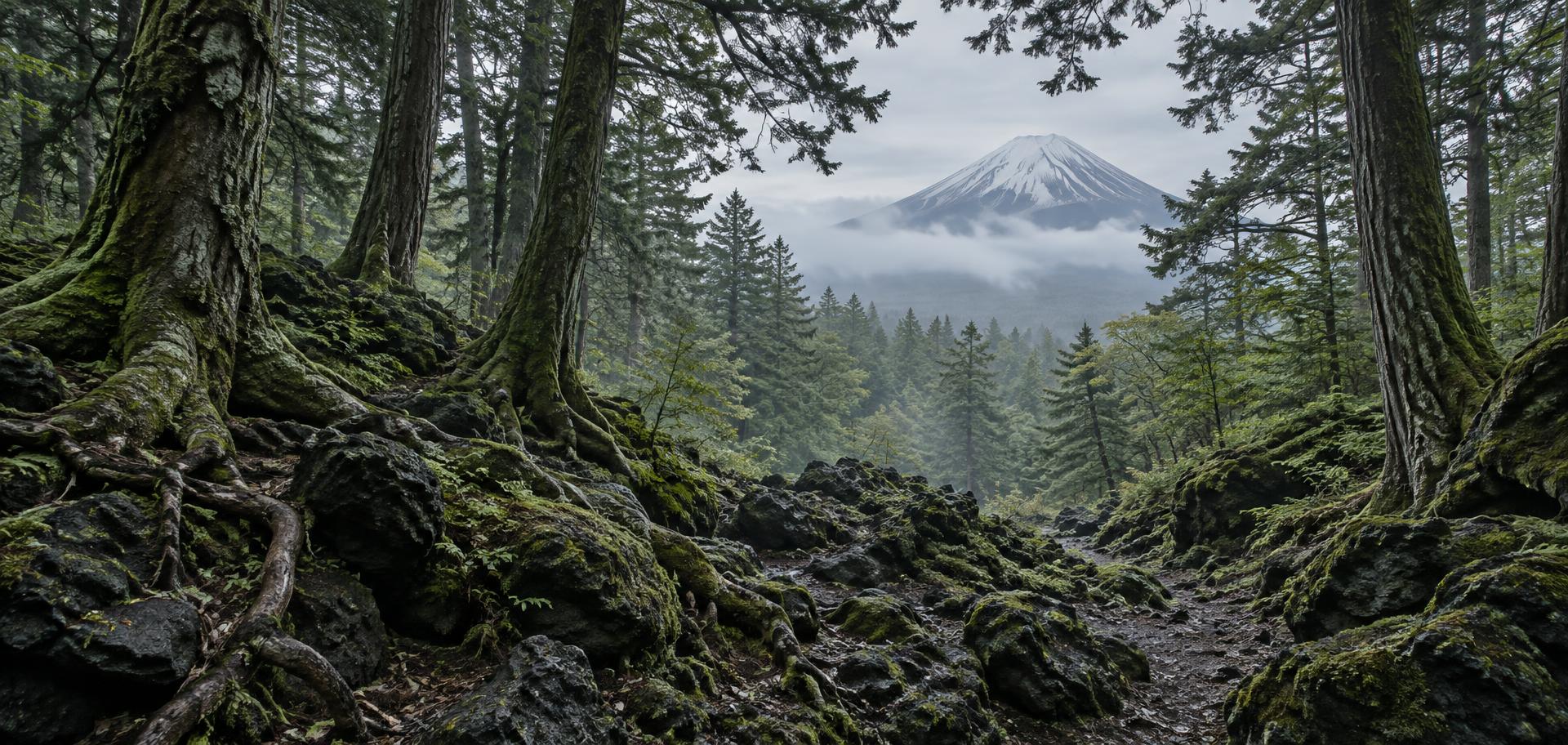
Illustrative reconstruction; not an archival photograph.
Aokigahara begins where the ordinary image of Mount Fuji ends. Beyond the symmetrical cone, postcard lakes, and climbing stations, the mountain’s northwestern slope descends into a dark green plain. From a distance it appears smooth. Inside, the ground is broken into shelves, hollows, and sharp seams of black lava. Trees grip the rock with roots that cannot sink deeply, spreading instead across moss and stone like exposed veins. The Japanese name Aokigahara means roughly the Plain of Green Trees; Jukai, another common name, means Sea of Trees. Both describe the living place more accurately than the label by which much of the world now knows it.
The forest is real, accessible, and crossed by maintained paths. It is also unusually easy to misunderstand. Its quiet has been called supernatural. Its difficult terrain has produced stories about compasses failing and people becoming instantly lost. Centuries of folklore have been compressed into claims of hauntings, while a modern association with suicide has repeatedly turned a place of geological and cultural importance into a setting for spectacle. The facts are stranger, and more human, than the mythology.
A forest born from fire
In 864 CE, Mount Fuji entered one of the largest eruptions in its recorded history. The Jōgan eruption opened vents on the mountain’s northwestern flank and sent lava across the land below. The flows divided an older body of water, leaving behind what are now Lakes Sai and Shōji, and created a broad field of basalt. As the surface cooled, gases and moving lava left behind tubes and caves. Soil accumulated only slowly. Over the centuries, hemlock, cypress, beech, oak, maple, and other plants established themselves in the cracks, creating a mature forest on ground that still reveals its volcanic origin at every step.
That origin explains much of Aokigahara’s atmosphere. Porous lava and a heavy layer of vegetation absorb and scatter sound, especially away from roads and busy visitor sites. Wind is broken by the canopy. There are few open views by which to judge distance. The result is not absolute silence, but a close, muffled acoustic space in which footsteps, birds, and dripping water seem isolated from the outside world. It feels enclosed because, physically, it is.
The forest’s quiet is not evidence of another world. It is the sound of this one meeting porous stone, moss, and a dense canopy.
— Interesting Files, from geological and visitor guidance
The compass myth
One of the most repeated claims about Aokigahara is that iron in the lava makes compasses useless. The story contains a small fact enlarged beyond recognition. Volcanic rocks can be magnetised, and a compass placed directly against some pieces of basalt may be deflected. Held normally at waist or chest height, however, a working compass functions. Modern navigation equipment functions too. The greater danger is ordinary: uneven ground, repeating scenery, dense growth, and informal tracks that can turn without offering a landmark. Visitors are advised to remain on official trails not because the forest defeats physics, but because forests are good at defeating confidence.
Caves beneath the trees
Aokigahara is not an untouched forbidden zone. It contains some of the Fuji Five Lakes region’s best-known natural attractions. Fugaku Wind Cave and Narusawa Ice Cave formed as the lava flows cooled. Their interiors remain cold through summer; ice once stored there was cut and transported for use by communities around the mountain. Marked walking routes connect these geological sites to lakes, shrines, and visitor centres. The forest is part of the wider Mount Fuji cultural landscape, inscribed by UNESCO in 2013 as a sacred place and source of artistic inspiration.
Its ecology is fragile precisely because the soil is thin. Roots lie exposed across the lava, and leaving the path can damage moss and plants that took decades to establish. The same cavities that shape the landscape can be concealed under leaf litter. Local guidance consistently asks visitors not to disturb wildlife, remove lava, mark trees, or enter unmaintained areas. The practical message is simple: Aokigahara can be visited safely and respectfully, but it should not be treated as a stage set.
Folklore, abandonment, and what can be proved
Stories linking the forest to death are often traced to ubasute, the supposed practice of abandoning elderly or infirm relatives in remote mountains during famine. Ubasute appears in Japanese folktales, literature, and theatre, but historians caution against treating it as evidence of a common, documented custom, or against assigning Aokigahara a specific role without records. A story repeated for centuries can be culturally important without being a census of events. The distinction matters here because foreign accounts frequently present legend as settled history.
Mount Fuji itself has long carried sacred associations. Pilgrims, ascetics, and religious communities approached the mountain as a place of purification and rebirth. Forests around it could be boundaries between cultivated settlement and sacred wilderness, but that does not make every modern ghost story ancient. Much of Aokigahara’s international folklore is recent, assembled from older motifs and amplified by novels, films, television, online videos, and travel writing.
How one reputation consumed the forest
Aokigahara’s association with suicide became prominent in postwar popular culture and intensified in the late twentieth century. Seichō Matsumoto’s 1960 novel Kuroi Jukai—Black Sea of Trees—used the forest in a tragic fictional ending. Later books and news reports returned to the location, each repetition making the association feel older and more inevitable than it was. International coverage often went further, presenting the forest through rankings, lurid numbers, and images designed to shock. Those choices did not merely describe a reputation; they helped manufacture and sustain it.
Deaths have occurred in the forest, and denying that would erase real people and the grief surrounding them. But responsible reporting avoids method details, precise locations, romantic language, and unsupported totals. Japanese authorities have at times limited the release of statistics, while local officials, police, volunteers, and mental-health organisations have used patrols and signs urging distressed visitors to contact family or seek help. For the people doing that work, the forest is not a legend. It is a place where intervention may still be possible.
A place associated with crisis should be reported as a place where help can reach someone—not as a destination, a challenge, or a myth to reenact.
— Following WHO guidance for responsible reporting on suicide
The damage done by spectacle
Sensational coverage has consequences. It intrudes on bereaved families, exposes first responders and local residents to repeated trauma, and encourages visitors to search for evidence of another person’s worst moment. It also flattens Aokigahara into a single story. A thousand-year-old volcanic ecosystem becomes a backdrop; the communities living beside it become supporting characters in a foreign horror narrative. The forest’s quiet, once explained by geology, is recast as proof of menace. Ordinary safety advice is repeated as paranormal warning.
The more accurate account is less theatrical. Aokigahara is a young forest by ecological standards, growing over one of Fuji’s major historic lava fields. It contains caves, wildlife, old footpaths, tourism infrastructure, and places of exceptional beauty. It also carries the weight of preventable deaths and decades of careless retelling. Both realities can be acknowledged without turning either into entertainment.
Visiting the Sea of Trees
Visitors who come for the landscape can use established routes near the official caves and visitor facilities, check local conditions, and avoid entering closed or unmarked areas. Staying on marked trails protects both the walker and the thin volcanic ecosystem. Photography should respect other people’s privacy. Objects encountered off a trail should not be handled or treated as souvenirs. If another visitor appears distressed or at risk, the appropriate response is to contact local staff or emergency services, not to record them.
What remains when the myth is removed
Take away the invented compass fields, the exaggerated folklore, and the language of cursed ground, and Aokigahara does not become ordinary. The lava still lies close beneath the moss. Roots still bridge cracks opened by an eruption more than eleven centuries ago. Ice remains in caves through warm months. The canopy still changes the sound of the world within it. Mount Fuji, hidden from most of the forest floor, is nevertheless the reason every stone is there.
The mystery of Aokigahara is not why supernatural forces gather there. It is how a real landscape can disappear beneath the stories told about it—and whether careful attention can restore what those stories obscured. The forest needs neither a curse nor a legend to be strange. It is a sea of trees rooted in fire, living on a mountain that has never truly been still.
A note for readers
This article discusses suicide without describing methods or locations. If this subject connects to an immediate risk for you or someone else, contact local emergency services now. In the United States and Canada, call or text 988; in the United Kingdom and Ireland, Samaritans can be reached at 116 123. Elsewhere, FindAHelpline.com lists verified crisis services by country. You do not have to manage the moment alone.
Sources & record
- 01Japan National Tourism Organization, ‘Aokigahara Forest’ — geography, caves, trails, and visitor guidance.
- 02Yamanashi Prefecture Official Tourism Guide, Aokigahara and Fuji Five Lakes visitor information.
- 03Geological Survey of Japan, National Institute of Advanced Industrial Science and Technology — Mount Fuji geological maps and eruption history.
- 04Japan Meteorological Agency, Mount Fuji volcanic activity and historical eruption records.
- 05UNESCO World Heritage Centre, ‘Fujisan, sacred place and source of artistic inspiration,’ inscribed 2013.
- 06Seichō Matsumoto, Kuroi Jukai (Black Sea of Trees), 1960 — a significant work in the forest’s modern cultural reputation.
- 07World Health Organization, Preventing Suicide: A Resource for Media Professionals, update 2023.
- 08Samaritans, Media Guidelines for Reporting Suicide — guidance on language, detail, and support information.
- 09TELL Japan, Lifeline and mental-health resources for Japan’s international community.