The Bermuda Triangle: The Sea That Swallows Ships
A stretch of the western Atlantic has been blamed for vanishing ships and aircraft for nearly a century. The sea gives nothing back easily, and the legend has grown in the silence.
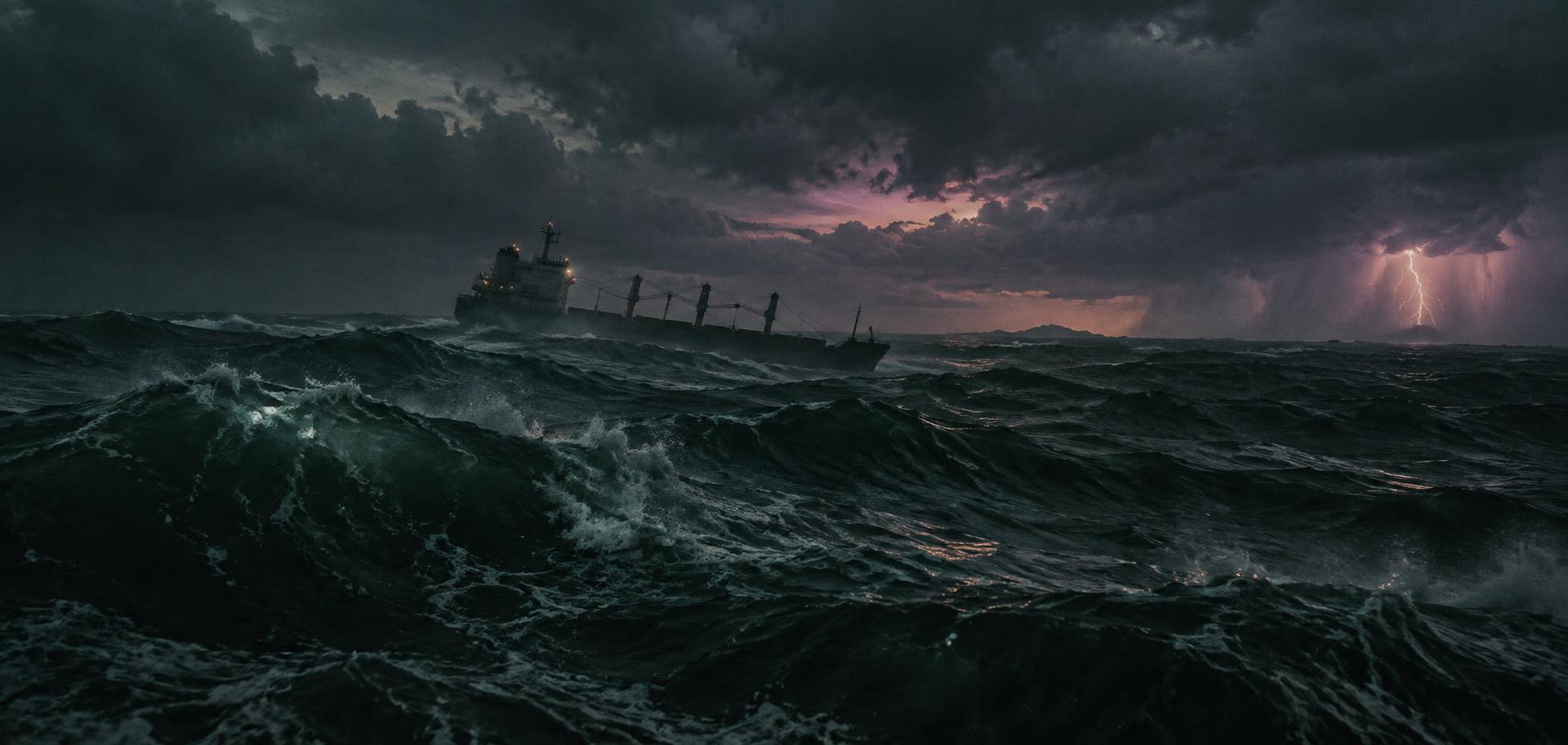
Illustrative reconstruction; not an archival photograph.
There is no line on any chart that marks the Bermuda Triangle. It has no coordinates, no recognised boundary, and no legal status as a body of water. It is, instead, a rectangle of ocean drawn by writers — roughly bounded by Miami, Bermuda, and San Juan, Puerto Rico — and given a name in 1964 that it has never been able to shed. What the name describes is a pattern of disappearances, of ships and aircraft that left port and were never seen again, within a region where the weather is violent, the currents are fast, and the sea floor is deep. Whether that pattern is real is the question this file cannot answer.
The legend is younger than the disappearances. The first cases that would later be folded into the Triangle were reported simply as losses at sea — ordinary, in the sense that the sea has always taken ships. What changed in the mid-twentieth century was the telling: a series of magazine articles and books gathered the losses into a region, gave the region a name, and proposed that something in the water itself was responsible. By the 1970s the Bermuda Triangle was a fixed object in popular culture, complete with its own theories, its own skeptics, and its own library of books. The sea, meanwhile, kept doing what the sea has always done.
The USS Cyclops, 1918
The earliest loss later claimed for the Triangle is the USS Cyclops, a Navy collier carrying a full load of manganese ore. On March 4, 1918, the ship left Barbados bound for Baltimore with 306 crew and passengers aboard. It was last seen steaming north into good weather. It never arrived. No distress call was sent. No wreckage was ever recovered. The Navy's official conclusion, filed after years of inquiry, is one of the most candid sentences in the American maritime record: 'The disappearance of this ship has been one of the most baffling mysteries in the annals of the Navy.' It remains, in terms of lives lost, the largest single non-combat loss in U.S. Naval history.
The Cyclops is the case the Triangle was built around, and it is the one the skeptics have the hardest time with, because nothing about the known evidence — a heavily overloaded ship, a known tendency to list, a captain who reported before sailing that his engines were troublesome — points cleanly to a single cause. The most sober investigators have proposed that the ship, riding low and out of trim, broached in a sudden squall and rolled over, going down so fast that no boat could be launched and no signal sent. The sea does not need a triangle to do that. But the absence of any wreckage, anywhere, in a century of trawling and sonar, is what keeps the file open.
Flight 19, 1945
The case that made the legend famous happened on December 5, 1945, off the coast of Florida. Five Navy Avenger torpedo bombers, together designated Flight 19, took off from Naval Air Station Fort Lauderdale for a routine training flight over the Atlantic. Fourteen men were aboard, led by Lieutenant Charles Taylor, an experienced instructor. The flight was supposed to last two hours. None of the five aircraft ever returned.
The radio transcripts are the reason Flight 19 became a myth. Taylor's voice, recorded by stations on shore, is confused and getting worse: he reports that his compasses have failed, that he cannot tell west from east, that 'everything looks strange' and the sea does not look right. He turns his flight, again and again, in patterns that took it further from land rather than toward it. A rescue flying boat, a PBM Mariner sent to search for the lost formation, also disappeared, apparently exploding in flight — a type known to leak fuel vapors. The Navy's final report on the loss, after the longest board of inquiry of the war, simply states that the cause is unknown.
We cannot see land. We are not sure where we are. Everything looks strange, even the ocean.
— Lt. Charles Taylor, Flight 19 radio, December 5, 1945 (standard paraphrase of the partial transcripts)
The conventional, unromantic explanation is that Taylor, whose compasses had genuinely failed, mistook his position and led the flight west into the Gulf of Mexico rather than east back to Florida, ran out of fuel after dark, and ditched in heavy seas where no one survived and the wreckage sank. The Navy's own board considered this and could not confirm it. What is certain is that no wreckage of the five Avengers has ever been found — not in a century of searching the sea floor, not in the Gulf, not off Florida. Five aircraft do not vanish without a trace unless the trace is somewhere no one has looked, and the sea is a place no one has looked properly.
The Marine Sulphur Queen, 1963
The third loss that the Triangle writers return to is the SS Marine Sulphur Queen, a T2 tanker converted to carry molten sulphur. On February 4, 1963, the ship was steaming from Beaumont, Texas, toward Norfolk, Virginia, with a crew of thirty-nine. It sent routine radio traffic, reported nothing wrong, and then did not arrive. The Coast Guard found only a life jacket and some debris, days later, far from the last known position. The Marine Sulphur Queen was old, poorly maintained, and carrying a cargo that could turn lethal if it shifted; the board of inquiry concluded that the ship had likely broken up in a storm, possibly after a cargo shift. The families of the crew sued the operator and settled. The loss is, on the evidence, a tragedy of an ageing ship and a hard sea — and it is also one of the cases most often cited as inexplicable.
The statistics, and what they don't say
The hardest fact to put into the file is the one the legend cannot survive. Lloyd's of London, which insures ships for a living and has every reason to know where they sink, was asked decades ago whether the Bermuda Triangle showed an unusual rate of loss. Their answer, recorded and never retracted, was that the region does not lose ships and aircraft at a rate higher than any comparable stretch of ocean. The U.S. Coast Guard, which patrols the area, does not recognise the Bermuda Triangle as a hazard zone and does not record it as a distinct region. The Navy's Historical Branch has stated plainly that the name is not used in official casualty reports and that the losses attributed to it are, individually, explained by ordinary causes.
The point is not that nothing has happened in the Triangle. It is that the Triangle is a busy sea lane — one of the most heavily trafficked in the world — and a busy sea lane produces more losses than a quiet one simply because there is more traffic to lose. Take any comparably sized rectangle of ocean crossed by shipping routes and you will find wrecks in it. The Triangle's reputation is an artefact of counting the wrecks inside its arbitrary lines and not counting the wrecks outside them.
The theories
The explanations offered for the legend fall into two kinds: those that try to save the phenomenon, and those that try to dissolve it. Among the first, the most enduring is the methane hydrate hypothesis — the idea that sudden releases of frozen methane from the sea floor could drop the density of the water and sink a ship in seconds. The chemistry is real; methane hydrates do exist on the continental shelf. But the volumes required to sink a hull are enormous, no such eruption has ever been observed in the Triangle, and the theory does nothing to explain vanished aircraft. Compass variation is real too: the Triangle is one of the places where magnetic and geographic north nearly align, but this is a known and charted condition that any trained navigator accounts for, and it does not sink ships.
The Gulf Stream is the best of the natural explanations, and the one the Coast Guard actually relies on. It is a river of warm water flowing through the Triangle at several knots, capable of carrying wreckage hundreds of miles before it sinks or beaches. A ship that founders in a Gulf Stream squall can scatter debris over a vast area, and the current will move it out of any search box within hours. Add the region's violent, fast-forming storms — waterspouts, microbursts, the sudden nor'easters of the Atlantic winter — and a ship that goes down in bad weather leaves very little to find. The sea is efficient at hiding what it takes.
The Triangle does not have to be a mystery to be dangerous. It is a piece of ocean where the weather turns fast and the current is strong, and where, historically, people have sailed a great deal. That is enough.
— Paraphrased from U.S. Coast Guard guidance on the region
What the file cannot close
The Bermuda Triangle is the rare case where the archive must record a negative: that the phenomenon, as described, probably does not exist, and that the individual losses it gathers are, on the evidence, the ordinary work of the sea. But the file cannot be closed, because closing it would require finding the wreckage of the Cyclops, of Flight 19, of the Marine Sulphur Queen, and of the dozens of smaller craft that left and did not return. Those wrecks are somewhere — on the sea floor, scattered by the current, corroded past recognition. Until one of them is found, the silence holds, and the legend feeds on it.
There is a last point worth making, because this archive is for the cases that resist a clean story. The Bermuda Triangle is not a mystery in the way a murder is a mystery — there is no culprit to name, no single event to explain. It is a mystery in the way the sea is a mystery: a place that takes things and does not give them back, and that we explain, over and over, with the words we have, which are never quite enough. The legend survives not because the evidence is strong but because the sea is large, and dark, and silent, and we have never quite made our peace with how little of it we can see.
Sources & record
- 01U.S. Naval History and Heritage Command — the official record and board findings on the loss of USS Cyclops, 1918.
- 02Naval Air Station Fort Lauderdale historical files and the Navy board of inquiry into Flight 19, December 1945–1946.
- 03U.S. Coast Guard Marine Board of Investigation report on the loss of SS Marine Sulphur Queen, 1963.
- 04Vincent Gaddis, 'The Deadly Bermuda Triangle,' Argosy magazine, February 1964 — the article that named the region.
- 05Lawrence David Kusche, The Bermuda Triangle Mystery — Solved, 1975 — the first systematic skeptical review of the cases, matching losses to known causes and weather records.
- 06Lloyd's of London and the U.S. Coast Guard statements on loss rates in the region, as cited in skeptical and Coast Guard literature.
- 07Charles Berlitz, The Bermuda Triangle, 1974 — the popular book that spread the legend, for the record of the claims made.
- 08NOAA and U.S. Navy Hydrographic Office charts of the Gulf Stream and the continental shelf in the western North Atlantic.
- 09U.S. Coast Guard search-and-rescue records and guidance for the Florida Straits and western Atlantic shipping lanes.