The Black Dahlia: What Los Angeles Never Solved
On a winter morning in 1947, a mother walking her child found a body in a vacant lot. It had been cut in two and drained of blood. The city named it after a film. Seventy years later, the file has never closed.
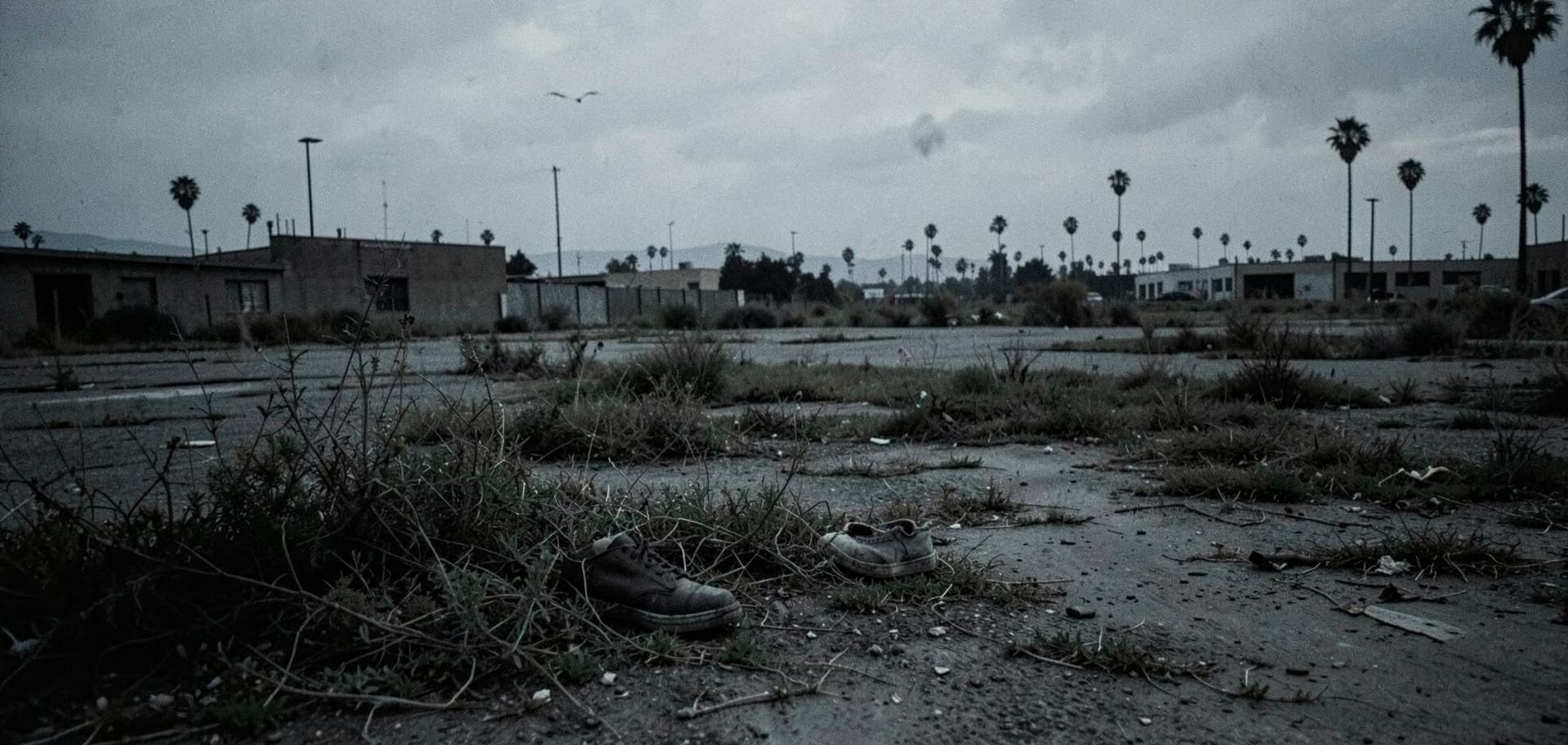
Illustrative reconstruction; not an archival photograph.
On the morning of January 15, 1947, a woman named Betty Bersinger walked her three-year-old daughter through a vacant lot on the south side of Los Angeles. The lot, on Norton Avenue near 39th Street in the Leimert Park district, was overgrown with weeds and broken only by a derelict trailer. Bersinger was looking for a place to leave a pair of shoes for repair. Instead she saw, lying in the grass at the edge of the sidewalk, what she first took to be a broken department-store mannequin. It was not a mannequin. The body was a young woman, severed cleanly at the waist, posed with her arms above her head and her legs spread apart. Bersinger ran to a neighbour's house and called the police. By the time the first officers arrived, the case had already begun to become a legend.
The woman was Elizabeth Short. She was twenty-two years old. She had been dead for some hours, and almost everything about the condition of her body was wrong. She had been cut in half between the second and third lumbar vertebrae, a cut that examiners would later describe as requiring considerable anatomical knowledge and a steady hand. The body had been drained of blood and washed, and there was almost no blood at the scene — meaning she had been killed and mutilated elsewhere, then transported and arranged. Her mouth had been cut at the corners, in what the press would call a 'Glasgow smile,' extending nearly to her ears. The cuts were clean, deliberate, and recent. The killer had taken time with the body, and had taken time to place it where it would be seen.
Who Elizabeth Short was
The press, and later the public, would call her the Black Dahlia — a name she never used in life. The nickname was borrowed from a film, The Blue Dahlia, released the year before, and it stuck because it suited the story the city wanted to tell: a beautiful woman, dark-haired, dressed in black, come to Hollywood to be a star and destroyed there. The real Elizabeth Short was more complicated and more ordinary than that. Born in Boston, raised in Medford, Massachusetts, she had come west during the war years, like thousands of other young women, to work and to chase the film industry. She was pretty, dark-haired, and moved among a loose circle of servicemen, aspiring actors, and bartenders in and around Los Angeles. She had no agent, no screen credit, and no steady job. She lived in rooms and apartments, borrowed money, and wrote letters home about an acting career that had not yet begun.
What the newspapers built around her — a scheming femme fatale, a habitué of nightclubs, a woman of loose morals who got what was coming — was largely invention. The Los Angeles press in 1947 was aggressive and unscrupulous, and the case was a windfall. Reporters paid for interviews, printed hearsay as fact, and invented a biography for Short out of fragments and guesses. Her mother, Phoebe, in Boston, was told initially that her daughter had won a beauty contest, so that she would speak freely before learning the truth. The distortion began almost immediately and has never fully been corrected.
The autopsy, and what it could not say
The autopsy was performed by Dr. Frederick Newbarr, the Los Angeles County coroner, on the day the body was found. Newbarr's report is the closest thing the case has to a foundation of fact, and it is sobering for what it contains and what it cannot establish. He recorded the severing of the body, the drainage of blood, the facial cuts, and ligature marks on the wrists and ankles consistent with binding. He found evidence of brutalisation and of extensive cutting, but he could not determine, from the state of the body, whether the killing had taken place at the scene where she was found or elsewhere — only that she had almost certainly not been killed in the lot. He could not fix a precise time of death. He could not identify the instrument used to cut the body, beyond that it was a sharp blade. He could not say, from the physical evidence alone, who had done it.
The body had been cleanly severed through the abdomen, the upper and lower halves placed about a foot apart, with the intestines tucked beneath the buttocks. The cuts about the mouth had been made after death. There was no blood on the ground where the body lay.
— Paraphrase of Dr. Frederick Newbarr's autopsy findings, January 15, 1947
What the report did establish, quietly, was that whoever killed Elizabeth Short had done something more than murder. The mutilation, the washing, the posing, and the transportation of the body spoke of time, privacy, a place to work, and a will to make the body into a display. The killer had a vehicle large enough to carry the two halves without being seen, and a place to keep the body between the killing and the discovery. These were practical facts. They were, for the investigators, the beginning of a narrowing: not many people had that combination of privacy, vehicle, and skill. The narrowing never produced a charge.
The investigation
The case was assigned to the Los Angeles Police Department, and quickly became the largest manhunt in the city's history to that date. Detectives Jack Donahue and Harry Hansen led the inquiry. Hundreds of men were questioned — servicemen Short had known, bartenders, landlords, doctors, anyone whose name appeared in her letters or address book. The press, which had made the case famous, also made it harder: tip lines were flooded with confessions from the disturbed and the attention-seeking, and each one had to be checked and dismissed. A handful of men confessed to the killing; all were cleared, several committed to psychiatric hospitals. The LAPD followed more than seven hundred leads in the first weeks. None produced an arrest.
The strongest leads pointed toward men Short had known in her last weeks. She had been seen in the company of a woman named Lynn Martin and others; she had spent time with a number of servicemen and with a circle around a nightclub owner named Mark Hansen. Several of these men were investigated closely. Robert 'Red' Manley, a married salesman who had spent two days with Short shortly before her death, was among the first serious suspects; he was questioned, given a lie detector test, and released. He passed. The physical evidence that would have placed any of them at the scene, or at the place where the body was cut, did not exist.
The 'suspects' that never closed
Over the decades, the case attracted a long procession of named suspects, proposed by detectives, journalists, and amateur investigators. Mark Hansen, the nightclub figure, was investigated at the time and never charged; his name returns in every retelling. A doctor named George Hodel, investigated in the 1940s for other matters, was posthumously accused by his own son, a former LAPD detective, in a book published in 2003; the physical evidence is circumstantial, and the accusation rests on interpretation and family documents rather than anything the original investigation could prove. A contractor named Les Dillon was accused decades later on the word of an acquaintance who said he had confessed. None of these accusations survived the standard the law requires.
What the LAPD's own files show, read plainly, is a case that ran out of evidence rather than out of suspects. The investigators had people they believed might have done it. They did not have the trace — the blood, the tool, the place — that would place a specific person at the act. The body had been washed. The scene had been cleaned. The weapon was never recovered. The place where Short was killed and cut has never been identified. In a case built entirely on trace, the absence of trace is the same thing as the absence of proof, and the file stayed open for that reason.
We have not got a suspect. We have not got a motive. We have not got the place where she was killed. What we have is a body and a city that will not stop talking about it.
— Paraphrase of investigators' early frank assessment, widely reported in the 1947 press
The letters
Three weeks after the body was found, the Los Angeles Examiner and the LAPD began receiving letters from someone signing them 'The Black Dahlia Avenger.' The letters were cut from pasted newspaper clippings, in the manner of a ransom note; some included a single handwritten line. One envelope held a small address book belonging to Elizabeth Short, soaked in cleaning fluid, with a handful of names inked out. The police traced the names and questioned the men behind them; none led to the killer. The letters continued for months, then stopped. The author was never identified. Whether the writer was the killer, an imitator, or a hoaxer has never been settled; investigators leaned toward hoax, but the possibility that the killer wrote to the press has never been eliminated.
The letters did one thing, regardless of their author: they deepened the case's hold on the city. The name 'Black Dahlia' had come from the press; the killer — or his imitator — adopted it, which meant the killer and the city were now reading from the same script. The letters were taunting, theatrical, and unrevealing. They gave the press a running serial to print, and they gave the public the sense that the killer was watching, which may have been the point.
Why it could not be closed
The case has remained open for nearly eighty years, and the reasons it has never closed are worth stating plainly. The body was killed and mutilated in a place the police never found, and the place — if it still existed — has long since been built over or forgotten. The weapon was never recovered. The scene where the body was found was contaminated almost immediately: the vacant lot was trampled by officers and by sightseers who arrived before the perimeter was set, and whatever trace the killer had left at the place of discovery was destroyed in the first hours. The body had been washed, eliminating what the autopsy might have read from residue and staining. The witnesses who saw Elizabeth Short in her final days gave conflicting accounts, and the press had so distorted the public record that separating what people actually saw from what they read in the papers became part of the work.
There is also the matter of time. The people who knew her, the men she was seen with, the officers who worked the case, the coroner who cut her — all are dead now. The people who remain are descendants, historians, and enthusiasts, and the evidence they work from is the same paper the original detectives worked from. No new physical evidence has appeared in decades. A confession made now, seventy years after the fact, could not be tested against the people who were there. The case is, in the practical sense, beyond the reach of the law — not because it is unsolvable in principle, but because the evidence that would solve it is gone.
The story the city told instead
What the case could not provide in resolution, the city provided in narrative. The Black Dahlia became the archetypal Los Angeles murder: beautiful woman, Hollywood dream, brutal crime, no answer. It has been the subject of novels, films, documentaries, and a library of books, each with its own suspect and its own theory. The most influential — John Gregory Dunne's True Confessions, James Ellroy's The Black Dahlia, and the later investigative books of Steve Hodel and others — are works of art as much as works of investigation, and they have shaped the public sense of the case more than the files themselves. The real case, read in the record, is quieter, sadder, and less glamorous than any of them.
There is a cost to that. Elizabeth Short was a real woman with a real family, and the legend that grew around her name made her into a character in a story she did not choose. Her mother lived to read it; her sisters lived to read it. The murder that took her life was real, and the decades of retelling have, in a way, taken it again — turning a specific, brutal, and unsolved killing into a mood, an aesthetic, a piece of the city's self-image. The file in the archive is here to record the killing, not the legend. The legend is what the city built in the place of an answer it never got.
The last honest sentence in this file is the one the LAPD has never been able to write: no one knows who killed Elizabeth Short, and the evidence that would name the killer has been gone for most of a century. The body in the vacant lot on Norton Avenue was the beginning of a question that the city of Los Angeles has been answering, badly and at length, ever since. The archive records the question. It does not record an answer, because there is not one.
Sources & record
- 01Los Angeles Police Department historical case file on the Elizabeth Short homicide, 1947 — the original investigative record.
- 02Los Angeles County Department of Medical Examiner-Coroner, Dr. Frederick Newbarr's autopsy report on Elizabeth Short, January 15, 1947.
- 03Los Angeles Examiner and Los Angeles Herald-Express coverage of the case, January–August 1947 — the contemporary press record, including the 'Black Dahlia Avenger' letters.
- 04Larry Harnisch, 'The Black Dahlia' research archive and Times coverage — a long-form skeptical review of the case, the press distortion, and the named suspects.
- 05John Gilmore, Severed: The True Story of the Black Dahlia Murder, 1994 — an early investigative reconstruction.
- 06James Ellroy, The Black Dahlia, 1987 — the influential novel that shaped the cultural memory of the case.
- 07Steve Hodel, Black Dahlia Avenger, 2003 — the posthumous accusation of Dr. George Hodel, for the record of the claim.
- 08Donald R. Bain, The Black Dahlia: A Most Notorious Case — documentary and archival treatment of the investigation.
- 09FBI Records: The Vault, 'Elizabeth Short' file — Bureau materials forwarded during the 1947 inquiry.