The Dancing Plague of 1518
In the summer of 1518, a woman in Strasbourg stepped into the street and began to dance. Within a week, dozens had joined her; within a month, hundreds. They could not stop. Some danced until they collapsed. Some, the chronicles say, danced until they died.
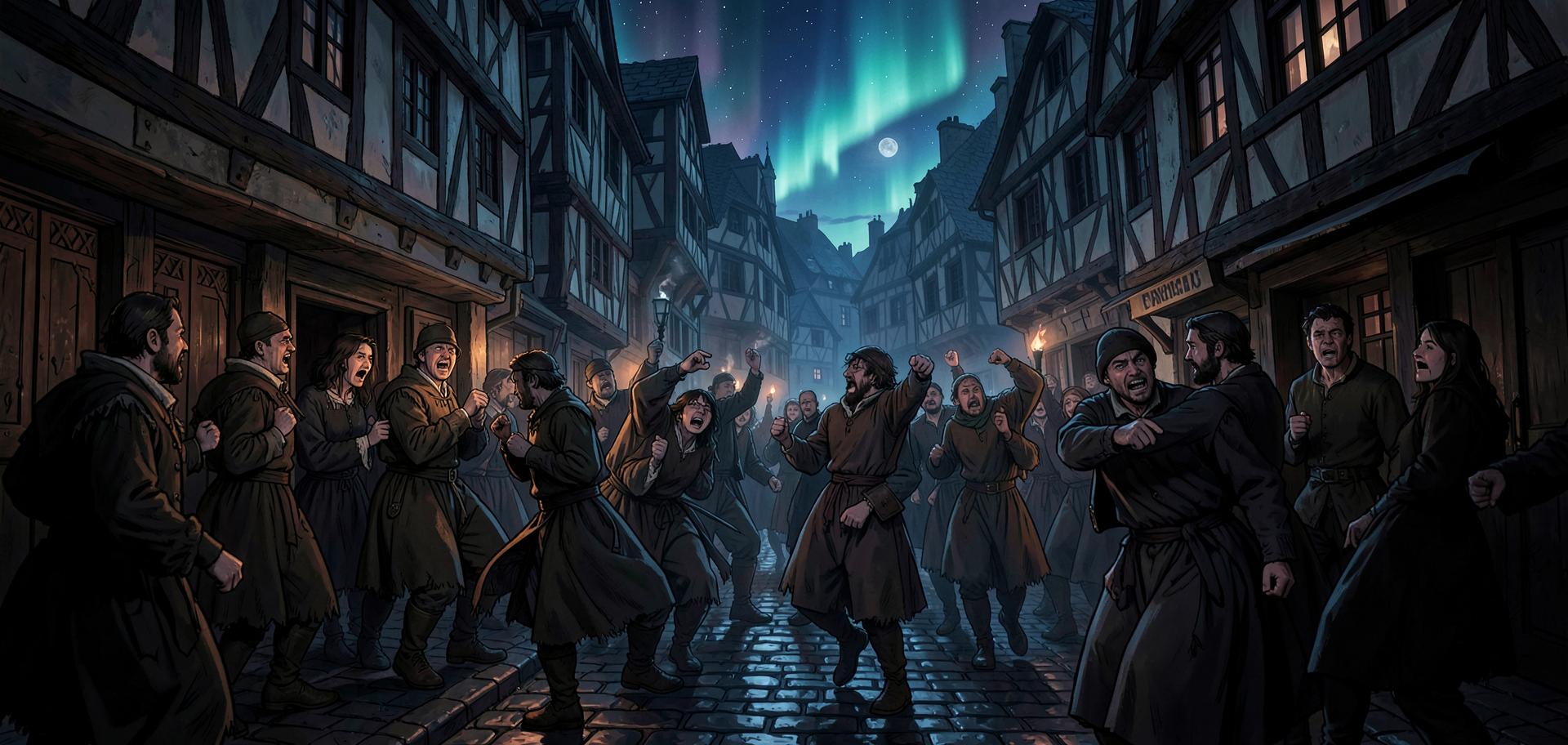
Illustrative reconstruction; not an archival photograph.
On or about July 14, 1518, a woman named Frau Troffea walked into a street in Strasbourg — then a free imperial city of the Holy Roman Empire, in the region of Alsace — and began to dance. She did not stop. According to the records that survive, she danced through the day and into the night, collapsed from exhaustion, woke, and danced again. Her feet bled. Her husband begged her to rest. She could not, or would not. Within a week, more than thirty people had joined her, dancing in the streets and market squares of the city. By August, the chroniclers counted hundreds.
The city that watched its people dance
What makes the Strasbourg outbreak so unnerving is how well, by sixteenth-century standards, it is documented. Strasbourg was a literate city of printing presses, guild registers, and civic administration, and the dancing sickness was recorded in the minutes of the city council, in physicians' notes, and in several contemporary chronicles. The names, the dates, and the civic response are not legend. They are minutes of a bewildered government trying to manage an epidemic it could not classify.
The dancers did not appear to be celebrating. Witnesses described people moving with contorted, involuntary-looking energy, faces blank or anguished, many calling out for help even as their bodies kept moving. Some danced until their feet were raw. Contemporary accounts record that a number of them — the chronicles disagree on how many — danced until they died of strokes, heart failure, or sheer exhaustion. One chronicle claims that at the outbreak's peak the dancing was killing as many as fifteen people a day, though that figure is almost certainly inflated.
The council's disastrous remedy: more dancing
The city council consulted the guild of physicians, and the physicians — reasoning from the humoral medicine of the day — concluded the dancers were suffering from overheated blood. The prescribed cure was counterintuitive: the afflicted should be made to dance the sickness out. The council cleared public halls, erected a stage at the grain market, and went so far as to hire musicians and strong men to keep the dancers upright and moving. It was, by any modern reading, exactly the wrong thing to do. The music seemed to draw more people into the dancing, and the outbreak swelled.
They danced day and night, and some of them danced until they fell down dead.
— Paraphrased from contemporary Strasbourg chronicle accounts
When the musical cure failed, the city turned to God. In September, the remaining dancers were loaded into wagons and taken up the mountain to the shrine of St. Vitus at Saverne, some twenty miles away. St. Vitus was the saint to whom sufferers of dancing sickness prayed, and at the shrine the afflicted were given red shoes and led around the chapel. There, according to the accounts, the dancing finally burned itself out. The outbreak faded by autumn, roughly two months after Frau Troffea first stepped into the street.
Five centuries of explanations
No one has ever established what happened. The most famous modern hypothesis is ergot poisoning: ergot, a fungus that grows on damp rye, produces alkaloids related to LSD, and the 1510s were years of famine, failed harvests, and hard winters in Alsace — conditions in which contaminated grain reaches the poor. The historian John Waller, the leading modern authority on the case, argues the ergot theory fails on its details: ergot's spasms typically affect the limbs with convulsions and gangrene, not the sustained, rhythmic, days-long dancing the chronicles describe.
Waller's own explanation is a trance state induced by extreme psychological stress — what modern medicine would call a mass psychogenic illness, or conversion disorder. The years before 1518 had been brutal: famine, epidemic disease, crushing poverty, and a clergy preaching that sin invited divine punishment. The cult of St. Vitus carried a specific local belief that the saint could curse sinners to dance. In that atmosphere, Waller argues, a mind under enough strain could seize on the one affliction the culture had prepared it for — and once the dancing began, belief and suggestion spread it through a frightened, hungry, devout population.
It was not the only time
Strasbourg was the largest and best-recorded outbreak, but dancing mania recurred across Europe for centuries: dancing processions in the Low Countries and the Rhineland, outbreaks along the Rhine in 1374 that crossed from town to town, later episodes in Switzerland and Italy. Whatever the mechanism, it was real, repeatable, and contagious through nothing more than witness. The file on 1518 remains open not because the event is in doubt, but because no single explanation has ever matched every fact in it.
Sources & record
- 01John Waller, The Dancing Plague: The Strange, True Story of an Extraordinary Illness (Sourcebooks, 2009) — the principal modern study of the outbreak.
- 02Strasbourg city council minutes and chronicle records, July–September 1518 — the contemporary civic record.
- 03Sebastian Brant-era chronicles and the Specklin family chronicle collections — contemporary narrative accounts.
- 04John Waller, 'A Forgotten Plague: Making Sense of Dancing Mania,' The Lancet, 2009 — the mass-psychogenic-illness argument against ergotism.
- 05E. Louis Backman, Religious Dances in the Christian Church and in Popular Medicine (1952) — the classic survey of medieval dancing mania.