Edgar Allan Poe, and the Ten Days Nobody Can Account For
The man who invented the modern detective story died in a stranger's clothes, in a city that was not his own, unable to say what had happened to him for the last ten days of his life. He was forty years old.
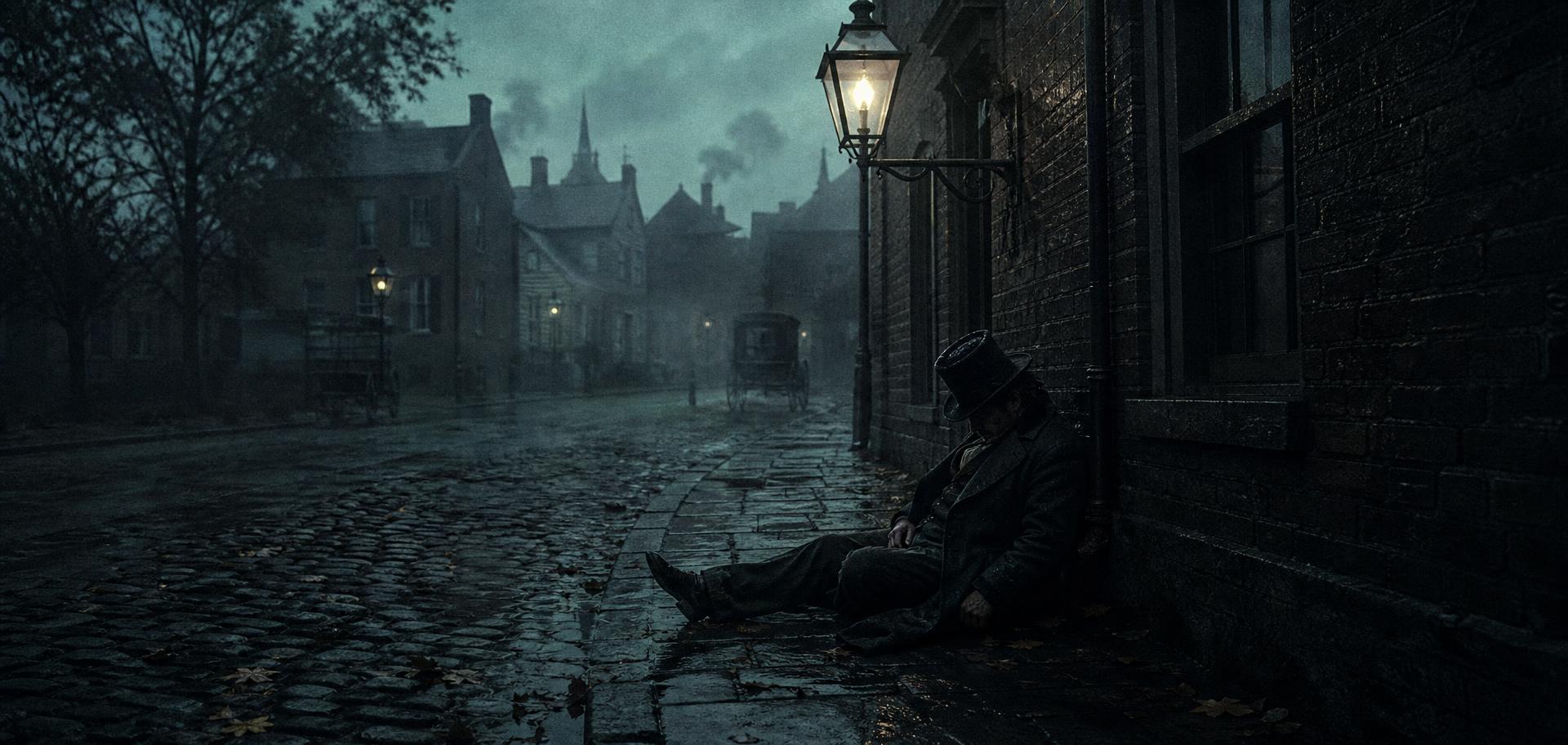
Illustrative reconstruction; not an archival photograph.
Edgar Allan Poe is the writer who taught the century after him how to be afraid on purpose. He gave the world the locked-room murder, the unreliable narrator, the story solved by reasoning backwards from the evidence. He wrote "The Murders in the Rue Morgue" in 1841 — the work usually credited as the first detective story — and the fool who walks into the room and explains everything, C. Auguste Dupin, is the direct ancestor of Sherlock Holmes and Hercule Poirot. He also wrote "The Fall of the House of Usher," "The Tell-Tale Heart," and "The Raven," which made him briefly famous and never made him solvent. He lived forty years and died in a way that none of his own detectives could have solved, because the evidence itself was destroyed within hours of his being found.
The last week of Poe's life is missing. This is not a figure of speech. There is a gap in the record — ten days between the last person who saw him well and the moment he was found — that has never been filled from his side. We know what other people did during those days. We do not know, with any certainty, what he did.
The last man to see him well
On September 27, 1849, Poe was in Richmond, Virginia, at the office of the doctor and magazine editor John R. Thompson. He was, by every surviving account, in good health and good spirits — a detail that matters enormously, because it is the last reliable one. He had spent the late summer in Richmond lecturing and courting his childhood sweetheart, the widow Elmira Royster Shelton, to whom he had become engaged. He was preparing to travel north to Philadelphia to edit a collection of poems by a Mrs. Loud, and then on to New York to bring his mother-in-law Maria Clemm, who had raised him, back to Virginia for the wedding.
He had money for the trip — about sixty dollars, a not inconsiderable sum for a man who was usually broke — and he told Thompson he would be gone a few days. He left Richmond on the evening train. And then the trail goes dark. He did not arrive in Philadelphia in any way that anyone recorded. He did not reach New York. He did not write to Maria Clemm, who was expecting him. He did not visit Mrs. Loud. For ten days, the man who had spent his life writing down everything simply was not where he was supposed to be.
Found at Gunner's Hall
On the afternoon of October 3, a Baltimore printer named Joseph W. Walker was passing Gunner's Hall, a tavern on East Lombard Street used as a polling place for the Fourth Ward, when he noticed a man slumped against the building. The man was delirious, unsteady, and unable to account for himself. Walker recognized him — with difficulty — as Edgar Allan Poe. He sent a note to Poe's Baltimore acquaintance, the doctor Joseph E. Snodgrass, asking him to come at once.
Snodgrass arrived and confirmed the identification, and what he found has been argued over ever since. Poe's clothes, Walker and Snodgrass both said, did not appear to be his own. The story that hardened later — that he was wearing a cheap, ill-fitting, possibly second-hand suit, a dirty shirt too small for him, a palm-leaf hat — has never been fully confirmed, but something was wrong with how he was dressed. He was taken by carriage to Washington College Hospital, four blocks away, under the care of the resident physician, Dr. John Joseph Moran.
He never recovered enough to tell anyone what had happened. Moran, who wrote about the case at length afterward — often inconsistently — said that Poe raved for the days that followed, calling out the name "Reynolds" again and again, a name that has never been satisfactorily explained. He had visitors, or Moran said he refused visitors; the record shifts. On the night of October 6 his delirium grew worse; early on the morning of October 7, 1849, he died. His last words, as Moran told and retold them, were "Lord, help my poor soul."
He was lacking nothing in his pockets but a fine mind and a clear week — and the week had been taken from him first.
— Dr. Joseph E. Snodgrass, in a letter describing the finding at Gunner's Hall
The cooping theory
The most enduring theory about Poe's death is also the most Baltimore-specific one, and it fits the evidence with an unsettling neatness. In the 1840s, American elections were run on a system so openly corrupt that it produced its own vocabulary. One of the standard frauds was called "cooping" — gangs working for a party would round up vagrants, drunks, and men too drunk to resist, herd them into a basement or a back room (the "coop"), dose them with liquor and sometimes drugs, and march them from polling place to polling place to vote under assumed names, again and again, in an age before voter registration.
October 3, 1849, was an election day in Baltimore — a municipal election, with heavy ward-level turnout and violence around the polls. Gunner's Hall, where Poe was found, was itself a polling place. The ill-fitting clothes — a detail that can sound like a Gothic flourish until you place it against the record — look very like the kind of disguise given to a man being moved between precincts so the same face would not be recognized twice. The ten lost days can be explained by a man kept drunk and confined for the whole run-up to the election and then dumped when he could no longer stand. The theory accounts for more of the known facts than any single rival. It has never been proven, and it probably cannot be, because the people who would have done it were never going to write it down.
The medical question
Poe's drinking is the explanation most people reach for, and it is the one his own life makes easiest to believe. He had a documented, severe, and lifelong problem with alcohol — a single glass, friends said, was enough to change him — and he had been on what appears to have been a prolonged abstinent stretch before his death. It is entirely possible that he drank during the lost week, drank badly, and died of alcohol poisoning or of delirium tremens. The problem is that the symptoms Moran described — the long lucid intervals, the slow decline over four days, the absence of the violent tremors associated with delirium tremens — do not fit a clean alcohol-death. Moran himself, who had every reason to emphasize drink, later insisted Poe was not intoxicated on admission.
Other proposed causes have come and gone. Rabies, suggested in 1996 by a physician who re-read Moran's notes, matches the delirium, the lucid intervals, and the four-day course with disturbing accuracy — but it explains neither the clothes nor the lost week and is not supported by any bite in the record. A brain tumor was proposed after a 1992 exhumation reportedly found a hardened mass in his skull, but the evidence is secondhand and the finding has never been verified. Cholera was epidemic in 1849 and killed him, some contemporaries said; the 1849 pandemic was real and reached Richmond and Baltimore that summer, but nothing in the record points specifically to it. Carbon monoxide from coal gas lighting has been floated. None of them closes the file.
The witnesses who could not keep their story straight
Part of why the death resists solution is that the men closest to it made the record worse, not better. Moran wrote and rewrote his account of Poe's final days across decades, each version more dramatic and more certain than the last, until his testimony became more hindrance than help. Snodgrass, who found him, was a temperance activist who had a cause to make of Poe's drinking; his letters stress the alcohol and quietly drop the details that don't fit it. Poe's literary executor, Rufus Wilmot Griswold — a man who genuinely hated him — wrote an obituary so malicious that it helped poison Poe's reputation for half a century, portraying him as a dissolute monster rather than a sick man who died badly. When the people nearest the evidence are editing it as they go, the evidence stops being evidence.
There is also the matter of the clothes. If the cheap suit was really not Poe's, it points one way — cooping, or some other forcible confinement. If it was his own and simply rumpled, the case for a drinking death gets stronger and the cooping theory weakens. Walker's note, Snodgrass's letter, and Moran's memoirs disagree on the point, and none of them are the kind of witness you can settle a case on. The clothes, like everything else, slipped into the gap.
If he was dressed as a stranger, then a stranger dressed him — and a stranger is exactly what the cooping men wanted him to be.
— from a later reconsideration of the Gunner's Hall finding
The name he could not stop saying
Moran said that in his delirium Poe called out the name "Reynolds" over and over — sometimes, Moran claimed, with his head buried in the pillow, as though he were ashamed. It is the single strangest detail in the case, because no one in Poe's life called Reynolds fits the moment. There was a Jeremiah Reynolds, a journalist connected to the whale-ship Essex story that may have shaped "Moby-Dick," and Poe is known to have read him. There was a Reynolds among the Baltimore cooping gangs. There may have been no Reynolds at all, only a dying man making sound. The name has absorbed more speculation than the rest of the case put together, and it has given back nothing.
What was buried, and what was not
Poe was buried on October 8, 1849, in the Poe family lot at Westminster Hall and Burying Ground in Baltimore, in a service attended by very few people. The grave was unmarked for eleven years — a detail that would have suited his own fiction, if not his own pride. In 1875 a monument was raised and his remains (and those of his wife Virginia and Maria Clemm) were moved to a more prominent spot. In 1949, a figure later known as the "Poe Toaster" began appearing at the grave on the night of Poe's birthday, leaving cognac and roses; the visits continued, with interruptions, until roughly 2009, when the tradition quietly lapsed.
The medical records, such as they were, are gone. Washington College Hospital was later renamed and rebuilt; the Fourth Ward polling tavern is long since demolished. There is no crime scene, no physical evidence, no file to reopen. There are letters written by men who were not disinterested, a doctor who kept changing his story, and a gap of ten days that the subject of the case left no account of at all. Everything that could have proven anything has either been lost or was never written down.
Why it stays open
Poe's death is the kind of case that survives because every explanation is plausible and none is decisive. The cooping theory explains the polling place, the clothes, the lost week, and the condition in which he was found — but it cannot prove intent or name a doer. The drinking theory fits a man whose whole life is a record of disaster around alcohol — but it cannot account for the clothes or the week, and the medical course does not match. Rabies fits the hospital course and nothing else. A brain tumor fits a rumor and nothing else. Each theory carries the part of the evidence it can use and discards the rest.
What keeps the file open is not that we lack a culprit. It is that we lack a story — a single account that takes in all the facts and leaves none of them stranded. Poe, of all people, would have known what that meant. He built a whole literature on the principle that the impossible case is the one where the explanation, when it comes, was always obvious, and that the detective's job is to find the one fact that does not fit and follow it until it does. He wrote the rules for the case of his own death. He just did not live to solve it.
Sources & record
- 01Jeffrey A. Savitt, 'Poe's Death: A New Theory,' Maryland Medical Journal, 1996 (rabies hypothesis).
- 02R. Michael Benitez, 'A 62-Year-Old Man with Sudden Onset of Agitation and Confusion' (clinical case study re-examining Moran's account), 1996.
- 03Dr. John Joseph Moran, published accounts of Poe's final days at Washington College Hospital, 1849–1885 (multiple, inconsistent versions).
- 04Joseph E. Snodgrass, letter of October 4, 1849, describing the finding at Gunner's Hall.
- 05Kenneth Silverman, Edgar A. Poe: Mournful and Never-Ending Remembrance, 1991 — standard biography covering the Richmond departure and final week.
- 06John H. Ingram, the first systematic biographical reconstruction of Poe's death, late 19th century.
- 07Contemporary Baltimore Sun election and ward coverage, October 1849, for the municipal election and polling-place context.
- 08Histories of Baltimore ward politics and cooping practices, 1830s–1850s, including the Fourth Ward polling at Gunner's Hall.
- 09The Westminster Hall and Burying Ground interment record, October 8, 1849, and the 1875 re-interment with the Poe family monument.