Ötzi the Iceman: A 5,300-Year-Old Murder on the Mountain
Two hikers found a corpse melting out of a glacier and assumed it was a lost mountaineer. It was a man who had been dead for fifty-three centuries — and a CT scan, ten years later, proved someone had shot him in the back.
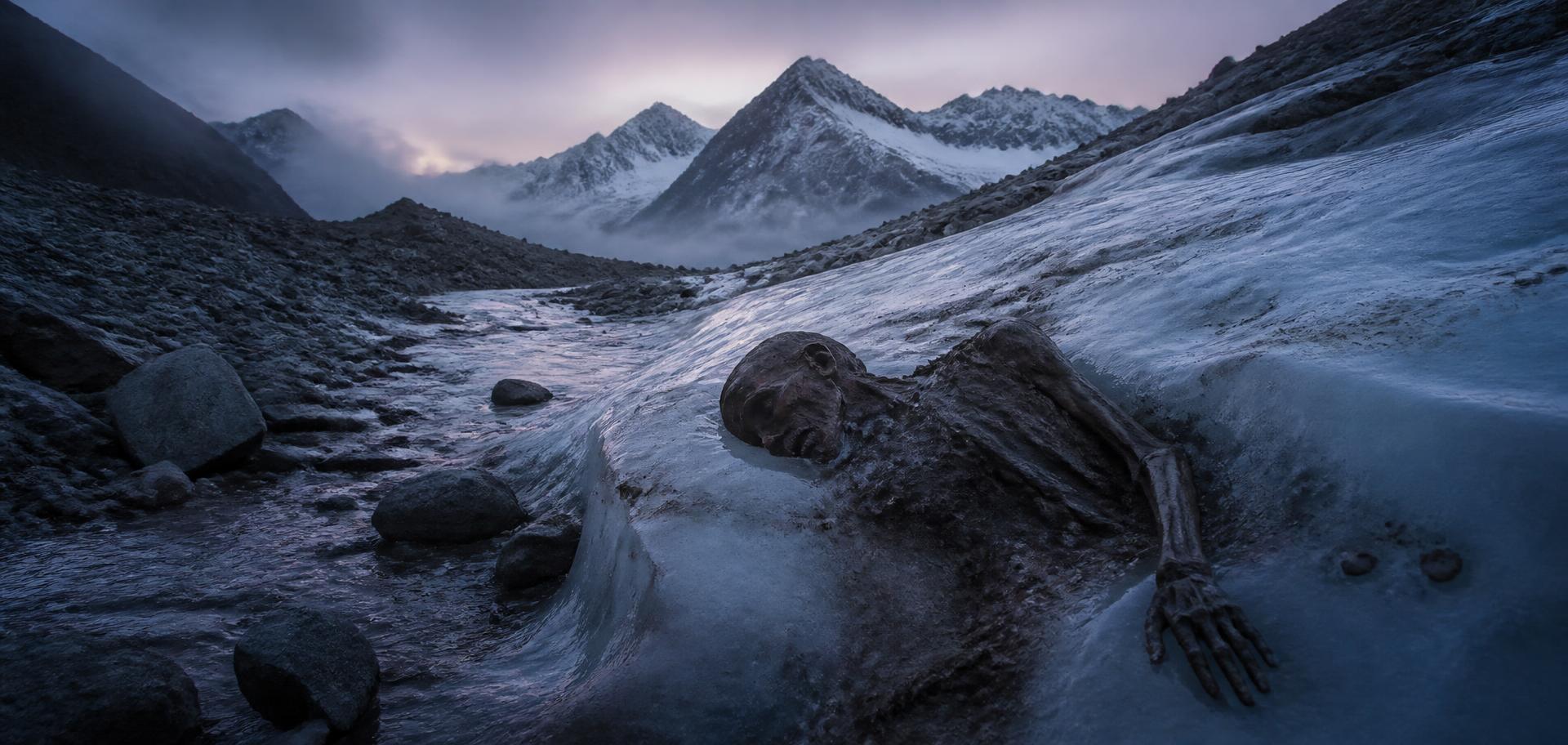
Illustrative reconstruction; not an archival photograph.
On September 19, 1991, two German hikers, Helmut and Erika Simon, were crossing a rocky gully near the Tisenjoch pass in the Ötztal Alps, at just over 3,200 metres, when they saw something brown in the meltwater: the head and shoulders of a human body, face down, still half-frozen into the ice. Alpine corpses are not rare — the mountains give up lost climbers every few summers — and the body was reported as a modern accident. When a mountain-rescue team hacked it free with a jackhammer and a pneumatic drill, they damaged the hip and the bow of the dead man's equipment, and no one thought it mattered, because everyone assumed the remains were decades old, not millennia.
It was Konrad Spindler, an archaeologist at the University of Innsbruck, who looked at the objects recovered with the body and said the sentence that turned an Alpine recovery into the most famous cold case in archaeology: the man was four thousand years old at least. He was wrong only in being cautious. Radiocarbon dating placed the death between roughly 3350 and 3100 BC — the most cited figure is about 3230 BC. The body was not a corpse but a natural mummy, preserved by the ice with skin, organs, stomach contents, and even the whites of the eyes intact. He became Ötzi, after the valley that kept him, and he remains the oldest wet mummy ever found, and the oldest known victim of a murder that science has reconstructed in forensic detail.
A man, not a specimen
The first thing the science established was that Ötzi was not an abstraction. He was about forty-five years old — elderly by Copper Age standards — around 160 centimetres tall, and he carried the wear of a hard life: worn joints, flecks of whipworm in his gut, traces of a recent frostbite injury to one toe, and the soot-darkened lungs of a man who had spent decades around open fires. He bore sixty-one tattoos, made by rubbing charcoal into fine incisions, clustered at his lower back, knees, and ankles — places where his joints hurt. Because the marks sit near traditional acupuncture points, researchers have suggested they were therapeutic rather than decorative: the oldest medical treatment ever directly observed.
His equipment was a working toolkit, not grave goods, which is what makes the find priceless. He carried a copper axe with a yew haft — an object so valuable it may have marked his status — a flint dagger, an unfinished yew longbow taller than himself, a quiver of fourteen arrows, only two of them finished, a grass net, a backpack frame, birch-bark containers that held embers wrapped in maple leaves for carrying fire, and a small pouch of medicinal bracket fungus on leather thongs, plausible treatment for his whipworm. His clothes were layered and repaired: leggings and coat of stitched goat and sheep hide, a bearskin cap, and shoes of deer and bearskin stuffed with grass — the most complete Copper Age outfit ever recovered.
The arrow in the back
For ten years the working theory was merciful: Ötzi was a shepherd or a traveller caught by weather, who lay down in the gully and froze. It fit the setting, the intact body, and the absence of obvious wounds. Then, in 2001, a new CT scan at Bolzano's hospital — where the mummy is kept at the South Tyrol Museum of Archaeology — showed what ten years of examination had missed: a flint arrowhead buried in the left shoulder, beneath the skin, invisible from outside. It had entered from behind and below, torn through the subclavian artery, and stopped near the lung. A wound like that bleeds catastrophically. Ötzi would have been dead within minutes, almost certainly in shock before the end.
We had looked at this body for ten years, and the answer had been inside the shoulder the whole time. The iceman did not fall asleep in the snow. Someone shot him.
— Paraphrased from the Bolzano pathology team's accounts of the 2001 CT discovery
The rest of the forensic picture assembled itself quickly. There was a deep defensive cut across the palm and fingers of his right hand, down to the bone — a wound sustained days before his death, in close combat, and already healing. There was bruising and a blow to the head, whether from the fall after the arrow or from his killer standing over him no one can say. And in his stomach, extraordinarily preserved, was his last meal, eaten within two hours of his death: ibex meat, red deer, and einkorn wheat, in a full stomach that proved he had stopped, eaten calmly, and moved on — which in turn proved he did not know he was being hunted at the end, or believed he had escaped.
Four people's blood
In 2003, a DNA study of Ötzi's equipment produced the case's most tantalising evidence: blood from four different individuals on his gear. One blood trace on his knife blade, two distinct sequences on the same arrowhead — as though he had shot two different men and recovered the arrow — and a fourth person's blood on the torn shoulder of his goatskin coat. The interpretation offered by the researchers was a running fight: Ötzi, perhaps with companions, in violent conflict with at least two opponents over the forty-eight hours before his death. He had a healing hand wound from the first encounter. He may have carried a wounded comrade on his back — one reading of the blood on the coat. And in the gully at Tisenjoch, the hunt ended.
Everything about the body's position and property supports an ambush rather than a robbery. His copper axe — the single most valuable object a Copper Age man could own — was still with him. No one shoots a stranger in the back, walks over to the body, and leaves a fortune lying next to it. The killer, or killers, wanted Ötzi dead, not rich. Modern forensic analysts who have reviewed the evidence, including a detective-inspector the Bolzano museum consulted, have described the pattern bluntly: a personal feud, an execution-style shot from behind, and no interest in the valuables. It is the oldest known murder investigation on Earth, and it reads like a modern one.
What we know and what we never will
The science has since filled in his biography to an almost uncomfortable degree. Pollen and isotopes in his body say he grew up in the valleys south of the mountains, in what is now South Tyrol, and spent his final decades around the Vinschgau. His genome shows brown eyes, lactose intolerance, a genetic predisposition to heart disease — his arteries were indeed calcified — and ancestry closest to early Sardinian farmers, a remnant population of the first Europeans who had been pushed into the hills by later migrations. In his last thirty-three hours, pollen from the hop hornbeam in his gut traces his descent from the valley floor at spring thaw up through the tree line to the pass. He went up in a hurry, and he did not come down.
What no instrument can recover is the part that makes it a mystery rather than a case file: who shot him, and why. The theories — a tribal feud, a dispute over status or property, a ritual sacrifice, an outlaw driven into the high country — are all compatible with the evidence and none is provable. The killer walked down off that mountain in the spring of a year we can only approximate, lived out his life, and took the motive with him. The oldest murder victim we can name is also a lesson in what evidence cannot do: it can tell us everything about a death except the one thing a courtroom needs.
The ice kept everything: the meal, the wounds, the blood of his enemies on his own arrows. The only thing it did not keep was the name of the man who killed him.
— Archivist's note, Interesting Files
There is a coda the file would be incomplete without. Ötzi has attracted a 'curse' legend, in the mould of Tutankhamun's: Helmut Simon, who found the body, died in a blizzard in the Alps in 2004 and was himself recovered from ice and meltwater; others connected with the recovery and research died in the following years, and the tabloids kept count. Researchers point out that hundreds of people worked on the mummy and the survival rate is unremarkable. But the symmetry of the finder's death — frozen in the same mountains that had held Ötzi for five thousand years — is the kind of detail this archive exists to record.
Sources & record
- 01South Tyrol Museum of Archaeology, Bolzano — the Ötzi permanent collection and published research summaries.
- 02Konrad Spindler, The Man in the Ice, 1994 — the first full archaeological account of the find.
- 03Gostner, Pernter, Bonatti, Graefen & Zink, 'New radiological insights into the life and death of the Tyrolean Iceman,' Journal of Archaeological Science, 2011.
- 04Zink et al., CT identification of the left-shoulder arrowhead and subclavian artery wound, 2001 — the determination that established homicide.
- 05Loy et al., 'Blood on the Iceman's equipment: DNA from four individuals,' 2003 — the four-blood-traces finding.
- 06Keller et al., 'New insights into the Tyrolean Iceman's origin and phenotype as inferred by whole-genome sequencing,' Nature Communications, 2012.
- 07Dickson et al., analysis of the Iceman's last meals and stomach contents (ibex, red deer, einkorn), Scientific Reports, 2018.
- 08Maixner et al., 'The 5300-year-old Helicobacter pylori genome of the Iceman,' Science, 2016.
- 09Reporting on the 1991 recovery at Tisenjoch and the Italy–Austria border survey that assigned the find to Italian territory.