Poveglia, the Island Venice Closed
Seven hectares of walled ground in the Venetian lagoon, used first as a plague station and then as an asylum, and abandoned so completely that the state still refuses to let anyone land.
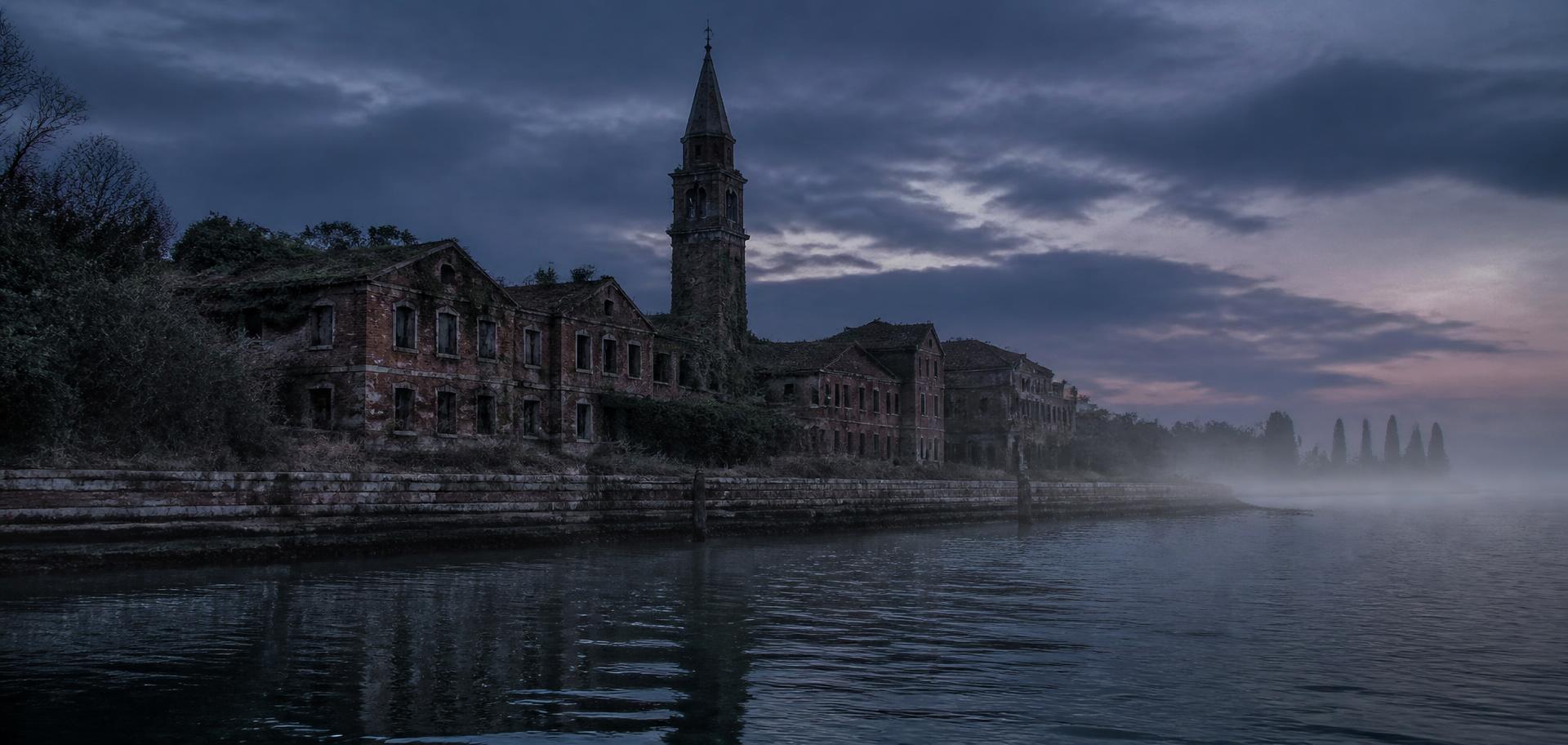
Illustrative reconstruction; not an archival photograph.
From the water Poveglia looks like most of the lagoon's small islands: a brick embankment, a line of cypress and poplar, a bell tower with no bell. The difference is that boats do not stop. Venice runs vaporetti to Murano, Burano, Torcello, San Servolo and half a dozen minor islands. Poveglia is a five-minute crossing from the Lido and has no service at all. Landing requires a permit from the state property agency, and permits are rarely given.
A village that emptied itself
The island was inhabited from at least the ninth century, when refugees from the mainland settled there, and for a time it was populous enough to have its own governing body and a church dedicated to San Vitale. War with Genoa in the fourteenth century emptied it; the government moved the remaining residents to the Giudecca and the island passed to the Republic. For four centuries it was used for whatever Venice needed done at a distance from Venice: a check-point for goods, a store, an octagonal fort in the lagoon's defensive ring — that eight-sided earthwork still stands at the southern tip.
The lazaretto
Venice invented quarantine. The word itself comes from the Venetian quaranta giorni, the forty days ships were made to wait, and by the fifteenth century the Republic operated dedicated plague islands — Lazzaretto Vecchio and Lazzaretto Nuovo — where the infected and the suspected were separated from the city. In 1793, after plague was found aboard two vessels, Poveglia was pressed into the same service and formally became a lazaretto. In 1805 it was fitted out again under Napoleonic administration, and it handled cholera cases through the nineteenth century.
The mass graves that Poveglia's reputation rests on are real, but they are largely a lagoon-wide phenomenon rather than an island-specific horror: excavations at Lazzaretto Vecchio in the early 2000s uncovered burial pits holding remains estimated in the thousands, and the plague islands generally were used for bulk interment during epidemics. The commonly repeated claim that half of Poveglia's soil is human ash, or that 160,000 people died there, has no documentary basis. What the archives do support is grim enough without embellishment: a walled island whose function, for the better part of two centuries, was to hold people the city could not save and did not want back.
The hospital, 1922–1968
In 1922 the buildings were converted into a hospital, generally described in the records as a long-stay facility for the elderly and chronically ill — a casa di riposo run under the health administration. Its rooms, ward blocks, and a bell tower repurposed from the old church still stand, roofless in places, on the northern half of the island. The later folklore around Poveglia turns almost entirely on this period: a doctor said to have performed crude lobotomies, driven mad by what he heard in the wards, throwing himself from the tower. No name, no record, and no contemporary report has ever been produced for him. Italian institutional psychiatry of the era has a genuinely disturbing documented history, most of it recorded on other islands in the same lagoon — San Servolo and San Clemente both held asylums, and both have surviving archives. Poveglia's does not appear to.
The horror of Poveglia is not in what can be proven about it. It is that the state closed the gate in 1968 and never satisfactorily explained why nothing has been done with seven hectares of prime lagoon land since.
After 1968
The hospital closed in 1968 and the island was abandoned. Vineyards were worked there briefly afterwards, then nothing. Vegetation took the buildings; floors gave way; the canal that divides the island silted. In 2014 the Italian state auctioned a 99-year lease, and a Venetian businessman won it with a bid of around €513,000 with a plan for a hotel; the concession collapsed when the restoration costs proved impossible. A citizens' group, Poveglia per Tutti, raised money in the same period to claim the island for public use and in 2024 secured a six-year concession over part of it, with the stated aim of turning it into an urban park for Venetians. The buildings remain unsafe and closed.
Why it stays on the file
Poveglia belongs in this archive not because of the doctor who probably never existed, but because of the shape of the place: an island whose entire recorded use is the removal of unwanted people from a city that could see it from its own windows. Venice put the plague there, then the cholera, then the old and the incurable, and when it had no further use for it, walled it and looked away for over half a century. The moods attributed to it by every visitor who has managed to land are, in a sense, the accurate reading. It was built to be a place nobody came back from.
Sources & record
- 01Archivio di Stato di Venezia, records of the Magistrato alla Sanità concerning lazaretti.
- 02Agenzia del Demanio, concession and auction documentation for Poveglia, 2014 and 2024.
- 03Excavation reports on Lazzaretto Vecchio mass burials, Venice, 2004–2007.
- 04Comune di Venezia records on the Poveglia hospital facility, 1922–1968.
- 05Poveglia per Tutti, public concession filings and press statements, 2014–2024.
- 06Jane Stevens Crawshaw, Plague Hospitals: Public Health for the City in Early Modern Venice (Ashgate, 2012).