The King Under the Car Park
The last English king to die in battle vanished from the record for five centuries. He was found in the first trench of a long-shot dig, under a painted letter R in a municipal car park.
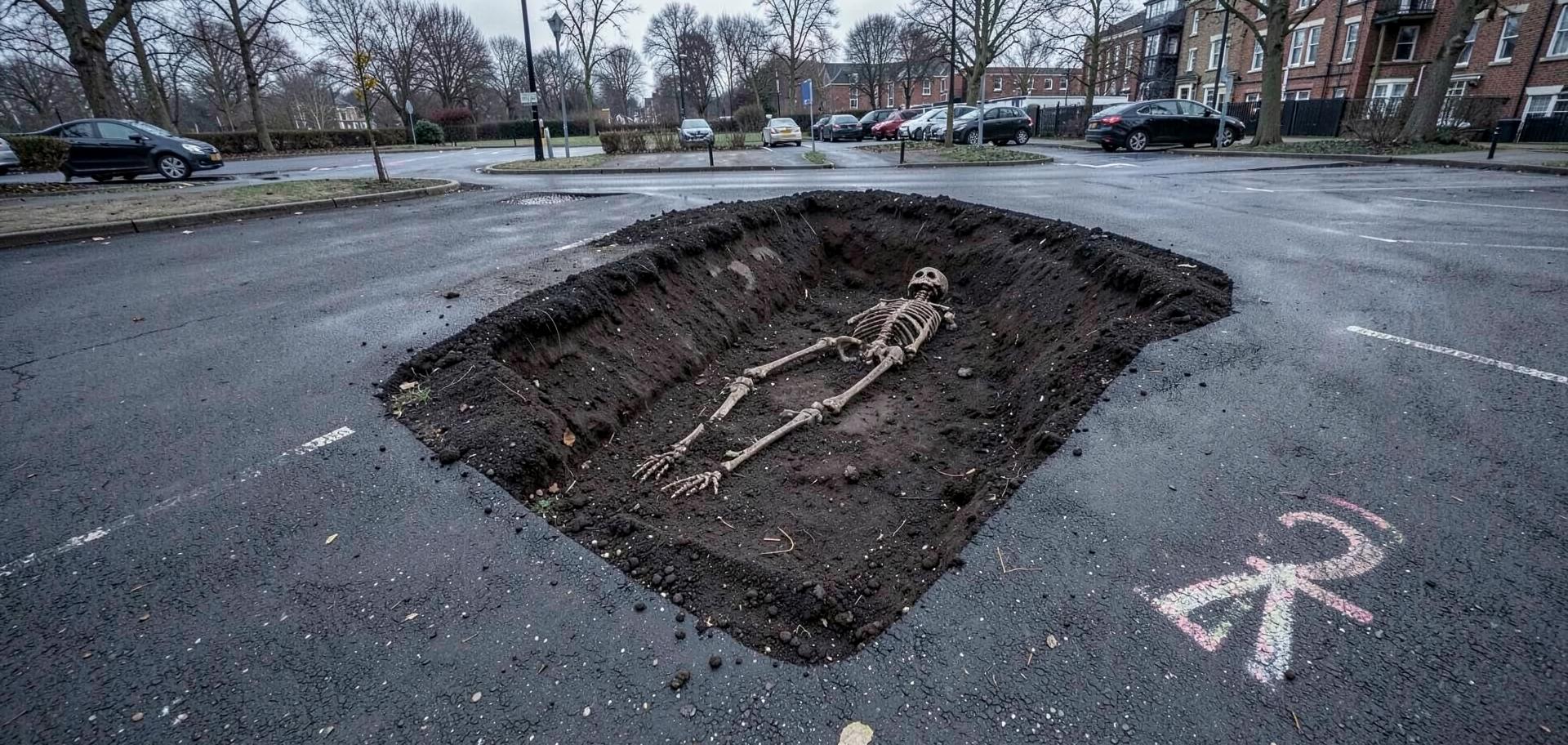
Illustrative reconstruction; not an archival photograph.
Richard III was killed at the Battle of Bosworth Field on 22 August 1485, the last king of England to die fighting. His body was stripped, carried to Leicester slung over a horse, displayed for two days so no one could claim he had escaped, and buried without ceremony in the church of the Greyfriars. The friary was dissolved fifty years later and demolished. By the eighteenth century a story circulated that the bones had been thrown into the River Soar. By the twentieth, the site was buildings, and then a car park for council staff.
A dig no one expected to work
In 2012 a search organised by Philippa Langley of the Richard III Society, with the University of Leicester Archaeological Services, opened trenches in that car park on documentary evidence of where the friary church had stood. Archaeologists gave the odds of finding the grave itself as very poor. On the first day of digging, in the first trench, they hit human leg bones — beneath a section of tarmac that happened to be marked with a painted letter R for 'reserved'.
The skeleton, fully excavated at the end of August, was of an adult male buried in a grave dug too short for him, with no shroud, no coffin, and hands possibly still bound. The spine showed severe idiopathic scoliosis — a pronounced sideways curve developed in adolescence, which would have made one shoulder visibly higher than the other, matching Tudor descriptions of a crooked back while flatly contradicting the withered arm and hunchback of Shakespeare's caricature.
How he died
The bones recorded the last minutes of Bosworth in detail. Eleven wounds, nine of them to the head, inflicted at or around the moment of death. His helmet was gone. Two of the head injuries were potentially fatal on their own: a sliced-off section at the base of the skull from a bladed weapon, and a deep penetrating wound consistent with a halberd or staff weapon. Further shallow cuts to the face, a rib and the pelvis appear to be 'humiliation injuries' delivered after death, consistent with the body being stripped and carried across a horse.
Beyond reasonable doubt, the individual exhumed at Greyfriars in September 2012 is indeed Richard III.
— University of Leicester announcement, 4 February 2013
The identification rested on convergence. Radiocarbon dating placed the death in the right window and the isotopes indicated a high-protein, high-status diet including notable quantities of wine. Genealogist Kevin Schürer traced living descendants of Richard's eldest sister, Anne of York, through the female line; mitochondrial DNA from the skeleton matched two of them. The Y-chromosome line, tested separately, did not match the presumed male-line relatives — evidence of at least one false paternity somewhere in the intervening centuries, an awkward footnote with implications for later royal claims that historians are still enjoying.
On 26 March 2015 Richard III was reinterred in Leicester Cathedral, after a legal challenge over whether York had the better claim to him. The file closes on the location and the manner of death. It does not close on the man: whether he ordered the deaths of his nephews in the Tower remains the open question of English history, and the bones under the car park had nothing at all to say about it.
Sources & record
- 01University of Leicester, Greyfriars Project scientific reports and press announcements, 2012–2014.
- 02Jo Appleby et al., "Perimortem trauma in King Richard III: a skeletal analysis," The Lancet, 2014.
- 03Turi King et al., "Identification of the remains of King Richard III," Nature Communications, 2014.
- 04Richard Buckley et al., "'The king in the car park': new light on the death and burial of Richard III," Antiquity, 2013.
- 05Philippa Langley and Michael Jones, The King's Grave (John Murray, 2013).