The Taung Child, and the Skull That Rewrote Our Origin
A small fossil face pulled from a lime quarry in 1924 told science that humanity began in Africa. The scientific establishment, in love with an English forgery, refused to listen for thirty years. And the marks in the child's eye sockets may still record how it died.
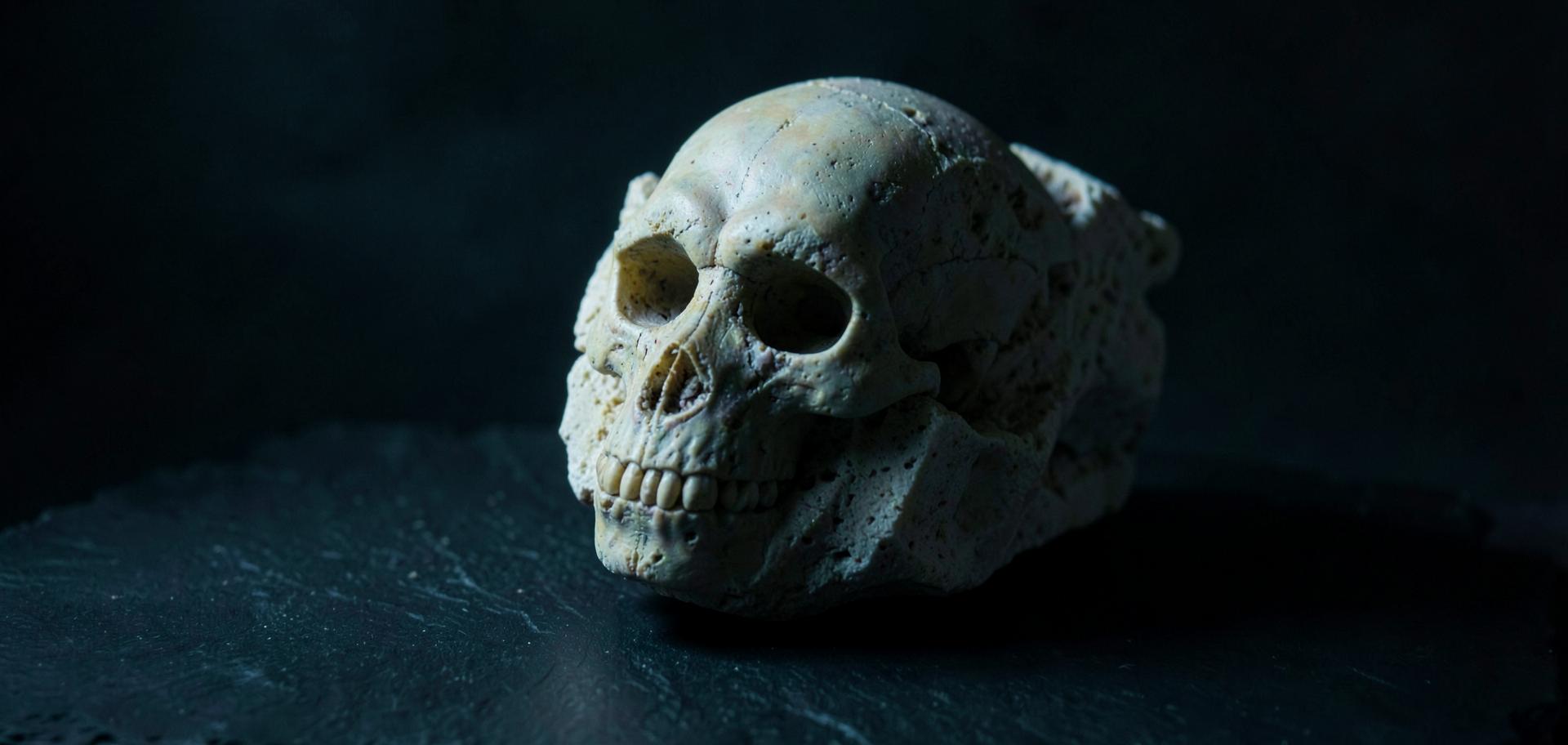
Illustrative reconstruction; not an archival photograph.
In the winter of 1924, workers blasting in the Buxton lime quarry at Taung, on the southern edge of the Kalahari, split open a block of fossil-bearing rock and found something that did not belong to any baboon: a small skull, its face still turned outward from the stone as though the child inside it had been sleeping. South Africa's lime quarries had been coughing up fossil baboons for years, and the quarry's manager knew a young anatomist in Johannesburg who collected such things. Two crates of fossils went south by rail to the University of the Witwatersrand, addressed to Professor Raymond Dart.
The crates arrived, by one of history's better-timed coincidences, while Dart was dressing for a wedding at his own house. He abandoned the occasion long enough to prise open the boxes — and there, on the top of the second, lay the fossilized impression of a small brain beside the face it had once animated. Dart spent the wedding in borrowed clothes, his mind elsewhere, and the next several months with a sharpened knitting needle, patiently freeing the child's face and lower jaw from the limestone that had held them for something close to three million years.
A child who stood upright
What Dart held was the skull of a child of about three or four, dead for a span of time his discipline was not yet prepared to imagine. The teeth were humanlike in pattern rather than apelike. The brain was small — apelike in size — but the crucial detail sat underneath the skull: the foramen magnum, the opening where the spinal cord enters, was positioned beneath the head, as it is in creatures that carry their skulls balanced atop a vertical spine. The Taung child had walked upright. It was, in other words, not quite an ape and not quite human, but something between — the thing that, according to the predictions of Darwin's more daring readers, ought to exist and had never been found.
Dart named it Australopithecus africanus — the southern ape of Africa — and published in Nature in February 1925, arguing that humanity's story had begun not in Asia, as the textbooks then insisted, but in Africa. He was thirty-two years old, Australian, teaching at a young colonial university, and he was claiming to hold the missing link. The reaction from the British scientific establishment was swift and almost uniformly hostile.
The specimen is of great interest, but it is not in the direct line of human ancestry — merely an ape that came curiously close to us, and then failed.
— Paraphrased from the establishment response in Nature, 1925
The rival from Piltdown
The trouble was that science already had a candidate for the human ancestor, and it was everything Taung was not. The Piltdown skull, 'found' in a gravel pit in Sussex, England, and unveiled in 1912, had a large, modern-looking braincase married to an apelike jaw — a brain-first ancestor, conveniently English. It fit every comfortable assumption: that intelligence had come first, that the cradle of humanity would turn out to be somewhere suitably northern. Taung said the opposite. Taung said the upright body came first, that the big brain came later, and that it happened in Africa.
For nearly thirty years, the establishment chose Piltdown. Dart's child was filed away as an aberrant young ape. It took Robert Broom — a dour Scottish doctor and fossil hunter who took up the search after Dart was effectively frozen out — to reopen the case. Beginning in 1936, Broom's excavations at Sterkfontein and other caves near Johannesburg produced adult australopithecine skulls by the dozen, including the famous 'Mrs Ples' in 1947, proving that Taung was not a freak but a population. Then, in 1953, Piltdown itself was exposed as a fraud: a medieval human skull fitted with an orangutan jaw, its teeth filed down and the whole stained to look ancient. The English ancestor had never existed. The African child had been right all along.
The exposure of Piltdown remains one of science's great unsolved subplots in its own right — the identity of the forger has never been settled, with suspicion falling variously on the amateur archaeologist Charles Dawson, on Arthur Conan Doyle, and even on the Jesuit priest Pierre Teilhard de Chardin. What is certain is that for four decades the fraud stood between the truth and the textbooks, and a small skull from a Kalahari quarry waited out the lie.
How did the child die?
The last mystery of the Taung child is the child itself. Dart, in his later years, argued that the australopithecines were hunters — killers who wielded bone and horn, and who may have killed their own. But the cave deposits told a different story: the bones of Taung accumulated the way prey accumulates, not the way hunters keep a larder. In 2006, researcher Lee Berger pointed to what may be the actual answer: the Taung skull bears small puncture marks at the base of the eye sockets of a kind documented in the skulls of monkeys taken by crowned eagles — birds that even today strike at the eyes and carry small prey to a feeding perch. The limestone of Taung may have formed around an eagle's kill.
The eagle hypothesis is not proven — the marks have been argued over since, and other predators, including large cats, remain in the frame — but it inverted the image of our origins in a single stroke. The ancestor of humanity, the evidence suggests, was not yet the killer of the African plain. It was the prey: a three-year-old child taken from the ground by a bird, carried to a perch, and consumed, leaving behind a skull that would outlast mountains, empires, and the fraud that tried to bury it.
For the history of science, the Taung child's most dangerous enemy was never the eagle. It was the fossil men wanted to be true.
— Interesting Files, archival assessment
Today the Taung child is the type specimen of Australopithecus africanus, held at the University of the Witwatersrand, and the Taung quarry is part of a UNESCO World Heritage landscape of hominid fossil sites. Raymond Dart lived to see his vindication; he died in 1988, decades after Piltdown fell. The establishment that rejected him has been replaced by one that teaches his discovery to every first-year student — which is perhaps the final, quiet lesson of the file: that the record does not care how long the truth has to wait.
Sources & record
- 01Raymond A. Dart, "Australopithecus africanus: The Man-Ape of South Africa," Nature, 7 February 1925.
- 02Raymond Dart with Dennis Craig, Adventures with the Missing Link (Harper, 1959).
- 03Robert Broom, field and publication record on Sterkfontein australopithecines, 1936–1949.
- 04J. S. Weiner, K. P. Oakley and W. E. Le Gros Clark, "The Solution of the Piltdown Problem," Bulletin of the British Museum (Natural History), 1953.
- 05Lee R. Berger, "Predatory bird damage to the Taung type-skull of Australopithecus africanus," American Journal of Physical Anthropology, 2006.
- 06University of the Witwatersrand, Raymond Dart and Taung Child archive collections.
- 07UNESCO World Heritage listing, Fossil Hominid Sites of South Africa (incl. Taung Skull Fossil Site).