The Axeman of New Orleans
For eighteen months a killer entered Italian grocers' homes through a chiseled door panel and struck with an axe taken from the victims' own hearths. He wrote to the papers, promised to spare anyone who played jazz, and vanished before he was ever named.
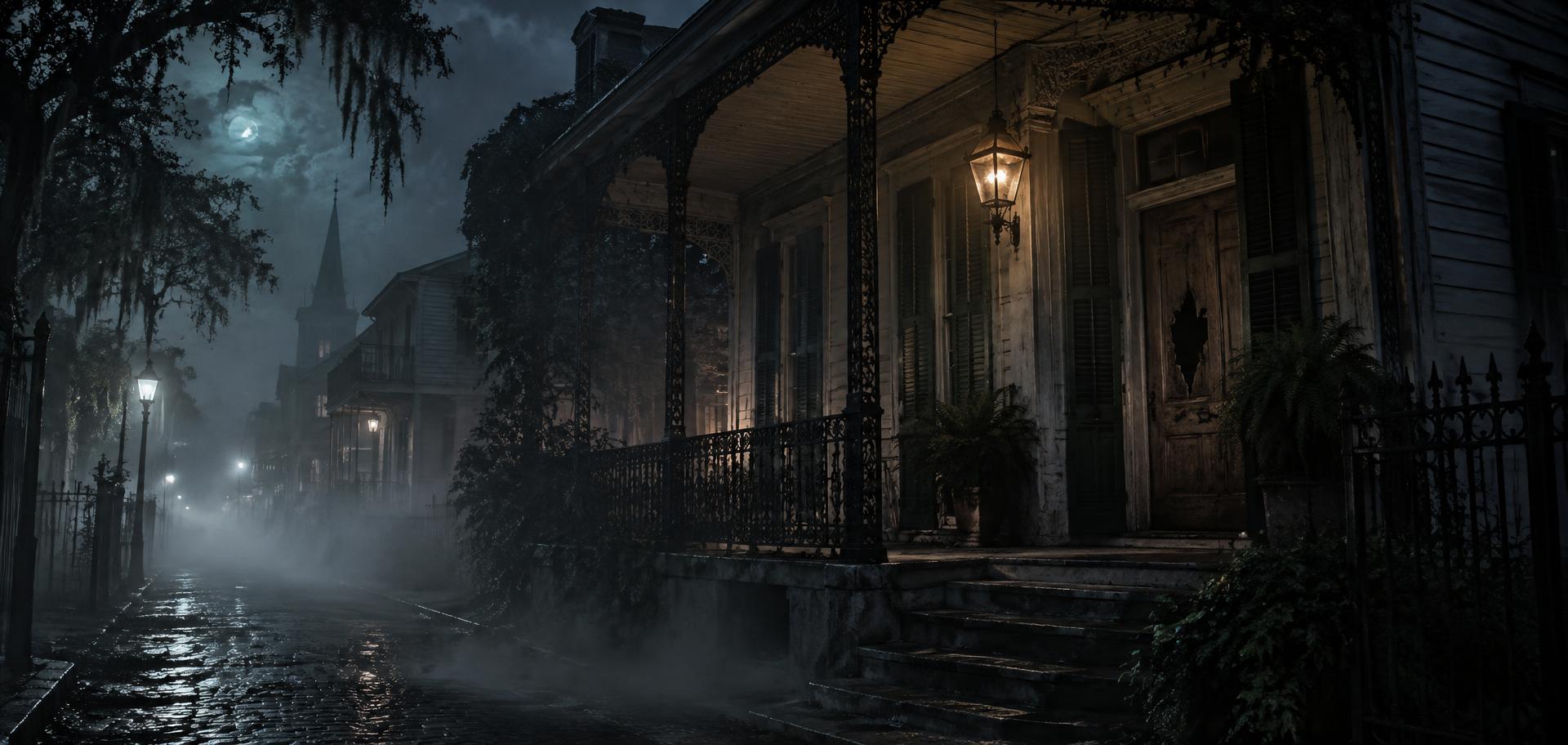
Illustrative reconstruction; not an archival photograph.
Between the spring of 1918 and the autumn of 1919, a city already famous for its music and its tolerance for the disreputable found itself locked in its houses after dark. New Orleans had weathered yellow fever, occupation, and political violence; what it had not weathered was a killer who came in through a panel cut from a back door and left the same way, taking nothing, saying nothing, and striking people in their sleep with an axe that belonged to the household he had entered. The press called him the Axeman. The police never learned his name, and the city has not, in the century since.
To read the Axeman file is to read a pattern so consistent it became a signature. The victims were, almost without exception, Italian immigrants or Italian-Americans, and most of them kept a grocery. The killer entered not by forcing a lock but by chiseling a rectangular panel from the lower part of a back door — a panel small enough for a man to reach through and turn a key, or to crawl through himself. He took the axe, or sometimes a straight razor, from inside the house. He struck the sleeping occupants, often the women first. He did not steal. In at least one house he changed out of his bloodied clothes and left them behind, walking out in a clean set. The chisel and the cut-out panel were left on the floor near the door, as though the work itself were the point.
The first door, May 1918
The attacks the city remembers as the Axeman's began on the night of May 22–23, 1918, at the corner of Upperline and Magnolia Streets. Joseph Maggio, an Italian grocer, and his wife Catherine were asleep in the apartment above the shop. The killer broke in and cut both their throats with a straight razor — Catherine's so deeply that her head was nearly severed — then struck them with an axe. Joseph was still alive when his brothers Jake and Andrew, who lived in the adjoining apartment, found them; he died minutes later. On the pavement nearby, someone had written in chalk: 'Mrs. Maggio will sit up tonight just like Mrs. Toney,' a line the police took as a reference to an earlier, unsolved attack on Italian grocers from 1912. The bloodied razor was later found on a neighbor's lawn. It belonged to Andrew Maggio, a barber, who had taken it from his shop two days earlier to have a nick honed out. Andrew, drunk that night, said he had heard only groaning through the wall. He became the police chief's prime suspect, and was then released.
What the Maggio house established, and what every scene after it confirmed, was that this was not a robbery. Money and valuables sat in plain sight and were left behind. The killer had wanted the people, not the things — and he had wanted them asleep. The weapon was ordinary, the entry was patient, and the escape was clean. By the time the city understood that one house was the beginning of something, the second house had already been entered.
A summer of doors cut open
On the morning of June 27, 1918, a bakery wagon driver named John Zanca arrived at Louis Besumer's grocery on the corner of Dorgenois and Laharpe Streets to make a routine delivery and found Besumer and his mistress, Harriet Lowe, critically injured in the quarters at the back of the shop. Besumer had been struck above the right temple with a hatchet; Lowe had been hacked over the left ear and left with one side of her face permanently paralyzed. The axe had belonged to Besumer himself. The police arrested a Black stockhand named Lewis Oubicon, who had worked in the grocery for a week, on the strength of conflicting accounts of his movements; they released him for lack of evidence. Lowe, disoriented, said her attacker had been a mixed-race man, but the statement was discounted.
What followed the Besumer attack showed how the panic bent the city's judgment. Lowe, from her bed, became a fixation of the press, making scandalous and often false statements about Besumer. When foreign-written letters were found in his possession, she told the police she believed he was a German spy, and he was arrested; released two days later, he was arrested again in August after Lowe, dying after failed surgery, named him as her assailant. He served nine months in prison before a jury acquitted him in ten minutes. The first instinct of a frightened city was to blame the man already in the room, and the room was wrong.
On August 5, 1918, a twenty-eight-year-old woman named Anna Schneider, eight months pregnant, woke to find a dark figure standing over her; she was beaten about the head and face, her scalp cut open. Her husband, returning late from work, found her. She remembered nothing, and gave birth to a healthy girl two days later. The doors and windows were unforced, and the police concluded she had most likely been struck with a lamp from a nearby table. Five days later, on August 10, the sisters Pauline and Mary Bruno were woken by a noise in the adjoining room and found their elderly uncle, Joseph Romano, standing with two open cuts to his head; they glimpsed a heavy-set, dark-skinned man in a dark suit and slouched hat fleeing the house. Romano walked to the ambulance and died two days later. His home had been ransacked, nothing stolen, and a bloody axe lay in the backyard. A panel had been chiseled from the back door. The pattern held.
The man who did this is a person of dual personalities. He is a man of two minds — one that is normal and law-abiding, and one that, without warning, is overcome by an overwhelming desire to kill.
— Paraphrase of retired detective John Dantonio's hypothesis, reported in the 1918 New Orleans press
The night the city played jazz
On March 13, 1919, the New Orleans newspapers printed a letter that arrived signed 'The Axeman.' It was written as though from a spirit, not a man — 'I am not a human being, but a demon from the hottest hell,' it began — and it made the city a proposition. At 12:15 on the morning of Tuesday, March 19, the writer said, he would pass over New Orleans. He would spare the occupants of any house in which a jazz band was playing in full swing. Everyone else would get the axe. The letter was theatrical, absurd, and almost certainly a hoax; no one could know, then or now, whether the Axeman wrote it. What is certain is what the city did with it.
On the night of March 19, New Orleans played music as it had never played it. The dance halls were filled to capacity. Professional and amateur bands set up in hundreds of houses across the city, and the streets rang with jazz hours past midnight. There were no murders that night. Whether the letter kept a killer away, or whether a hoaxer gave a frightened city a single night of solidarity and a story it would tell forever, is not something the record can decide. The letter did one thing the writer may not have intended: it fused the Axeman to the city's music, so that the case and jazz would be named together ever after.
Gretna, and the wrong men
Three weeks before the letter was published, on the night of March 10, 1919, the Axeman crossed the river. In Gretna, a New Orleans suburb, the Italian immigrant Charles Cortimiglia, his wife Rosie, and their infant daughter Mary were attacked in their home on the corner of Jefferson Avenue and Second Street. Charles and Rosie were both struck in the head with an axe found afterward on the back porch; the baby Mary was killed by a blow to the back of the neck while in her mother's arms. A panel had been chiseled from the back door, and nothing was stolen. A grocer across the street, Iorlando Jordano, ran over when he heard the screams.
When Rosie Cortimiglia regained consciousness, she named Jordano and his eighteen-year-old son Frank as the attackers. The police arrested them, and a jury convicted them — Frank sentenced to hang, his father to life. It was a conviction built on the word of a wounded woman, and it was wrong. Iorlando was sixty-nine and in poor health; Frank was over six feet tall and more than two hundred pounds, too large to have fit through the panel that had been cut from the door. Charles Cortimiglia denied his wife's account from the first. Almost a year later, Rosie admitted she had accused the Jordanos out of jealousy and spite, and the two men were released. The case is the clearest measure of what the Axeman did to the city's capacity to judge: fear produced a verdict, and the verdict was false, and two innocent men sat in a cell for a killing done by someone they never saw.
The last doors
The attacks continued after the letter, and grew no easier to read. On August 10, 1919, the grocer Steve Boca was struck in the head as he slept; he woke to a dark figure over his bed, ran bleeding to a neighbor's house, and collapsed. The back-door panel had been chiseled away; nothing was taken; he could not remember the attack. On September 3, the nineteen-year-old Sarah Laumann was found unconscious in her apartment, her head injured and several teeth missing, a bloody axe on the front lawn; she had lived alone, and she too remembered nothing. The last of the attacks attributed to the Axeman came on the night of October 27, 1919. Mike Pepitone was struck in the head in his bedroom; his wife, woken by a noise, reached the door in time to see a large man fleeing with an axe. The room was soaked in blood. Pepitone died. His wife, the mother of six, could describe the killer only as large. After that night, the attacks stopped as quietly as they had begun.
Who the Axeman was, and wasn't
The killer was never caught, and the file stayed open in the only sense an unsolved case can: as a name for a pattern. The chief suspect proposed by later researchers is a man named Frank 'Doc' Mumphrey, who used the alias Leon Joseph Monfre, or Manfre — a figure connected to a Garden District jazz business that, the argument goes, did unusually well once the city was compelled by threat to hire jazz bands. It is a theory built on a coincidence of interest rather than on trace, and it has never been proved. Others were named at the time — a barber, a stockhand, a spy, a jealous neighbor — and every one of them was released or cleared. The one consistent witness description, 'a large man,' was given by a woman who saw him for a moment in the dark.
What the record actually shows is a city that ran out of evidence before it ran out of suspects. The axe was always the household's own, so it pointed at no one. The door panel was cut with a chisel left behind, so it pointed at no one. The bloodied clothes were left in one house and never matched to a name. The killer left no fingerprint the police of 1918 could read, and the scenes, walked through by neighbors and press before the perimeter was set, gave up whatever they had to give to strangers. By the time the attacks stopped, the trail was eighteen months cold, and the man who had made it had walked out of a back door for the last time.
Why it stays open
The Axeman of New Orleans has stayed open for over a century for the same reason the best-known unsolved cases do: the signature was unmistakable and the author was invisible. He had a method so regular it could be named — the chiseled panel, the household axe, the sleeping Italians — and a method is not a name. He wrote to the city, or someone did, and the letter made him a character before it made him a suspect. He chose victims the press of 1918 was willing to treat as a category rather than as people, which meant the investigation was shaped by xenophobia as much as by evidence, and the wrong men sat in cells while the right one walked free.
The file records what can be recorded: the dates, the doors, the dead, the one letter, the cleared names. It does not record a killer, because no one ever knew him. New Orleans kept the jazz and kept the story, and the story is what the city has in place of an answer. The last honest sentence in the file is the one the New Orleans police never wrote: the Axeman came in through a cut door, struck with an axe that was not his, took nothing, and was never seen again.
Sources & record
- 01New Orleans Police Department contemporary case files on the 1918–1919 Axeman attacks — the original investigative record.
- 02New Orleans Times-Picayune coverage, May 1918 – October 1919 — the contemporary press record, including the Axeman letter of March 13, 1919.
- 03Miriam Davis, 'The Axeman of New Orleans Preyed on Italian Immigrants,' Smithsonian Magazine, February 2018 — historical context on the Italian-community targeting and xenophobia.
- 04Richard Warner, research identifying Frank 'Doc' Mumphrey (alias Leon Joseph Monfre/Manfre) as the chief suspect — the principal named-suspect theory, for the record of the claim.
- 05The Historic New Orleans Collection, 'The Mysterious Axman's Jazz' archive — sheet music and records of the March 19, 1919 jazz night.
- 06Crime+Investigation UK, 'The Axeman of New Orleans — Overview & Analysis' — a summary of the attacks, the letter, and the cleared suspects.
- 07Wikipedia, 'Axeman of New Orleans' — a consolidated reference for the sequence of attacks and the cleared suspects.