Tunguska, 1908: The Morning the Sky Exploded Over Siberia
Just after seven in the morning, something detonated in the air above the Siberian taiga with the force of a large hydrogen bomb, flattening some eighty million trees. No crater was ever found, and no fragment of the object has ever been recovered.
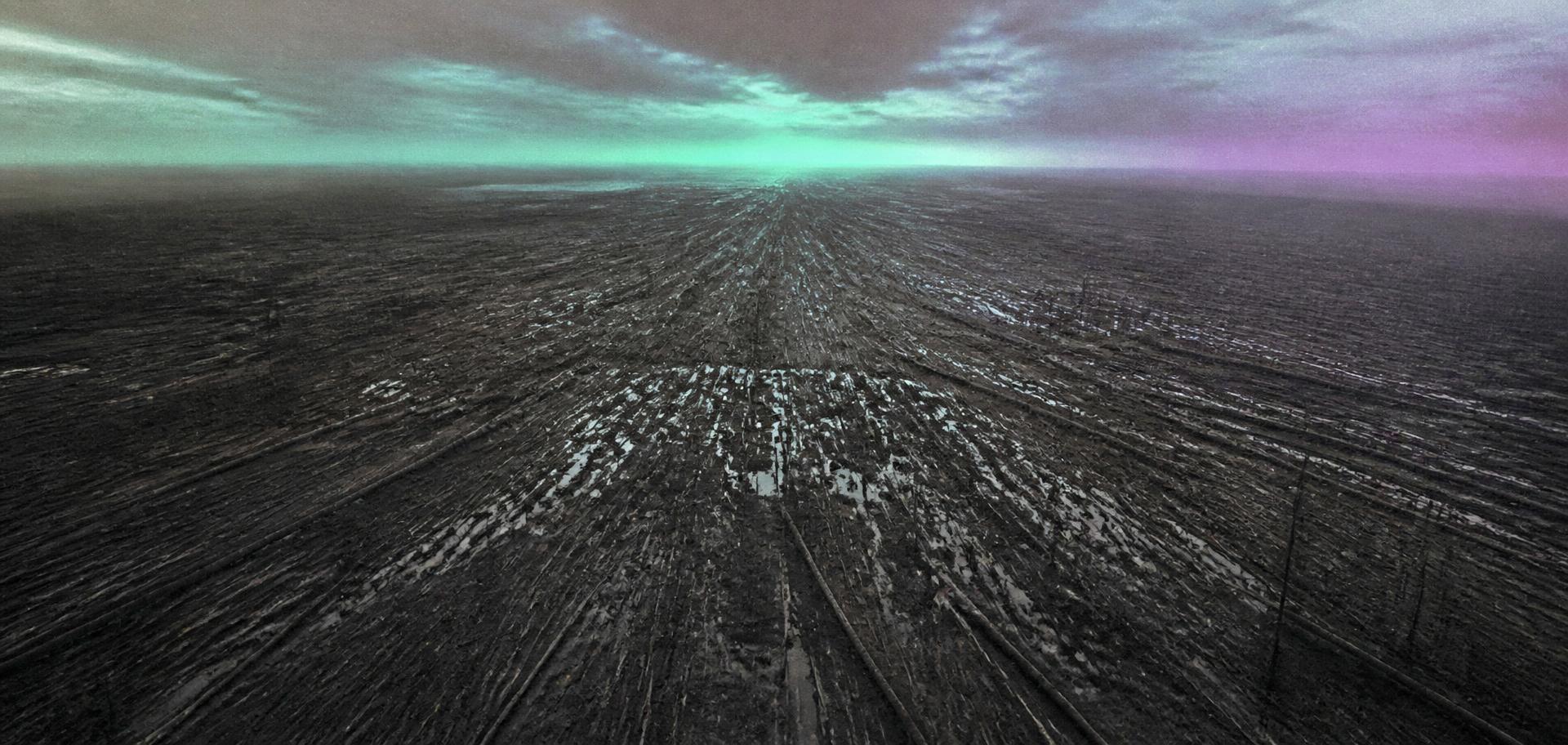
Illustrative reconstruction; not an archival photograph.
The Podkamennaya Tunguska is a river running north through one of the emptiest landscapes on Earth: swampy taiga, larch and pine, permafrost underneath, the nearest settlement often days away. On the morning of 30 June 1908, Evenki reindeer herders and Russian settlers across a region larger than several European countries saw a column of blue-white light move across the sky, brighter than the sun. Then came a flash, and then a shock that knocked people off their feet up to sixty-five kilometres away.
What the witnesses actually said
The testimony gathered after the fact is remarkably consistent given that it came from people who had never seen anything remotely comparable. At the trading post of Vanavara, some sixty kilometres from what would later be identified as the epicentre, a settler named Semen Semenov was sitting outside on his porch. He recalled being thrown from his chair by a wave of heat so intense he thought his shirt was burning. He said he wanted to tear the shirt off, but then the sky slammed shut and there was an enormous crash. He lost consciousness, came to, and heard the earth groaning. Windows broke, crockery fell from shelves, and horses bolted across the region.
The sky split in two, and high above the forest the whole northern part of the sky appeared covered with fire.
— Semen Semenov, Vanavara trading post, in testimony recorded by Kulik's expedition
Evenki accounts collected later by Kulik and by ethnographers describe reindeer being hurled into the air, herders thrown out of their tents, and whole herds destroyed near the epicentre. People spoke of iron birds and of the fire-god Ogdy, and for years many Evenki avoided the devastated area entirely — an avoidance that complicates the effort to separate what was seen in 1908 from what was remembered in 1927. One herder's testimony mentions finding two reindeer afterwards whose bodies were burned but whose legs, oddly, had broken with no obvious wound. The details drift toward folklore in places, and the honest record admits that.
The event was not only seen — it was measured, by instruments that had no idea what they were measuring. Seismic stations as far away as Irkutsk registered the shock; barographs in Britain recorded the pressure wave circling the globe, and it was later found to have gone around twice. For several nights afterwards, the skies over Europe and western Russia stayed unnaturally bright: people in London reported reading newspapers outdoors at midnight, and astronomers photographed luminous night clouds over Europe, now understood as the signature of tonnes of ice and dust injected into the upper atmosphere. Nobody connected any of this to Siberia. The news simply never made the connection.
Nineteen years of nothing
Russia in 1908 had little appetite for an expedition into remote Siberia over an event with no confirmed human casualties in a region with almost no population. A handful of provincial newspapers ran reports; the Ministry of the Interior took no interest. Then the world moved on to larger catastrophes. The Tsarist state fell, war and revolution followed, and the reports sat in archives and in local memory. When the Soviet mineralogist Leonid Kulik finally assembled an expedition in 1927 — convinced he was tracking a giant iron meteorite that could be mined to benefit Soviet industry — nineteen years of weather, regrowth, and decay had already passed over the site.
What he found was one of the strangest landscapes ever photographed. For tens of kilometres, mature trees lay flattened on the ground, all pointing outward from a single central area, their branches stripped. At the centre itself the trees still stood upright — but scorched, limbless, a forest of bare poles. That pattern is the signature of a blast directly overhead rather than an impact: the shock arrived vertically at the centre and laterally everywhere else. It is the same geometry that would later be observed beneath the airbursts over Hiroshima and over Chelyabinsk.
Kulik searched for the crater he expected, drained bogs he thought might be impact pits, interviewed everyone still alive who remembered the morning, and returned repeatedly over the following decade. He never found a crater, and never found a meteorite. His last expedition was in 1939. When war came he volunteered, was captured, and died in a German prison camp in 1942, the question still open. The taiga then went quiet again for another generation, visited mainly by the Evenki and by scientists working from Kulik's maps.
The mid-century detour
After 1945 the event took on a new kind of attention, because humanity now had a vocabulary for what an airburst could do. The Soviet engineer and science-fiction writer Alexander Kazantsev visited Hiroshima in 1946 and publicly suggested that the Tunguska devastation resembled a nuclear blast — proposing, in fiction and then in earnest argument, an exploding alien spacecraft. For decades afterwards the site attracted competing camps: careful geochemists counting spherules in peat, and others searching for radiation anomalies, 'mutant' growth rings, or proof of a crash. Reports of accelerated tree growth after the event were real, but the more prosaic explanation — fertilisation by ash and the sudden opening of the canopy — covers most of it. No persistent radiation anomaly was ever established.
The fringe theories deserve a sentence each, because they keep resurfacing. Antimatter annihilation: ruled out, since it would have produced a gamma signature incompatible with the observed effects and no isotopic residue supports it. A black hole passing through the Earth: ruled out, since it would have had to exit somewhere and nothing happened. A Tesla experiment at Wardenclyffe: chronologically and physically impossible. What is striking is not that these ideas persist, but that a century of physical evidence keeps pointing to something almost more disquieting — an ordinary rock, arriving unannounced, at random.
What the evidence supports
The mainstream scientific account is that a stony asteroid or a fragment of a comet, perhaps fifty to sixty metres across, entered the atmosphere at tens of kilometres per second and disintegrated in an airburst roughly five to ten kilometres above the ground. The object's own material was largely vaporised or dispersed as microscopic particles, which is why there is no crater and no recoverable fragment. Estimates of the energy released vary widely — published figures commonly range from about three to thirty megatons — because they depend on how the tree-fall, seismic and barographic data are modelled.
Supporting evidence has accumulated slowly. Microscopic spherules of silicate and magnetite consistent with extraterrestrial material have been found in soil and in peat layers dating to 1908. Resin from surviving trees shows an anomaly in the same layer. Isotopic work on the peat has been read by some researchers as indicating cometary material, by others as inconclusive. Lake Cheko, a small lake about eight kilometres from the epicentre, was proposed in 2007 by an Italian team as a possible impact crater from a surviving fragment; later sediment coring by other researchers indicated the lake is considerably older, and the claim is not widely accepted. Some studies find trace enrichment of iridium and other elements in the 1908 layer; the totals involved remain far too small to identify the object with confidence.
One genuine recent change came from an entirely different event. On 15 February 2013, a roughly twenty-metre object burst over Chelyabinsk, injuring more than a thousand people, mostly from broken glass — and this time the explosion was recorded by hundreds of dashboard cameras, by infrasound networks, and by satellites. Tunguska became, overnight, a calibration point: the benchmark against which planetary-defence models of small-body airbursts are now tested. The models that reproduce Chelyabinsk well tend to converge on a Tunguska object of stony composition entering at a shallow angle. The file narrowed considerably in 2013, and almost nobody noticed.
The parts that stay open
No physical piece of the Tunguska object has ever been held in a hand. Whether it was a stony asteroid or a comet fragment is still argued in the literature, as is the precise trajectory — reconstructions of the entry angle and direction from eyewitness accounts collected decades later disagree with each other. Because the site was not examined for nineteen years, and because the region has no dense population, the record rests on memory, on the geometry of fallen trees, and on trace particles in soil.
The uncomfortable part is arithmetic rather than mystery. Objects of Tunguska size are thought to arrive every few centuries on average, and roughly three-quarters of Earth's surface is ocean or wilderness. Had the 1908 object arrived a few hours later, the Earth's rotation would have placed a major European city beneath it, and the event would not be a footnote but one of the defining catastrophes of modern history. Tunguska is the largest impact event in recorded history, and it happened over one of the few places on the planet where it could kill almost no one. That is the entire reason it is a curiosity rather than a catastrophe.
Sources & record
- 01L. A. Kulik, expedition reports on the Tunguska fall, USSR Academy of Sciences, 1927–1939.
- 02Eyewitness testimony collected by Kulik and by later Soviet expeditions, including the Vanavara accounts.
- 03NASA and ESA planetary defence summaries of the 1908 Tunguska airburst.
- 04Gasperini et al., proposal of Lake Cheko as an impact feature (2007), and subsequent sediment-core rebuttals.
- 05Peer-reviewed analyses of peat-layer microspherules and isotopic anomalies from the Tunguska site.
- 06Barograph and seismograph records of 30 June 1908, including UK Met Office and Irkutsk station data.