Roopkund's Skeleton Lake: Hundreds of Skeletons, and DNA Keeps Contradicting Every Explanation
Roopkund is a shallow glacial lake in the Indian Himalayas, about 5,029 metres above sea level, in the shadow of the Trishul massif. For a few weeks each summer the ice melts, and the lake shows what it keeps: the skeletons of hundreds of people, scattered in and around the water. For decades the accepted story was simple — a single group, caught in one catastrophic storm. Then the bones were dated, and sequenced, and the simple story fell apart.
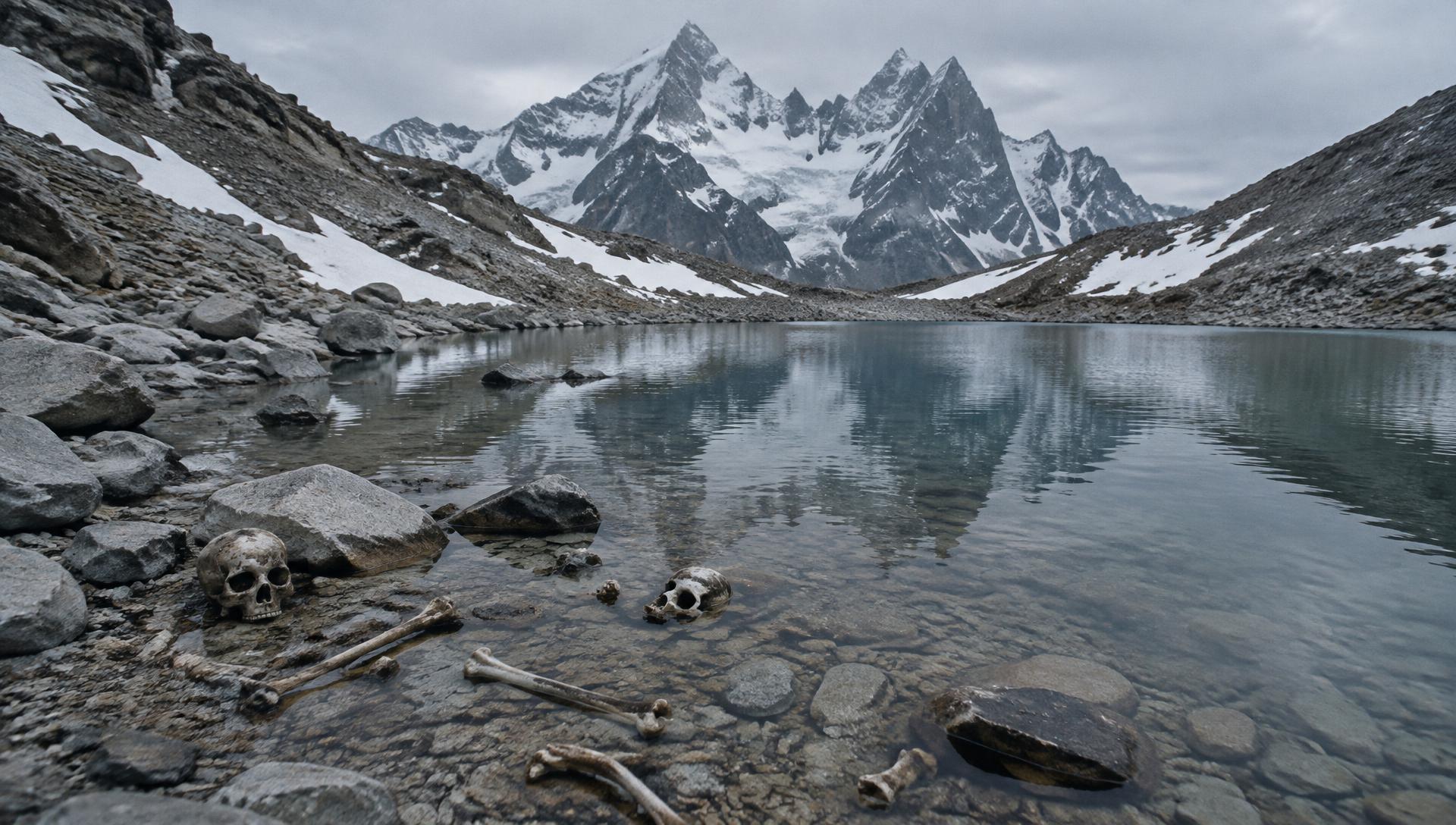
Illustrative reconstruction; not an archival photograph.
Roopkund sits in a glacial hollow at about 5,029 metres in the Chamoli district of Uttarakhand, in the Indian Himalayas, beneath the 7,120-metre Trishul massif. The lake is small — roughly forty metres across and only a few metres deep — and it is frozen for most of the year. For a few weeks each summer the ice retreats, and the shallows and the shoreline reveal what the lake keeps: the scattered skeletons of hundreds of people, along with wooden artefacts, leather slippers, rings and spearheads. There is no settlement here, and never has been. Everything at Roopkund belonged to people who were passing through.
A discovery made in wartime
Local people had known about the bones for generations — the lake lies on the route of the Nanda Devi Raj Jat, a pilgrimage held roughly every twelve years, and the skeletons were part of the landscape's folklore long before outsiders arrived. The wider world learned of them in 1942, when Hari Kishan Madhwal, a ranger of the Nanda Devi game reserve, came across the remains and reported them. The timing mattered. With the Second World War under way, British authorities' first fear was that the bones might be the remains of Japanese soldiers who had died attempting a covert passage through the mountains. A team was sent to investigate, and the theory collapsed almost immediately: the bones were plainly far older than the war, and they included women and children.
What the first investigators found was stranger than any wartime explanation. The dead were not buried. They lay in and around a tiny lake at an altitude where almost no one lives, mixed with the equipment of travellers rather than soldiers. Estimates of the total number of dead have ranged from around 300 to more than 600 individuals. And because the lake freezes and thaws each year, the ice keeps moving the remains — bones surface, sink and resurface, which is part of why no count has ever been final.
The legend of the goddess
Local tradition offered its own answer. A folk song sung along the pilgrimage route tells of a king of Kanauj, Jasdhaval, who undertook the Nanda Devi pilgrimage with his pregnant queen, Rani Balampa, accompanied by dancers and musicians — a celebration considered disrespectful to the goddess. Nanda Devi, the story goes, punished the party with a storm of hailstones as hard as iron, and the entire procession perished on the mountain. For decades the song was treated as folklore. Later, researchers would note with some discomfort how closely it matched one of the leading scientific theories.
The 2004 expedition and the hailstorm theory
The first systematic modern study came in 2004, when a National Geographic–backed expedition reached the lake and examined the remains in place. The team's working conclusion became the standard account for the next fifteen years: a single group of a few hundred people — pilgrims, porters and guides — had been caught on the exposed slope above the lake by a sudden and exceptionally violent hailstorm, and killed where they stood.
The theory rested on real observations. Many of the skulls show fractures, and the injuries cluster on the head and shoulders rather than the arms and legs — the pattern you would expect from blows coming from above, not from a fight or a fall. The researchers also noted that the slope offers no shelter: no caves, no overhangs, no trees. The Himalayas do produce severe hail, and hailstones at altitude can grow large enough to kill. As a single-event story it was coherent, it matched the folk song, and it was repeated in documentaries and articles around the world. It just did not survive the next round of evidence.
The dating problem
Radiocarbon work had already hinted at trouble, but the decisive study was published in 2019 in Nature Communications. An international team — led by researchers at Harvard Medical School, the Max Planck Institute and the Birbal Sahni Institute of Palaeosciences, and including geneticist David Reich — extracted genome-wide ancient DNA from 38 skeletons and obtained new radiocarbon dates. It was the first ancient DNA ever reported from India, and it dismantled the single-disaster account in two ways at once.
First, the dead did not die together. The dated remains fell into distinct groups separated by roughly a thousand years. One cluster — 23 individuals — dated to around the 7th to 10th centuries, and even they may have died in more than one event. A second cluster dated to around the 17th to 20th centuries, some of them recently enough to overlap with the era when the lake was already appearing in written reports. Whatever Roopkund does to people, it has done it repeatedly, across a millennium.
The ancestry problem
Second, the dead were not one population. The earlier group was broadly consistent with people of South Asian ancestry — plausible pilgrims or local travellers, exactly as the traditional story assumed. But the later group was not. Fourteen of the recently dated individuals showed ancestry the researchers described as eastern Mediterranean — genetically closest to present-day people of Crete and Greece — and at least one further individual carried East or Southeast Asian–related ancestry. A party of people of Mediterranean origin dying at a remote Himalayan lake within the last few centuries fits no known pilgrimage, trade route or recorded expedition.
Stable isotope analysis of the bones deepened the divide. The two main groups had eaten different diets — the South Asian group consistent with millet-based foods, the later group with wheat and barley — meaning they had lived different lives in different places before dying in the same one. None of the tested individuals were closely related to each other. This was not a family, a village or a single caravan.
What happened to the hailstorm
The DNA did not disprove that hail killed some of the dead — the head injuries are real, and a storm remains plausible for at least one group. What it disproved was the idea of one storm, one party and one explanation. The injuries may also have more than one cause: falls on rock, collapsing ice, or violence. The 2019 researchers were careful to say that no single event can account for what the lake contains.
The theories that remain
No current theory covers all of the evidence, and researchers say so openly. The South Asian group plausibly fits the Nanda Devi pilgrimage, which still crosses the region today, and a mass-casualty event — storm, avalanche or epidemic — remains possible for some of the dead. The Mediterranean group is the standing anomaly. Proposed explanations have ranged from an unrecorded band of travellers or merchants to descendants of soldiers or settlers moved across Asia in earlier centuries, but none is supported by a document, an inscription or a named expedition. It is also possible that Roopkund is less a single event than a trap that collected the dead of the route over centuries — a place where many separate journeys simply ended.
A site that is disappearing
There is a final complication, and it is a modern one. Researchers who have worked at Roopkund have repeatedly warned that the site is being stripped: visitors and trekkers carry away bones and skulls as souvenirs, and the remains are visibly fewer than they were in photographs from earlier expeditions. Every removal makes future study harder. The mystery of Roopkund may never be solved not only because the evidence is old, but because it is being taken home in backpacks.
What the DNA settled is the shape of the mystery, not its solution. Hundreds of people, from at least three populations, across roughly a thousand years, died at one small lake high above the treeline — and no written record from any of their worlds mentions it. The bones are still there, and each summer the ice gives a few more of them back.
Sources & record
- 01Harney, É., Nayak, A., et al. — 'Ancient DNA from the skeletons of Roopkund Lake reveals Mediterranean migrants in India', Nature Communications (2019)
- 02National Geographic — reporting on the 2019 DNA findings
- 03Nature India — coverage of the Roopkund research
- 04The Indian Express — reporting on the CCMB findings
Online citations
- →Nature Communications — the 2019 ancient DNA study of Roopkund
- →National Geographic — DNA study deepens mystery of lake full of skeletons
- →Nature India — Mystery of Himalayan Skeleton Lake unravelled
- →The Indian Express — at least 3 gene groups, died 1,000 years apart
- →PubMed — the 2019 Roopkund ancient DNA study (abstract)
- →Wikipedia — Roopkund