Dyatlov Pass: What Happened to the Nine Hikers?
Nine experienced hikers left their tent on a frozen Ural slope without boots or winter clothing. Their bodies were found between the camp and a cedar forest, some with devastating internal injuries. Decades of retelling turned the tragedy into a supernatural puzzle. The original record is stranger, more coherent and less certain.
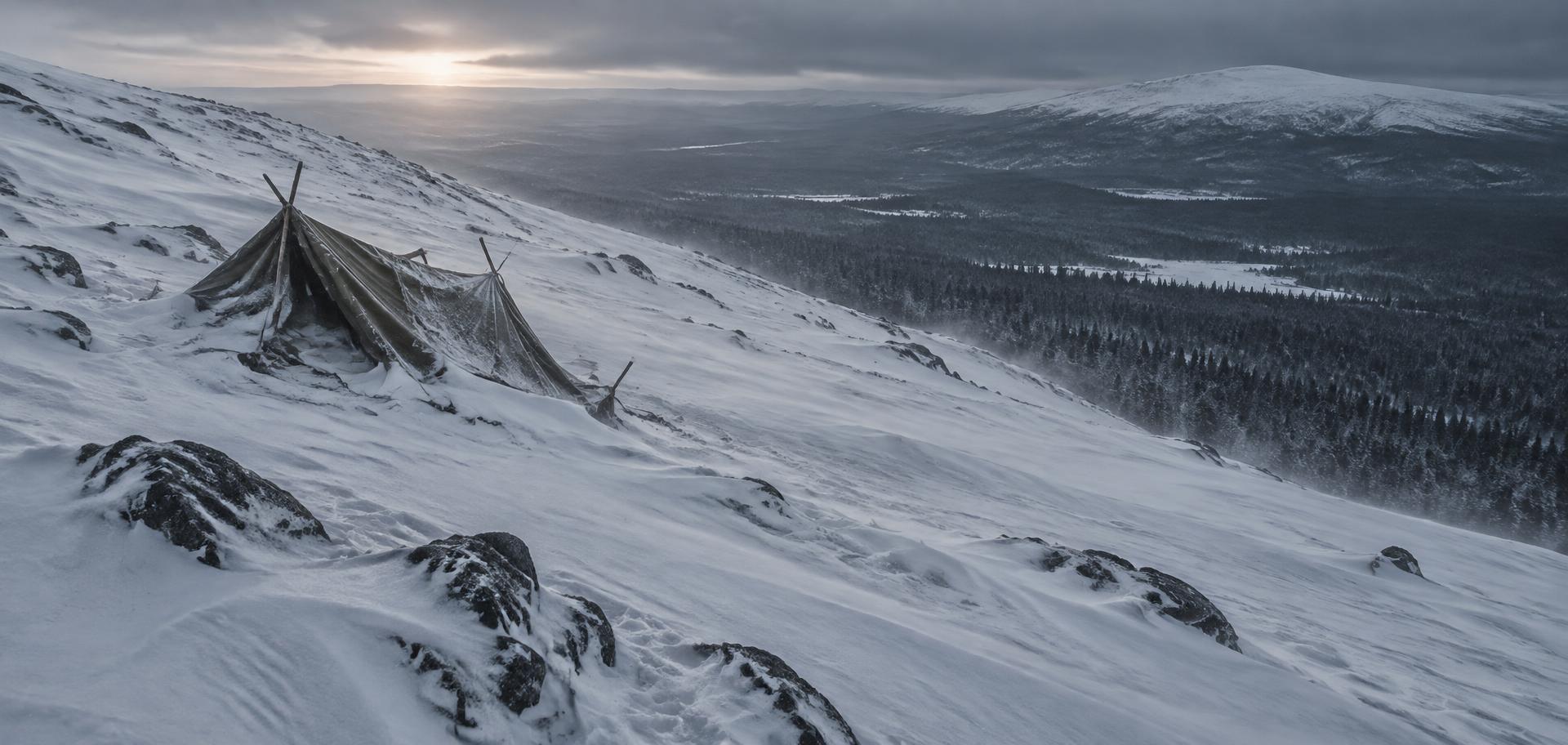
Illustrative reconstruction; not an archival photograph.
On 23 January 1959, ten young hikers left Sverdlovsk for a winter ski journey across the northern Urals. Most were students or graduates of the Ural Polytechnic Institute, and all but one held advanced hiking qualifications. Igor Dyatlov, twenty-three, led the group. With him were Zinaida Kolmogorova, Lyudmila Dubinina, Rustem Slobodin, Yuri Doroshenko, Yuri Krivonischenko, Alexander Kolevatov, Nikolai Thibeaux-Brignolle, Semyon Zolotaryov and Yuri Yudin. The route was classed Category III, then the Soviet system's highest difficulty. Yudin turned back on 28 January when joint pain made continuing impossible. That decision made him the expedition's only survivor.
The last camp on the slope
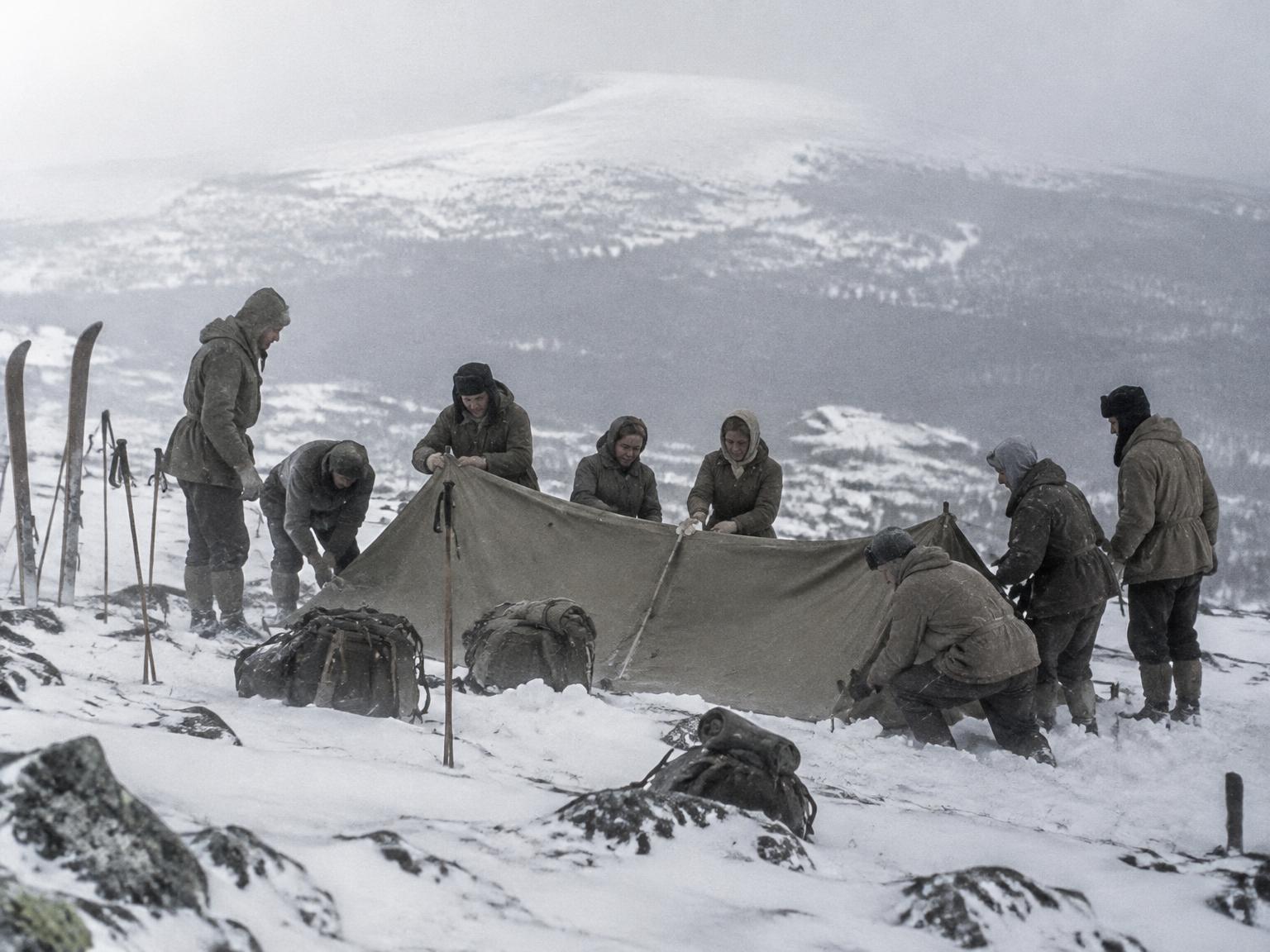
Diaries and photographs recovered later allow the party's progress to be followed almost to the end. After Yuri Yudin turned back, the final party comprised nine hikers: seven men and two women. On 1 February, poor visibility carried them west of their intended route and onto the exposed flank of Kholat Syakhl. Rather than lose altitude to camp in the forest, they cut a platform into the slope and pitched their long canvas tent there. A final photograph appears to show the group setting it up in blowing snow. What happened after dark was witnessed by no one who survived.
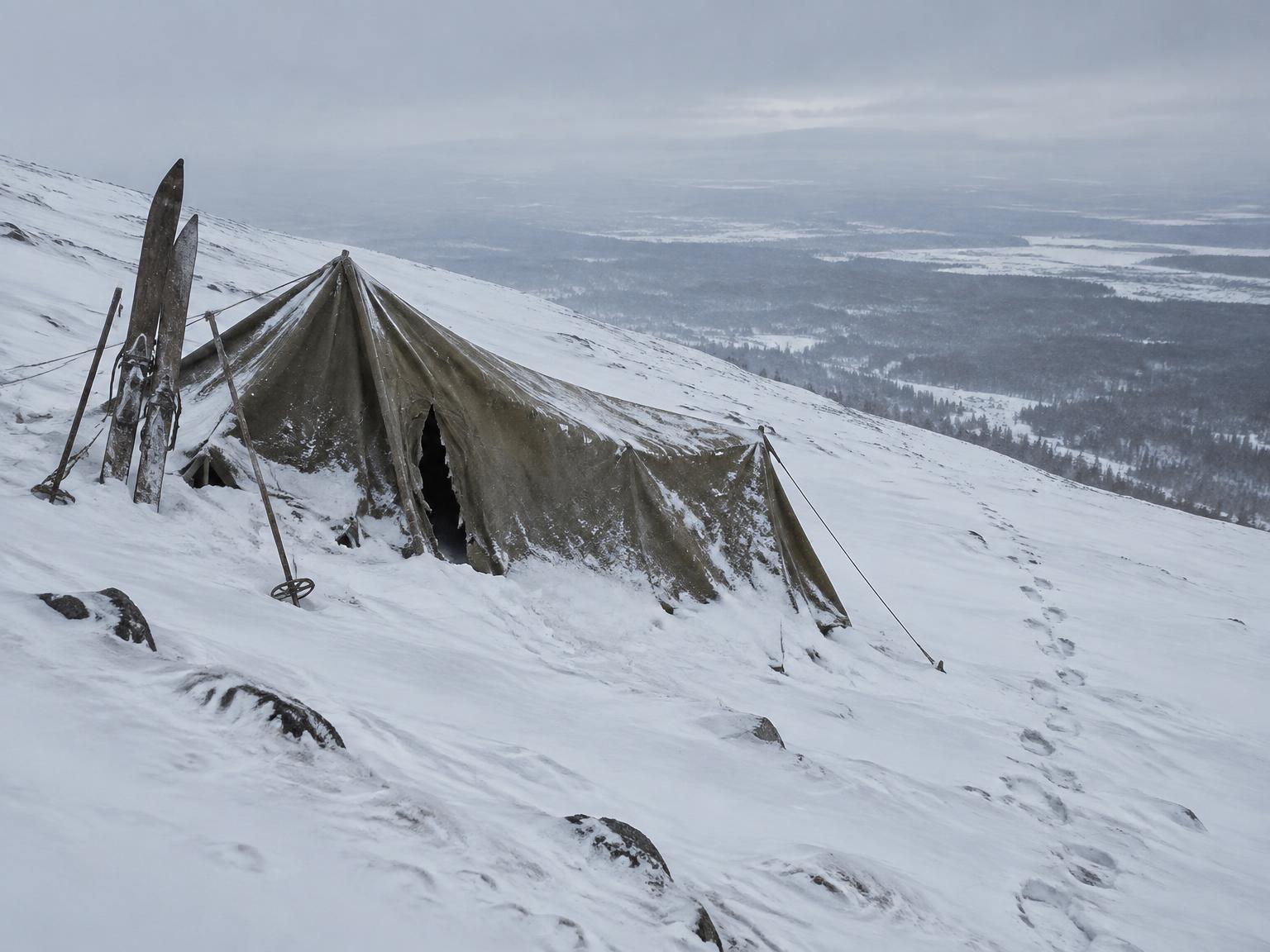
The group was expected to send a telegram after returning to Vizhay around 12 February. Dyatlov had warned Yudin that they might be several days late, so the delay did not immediately cause alarm. Search parties were organized on 20 February. Six days later, searchers found the tent partly collapsed and covered by snow. Boots, warm clothing, food, diaries and cameras remained inside. Forensic examination concluded that several cuts in the canvas had been made from within. Tracks from eight or nine people led down the slope; some prints showed socks, bare feet or a single shoe. The line was sufficiently orderly that the evidence does not support the familiar image of nine people scattering in blind panic.
A fire beneath the cedar
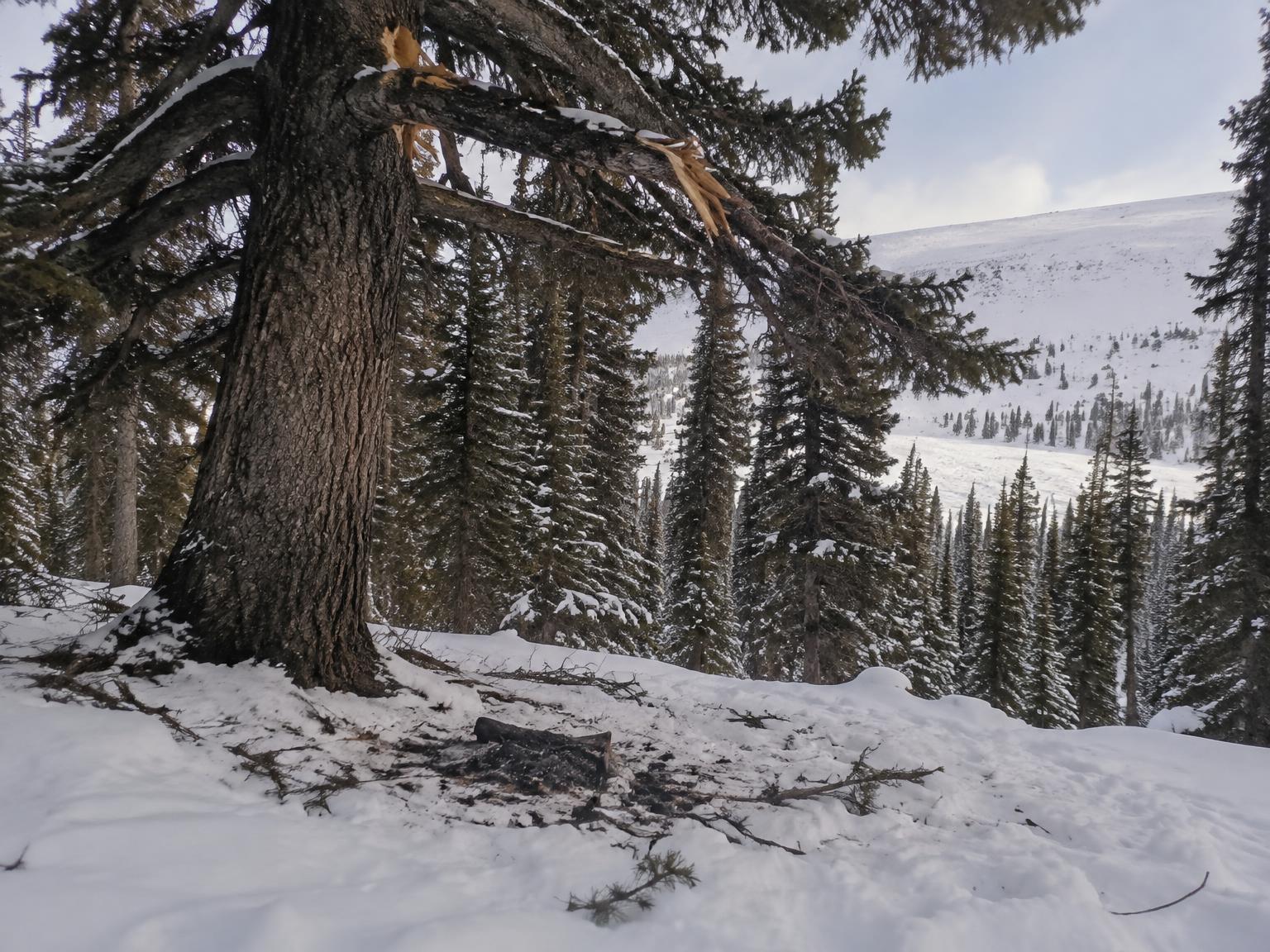
At the forest edge, roughly 1.5 kilometres downhill, searchers found the remains of a small fire beneath a large cedar. Yuri Doroshenko and Yuri Krivonischenko lay nearby in their underwear. Branches had been broken high in the tree, perhaps for fuel or to gain a view of the slope. Igor Dyatlov, Zinaida Kolmogorova and Rustem Slobodin were found at intervals between the cedar and the tent, positioned as if they had tried to climb back. The initial autopsies attributed all five deaths primarily to hypothermia; Slobodin also had a skull fracture, but the examiner did not consider it immediately fatal.
The remaining four were not found until 4 May, buried beneath metres of snow in a ravine near a stream. Alexander Kolevatov had died of hypothermia. Nikolai Thibeaux-Brignolle had a major skull injury; Lyudmila Dubinina and Semyon Zolotaryov had severe chest fractures. The internal damage was extensive while the overlying skin showed relatively little external injury, suggesting a broad, powerful load rather than blows from a handheld weapon. Clothing had been redistributed among the group: garments taken from those who died first were worn or wrapped around others. That practical response to cold explains much of the apparently strange undressing better than the phrase “paradoxical undressing,” though late-stage hypothermia may also have affected behaviour.
The missing tissue was not a surgical mystery
Popular accounts dwell on Dubinina's missing tongue and the absent eyes of two bodies. The four ravine victims had lain for three months in a meltwater channel before recovery. Their autopsies described decomposition and water exposure; soft tissues open to the environment disappear first through decay and scavenging. There was no evidence that the tongue or eyes had been deliberately removed before death. The condition is disturbing, but it is not evidence of ritual mutilation, a weapon or an unknown attacker.
What the Soviet file did — and did not — say
The 1959 inquiry found no sign of another party at the camp and no basis for blaming local Mansi people, an early suspicion unsupported by tracks, motive or evidence. Investigator Lev Ivanov closed the case with the conclusion that the hikers died because of a “compelling natural force” they could not overcome. The Russian phrase stikhijnaja sila is often rendered as “unknown compelling force” and presented as an official admission of the paranormal. It was not. It was an administrative conclusion that named no perpetrator and left the initiating natural event unspecified.
Other details became larger in retelling. Tests found beta activity on parts of a few garments, but not evidence of a lethal radiation event; Krivonischenko had worked at the Mayak nuclear facility, providing an ordinary route for contamination. Reports of orange lights in the sky were not tied by physical evidence to the hikers' deaths. No shrapnel, explosive residue or military record has established a weapons test at the camp. Infrasound generated by wind has never been measured there in conditions matching the incident. A yeti attack has no tracks, hair, injuries or other evidence. These ideas are stories built around gaps in the record, not findings from it.
The modern avalanche case
In 2019, Russia's Prosecutor-General reopened a review focused on natural causes. The office announced in July 2020 that a snow slab had threatened or struck the camp, prompting an orderly emergency evacuation. In darkness and visibility reported as only several metres, the hikers descended beyond a rock ridge and could not relocate the tent. They reached the trees, made a fire and attempted survival; some tried to return, while others built a snow shelter near the ravine. Hypothermia killed six, and snow pressure or a later collapse accounted for the fatal injuries. This is an official reconstruction, not a witnessed sequence, and relatives and independent researchers have disputed parts of it.
The strongest scientific support came independently in 2021. Snow scientists Johan Gaume and Alexander Puzrin modelled a small delayed slab avalanche in Communications Earth & Environment. Their mechanism answered several objections to older avalanche theories: the hikers' cut into the slope could weaken a buried snow layer; strong downslope winds could load snow above the tent for hours; irregular terrain could permit release even where the broad slope seemed too shallow; and a compact slab striking people lying on skis and bedding could produce severe chest and skull trauma without obvious external wounds. The paper demonstrated physical plausibility. It did not prove that this exact sequence occurred.
Follow-up expeditions reported in 2022 documented avalanche terrain above the camp location and observed slab releases in the wider pass. That evidence weakened the old claim that avalanches simply do not occur there. Questions remain. Searchers recorded no obvious avalanche deposit weeks later; the timing and scale of any slab must be reconstructed; and not every injury necessarily happened in the tent. A later collapse in the ravine could account for some trauma. The evidence therefore supports an avalanche-led disaster while leaving its precise mechanics open.
The last hours, without the legend
The least speculative outline is also the most human. Something credible and immediate made nine experienced people leave a damaged or threatened tent before they could dress. They descended together to the forest, where wood and shelter were available. They built a fire, divided clothing, attempted to create a snow refuge and sent at least three people back toward the tent. Extreme cold then turned each setback into a fatal one. An avalanche or unstable snow slab currently offers the best-evidenced trigger, supported by an official review, physical modelling and later field observations. It remains a reconstruction rather than a final proof.
The Dyatlov Pass mystery persists because the nine left no account of the first decisive minutes. Yet the surviving evidence does not require monsters, secret weapons or inexplicable madness. It records a series of rational survival decisions made under darkness, wind and lethal cold — decisions that failed after the group lost access to the equipment only a kilometre and a half above them. The uncertainty is real. So is the boundary between that uncertainty and folklore.
Sources & record
- 01The 1959 criminal investigation, search records, autopsy reports, expedition diaries and recovered photographs.
- 02Russian Prosecutor-General's Office review announced in July 2020 by Andrey Kuryakov.
- 03Johan Gaume and Alexander M. Puzrin, 'Mechanisms of slab avalanche release and impact in the Dyatlov Pass incident in 1959' (2021).
- 04Alexander M. Puzrin and Johan Gaume, 'Post-publication careers: follow-up expeditions reveal avalanches at Dyatlov Pass' (2022).
- 05Contemporary biographies and diary chronology of the Ural Polytechnic Institute expedition.
Online citations
- →Communications Earth & Environment — slab avalanche mechanism (2021)
- →Communications Earth & Environment — follow-up expeditions (2022)
- →ETH Zurich — a new take on an old mystery
- →Interfax — 2020 Prosecutor-General review conclusion (Russian)
- →Radio Free Europe/Radio Liberty — closure of the 2020 investigation
- →Dyatlov Pass archive — expedition diaries and chronology
- →Dyatlov Pass archive — group biographies and route
- →Live Science — evidence and avalanche research overview