The Island of the Dolls: A Hermit Spent 50 Years Hanging Dolls in the Trees
In the canals of Xochimilco, south of Mexico City, there is a small island where the trees are full of dolls. Thousands of them hang from branches and rot against the walls of a wooden shack — sun-bleached, rain-swollen, missing eyes and limbs. They were put there over roughly fifty years by one man, Don Julián Santana Barrera, who said he was appeasing the spirit of a drowned girl. In 2001, he drowned in the same stretch of canal where he said he had found her.
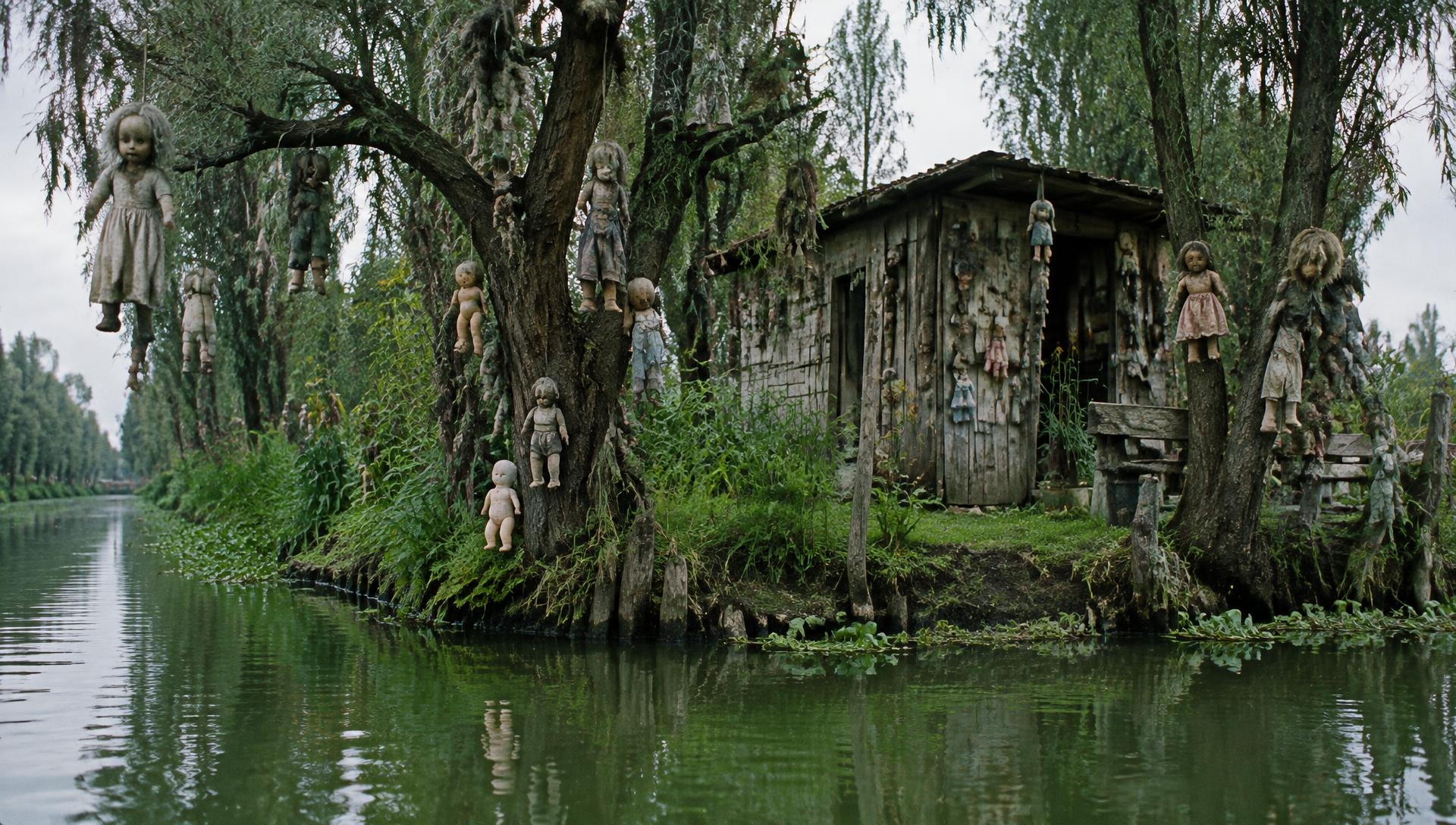
Illustrative reconstruction; not an archival photograph.
Xochimilco is the last surviving fragment of the lake-and-canal system on which the Aztec capital was built — a network of waterways and chinampas, the 'floating gardens' created by piling lake mud between willow stakes until they rooted into artificial islands. It is a UNESCO World Heritage Site, famous for the brightly painted trajinera boats that carry weekend crowds past floating mariachi bands. The Island of the Dolls — La Isla de las Muñecas — lies deeper in the canals, away from the party boats, on a chinampa that for decades was home to a single resident.
Don Julián and the drowned girl
Don Julián Santana Barrera moved to the island around the 1950s, leaving behind a wife and family in town, and lived there alone as a recluse, growing vegetables and flowers to sell in the markets. According to the story he told and retold, a young girl drowned in the canal near his island — some versions say he found her body tangled in the water lilies, others that he saw her floating and could not save her. Shortly afterward, he said, a doll came floating down the canal, and he fished it out and hung it in a tree as an offering to her spirit. No death record or contemporary report confirming the drowning has ever surfaced; members of his own family reportedly doubted the girl ever existed. Researchers treat the story as Santana's own account rather than established fact.
What is documented is what he did next. For the rest of his life — close to fifty years — Santana collected dolls. He pulled them from the canals, scavenged them from rubbish dumps, traded vegetables for them, and accepted them from neighbors who learned of his fixation. He hung them from trees, nailed them to fences and covered the walls of his shack: whole dolls, heads, torsos, limbs. He rarely cleaned or repaired them. He told the few visitors who came that the dolls protected him and the island from the girl's spirit, and that at night he could hear them whisper and move. Whether he believed this literally, or was building something between a shrine, a penance and an obsession, no one can now say.
Fifty years of weather
The island's power comes from time, not design. Decades of sun, rain and canal damp did what no artist would: plastic faces bleached blank, eyes clouded or fell out, hair matted into grey nests, dresses rotted to gauze, and insects and spiders moved into hollow heads. Santana arranged some dolls deliberately — a favorite he called Agustina held pride of place near his shack — but most simply accumulated, thousands of them, until the island itself seemed to be made of dolls. Visitors began arriving by boat in the 1990s, and after Mexican television featured the island, it became a strange fixture of the Xochimilco canals.
The ending that wrote itself
In April 2001, Santana's nephew, Anastasio Velázquez, was visiting the island. According to his account, the two were fishing together when Santana began singing and told his nephew that the mermaids in the canal were calling him — he had reportedly said before that spirits in the water wanted to take him. Velázquez left briefly, and returned to find his uncle floating face down in the canal, dead, in the same stretch of water where Santana said the girl had drowned half a century earlier. He was around 80 years old. The death was reported as a drowning; nothing suspicious was established. The symmetry — the collector dying in the exact water that started the collection — is the reason the story spread far beyond Mexico.
The island today
Santana's family kept the island and opened it to visitors, and it now appears on lists of the world's creepiest destinations — reachable only by trajinera, roughly a two-hour boat ride through the canals. Visitors still bring dolls and hang them, so the collection keeps growing; the island has a small museum room and Santana's shack, still papered with dolls, alongside his original offerings. Local guides tell the story of the drowned girl as fact. The record supports something simpler and stranger: one man, one island, fifty years, and thousands of dolls — and a death in exactly the water he had spent his life watching.
Sources & record
- 01Mexican and international press reporting on Don Julián Santana (1990s–2001)
- 02BBC Travel — feature on the Island of the Dolls
- 03Smithsonian Magazine — coverage of Isla de las Muñecas
- 04Atlas Obscura — Isla de las Muñecas entry
Online citations