Leap Castle: Ireland's Bloodiest Room Has No Equal
One room in one Irish tower house has a body count no other can match. A chieftain was cut down at its altar, prisoners were dropped through its floor onto spikes, and when excavators finally opened the chamber below, they carried out more than 150 skeletons.
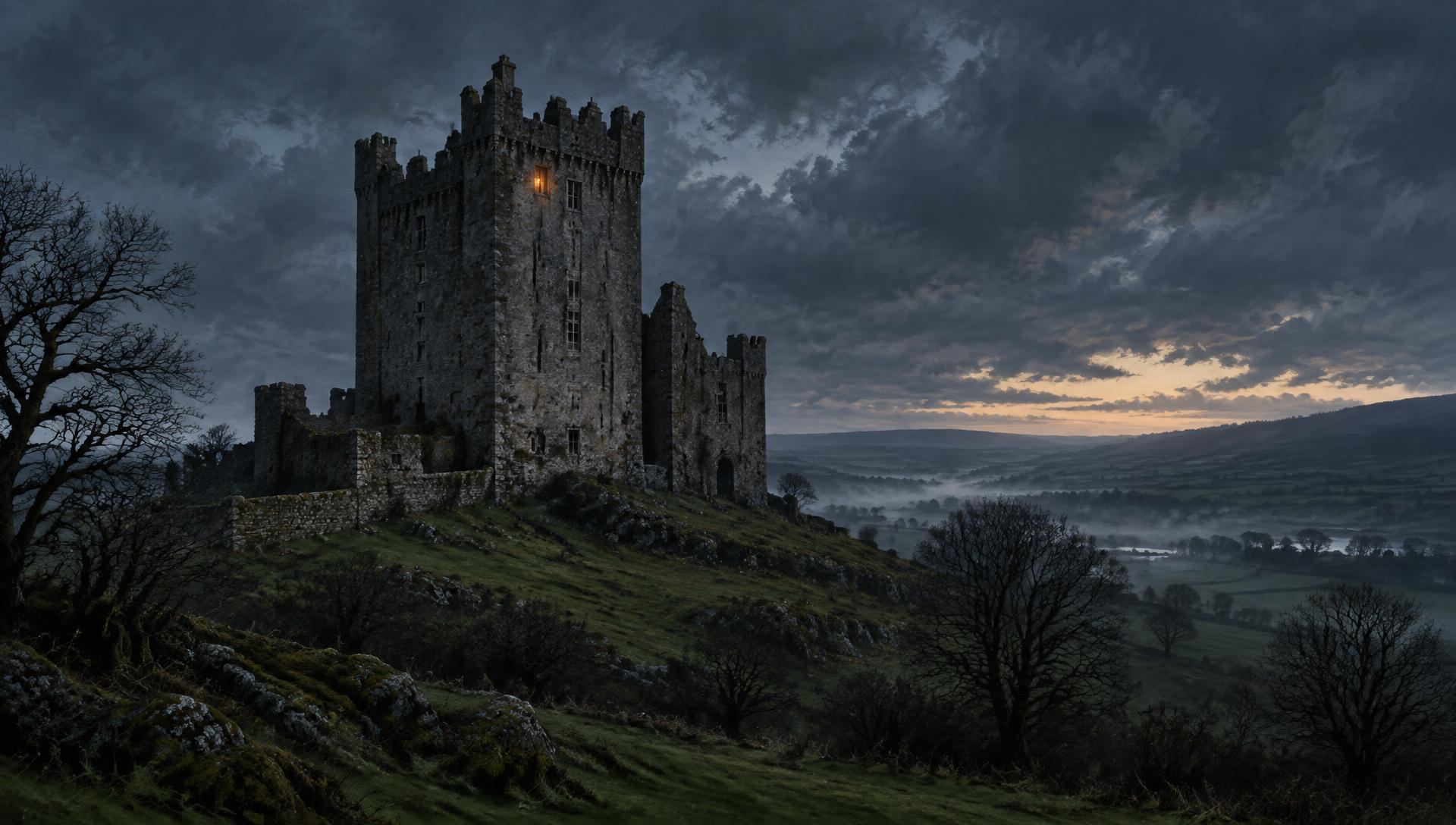
Illustrative reconstruction; not an archival photograph.
Every old country has a house with bad stories attached to it. Leap Castle, a stone tower on a rocky outcrop in County Offaly, has something different: a single room that appears again and again in Ireland's history of violence, with a dungeon built directly beneath its floor. The upper chamber is known as the Bloody Chapel. The chamber below it is an oubliette — from the French oublier, to forget — and when it was finally excavated in the 1920s, the men clearing it reportedly filled more than one cart with human bones.
A fortress guarding the pass into Munster
Leap Castle stands about six kilometres north of the town of Roscrea, on the R421 between Kinnitty and Roscrea. Accounts disagree on exactly when the main keep was built — anywhere from the thirteenth century to the late fifteenth — but most place the earliest stone structure around 1250. It was built by the O'Bannon clan, the secondary chieftains under the ruling O'Carrolls, and its Irish name was Léim Uí Bhanáin, the Leap of the O'Bannons. In one foundation story, two O'Bannon brothers settled a contest for the chieftainship by leaping from the sheer rock the castle stands on; in another, a chieftain leapt to his death from the battlements. Either version gives the place its name.
By the late fifteenth and early sixteenth centuries the castle was the principal seat of the O'Carroll clan, lords of Ely O'Carroll, watching the pass from the Slieve Bloom Mountains into Munster. The Annals of the Four Masters record that Gerald FitzGerald, Earl of Kildare, tried and failed to seize the castle in 1513, attacked again in 1516 and partially demolished sections of it; the O'Carrolls had regained possession by 1557. This was a border fortress in a genuinely lawless frontier, and its recorded use matches that.
The murder in the chapel
The event that named the room is recorded as legend rather than verified history, and it is worth being precise about that. After the death of the chieftain Mulrooney O'Carroll in 1532, a fierce power struggle broke out within the family — brother against brother for the chieftainship. One of the competing brothers was a priest. The tradition says that while he was celebrating Mass in the upper hall of the castle, his own brother, enraged — in the telling, because the priest had dared to begin the service before his arrival — burst in and slaughtered him where he stood, the body falling across the altar.
No contemporary document of the killing survives to confirm the details, and the castle's own archive keeps the story explicitly filed under legend and testimony. What is not in doubt is the room itself: the chapel at the top of the tower, its access to the battlements, and the small, easily missed opening in its north-eastern corner.
The oubliette
That opening was a trap. The chamber beneath the chapel floor is a small stone dungeon, entered through a narrow hole originally fitted with a form of trap door. Prisoners thrown in were dropped dead or dying onto what later accounts describe as a bed of spikes at the bottom, roughly eight feet below the entrance, and left there. The room was forgotten on purpose; that is what its name means.
How it was emptied is the best-documented part of the whole story. During renovations in the early twentieth century, after the Darby family had begun work on the building, workmen discovered the oubliette and cleared it out. Later accounts of the excavation describe more than 150 skeletal remains removed from the chamber — the single hardest piece of physical evidence behind Leap Castle's reputation. Nobody knows how many of the dead were prisoners, how many were the victims of the incidents recorded below, or how many centuries of use the small dark room accounted for.
Mercenaries, and the feast that ended them
The traditions attached to the oubliette describe how it was filled. The O'Carrolls, by these accounts, hired other clans as mercenaries to kill off nearby rivals, invited the hired men back to the castle to celebrate, and killed them at the feast — the meal poisoned, the survivors' throats cut, the bodies dropped into the oubliette. One version holds that thirty-nine men of the O'Neill clan were disposed of in this way.
A second, more specific story is dated to 1599. Charles O'Carroll, described as the last chieftain at Leap, was at war with the Earl of Tyrone and hired warriors of the MacMahon clan from Monaghan. One of the MacMahons, the story goes, killed an O'Carroll page boy; in revenge, the MacMahon men were invited to a feast at the castle and butchered, one by one, as they arrived. Like the 1532 killing, this survives as a traditional account rather than a documented event — but it is exactly the kind of account that fills an oubliette.
The Darbys and the Elemental
In the seventeenth century the castle passed by marriage to the Darby family, an English planter family who held it into the twentieth and added a Jacobean house and later a Georgian wing to the tower. The Darby era produced the story Leap Castle is now best known for. Mildred Darby, a Gothic novelist with an interest in the occult, held séances in the castle, and in 1909 she published her account of what she called the Elemental: a creature about the size of a sheep, with a gaunt, half-human face, black hollows for eyes, and an overwhelming smell of sulphur and decaying flesh. She reported it appearing near the gallery — an experience she described as one of the most terrifying of her life.
Sceptical readers will note, correctly, that a Gothic novelist with an interest in spiritualism is not a disinterested witness. But Mildred Darby was not the last person to report the thing. The Elemental — sometimes just called 'It' — has been described by subsequent owners and visitors in similar terms, always with the smell. Two other presences recur in the same folklore: the Red Lady, a tall woman in a red dress sometimes seen holding a dagger, and two young girls, Emily and Charlotte, whose appearances are tied to a story of eleven-year-old Emily falling to her death from the battlements. The castle's current owners treat all of this as living folklore, not verified fact.
The burning of 1922
The Darbys remained at Leap until 1922, when the castle was burned during the Irish Civil War and left a gutted shell. The interior, with its woodwork and fittings, was largely destroyed; the tower survived. After the fire the building fell into decay for decades, until the Australian historian Peter Bartlett began a restoration in the 1970s. Since 1991 — sources are consistent on this — the folk musician Sean Ryan and his wife Anne have owned the castle, lived in it, and continued the restoration work, opening it to visitors by appointment.
Why the room has no equal
Plenty of places claim a bloody room. Leap's claim is unusually concrete: the chapel where a chieftain was killed at the altar, the oubliette beneath its floor that was built to make people disappear, and the more than 150 skeletons that were physically carried out of that dungeon in the 1920s. Layered on top is a hundred years of haunting reports — the Elemental, the Red Lady, the two girls, the lights said to stream from the chapel windows since the Darby era — which the owners themselves present as folklore rather than fact.
The documented spine is short but solid: a fortress fought over in the Annals, a chapel, a trapdoor, a chamber of bones, a fire, and a family who still live there and let you in. The rest is the story Ireland tells about the place. Leap Castle stands on its rock either way.
Sources & record
- 01Annals of the Four Masters — entries on the Earl of Kildare's attacks on Leap, 1513 and 1516.
- 02Leap Castle Archive (official site) — 'The Bloody Chapel' and oubliette records.
- 03Accounts of the early-20th-century clearance of the oubliette, as summarised in published guides.
- 04Mildred Darby, account of the Elemental (1909), as reproduced in later collections.
Online citations
- →Leap Castle Archive (official site) — The Bloody Chapel
- →Wikipedia — Leap Castle, sourced overview
- →Discover Ireland — Leap Castle (official tourism listing)
- →Discover Ireland — 9 Most Haunted Houses in Ireland
- →Trips.ie — Leap Castle, Ireland's most haunted (guide)
- →The Standing Stone — Leap Castle, Co. Offaly (field survey)
- →Haunted Rooms Ireland — The Haunted Leap Castle