Stonehenge: The Temple That Outlived Its Builders
For five thousand years a ring of standing stone has held its place on Salisbury Plain. No written record explains who raised it, how the stones were moved, or what it was for — and every answer we offer is read from the ground itself.
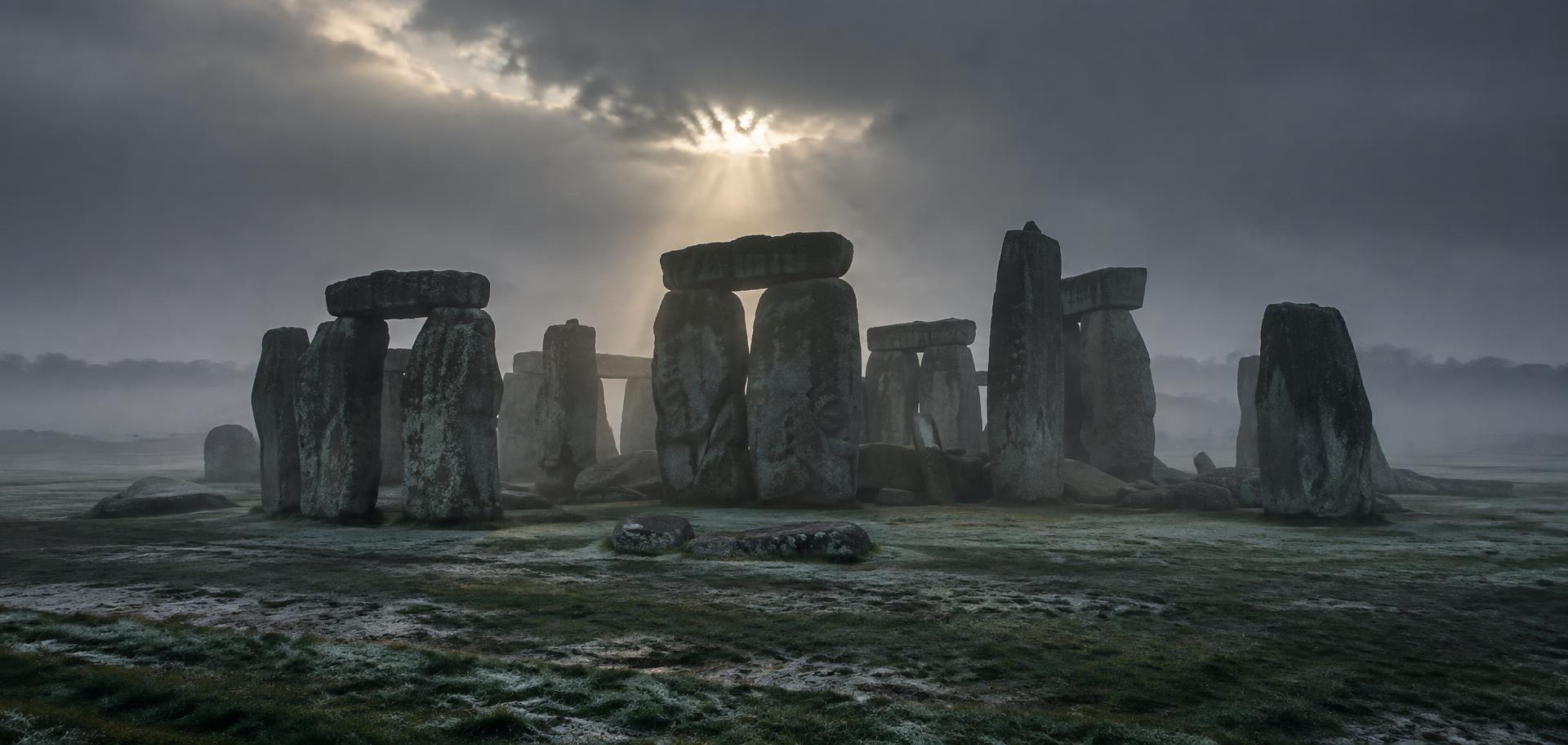
Illustrative reconstruction; not an archival photograph.
What is Stonehenge?
Stonehenge is a Neolithic and Bronze Age monument on Salisbury Plain in Wiltshire, England. Its best-known element is a ring of massive sarsen uprights — the tallest standing stones from the period in Britain — capped by continuous horizontal lintels to form a continuous trilithon circle. Inside that ring stands a horseshoe of five freestanding trilithons, two uprights and one lintel each, arranged in graduated height toward the centre. Smaller bluestones, brought from Wales, were set in various configurations within and between the larger stones across successive rebuildings.
What survives today is roughly half the monument. Centuries of weathering, collapse and deliberate stone-breaking have reduced the circle, but enough stands to show that the architecture is deliberate: the lintels are joined with mortise-and-tenon joints and tongue-and-groove edges, woodworking techniques translated into stone. Nothing else of this complexity survives from Neolithic Britain.
Who built Stonehenge, and when?
Stonehenge was not built in one campaign. Archaeologists divide its construction into phases that span roughly 1,500 years, from about 3000 BCE to 2000 BCE, with the surrounding ritual landscape in use long before and after the stones were raised.
The earliest known phase, Stonehenge Phase 1, was not a stone circle at all. Around 3000 BCE a circular bank and internal ditch were dug, enclosing a roughly 100-metre space. Inside this enclosure, 56 pits known as the Aubrey Holes held the cremated remains of an estimated 150 to 240 individuals — making the monument one of the largest known Neolithic cremation cemeteries in Britain. The dead came first; the stones came after.
Phase 2, beginning around 2500 BCE, is when the large sarsen stones arrived. The sarsens — a hard silcrete sandstone — were dressed and raised into the outer circle and the inner trilithon horseshoe. The bluestones, a group of smaller stones of varied geology, were introduced during the same phase and repositioned in later centuries. The final major arrangement of stones was largely complete by about 2000 BCE, though the surrounding landscape continued to evolve.
Where did the stones come from?
The sarsen stones are the easier problem. Geochemical analysis published in 2020 traced the sarsens to West Woods on the Marlborough Downs, about 30 kilometres north of Stonehenge. Each sarsen upright weighs on the order of 20 to 25 tonnes, with the largest, the Heel Stone, estimated above 30 tonnes. The route from West Woods is mostly downhill, but the scale of the task — moving and raising dozens of stones without wheels or draught animals — remains difficult to reconstruct in detail.
The bluestones are the harder and more famous question. Their geology ties them to the Preseli Hills in Pembrokeshire, west Wales, roughly 240 kilometres from Salisbury Plain by land. Some of the larger bluestones weigh two to four tonnes. Transport by a combination of river, sea and coastal passage around south Wales and up the Bristol Channel, then overland to the Plain, is the explanation most archaeologists now favour, though the mechanics remain debated.
An older hypothesis held that glaciers carried the bluestones to the Plain, sparing Neolithic people the long journey. The present consensus leans toward human transport: the bluestones do not show the glacial scarring or sorting expected of material deposited by ice, and no other Preseli-type stones are scattered across southern England in the way a glacier would leave. The question is not fully closed — glacial movement is difficult to prove or disprove entirely — but recent work, including Mike Parker Pearson's excavations at the Preseli source quarries, supports deliberate quarrying and transport.
In 2024, a study published in Nature re-examined the Altar Stone — a large recumbent bluestone at the centre of the monument — and found that its chemistry does not match the Preseli source. The authors identified the stone's origin in the Orcadian Basin of northeastern Scotland, far older sedimentary rock, implying a source over 700 kilometres from Salisbury Plain. If confirmed, this would extend the known supply network for Stonehenge across most of Britain, though how the stone travelled that distance remains unknown.
How were the stones moved and raised?
No contemporary description of the construction survives — Stonehenge predates writing in Britain by two millennia. Reconstruction is therefore experimental and inferential. Sledges running on greased timber rollers or rails, levered and hauled by rope teams, can move stones of this weight, and experiments have confirmed that a few dozen people can drag a 20-tonne block at walking pace on prepared ground. Raising the uprights into their holes, then lifting the lintels into position with timber cribbing and levers, is consistent with known woodworking and earth-moving techniques of the period.
The difficulty is not the principle but the organisation. Moving the sarsens from West Woods and the bluestones from Wales required sustained labour, prepared routes, and coordination across large groups over years or decades. Whoever directed the work commanded a workforce and a surplus that the conventional picture of Neolithic Britain is still struggling to accommodate.
Was Stonehenge an astronomical observatory?
Stonehenge is aligned to the solstices. On the summer solstice sunrise, viewed from the centre of the circle, the sun rises close to the Heel Stone on the north-east horizon. On the winter solstice sunset, the direction reverses: the sun sets between the uprights of the great trilithon. This solstitial alignment is deliberate — it is too precise to be coincidental — and it is the strongest single clue to the monument's purpose.
Whether it amounts to an 'observatory' is another matter. The monument does not appear to track complex calendrical or stellar events in the way that some later Bronze Age monuments in Europe do; it marks the extremes of the solar year. More recent interpretations, advanced notably by the archaeologist Timothy Darvill, argue that the sarsen circle encodes a solar calendar of 30 stones per month plus intercalary days, but this reading is debated and depends on assumptions about missing and reconstructed stones.
What was Stonehenge for?
No single purpose has been confirmed. The dominant reading among archaeologists is that Stonehenge was a ceremonial and religious centre, a place of the dead. The Aubrey Holes held cremated remains; the surrounding landscape contains hundreds of burial mounds and ceremonial avenues; the Stonehenge Cursus, a long rectangular earthwork to the north, predates the stones. The cremation cemetery and the solstitial alignment together suggest a monument tied to the passage of the year and the passage of the dead.
A second school of thought, most strongly associated with Mike Parker Pearson and the Stonehenge Riverside Project, reads Stonehenge as a domain of the ancestors. Durrington Walls, a large settlement a short distance to the north-east, was occupied seasonally — possibly during the winter solstice feasts — and linked to Stonehenge by the Stonehenge Avenue and the River Avon. In this reading the living gathered at Durrington, and the dead were commemorated at Stonehenge, the two sites forming a single ritual complex oriented along the solstitial axis.
Other proposals have been offered and partly abandoned. A healing-cult interpretation, advanced by Timothy Darvill and Geoffrey Wainwright, argued that the bluestones were believed to have curative properties and that Stonehenge functioned as a pilgrimage shrine. The idea drew on the evidence of injured and diseased individuals buried in the area, but it has not become the consensus. Earlier and more speculative readings — a Druid temple, a Roman ruin, an astronomical computer of great complexity — date from antiquarian writers before the modern phases of excavation and are not supported by the evidence now in hand.
What has been found at Stonehenge?
The monument sits inside one of the densest ceremonial landscapes in Europe. Within a few kilometres are Woodhenge, the Stonehenge Cursus, Durrington Walls, and hundreds of round barrows. Excavation of the Aubrey Holes and the ditch has yielded the cremated remains already described, plus antler picks and animal bone used to date the phases. The Amesbury Archer, a rich early Bronze Age burial of about 2300 BCE, was found near the avenue; he is one of the wealthiest individuals known from the period in Britain, and isotope analysis of his teeth suggests he grew up in the Alpine region of central Europe. Whether he had any direct role in Stonehenge is unknown, but his burial ties the landscape to long-distance movement of people and goods.
Between 2010 and 2014 the Stonehenge Hidden Landscapes Project, led by the University of Birmingham and the Ludwig Boltzmann Institute, used ground-penetrating radar and other remote-sensing tools to survey the ground around the monument without excavation. It revealed a dense complex of previously unknown pits, post-holes, and timber structures surrounding the stones, confirming that the standing circle was the visible centre of a much larger built landscape, not an isolated monument.
Has Stonehenge been restored?
Yes, extensively. Several of the sarsen uprights had fallen or leaned badly by the early twentieth century. Restoration campaigns in 1901, 1920, and the late 1950s straightened, re-erected and re-set many stones. The most visible intervention came in 1958, when a large trilithon that had collapsed in 1797 was re-erected using cranes and concrete. The work was done to stabilise the monument, and although there has been controversy over how faithfully the re-erected stones reproduce the original arrangement, the project is documented and the changes are consistent with the evidence available at the time.
In 1915 the land on which Stonehenge stands was sold at auction and bought by Cecil Chubb, a local barrister, for £6,600. He gave it to the nation in 1918. Management passed to what is now English Heritage, and the monument was inscribed as a UNESCO World Heritage Site in 1986, along with the wider Stonehenge, Avebury and Associated Sites grouping.
Is Stonehenge still being studied?
Stonehenge is one of the most intensively studied archaeological sites in the world, and new results continue to revise the picture. The 2020 sarsen provenance study, the 2024 Altar Stone re-attribution, and the ongoing Stonehenge Hidden Landscapes Project all confirm that the monument and its setting are larger, more connected, and more complicated than earlier generations of archaeologists supposed.
What it does not yet do is answer the oldest questions. We know where the stones came from. We know the monument was built in phases over fifteen centuries. We know it was aligned to the solstices and associated with the dead. We do not know what the builders believed, what words they said there, or what they expected the stones to do for them. Those answers, if they can be recovered at all, lie still in the ground.
Sources & record
- 01English Heritage, 'Stonehenge: History and Legend'
- 02University of Birmingham, Stonehenge Hidden Landscapes Project
- 03Mike Parker Pearson, 'Stonehenge: A New Understanding' (2012)
- 04Timothy Darvill, 'Stonehenge: The Biography of a Landscape' (2006)
- 05Nature (2020): Nash et al., 'A provenance study of the sarsens at Stonehenge'
- 06Nature (2024): Clarke et al., 'The Altar Stone of Stonehenge: A Scottish source'
- 07UNESCO World Heritage Centre, 'Stonehenge, Avebury and Associated Sites'
Online citations