The Wow! Signal: 72 Seconds That Seti Has Never Explained
On the night of August 15, 1977, a radio telescope in a cornfield outside Delaware, Ohio, recorded a signal thirty times louder than the background noise of space. It rose, peaked and faded in exactly the pattern a deep-space source should. It sat beside the most famous frequency in astronomy. And then it was gone — forever.
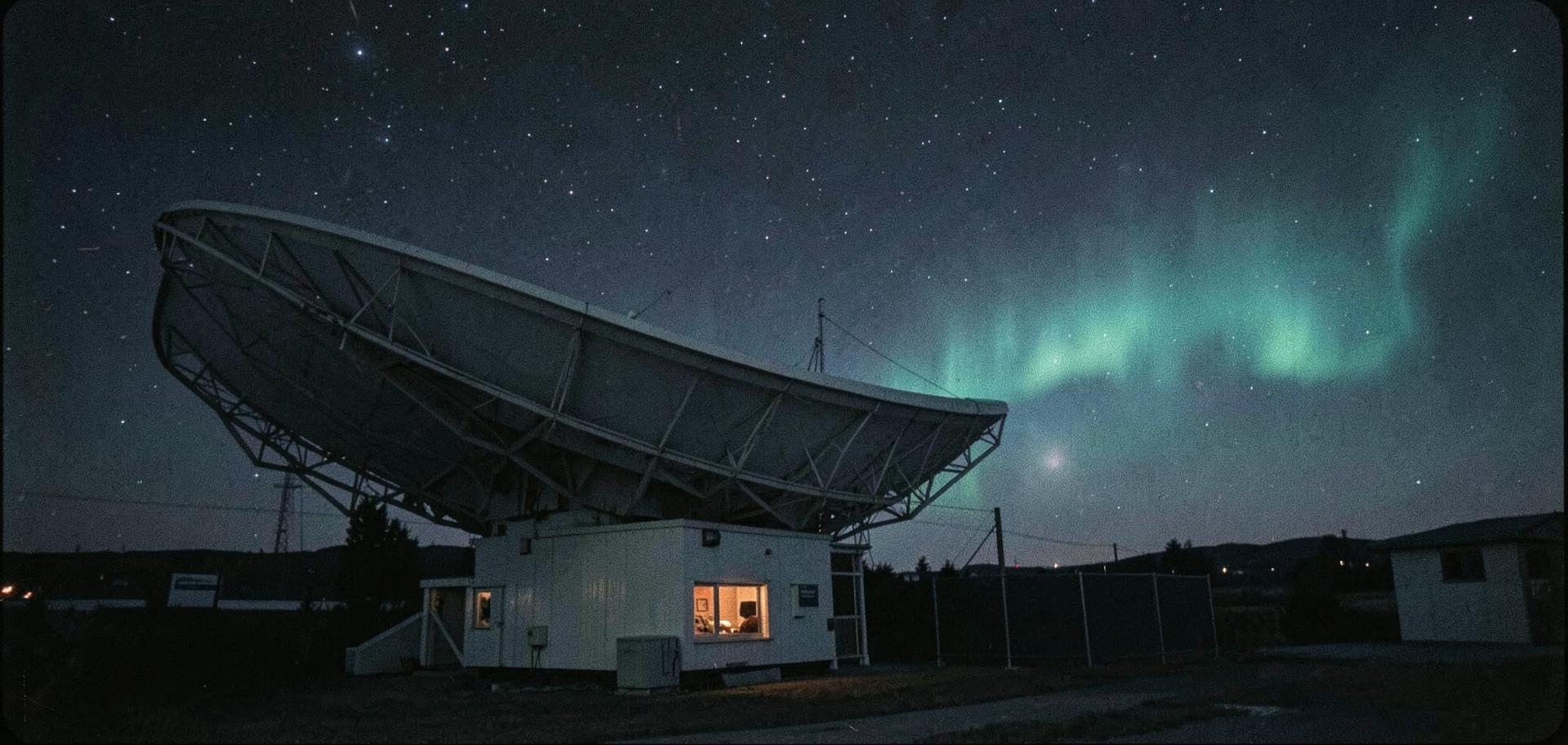
Illustrative reconstruction; not an archival photograph.
For most of the 1970s, one of the most sensitive ears humanity had ever turned toward the cosmos sat in a flat field outside Delaware, Ohio, surrounded by farmland. The Big Ear radio telescope — officially the Ohio State University Radio Observatory — was not a dish you could steer. It was a vast flat reflector, longer than a football field, that stared at whatever patch of sky the Earth's rotation carried past it. From 1973 onward it was dedicated almost entirely to one task: the longest continuous search for extraterrestrial intelligence ever attempted. Night after night, its computer printed rows of numbers on fan-fold paper, logging the intensity of radio noise arriving near the hydrogen line — 1420 MHz, the natural emission frequency of the most common element in the universe, and the channel many researchers considered the logical place for any technological civilisation to make itself heard.
The printouts were, for years, profoundly boring. Background hiss, the occasional satellite, interference from Earth. Volunteers sifted the pages by hand, because no one had funded the software to do it for them. One of those volunteers was Jerry Ehman, an astronomer who had worked on the observatory's sky surveys. A few days after the night of August 15, 1977, Ehman sat down with a fresh stack of paper and began to read. Partway through, he stopped. One column of six characters broke every pattern he had ever seen on the page. He took a red pen, circled the sequence, and wrote a single word in the margin that would name the event for the next half-century: Wow!
What did the Big Ear actually record?
The circled sequence — 6EQUJ5 — was not a message. It was the computer's shorthand for signal strength, sampled in roughly ten-second intervals. On the Big Ear's scale, digits 1 through 9 meant rising intensity; beyond that the system switched to letters, each one a stronger step. A value of 6 was a noticeable blip. A value of E was a roar. And U, at the peak, represented a signal roughly thirty times stronger than the background noise of deep space — the strongest narrow-band signal the observatory recorded in its entire SETI survey.
What electrified Ehman was not just the strength but the shape. The values climbed — 6, E, Q — crested at U, and then fell back through J and 5 in a near-perfect arc. That arc is the fingerprint of a point source fixed on the celestial sphere: as the Earth's rotation sweeps the telescope's beam across a distant object, the signal should rise smoothly, peak at the centre of the beam, and fall away. The Wow! signal lasted 72 seconds — almost exactly the time it took for the beam to cross a stationary point in the sky. Terrestrial interference, satellites and equipment faults do not politely reproduce that curve. Whatever it was, it behaved like something far away and very, very loud.
I circled it in red and wrote 'Wow!' in the margin. It was the most significant signal we had ever seen.
Jerry Ehman, recalling the discovery (paraphrased from his published accounts)
Why did astronomers take it so seriously?
Three properties made the signal extraordinary. The first was its frequency: approximately 1420.4556 MHz. That sits almost on top of the hydrogen line at 1420.4058 MHz, in a protected band where transmitters on Earth are forbidden by international agreement to operate. If you wanted to design an artificial beacons' channel — a frequency every radio-capable species in the galaxy would know to monitor — the hydrogen line is where virtually every SETI pioneer since Giuseppe Cocconi and Philip Morrison proposed putting it in 1959. The signal was narrow-band, meaning its energy was packed into a tiny slice of spectrum, far tighter than any known natural radio source produces. Natural emissions smear across wide bands. Concentrated energy in a narrow channel is, historically, the signature of a transmitter.
The second property was the direction. The signal arrived from the constellation Sagittarius, looking inward toward the crowded star fields near the galactic centre — a region dense with suns, not empty sky. The third was what it did not do: repeat. Big Ear had two feed horns pointed at slightly different patches of sky, so a fixed celestial source should have appeared twice, about three minutes apart. The signal appeared in only one horn, one time. That anomaly has never been resolved. It may mean the source itself switched on and off, or that it flickered, or that something about the instrument that night was subtly wrong. Nobody knows.
Could it have come from Earth?
Every mundane explanation has been examined and found wanting, though none can be ruled out with absolute certainty. Ground-based interference should not have existed in a protected band, and the 72-second rise-and-fall arc argues against a local transmitter. Aircraft and satellites were checked; no known satellite was in the beam at that time, and a passing satellite would trace a different intensity curve as it moved. A signal bouncing off space debris or the Moon would not have produced so clean an arc either. Ehman himself has always been careful: he has said the signal remains unexplained, and that unexplained is not a synonym for alien.
The searches that came back empty
If the Wow! signal was a beacon, the obvious test was to point other telescopes at the same spot and listen. The spot was revisited obsessively. Robert Gray, a Chicago data analyst who became the signal's most dedicated pursuer, used the Harvard META array and later the Very Large Array in New Mexico — instruments vastly more powerful than Big Ear — to sweep the Sagittarius coordinates again and again through the 1980s and 1990s. He found nothing. Gray argued that if the source was an intermittent beacon sweeping its own narrow beam across the galaxy, decades might pass between the moments its beam and our beam happened to overlap. In 2012, on the signal's 35th anniversary, a project called Arecibo Wow! transmitted a response package toward the region, largely as a public commemoration. Breakthrough Listen, the best-funded SETI programme in history, has added the coordinates to its surveys. Silence has held for nearly fifty years.
Since it has not been detected a second time, we cannot prove what it was. It remains the best candidate for an extraterrestrial radio signal ever recorded — and it may always remain just that: a candidate.
Editorial summary of the published scientific position, Interesting Files
Comets, hydrogen clouds and other suspects
In 2017, astronomer Antonio Paris proposed that the signal came not from a beacon but from the hydrogen clouds surrounding two comets — 266P/Christensen and P/2008 Y2 — that were in the same region of sky that night. The idea attracted wide press coverage and immediate criticism from radio astronomers, including Ehman's former colleagues, who noted that comet emissions are broad and diffuse, nowhere near strong enough, and that the comets' computed positions did not actually match the telescope's narrow beam well. The hypothesis is generally regarded as unlikely, though Paris has defended follow-up observations.
A more recent idea came in 2024 from a team led by Abel Méndez at the University of Puerto Rico's Arecibo Observatory. Re-analysing archival survey data, they found several faint signals with Wow!-like characteristics and proposed that such events could be produced by cold interstellar hydrogen clouds that suddenly brighten — a natural 'maser' flare — when a powerful burst of radiation from an object like a magnetar passes through them. If correct, the Wow! signal was a rare, dramatic natural event rather than a transmission. The team stresses the idea is a hypothesis awaiting confirmation; it does not rule out other origins. Separately, a 2020 analysis of Gaia satellite data identified a Sun-like star catalogued as 2MASS 19281982-2640123, roughly 1,800 light-years away, sitting inside the signal's error box — an intriguing target, though one among many stars in that crowded patch.
What happened to the Big Ear?
There is an epilogue that still stings for SETI researchers. The Big Ear never got its second chance. The land beneath the telescope was sold to developers, and in 1998 — twenty-one years after its moment of fame — the great reflector was demolished. A golf course now occupies the site. Jerry Ehman has written that the loss of Big Ear ended the longest-running SETI survey of its era and left the Wow! coordinates without the instrument best suited to catch a repeat. Whatever spoke to Ohio for 72 seconds in the summer of 1977 did so to a telescope that no longer exists.
So what was the Wow! signal?
Nearly half a century later, the honest answer is unchanged: nobody knows. The signal remains the strongest candidate event in SETI history — strong enough, shaped correctly, at the right frequency, from a plausible direction — and simultaneously the weakest kind of evidence there is: a single detection, never repeated, seen by an instrument that cannot be questioned further. Scientists split broadly between a rare natural flare, an instrumental or interference event we have failed to identify, and the possibility Ehman's red pen immortalised. Until something like it is heard twice, the Wow! signal sits in the archive exactly where it has always been: unexplained, unrepeatable, and very hard to forget.
Sources & record
- 01Jerry R. Ehman, 'The Big Ear Wow! Signal: What We Know and Don't Know About It After 20 Years' (1997) — the discoverer's own account.
- 02Ohio State University Radio Observatory ('Big Ear') SETI survey records, 1973–1997.
- 03Robert H. Gray, The Elusive Wow: Searching for Extraterrestrial Intelligence (Palmer Square Press, 2012) — the principal account of the follow-up searches.
- 04Abel Méndez et al., 'Arecibo Wow! I: An Astrophysical Explanation for the Wow! Signal' (2024) — the hydrogen-cloud maser hypothesis.
- 05Alberto Caballero, 'An Approximation to Determine the Source of the WOW! Signal,' International Journal of Astrobiology (2020) — the 2MASS 19281982-2640123 candidate star.
- 06Antonio Paris & Evan Davies, 'Hydrogen Line Observations of Cometary Spectra at 1420 MHz,' Journal of the Washington Academy of Sciences (2017) — the disputed comet hypothesis.
Online citations