What Happened to the Sodder Children?
A house burned to its foundations on Christmas morning 1945 and five children were said to have died inside it. No remains attributable to them were ever recovered.
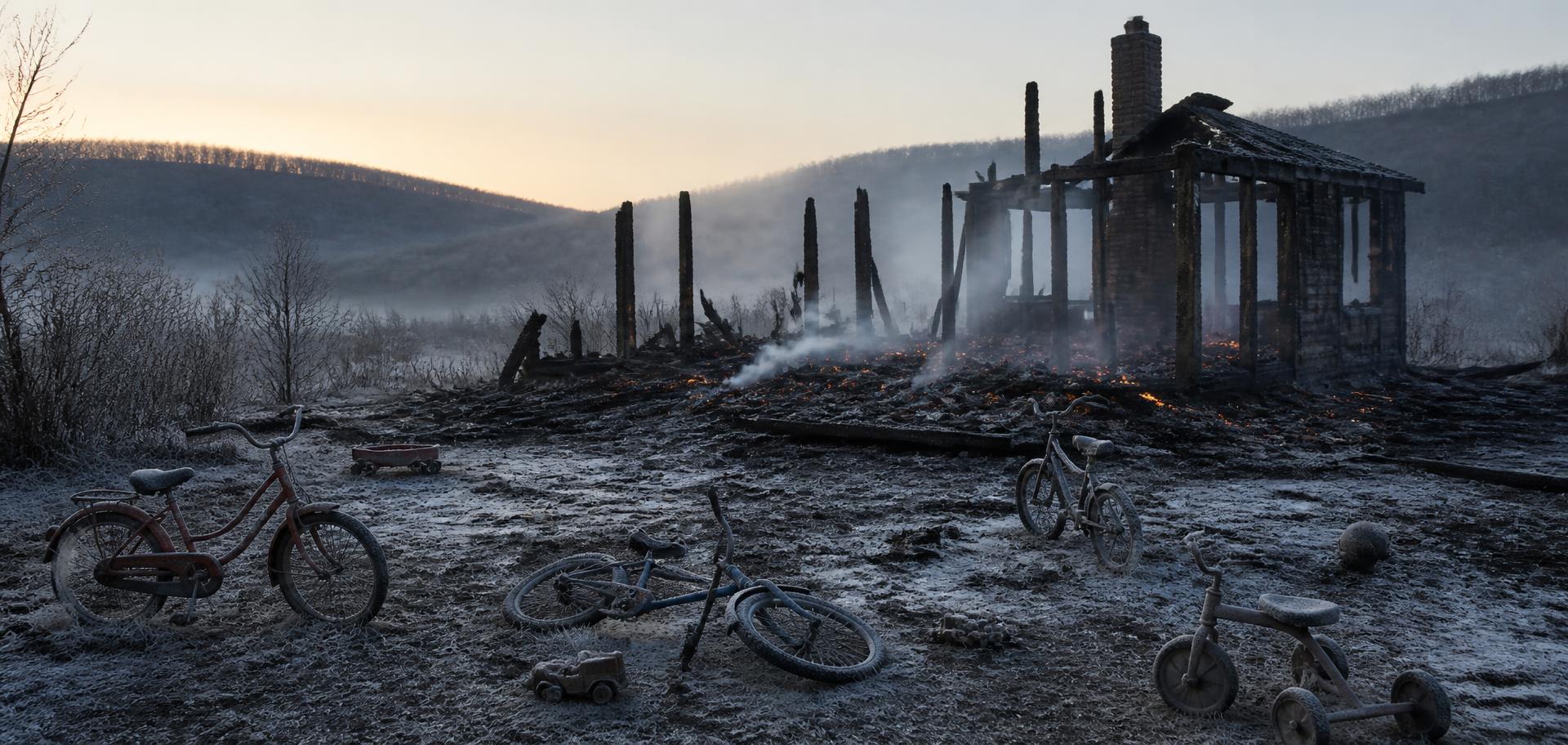
Illustrative reconstruction; not an archival photograph.
Who were the missing Sodder children?
George Sodder had come to West Virginia from Sardinia as a boy and built a trucking business in the coal country around Fayetteville. By Christmas Eve 1945 he and his wife Jennie had ten children, nine of them at home; the eldest, Joe, was still in the army. The younger ones had new toys and were allowed to stay up late. Some time after midnight, by Jennie's account, a telephone call woke her — an unfamiliar woman's voice asking for a name she did not know, laughter in the background, then the line went dead. She noticed on her way back to bed that the downstairs lights were still on and the front door unlocked, and that her daughter Marion had fallen asleep on the sofa. She assumed the older boys had come in last and gone up to bed.
What happened on Christmas Eve 1945?
At around one in the morning she woke again to a sound on the roof, like something heavy landing and rolling. Some time later she woke to smoke; George's office at the front of the house was burning. George and Jennie escaped with Marion and their sons John and George Jr., and with two-year-old Sylvia. Five children — Maurice, fourteen; Martha, twelve; Louis, nine; Jennie, eight; and Betty, five — were upstairs, and no one ever saw them again. The family later said the house was gone in about forty-five minutes; that timing comes from their recollection, not from a fire-service record.
What went wrong that night?
The list of things that failed that hour comes largely from the family's own account, and it is the heart of their case. George went for the ladder he always kept against the side of the house; the ladder was gone, later found down an embankment some seventy feet away. He tried to move one of his two coal trucks under the windows; neither engine would turn over, though both had run the day before. Marion ran to a neighbour's to telephone the fire department and could not get an operator. A passer-by tried from a tavern and also failed. The Fayetteville department, then a volunteer service relying on a telephone call tree, did not arrive until around eight in the morning. The often-quoted seven-hour delay assumes an alarm was received around one o'clock; when the department was actually notified has never been documented.
Investigators attributed the blaze to faulty wiring and death certificates were issued for the five children. The family disputed that finding, noting the house had recently been rewired and that an electrician had passed the work. No detailed fire-investigation report supporting the wiring conclusion has been published. George bulldozed earth over the site, intending it as a memorial — a decision he spent the rest of his life regretting, because it ended any chance of a careful search of the debris.
Why were no bodies identified?
The Sodders' doubt began with the simplest fact available to them: a wood-frame house that burned rapidly had produced no identifiable human remains in the debris searched at the time. Household appliances survived the fire recognisably. Neighbours said they had seen bones recovered from hotter and longer fires. Years later the family consulted a crematorium operator, who told them that even at temperatures above what a house fire reaches, and over hours rather than minutes, bone fragments remain. Fire investigators have since noted that an unsearched, bulldozed basement is a poor test of that claim.
If the fire took them, it took them without leaving a single tooth.
Editorial summary of the family's standing objection, repeated for four decades — Interesting Files
What did the Smithsonian find?
A 1949 excavation of the site, arranged by the family and overseen by a Washington pathologist, turned up several small bone fragments. They were sent to the Smithsonian Institution, which reported that they were human lumbar vertebrae from a person most likely between sixteen and twenty-two years old — older than any of the missing children — and that they showed no evidence of exposure to fire. The report suggested the likeliest explanation was that the fragments had arrived with the fill dirt George used to cover the basement, an inference about the dirt's origin rather than a demonstrated fact.
Were the Sodder children seen after the fire?
In the months after the fire, reports reached the Sodders that seemed to place the children alive. A woman at a rest stop between Fayetteville and Charleston said she had served breakfast to children matching their descriptions the morning after the fire, arriving in a car with Florida plates. A hotel worker in Charleston said four of them had stayed the night, accompanied by adults who spoke Italian and who blocked her from talking to them. None of these accounts was ever confirmed, and none was tied to a named child.
What was written on the Louis Sodder photograph?
The family put up a billboard on Route 16 showing the five faces and offering a reward; it stood for decades and made the case a permanent local landmark. In 1968, more than twenty years after the fire, Jennie opened an envelope with a Kentucky postmark and no return address. Inside was a photograph of a young man in his twenties. On the back was written: 'Louis Sodder. I love brother Frankie. Ilil boys. A90132 or 35.' The family considered the resemblance to Louis strong, had the picture enlarged and added it to the billboard; no identification was ever established. A private investigator hired to follow the Kentucky lead took their money and, the family said, was never heard from again.
Did the children die in the fire?
The elements usually offered as motive come from the family's own recollections, recorded years after the fire, and have no independent documentary confirmation. George Sodder was outspoken, and in a community with a substantial Italian population he was said to have been openly critical of Mussolini. The family recalled that a life-insurance salesman he had turned away warned him his house would go up in smoke and his children would be destroyed for the remarks he had made; that a stranger looking for hauling work pointed at fuse boxes at the back of the house and said they would cause a fire one day, despite the house having been recently rewired; and that a bus driver reported seeing someone throwing balls of fire at the roof that night, which the family connected to the thud Jennie heard. Each of these is a reported recollection rather than an established fact.
A claim later relayed to one of the Sodder daughters held that the children had been taken by people connected to organised crime after an extortion attempt on their father failed. It was never substantiated and should be treated as hearsay. What is documented is narrower: the ladder was not in its place, the two trucks did not start, the call to the fire department did not connect, the department arrived hours later, and the excavated basement produced no remains attributable to the five children.
Is the case still open?
George Sodder died in 1969. Jennie wore black for the rest of her life and kept the billboard standing until her death in 1989, after which the family took it down. Sylvia, the youngest child in the house that night and two years old at the time of the fire, escaped with her parents and was the last surviving witness; she maintained until her death in 2021 that her brothers and sisters did not die in that house. No publicly documented official reinvestigation has resolved the case. The official record still says five children died in an accidental fire on Christmas morning; the physical evidence offered for that has always been the ash where a house used to be.
Sources & record
- 01West Virginia State Police and Fayette County fire investigation records, 1945–1946.
- 02Smithsonian Institution report on skeletal fragments recovered at the Sodder site, 1949.
- 03Contemporary reporting, Charleston Gazette and Fayette Tribune, 1945–1968.
- 04West Virginia Division of Culture and History, Goldenseal magazine feature on the Sodder case.
- 05Family papers and interviews with Sylvia Sodder Paxton, collected 1990s–2010s.
Online citations