The Villisca Axe Murders: Evidence, Suspects and Unanswered Questions
In one night, eight people were murdered inside a family home in Villisca, Iowa. The murder weapon was found downstairs, but the killer was never identified.
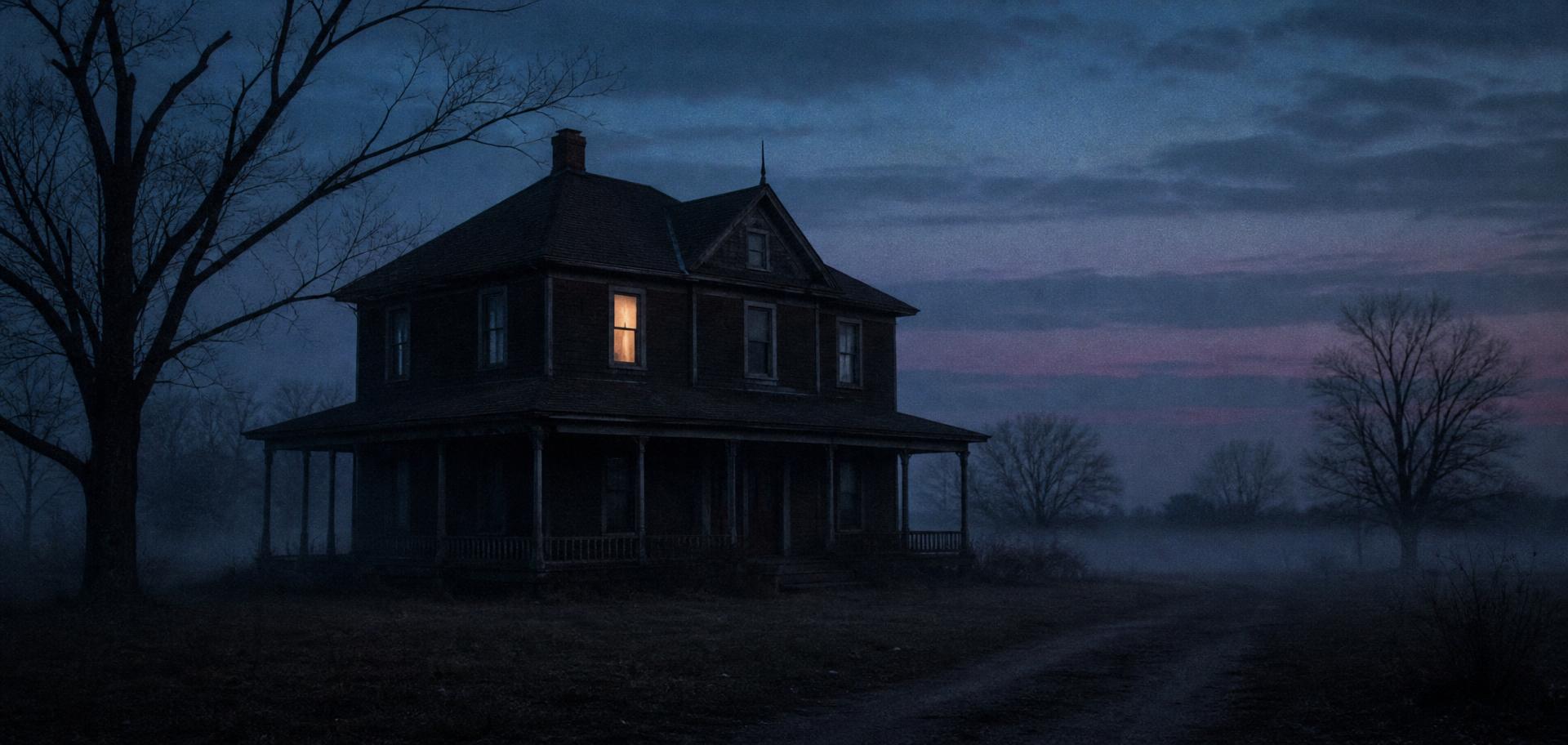
Illustrative reconstruction; not an archival photograph.
The Moore house on Second Street in Villisca, Iowa, was the kind of home a small town builds its memory around — a two-story frame house with a porch, a parlor, and a door that, on most nights, was simply locked. Josiah Moore was a well-liked implement dealer; his wife Sarah kept the house. On the evening of June 9, 1912, they returned from a Children's Day program at the Presbyterian church with their four children and two visiting friends, Lena and Ina Stillinger. They put out the lamps and went to bed. No one in the house woke again.
What happened in the Villisca axe murders?
It was a neighbor, Mary Peckham, who noticed the silence first. The next morning the house was still; the blinds were drawn; no one came to the door. She let the Moore chickens out, then called Josiah's brother Ross, who unlocked the house while Peckham waited outside. What he found inside is what the town would spend the next century trying to understand.
Villisca in 1912
To understand what happened in the Moore house, it helps to understand Villisca in 1912. It was a town of roughly twenty-five hundred people on the Chicago, Burlington & Quincy line, prosperous enough to support two newspapers, several churches, and a business district that dealt in farm implements and grain. Josiah Moore had worked for years for a local implement dealer named Frank Fernando Jones — a state senator, a banker, and by most accounts the single most powerful man in Montgomery County — before leaving to open a competing dealership of his own and taking the lucrative John Deere franchise with him. That departure was remembered locally as a hard one. It would matter later, though never in a courtroom.
The Children's Day program at the Presbyterian church ended sometime between nine-thirty and ten o'clock. Sarah Moore had helped organize it. Walking home, the family collected Lena Stillinger, twelve, and her sister Ina, eight, who had asked to stay the night rather than walk out to their own farm. The house had eight people in it when the lamps went out: two adults, four Moore children, and two guests. One later theory proposed that the killer waited inside the house, possibly in the attic. Reports of cigarette butts found on the attic floor have been repeated frequently, although the detail is disputed by later researchers and by the present custodians of the house.
Who were the eight victims?
The medical examination placed the deaths between midnight and five in the morning. All eight had been struck in their beds with the blunt reverse of an axe taken from the Moores' own woodpile. Josiah was struck more times than anyone else, and with the blade rather than the poll — a detail that has fed a century of speculation about whether he, specifically, was the point of the exercise. The killer then went through the house doing things that no ordinary burglar or drifter does.

What evidence was found inside the house?
Every mirror in the house was covered with cloth. So were the faces of the dead — with bedsheets, and in one case with a skirt. The two windows that could be seen from the street were covered with the Moores' own clothing. A four-pound slab of uncooked bacon lay on the parlor floor beside the axe, next to a keychain that belonged to no one in the household. A bowl of bloody water sat on the kitchen table, and a plate of uneaten food beside it. By the account kept by the historic house, the killer appears to have left through a door and locked it behind him with the Moores' own key. The unusual arrangement of the scene has inspired theories of ritualistic behaviour, but its purpose remains unknown.
The thing I could not explain was not the violence itself, but how completely the house had gone quiet — as though the night had simply closed the door behind it.
Editorial summary based on witness accounts in the 1912 investigation.
The scene did not survive the morning. Word travelled through Villisca faster than any authority could reach the house, and by mid-morning the Moore home had been walked through by neighbours, curiosity-seekers, and — by one contemporary estimate — well over a hundred people. Children were lifted to the windows. Souvenirs were taken. The National Guard was eventually called to cordon the property, but by then the only crime scene that would ever exist had been trampled into uselessness. Fingerprinting was in its infancy in Iowa and was never meaningfully applied. Whatever the house had to say, it had said it to strangers.
The investigation that followed was less a single inquiry than a series of competing ones. Private detectives arrived within days — including the Burns Agency, whose operatives worked the case for years — often hired by parties with their own interests in the outcome. The county sheriff, the state, and the private agencies did not share what they found. Rumour did the rest. Within a month the town had turned inward on itself, and local accounts describe a generation that locked its doors at sundown.
Who were the leading suspects?
Four names carried the weight of suspicion. The first was Frank F. Jones. Detective James Wilkerson, working for the Burns Agency, pursued the theory that Jones had paid a man named William "Blackie" Mansfield to kill Josiah Moore — a theory driven partly by the business rivalry and partly by a persistent local rumour of an affair between Moore and Jones's daughter-in-law. Wilkerson's campaign was public, aggressive, and never supported by evidence a grand jury would accept. Jones was never charged. He sued for slander instead, and the case against him collapsed into a feud that split the town for decades.
Mansfield himself was the second name. Wilkerson — and, much later, other researchers — argued that a cluster of similar axe killings across the Midwest belonged to the same hand: Colorado Springs in September 1911, Ellsworth, Kansas in October, Paola, Kansas in June 1912, Monmouth, Illinois days before Villisca. The parallels drawn between these cases are a proposed serial-offender theory rather than an established investigative link, and each case has its own contested record. A grand jury heard the case against Mansfield in 1916 and released him; payroll records placed him in Illinois on the night of the murders. He, too, sued Wilkerson, and won.
Did George Kelly confess?
The third was Reverend George Kelly, an English-born travelling minister who had been in Villisca that weekend and left on the early morning train. Kelly was an unstable man with a documented history of voyeurism and erratic behaviour, and he had attended the Children's Day program. Over the following years he wrote letters to investigators, to the victims' families, and to himself in the voice of the killer. In 1917 he confessed — then recanted, saying the confession had been extracted after long interrogation. His first trial hung. His second acquitted him. Whether the confession described a memory or a fantasy has never been settled.
The case did not fail for lack of a suspect. It failed for having too many, and not one of them quite enough.
Editorial summary of the investigative record, Interesting Files.
Were the murders connected to other axe killings?
The fourth possibility has no name at all. Beginning in the 1990s, researchers revisiting the Midwest killings of 1911–1912 argued for a single travelling offender moving along the rail lines — a figure who has been called, for want of anything better, the Man from the Train. The pattern is consistent enough to be uncomfortable: houses within easy walking distance of a railway, families struck at night, an axe from the victims' own property used with the blunt end, mirrors and faces covered, lamps left with their chimneys removed, and no theft. Villisca fits the pattern almost exactly. It is also, by its nature, a theory that can implicate everyone and convict no one.
Against these theories sit the small facts that never resolved. The keychain on the parlor floor was never traced. The bacon was never explained; one reading is that it was taken from the icebox to soothe a hand injured on the axe, another that it belonged to the same order of gestures as the covered mirrors. The uneaten plate of food suggests the killer stayed in the house after the killings — possibly for hours. Dr. F. S. Williams, one of the first physicians on scene, noted the beds were still warm. Whoever it was left through the back door and walked into a town of two and a half thousand people without being seen.
Was the case ever solved?
Nobody was ever convicted. The Moore and Stillinger children are buried in Villisca Cemetery, and the town has spent more than a century living beside a house it cannot quite finish talking about.
Is the Villisca Axe Murder House still open?
In the decades since, the Moore house has passed through private hands and become, for better or worse, a place people travel to stand in. Restored in the 1990s to its 1912 condition — no electricity, no plumbing, the rooms arranged as they were on the morning of June 10 — it is now on the National Register of Historic Places and open for daytime tours and overnight stays. Visitors report the sounds and impressions that an old, grief-soaked house tends to gather around itself. None of it has solved the case. The axe was never matched to a hand that mattered, and Villisca has kept the file open in the only way a place can: by remembering.
Sources & record
- 01Villisca Historical Society, case records and town archives.
- 02Roy Marshall, The Villisca Axe Murders (Drukenstein Press, 1977).
- 03Regional press reports, The Villisca Review and Montgomery County press, June–July 1912.
- 04State of Iowa v. George Kelly, court transcripts, 1917 (first and second trials).
- 05Montgomery County grand jury proceedings concerning William Mansfield, 1916.
- 06Bill James & Rachel McCarthy James, The Man from the Train (Scribner, 2017).
- 07Villisca Axe Murder House, National Register of Historic Places nomination file.
- 08Edgar V. Epperly, Fiend Incarnate: Villisca Axe Murders of 1912 (2016).
Online citations