The Voynich Manuscript: No One Can Read This 600-Year-Old Book
Its pages show impossible plants, circular star maps and lines of fluent-looking writing in an alphabet found nowhere else. The parchment is medieval. The book is real. After more than a century of modern study, however, no one has produced a translation that other specialists can reliably reproduce.
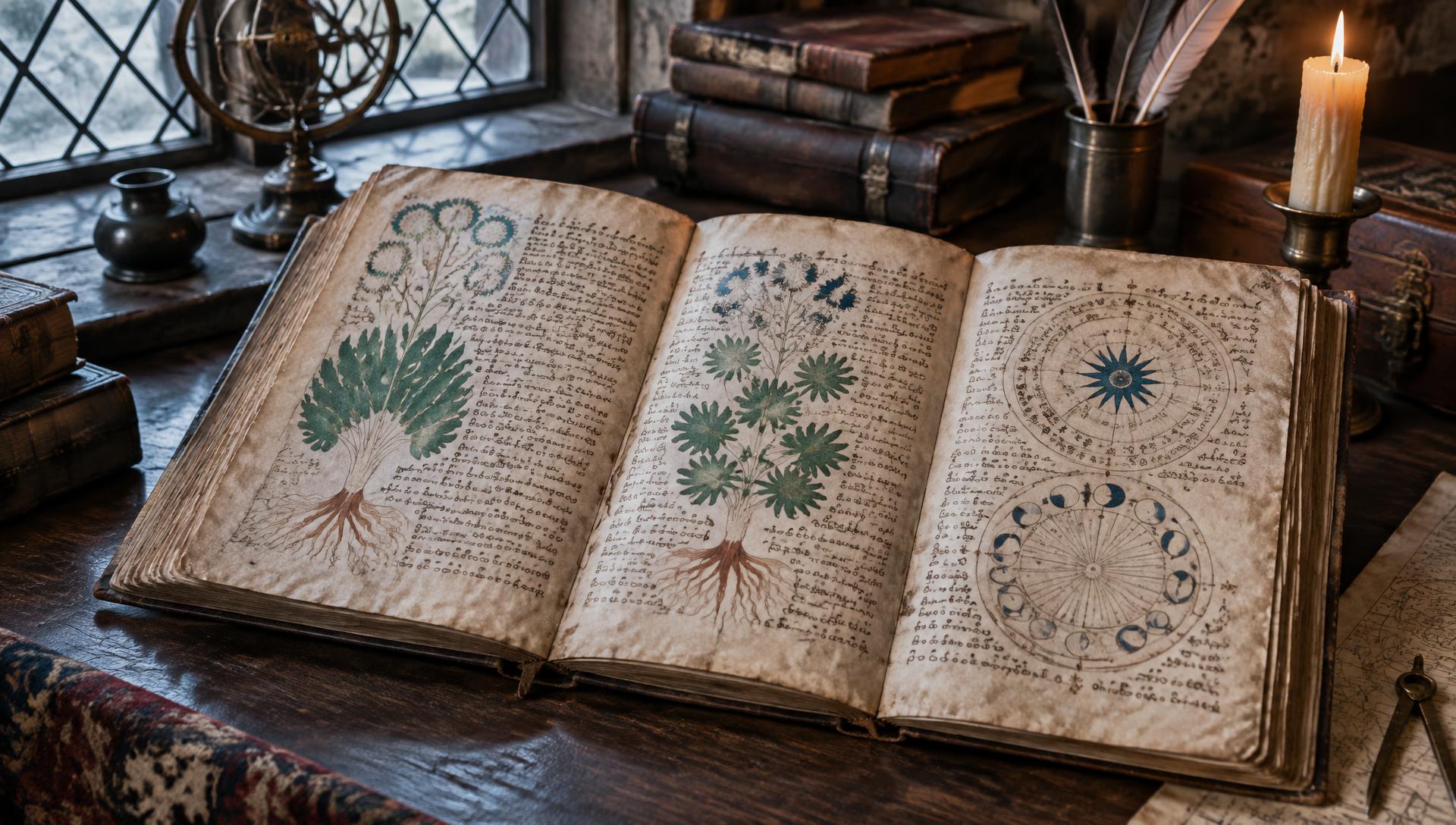
Illustrative reconstruction; not an archival photograph.
Inside Yale University's Beinecke Rare Book and Manuscript Library sits a small vellum codex catalogued as MS 408. Its surviving leaves carry tens of thousands of word-like groups written from left to right in a smooth, unfamiliar hand. Nearly every opening adds another puzzle: plants that resist secure identification, zodiac wheels, stars linked by tubes, circular maps, small human figures bathing in green pools and pages of short entries marked by flower-like stars. The writing looks deliberate. Its meaning remains unknown.
A medieval object, not a modern fake
The strongest firm conclusion concerns the object itself. Radiocarbon tests on samples from four parchment leaves dated the animal skins to between 1404 and 1438 with high probability. Analysis of the inks and pigments found materials compatible with historical manuscript production rather than an obvious modern forgery. This does not date every pen stroke to an exact year, because old parchment could theoretically be used later, but the uniform construction and writing make a modern fabrication increasingly difficult to sustain. Whatever the text says, the physical book belongs to the late medieval world.
The codex is smaller than a modern sheet of office paper, roughly 23 by 16 centimetres. Yale records 102 surviving folios, several of them large foldouts, while modern descriptions commonly count about 234 written pages. Gaps in the old foliation and missing leaves show that the volume was once longer. A later binding altered the original structure, and some foldouts contain diagrams far wider than an ordinary page.
Six illustrated worlds inside one book
The illustrations divide the manuscript into recognizable visual sections even though their labels cannot be read. The largest is botanical: a plant fills most of each page beside one or more paragraphs. Some roots, leaves or flowers resemble familiar species, but many appear composite or stylized, and proposed identifications rarely agree. Calling the book a herbal is therefore a useful description of its format, not a translation of its contents.
Other leaves contain astronomical or astrological circles, including zodiac signs surrounded by rings of human figures. A biological or balneological section shows small nude figures standing in pools and connected vessels. Elaborate cosmological foldouts present nested circles and a famous nine-medallion diagram whose geography is uncertain. A pharmaceutical section pairs containers with plant parts, while the final pages contain short, mostly unillustrated paragraphs, each introduced by a star-shaped marker. They are often called recipes, but that name describes their layout rather than proven subject matter.
The writing behaves like a system
The script contains a limited set of recurring signs. Some are simple curves; others are tall characters nicknamed gallows. Spaces divide the lines into word-like units, and repeated combinations occur in patterned positions. Researchers have identified differences between major parts of the manuscript, traditionally called Currier A and Currier B after the scholar who described them. Paleographic work also indicates that several scribes — probably five — collaborated on the text and illustrations.
Statistical structure is not the same as readable language. Voynich words repeat and vary in ways that share some properties with natural-language texts, yet the manuscript also has unusually predictable character sequences and strong positional rules. The patterns could represent an unknown language, a cipher, an invented notation, heavily abbreviated technical writing or a structured method of generating meaningless text. Current linguistic research finds reasons to take a language-like explanation seriously, but it has not identified the underlying language or supplied a translation.
From an emperor's library to a locked Jesuit collection
The manuscript's early path is reconstructed from ownership marks and surviving letters. A 1666 letter sent with the book by the Prague physician Johannes Marcus Marci to the Jesuit scholar Athanasius Kircher reported that Emperor Rudolf II had once bought it for 600 ducats and believed it to be the work of the 13th-century friar Roger Bacon. The Bacon attribution was hearsay and is incompatible with the later parchment date. Rudolf's connection is plausible and accepted in the manuscript's institutional history, but the purchase itself survives through Marci's report rather than a known imperial receipt.
A faded signature links the book to Jacobus Horčický de Tepenec, an imperial pharmacist associated with Rudolf's court. By the 1630s it belonged to the Prague alchemist Georg Baresch, who asked Kircher to solve it. Baresch left it to Marci, and Marci sent it to Kircher in Rome. It later entered the Jesuit collection at the Collegio Romano and was moved to the Villa Mondragone near Frascati.
In 1912, the Polish-born bookseller Wilfrid M. Voynich acquired the codex during a secret sale of manuscripts by the Jesuits. His publicity made the book famous and supplied its modern name. After Voynich died, it passed through his widow Ethel, her associate Anne Nill and dealer Hans P. Kraus. Kraus could not sell it and donated it to Yale in 1969, where high-resolution scans now allow anyone to inspect the pages.
The codebreakers who could not break it
Voynich believed the author might have been Roger Bacon, and in 1921 the philosopher William Romaine Newbold announced a solution built from supposed microscopic marks inside the letters. His reading described telescopes and galaxies centuries before their invention. After Newbold's death, cryptologist John Manly showed that the tiny marks were ordinary cracks and ink irregularities and that the method could produce almost any desired result. The spectacular solution collapsed.
Professional cryptanalysts did no better. William F. Friedman, one of the most important American codebreakers of the 20th century, organized a study group around the manuscript. He came to suspect an artificial or constructed language rather than a conventional substitution cipher, but he never decoded it. Later computer analysis made transcription and pattern counting far more powerful without providing the missing bridge between signs and meaning.
Why every dramatic solution fails the same test
Claims of solution appear regularly. Proposed languages have included Latin, Hebrew, Nahuatl, Turkish and a supposed proto-Romance tongue. Other theories treat the signs as shorthand, an anagram system, a polyalphabetic cipher or phonetic notation. Artificial intelligence has been enlisted as well. A method can usually force selected words into a preferred reading; the harder test is whether it defines its signs and rules in advance, translates long passages consistently, explains exceptions without improvisation and allows independent researchers to reproduce the result. No public claim has yet passed that test and won specialist consensus.
The illustrations cannot serve as a free answer key. A researcher who decides that a drawing is a particular plant can search for a language whose plant name resembles a nearby token, but a different identification generates a different result. Zodiac signs and familiar-looking containers provide context, not certain vocabulary. Because neither the script, language nor subject labels are independently known, assumptions can reinforce one another until a speculative reading looks deceptively complete.
Could it be an elaborate hoax?
A medieval hoax or pseudo-text remains possible. Rudolf's reported price offered an obvious motive, and mechanical systems can generate strings that resemble Voynich words. Yet a hoax must account for a large, carefully organized book made from expensive parchment, written by several practiced hands, with recurring textual differences linked to sections and scribes. Modern statistical studies have also found that simple random or grille-based generators do not easily reproduce all of its patterns. None of this proves meaningful language; it shows why ‘gibberish’ is a hypothesis requiring evidence, not a default answer.
What can responsibly be said
The Voynich Manuscript is not unreadable because it is visibly chaotic. It is unreadable because it is orderly in a way that has not been connected to any known system. Its medieval materials are genuine. Its production involved sustained planning and probably several people. Its visual subjects resemble areas of late medieval knowledge — herbs, bodies, stars, medicine and cosmology — without revealing what the sentences claim about them.
A future solution would need more than a persuasive handful of labels. It would need to explain the complete manuscript, its different textual varieties and its relation to the pictures while surviving independent testing. Until then, the honest ending is the least sensational one: six centuries after its parchment was prepared, and more than a century after modern cryptographers began attacking it, the book has not been read.
Sources & record
- 01Beinecke Rare Book and Manuscript Library, catalogue and digital collection for MS 408.
- 02Raymond Clemens, ed., The Voynich Manuscript, Yale University Press, 2016.
- 03Claire L. Bowern and Luke Lindemann, 'The Linguistics of the Voynich Manuscript,' Annual Review of Linguistics 7 (2021), 285–308.
- 04Greg Hodgins and colleagues, University of Arizona radiocarbon analysis of the manuscript parchment, reported by Yale and the Beinecke Library.
- 05Johannes Marcus Marci's 1666 letter to Athanasius Kircher, preserved with Beinecke MS 408.
Online citations
- →Yale Beinecke Library — Voynich Manuscript overview, sections and provenance
- →Yale Beinecke Library — detailed catalogue record for MS 408
- →Yale Digital Collections — complete high-resolution manuscript
- →Yale News — what current linguistics can establish (2025)
- →Annual Review of Linguistics — Bowern and Lindemann review (2021 PDF)
- →Yale News — manuscript history and facsimile edition
- →University of Arizona — radiocarbon dating the Voynich Manuscript
- →PLOS ONE — statistical analysis of symbol roles (2022)