Madame Blavatsky: Medium, Author of The Secret Doctrine, and the Woman Behind Modern Occultism
She claimed that invisible Masters dictated her teachings and produced letters out of thin air. Scholars call her a fraud, followers call her a messenger — and the movement she founded still shapes modern spirituality.
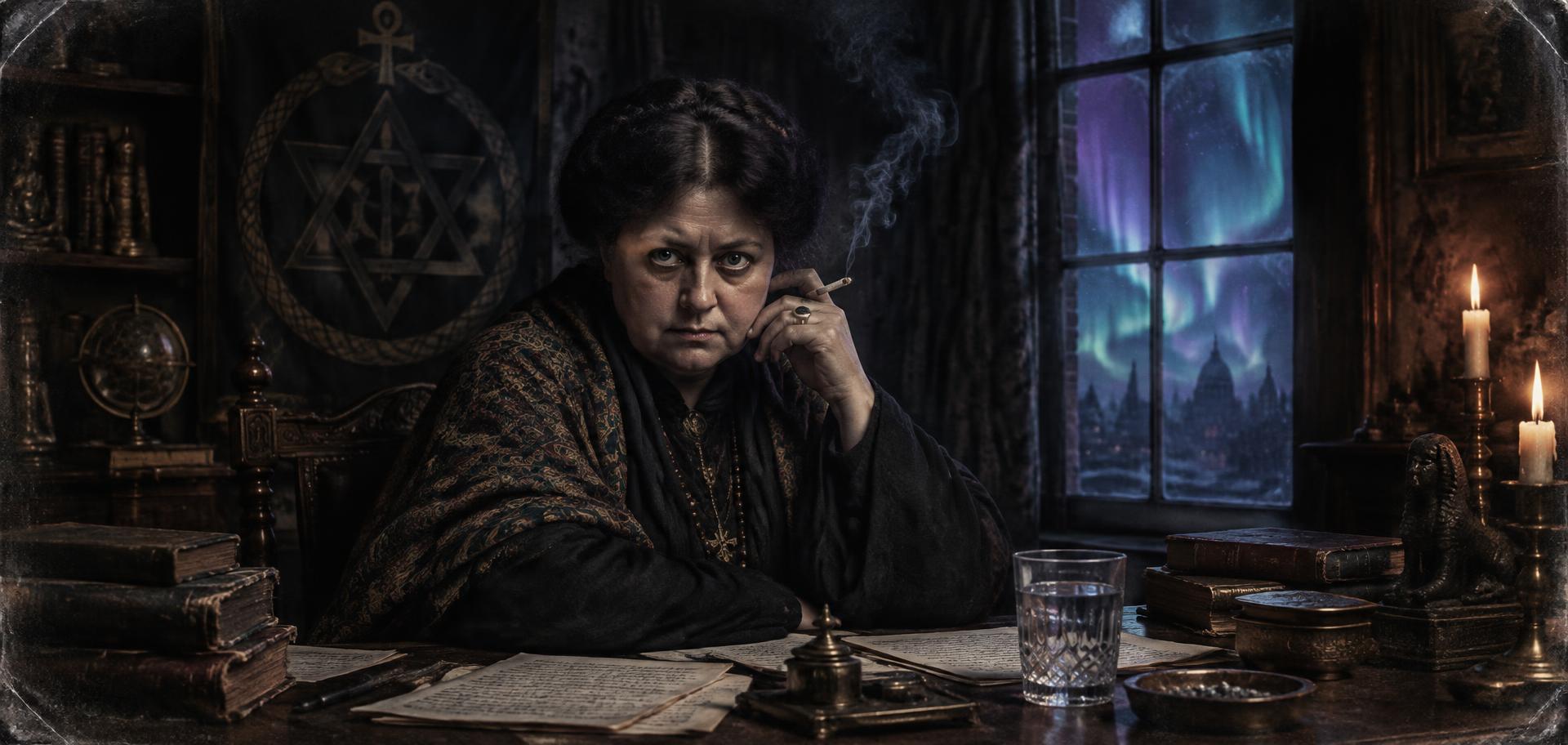
Illustrative reconstruction; not an archival photograph.
Helena Petrovna Blavatsky was born in 1831 into the Russian aristocracy — her father was an army officer, her mother a well-known novelist — and she spent the rest of her life refusing to live like either. At seventeen she briefly married a middle-aged provincial governor, Nikifor Blavatsky, fled the marriage within weeks, and left the Caucasus. What happened over the next twenty-five years is the first gap in the file: Blavatsky claimed to have spent those years travelling the world — Egypt, the Americas, Tibet — studying under hidden spiritual Masters she called the Mahatmas. No independent evidence places her in Tibet, and her own timelines shift between tellings. What is certain is that she surfaced in New York in 1873 with almost no money, and within two years had helped build one of the most influential occult organisations in history.
Who was Madame Blavatsky?
In New York she became a fixture of the spiritualist scene, performing séances and claiming to channel the spirits of the dead. At a farmhouse in Vermont in 1874 she met Colonel Henry Steel Olcott, a journalist and lawyer investigating spiritualist phenomena. He became her closest collaborator. Together with the lawyer William Quan Judge, they founded the Theosophical Society in New York in 1875, dedicated to the study of comparative religion, philosophy and 'the unexplained laws of nature and the powers latent in man.'
Blavatsky told Olcott and her circle that she no longer worked with ordinary spirits but was in contact with the Mahatmas — living, highly evolved Masters of ancient wisdom, chiefly two she named Koot Hoomi and Morya, said to reside beyond the Himalayas. These Masters, she said, directed the Society and dictated much of her writing. No one else could verify their existence; everything known about them came through her.
Isis Unveiled and the move to India
In 1877 she published Isis Unveiled, a sprawling two-volume attack on materialist science and orthodox Christianity that presented an ancient, secret 'wisdom religion' behind all faiths. It sold and it argued; scholars later showed that large passages were copied, without credit, from more than a hundred existing books on magic, religion and freemasonry — a finding Blavatsky's defenders answered by claiming she wrote in a trance state guided by the Masters.
In 1879 Blavatsky and Olcott moved the Society to India, settling at Adyar, near Madras, in 1882. There the Theosophical Society flourished in a way it never had in New York: it championed the dignity of Hindu and Buddhist traditions against colonial and missionary condescension, and attracted both Indian intellectuals and British residents fascinated by Eastern religion. The Adyar headquarters, with its shrine room for the Mahatma phenomena, became the centre of the movement — and of the scandal that followed.
The letters, the cupboard and the Hodgson Report
At Adyar, letters from the Mahatmas appeared inside a wooden wall cabinet known as the 'shrine', sometimes materialising during interviews with visitors. In 1884, while Blavatsky and Olcott were in Europe, the couple who ran the household, Alexis and Emma Coulomb, were dismissed — and retaliated by giving Christian missionaries letters they said Blavatsky had written, instructing them how to fake the Mahatma letters and other phenomena. The missionaries published them as proof of fraud.
The Society for Psychical Research in London sent a young investigator, Richard Hodgson, to Adyar. His 1885 report — the famous Hodgson Report — examined the handwriting, the shrine (which was found to have a concealed back panel, later dismantled before inspection) and the phenomena, and concluded that Blavatsky was a fraud and the Mahatma letters written by her. It called her, in a phrase that followed her for the rest of her life, one of the most accomplished impostors in history.
The Coulomb letters' authenticity was never independently established — Blavatsky always denied writing them — and a century later the Society for Psychical Research published a critique by researcher Vernon Harrison arguing the Hodgson Report was methodologically flawed and its handwriting analysis unreliable. That critique exonerates the report, not the phenomena: it leaves the file exactly where it was, with claims of miracles on one side and evidence of trickery and stagecraft on the other, and no phenomenon that survived controlled conditions.
The Secret Doctrine and the last years in London
Blavatsky left India in 1885 and settled in London, where she wrote her major work, The Secret Doctrine (1888) — a vast cosmology describing the evolution of the universe and humanity through a succession of 'root races', which she presented as a commentary on an ancient text called the Book of Dzyan that no one else has ever seen. Scholars of religion treat it as a work of modern esoteric literature, not an ancient record. Historians also note its darker legacy: its speculative race categories were later borrowed and distorted by Ariosophist and Nazi-era occultists, though Blavatsky's own stated doctrine was universal brotherhood and the Society she founded explicitly barred racial discrimination.
She died in London in May 1891, during an influenza epidemic, aged fifty-nine. Theosophists still mark the date as White Lotus Day. Olcott led the Society until 1907; under Annie Besant it grew into a worldwide movement, helped seed the Indian renaissance of the late nineteenth century, and carried ideas about karma, reincarnation and hidden masters into the West — the direct ancestor of much of today's New Age spirituality.
So what was she — fraud, medium, or something else?
The honest file reads like this. Documented: she plagiarised heavily, her phenomena repeatedly bore the marks of conjuring, and no Mahatma ever appeared to anyone but through her word or her pen. Also documented: she built, from nothing, an international movement that outlasted her by more than a century, influenced figures from Gandhi to Yeats, and forced the West to take Indian philosophy seriously. Whether the Masters were real, invented, or something in between — a deliberate fiction in service of a sincere teaching — is a question the record cannot close. Madame Blavatsky filed no confession, and the Mahatmas, if they exist, have not commented.
Sources & record
- 01Richard Hodgson's 1885 report for the Society for Psychical Research on the Theosophical phenomena at Adyar.
- 02Vernon Harrison's reassessment of the Hodgson Report, published by the Society for Psychical Research, 1986–97.
- 03H.P. Blavatsky, Isis Unveiled (1877) and The Secret Doctrine (1888), primary sources.
- 04Academic studies of Blavatsky and Theosophy, including work on the movement's influence on modern Western esotericism.
Online citations