The Amber Room: Nazi Plunder and the Missing Panels of Königsberg
German forces removed the Amber Room from the Catherine Palace in 1941 and took it to Königsberg. Its trail breaks down amid the destruction of 1944–1945, leaving a contested choice between wartime loss and an unproved escape into hiding.
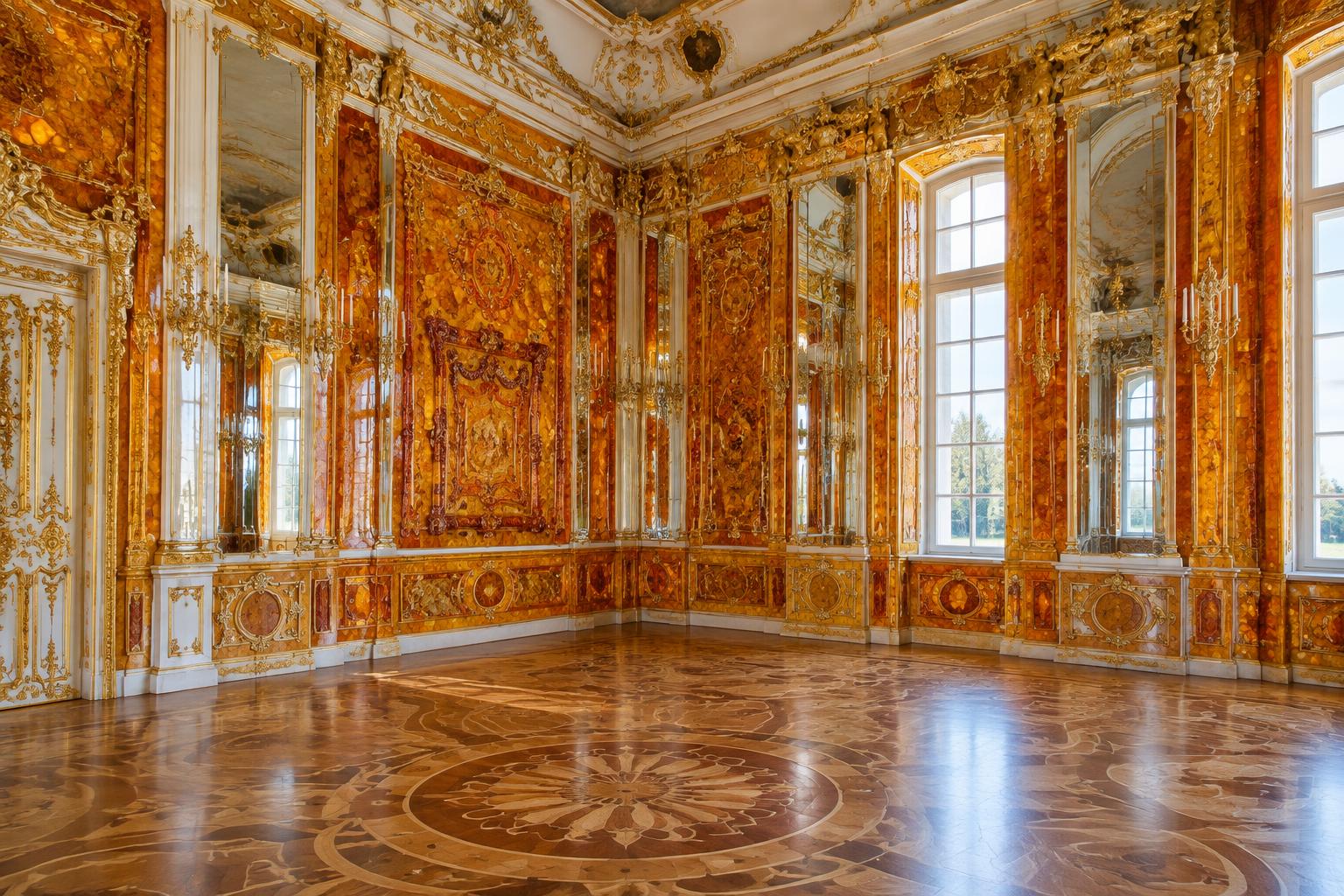
Illustrative reconstruction; not an archival photograph.
A room that could be taken apart
The Amber Room was an architectural interior made from carved amber panels, mirrors, gilded decoration and other elements. Its beauty depended on the arrangement of many separate components. That physical fact made its history possible: the room could be dismantled, shipped between rulers, expanded for another palace and eventually stolen. It also complicates the mystery, because an account of one component is not necessarily an account of the whole.
The room now visited in the Catherine Palace near St Petersburg is a reconstruction completed in 2003. It should not be confused with the recovered original. The central question concerns the eighteenth-century ensemble removed during the German occupation in 1941. Claims that it was first looted in 1945 collapse two distinct events: the documented Nazi seizure and the later disappearance during the destruction of East Prussia. Keeping those events apart is the first requirement of an intelligible chronology.
From Prussian commission to diplomatic gift
Work began in Prussia in the early eighteenth century under Frederick I. The project involved designer Andreas Schlüter and specialist amber craftsmen, including Gottfried Wolfram and later masters from Danzig. Amber was particularly suited to intricate carving and luminous surfaces, but assembling substantial wall panels required exceptional technical skill. The result was a political demonstration of craftsmanship and princely resources as well as an interior decoration.
In November 1716, Frederick William I gave the amber study to Peter the Great in the context of a Prussian-Russian alliance. The museum distinguishes the gift from its subsequent transport: the dismantled material reached St Petersburg in crates. Accounts sometimes compress these stages into a single date. The Tsarskoe Selo museum also cautions against unsupported assumptions that Peter installed the panels in his Winter Palace. Its detailed history identifies documentary evidence for installation under his daughter Elizabeth in 1743 instead. That caution is a useful model for the room's later, much less secure wartime story.
The Catherine Palace transformation
The panels were later adapted for the Catherine Palace at Tsarskoe Selo under Elizabeth. Architect Bartolomeo Francesco Rastrelli integrated the inherited amber work into a larger, elaborately decorated interior. Additional amber, mirrors and gilded features helped the original material occupy a space for which it had not initially been designed. The museum dates the completed decorative scheme to the later eighteenth century, during Catherine the Great's reign.
This was therefore not an untouched Prussian room transplanted intact to Russia. It was a developing ensemble whose different elements had different histories. That matters when a mosaic or piece of furniture later resurfaces: identification of an associated object does not prove the survival of every amber panel. Descriptions of the room's size and weight also vary across popular sources. Such measurements convey its scale but do little to resolve its disappearance. The evidential questions concern inventories, custody and transport, rather than an estimated modern cash value for a unique cultural object.
1941: a failed attempt to protect the panels
After Germany invaded the Soviet Union in June 1941, museum staff worked to evacuate palace collections. The amber presented special difficulties because age and fragility made dismantling dangerous. Accounts describe attempts to conceal the panels under coverings rather than remove them. Other portable objects could be packed, but the room's most distinctive material remained in place when German forces occupied Pushkin, the town containing the palace.
German personnel knew the interior's importance. They dismantled the panels and transported them to Königsberg in East Prussia later in 1941. This was Nazi cultural plunder, not an unexplained disappearance from an otherwise secure museum. The museum's own account and independent histories agree on the essential transfer. Whatever happened later, the identity of the force responsible for removing the room from its Russian setting is not a mystery. Uncertainty about the panels' ultimate fate should never be allowed to obscure that established responsibility.
Königsberg: exhibition and renewed packing
At Königsberg Castle, the looted material came under the supervision of museum director and amber specialist Alfred Rohde. Panels were assembled for display. Contemporary documentation and photographs place the Amber Room in the city, providing a much stronger evidential footing than the many later stories about mines, secret tunnels and remote castles. Königsberg is the last securely established location of the principal ensemble.
As the war turned against Germany, the panels were dismantled and packed again in 1944. Subsequent accounts differ over precisely where crates stood and what survived particular attacks. British bombing devastated Königsberg in August 1944, and the Soviet assault in April 1945 brought further destruction. The familiar statement that the room was last seen in 1944 or 1945 therefore compresses a deteriorating documentary trail, not a single universally agreed eyewitness sighting of intact crates. The boundary between a recorded movement and a later recollection becomes decisive at this point.
The destruction hypothesis
One major explanation holds that the room never escaped Königsberg and was destroyed in the castle's wartime fires or the city's final battles. This requires no secret convoy reaching an undocumented destination. Amber is organic fossil resin, vulnerable to heat, while the castle and its surroundings suffered extensive destruction. The material's fragility makes catastrophic loss entirely plausible.
Plausibility is not a complete chain of proof. Reports concerning fire damage, crate locations and postwar searches are not perfectly consistent, and the absence of an identifiable surviving room does not specify exactly when or where it burned. A claim that every component was conclusively reduced to ash goes further than the surviving uncertainty allows. The strongest version of the destruction explanation is comparative: the documented last location was devastated, whereas a successful evacuation has not been securely demonstrated. It remains a serious explanation even though it cannot presently account for every object or every contradictory recollection.
Evacuation, hiding places and wrecks
The principal alternative is that German authorities moved some or all of the packed panels before Königsberg fell. Late-war evacuations did carry people and property away from East Prussia, creating a plausible setting for movement by road, rail or ship. From that general possibility grew proposed caches in mines, bunkers and estates, together with claims about cargo on vessels lost in the Baltic.
Each proposed destination needs its own evidential chain. An unidentified crate on a manifest is not an amber panel, and a cavity detected underground is not a recovered room. A witness's recollection that valuables were transported may justify searching but does not establish the contents. News reports announcing promising locations frequently outlast public memory of unsuccessful searches. None of the cited museum and historical accounts identifies a verified discovery of the principal missing ensemble. The evacuation hypothesis remains possible, but the proliferation of proposed destinations is evidence of continuing interest rather than cumulative proof that the room survived.
The mosaic that genuinely returned
Not every recovery claim is imaginary. An eighteenth-century Florentine mosaic associated with the room surfaced in Germany in 1997 and was returned to Tsarskoe Selo in 2000. The museum records its recovery. This is a verified surviving element, not merely a conjecture about what might lie behind a sealed door. It demonstrates the value of object identification and documented restitution.
It does not prove that the principal amber panels reached the same destination or remained together. Contemporary RFE/RL reporting stressed that the recovered piece's separate history failed to provide the hoped-for route to the entire chamber. Looted interiors can fragment at the first seizure, during transport or through individual theft. A small element can survive while most of an ensemble is destroyed. The mosaic therefore refutes a careless claim that absolutely nothing survived, but it cannot carry the much larger conclusion that a complete Amber Room is waiting intact in a single hiding place.
1979–2003: rebuilding a lost interior
A reconstruction programme began in 1979. According to the museum, research and design occupied its first seven years, followed by seventeen years of practical work. Craftspeople had to recover techniques for selecting, treating, carving and assembling amber while drawing on photographs, descriptions and surviving evidence. Gemological reporting explains that lost recipes and workshop practices made this a technical investigation as well as an artistic undertaking.
The rebuilt room opened on 31 May 2003. Its completion restored an experience of the palace interior without resolving the original's disappearance. This distinction is not a criticism of the reconstruction: it is part of understanding its achievement. The new work embodies the judgement and skill of modern specialists responding to historical evidence. It also records a different kind of survival, in which a design and craft tradition can be recovered even when the original material is absent. The museum appropriately presents the room as both decorative art and a memorial to wartime cultural destruction.
The material behind the name
Amber is fossil resin, not a mineral carved from a single block. Its usefulness in a palace interior depended on combining many small pieces into an appearance of continuous richness. Russell Shor's account in Gems & Gemology describes thin slices assembled as mosaics on backing panels, with relief ornaments and carved elements providing depth. Mirrors and gilded wood completed an effect that was never made of amber alone. The distinction matters both to the original engineering and to any supposed rediscovery.
Shor describes the original craftsmen confronting the movement of wooden supports as temperature and humidity changed. A rigid decorative surface could crack or detach from a backing that expanded or contracted. Metal foil, adhesives and carefully fitted joints were therefore part of the achievement. The room was a system of materials with different vulnerabilities, not an indestructible treasure that could simply be boxed indefinitely. Its successful eighteenth-century journeys should not be mistaken for evidence that it would survive any twentieth-century storage conditions.
This also changes what searchers ought to expect. Even if some panels escaped destruction, survival might mean loose carvings, damaged backing boards or detached fragments rather than walls ready for reassembly. Conversely, finding amber in the Baltic region would be unremarkable without evidence connecting the workmanship to the palace. Recognition would require comparison with the room's documented patterns and construction. The material is distinctive enough to attract attention, but it is the manufactured object, not merely the substance, that must be identified. Claims of amber in a wreck or cellar do not by themselves bridge that evidential gap.
Workshops, patronage and interrupted work
The original commission drew on an established Baltic craft economy. Danzig and Königsberg were important centers of amber work before the room existed. Shor traces the development of guilds and workshops making devotional objects, boxes, mirror frames and elaborate court gifts. The room enlarged these specialized practices to architectural scale. Its apparent unity concealed the labor of designers, carvers and assemblers whose skills were neither identical nor easily replaceable.
The work also passed through changes of personnel and royal preference. Wolfram's involvement ended before the project was complete, while Gottfried Turau and Ernst Schacht continued it. Frederick I's death in 1713 brought a different attitude toward expensive display under Frederick William I. The later gift to Peter was therefore not simply the disposal of an ordinary furnished room. It redirected a costly and technically demanding court project into international diplomacy. Giving the material a new owner did not eliminate the practical question of how it should be installed.
Seen this way, the room's history before Russia already contains discontinuity: changing patrons, unfinished work, packing and renewed interpretation. These are documented aspects of its manufacture, not clues to a secret design. They help explain why the museum's detailed chronology matters more than a compressed story of one king giving another a finished chamber. They also caution against assigning every surviving detail to the same maker or date. The later Russian ensemble was the result of continued work on inherited material, rather than the preservation of a single moment in Prussian taste.
Making the gift fit a Russian palace
The museum's history places the 1743 installation in the Winter Palace under Elizabeth, followed by the transfer to Tsarskoe Selo in 1755. Rastrelli had to reconcile the earlier panels with a new architectural setting. A decorative scheme conceived for one space did not acquire the right dimensions merely because it had become an imperial possession. Architectural framing and additional decoration were essential to turning the panels into a coherent Russian state interior.
The Florentine stone mosaics are particularly useful reminders of that enlargement. Their inclusion joined different kinds of luxury craftsmanship within one room. A recovered mosaic can consequently be authentic to the Amber Room without being made of amber. The phrase names an interior ensemble, not a uniform material category. Later inventories, photographs and restitution records have to be read with that distinction in mind, especially when a report uses the survival of an associated object as shorthand for the survival of the room.
The museum dates the completion of the expanded decorative scheme to 1770. Thus the ensemble removed in 1941 embodied several reigns and workshops. Its loss was not just the disappearance of an early Prussian commission; it also removed the evidence of how Russian court designers had adapted that commission. Reconstruction required decisions about this later, historically layered appearance. The task was not to recreate a hypothetical first version stripped of subsequent additions, but to recover the interior known from the palace's surviving visual and documentary record.
Plunder disguised as return
Shor connects the wartime seizure with the German program to recover works regarded by Nazi officials as German cultural property. His account places the room on the list associated with the Kümmel report. That ideological framework is important: calling an object German-made did not give occupying forces a legitimate right to remove it from a museum in another country. In the room's case, the earlier diplomatic gift makes the distinction between origin and ownership especially clear.
The panels were not an accidental discovery by troops who happened upon anonymous crates. Their fame and their documented Prussian manufacture made them an identifiable target. The operation depended on recognizing what was on the walls and having the labor and transport to take it away. Shor recounts rapid dismantling and packing for rail transport. Such details explain how an architectural interior could become a movable collection under occupation, without suggesting that the speed of removal guaranteed the preservation of every component.
There is a further distinction between this organized seizure and the separate histories of individual objects. The recovered mosaic was understood by investigators to have become detached from the principal shipment's later fate. A military removal could coexist with private appropriation along its route. That possibility does not make every account of a soldier carrying valuables evidence about the main panels. It instead requires separate custody histories. The responsible record preserves both scales: the official transfer of the ensemble and the documented recovery of an object that had traveled separately.
Rohde and the limits of a named custodian
Alfred Rohde occupies a central place because he was a museum specialist with direct responsibility for the material in Königsberg. His name offers something the later hiding-place stories often lack: an identifiable professional connected to the room at a securely established location. That makes records associated with his work important. It does not make every later account of what he intended to do equally reliable, or turn an intended evacuation into a completed one.
Shor's history reports a January 1945 communication concerning packing and a proposed move to Saxony. This is useful evidence of the problem officials were confronting, but its implications need to be limited. Instructions, plans and reports of preparation belong to different evidential categories from signed receipts at a destination. During the collapse of East Prussia, the difference between deciding to move property and actually moving it could be decisive. A destination named in a plan cannot serve as proof that the panels arrived there.
The same principle applies to the room's last appearance. A dated letter discussing crates is not necessarily an independent visual inspection of their contents. Different histories emphasize different records and therefore give different terminal dates. Rather than selecting the latest date and treating everything before it as secure, an investigator must ask what each document establishes. The useful question is not simply who last mentioned the room, but what that person could know, whether the statement concerns the complete ensemble, and whether the next stage of custody is documented.
Postwar evidence and the damaged castle
The postwar search did not begin with a blank map. Investigators had a last known building and a collection of related objects to look for. Shor describes searches in the ruined castle and reports damaged remains associated with the stone mosaics. Such material is important to the destruction hypothesis because it places elements of the palace ensemble in the area where the room was known to have been held. It is not the same as an inventory establishing the fate of every amber panel.
The condition of different materials complicates interpretation. Stone can leave recognizable debris under circumstances in which resin, wood and adhesives are consumed or disintegrate. Conversely, the survival of stone fragments does not identify the precise fire, date or storage arrangement responsible. A responsible reconstruction must avoid both errors: ignoring physical traces because they do not fit a hidden-cache narrative, and treating a partial assemblage of debris as an exhaustive account of the missing interior.
Königsberg became Kaliningrad after the war, and the castle itself did not survive as an intact investigative setting. A search conducted amid ruins is fundamentally different from opening a sealed storeroom with its register beside the door. Wartime damage, clearance and later alteration reduced the possibility of recovering an undisturbed context. This limits the certainty available to historians now. It does not establish concealment or a cover-up. Destruction of a site can explain why a question remains difficult without supplying a dramatic alternative answer.
Reconstructing color from incomplete witnesses
The reconstruction had to solve problems that ordinary copying would not address. Black-and-white photographs can record carving, proportions and contrasts, but they do not directly specify the colors of individual amber pieces. Shor's reporting describes reliance on historic photographs and a rare prewar color slide, alongside surviving objects and technical experimentation. Even a color image represents a particular light, photographic process and stage in the aging of the material, rather than an unmediated view of an eighteenth-century surface.
The choice between natural amber colors and treatment to reproduce the darker recorded appearance became part of the reconstruction process. Shor describes research into dyes and the preparation and numbering of pieces before assembly. His account also makes clear that the workshop used modern methods where necessary. The result should therefore not be described as a rediscovered secret formula that perfectly erased two centuries of change. It was a documented modern interpretation aimed at recovering the historic appearance of a lost interior.
Carving was only one part of the work. Craftspeople had to produce compatible components, fit them into patterns and integrate them with the room's architectural decoration. A successful surface required coordination between repeated small decisions. That patient process helps explain the twenty-four-year span more convincingly than the idea that reconstruction simply waited for enough amber to be purchased. The project recovered practical knowledge through making, and its completed walls preserve the results of that research even while the original panels remain missing.
What would count as a discovery?
An authenticated panel would be a major development, but authentication would require more than age and beauty. Comparison could draw on prewar photographs, known carving patterns, the construction described by specialists and evidence of provenance. A loose object would need to be distinguished from other historical amber work made in the same region. None of these tests alone would reveal where every other panel went. A genuine partial recovery could narrow the mystery without resolving the complete disappearance.
A claimed cache would also need a documented context. The date and manner of deposition, the relationship between objects in the deposit, and any accompanying packing or transport records would matter. A story attaching a famous name to anonymous wartime crates cannot substitute for that work. This is why excavation announcements and speculative valuations should remain outside the established chronology until identifiable evidence appears. The standard is not whether a location could conceivably have held the room, but whether it can be shown to have done so.
The 2003 reconstruction and the returned mosaic supply two different forms of certainty. One is a new work whose history of creation is known; the other is an original element recognized and restituted. Neither justifies dismissing the loss as solved. Together they offer a better model for discussing the case than an endless succession of supposed hiding places. The archive can distinguish what has been remade, what has been recovered and what remains unaccounted for, without promising that all three categories will eventually become one.
Where the trail ends
The defensible sequence is clear until its final stage: Prussian creation, diplomatic transfer, Russian expansion, Nazi seizure in 1941, display and repacking in Königsberg, then a broken trail amid the destruction of 1944–1945. Beyond that point, destruction and evacuation are explanations to be weighed, not interchangeable facts. An authenticated transport order, a securely identified panel or an independently documented cache could materially alter the balance.
Until such evidence appears, a responsible account must resist both the certainty that nothing could have survived and the promise that discovery is always imminent. Treasure values, secret maps and dramatic excavation announcements do not repair gaps in custody. The recovered mosaic shows what a genuine evidential advance looks like: an identifiable object with a history that can be examined. The reconstructed room offers visitors something different but equally tangible. The missing original remains a documented victim of Nazi plunder whose last chapter has not been conclusively recovered.
Sources & record
- 01Tsarskoe Selo State Museum — detailed Amber Room history
- 02Tsarskoe Selo State Museum — reconstruction anniversary and recovered mosaic
- 03Gems & Gemology — The History and Reconstruction of the Amber Room
- 04BBC Travel — history, wartime loss and reconstruction
- 05Smithsonian Magazine — A Brief History of the Amber Room
- 06The New Yorker — Elizabeth Kolbert, Forever Amber, 2003
- 07RFE/RL — contemporary reporting on the recovered mosaic, 1997
Online citations
- →Tsarskoe Selo State Museum — detailed Amber Room history
- →Tsarskoe Selo State Museum — reconstruction anniversary and recovered mosaic
- →Gems & Gemology — The History and Reconstruction of the Amber Room
- →BBC Travel — history, wartime loss and reconstruction
- →Smithsonian Magazine — A Brief History of the Amber Room
- →The New Yorker — Elizabeth Kolbert, Forever Amber, 2003
- →RFE/RL — contemporary reporting on the recovered mosaic, 1997