The Princes in the Tower: Two Boys Who Vanished in 1483
In the spring of 1483, a twelve-year-old boy became King Edward V of England. By the end of that summer he and his nine-year-old brother Richard had disappeared inside the Tower of London, their uncle had taken the crown as Richard III, and no one has been able to say — with proof — what happened to them since.
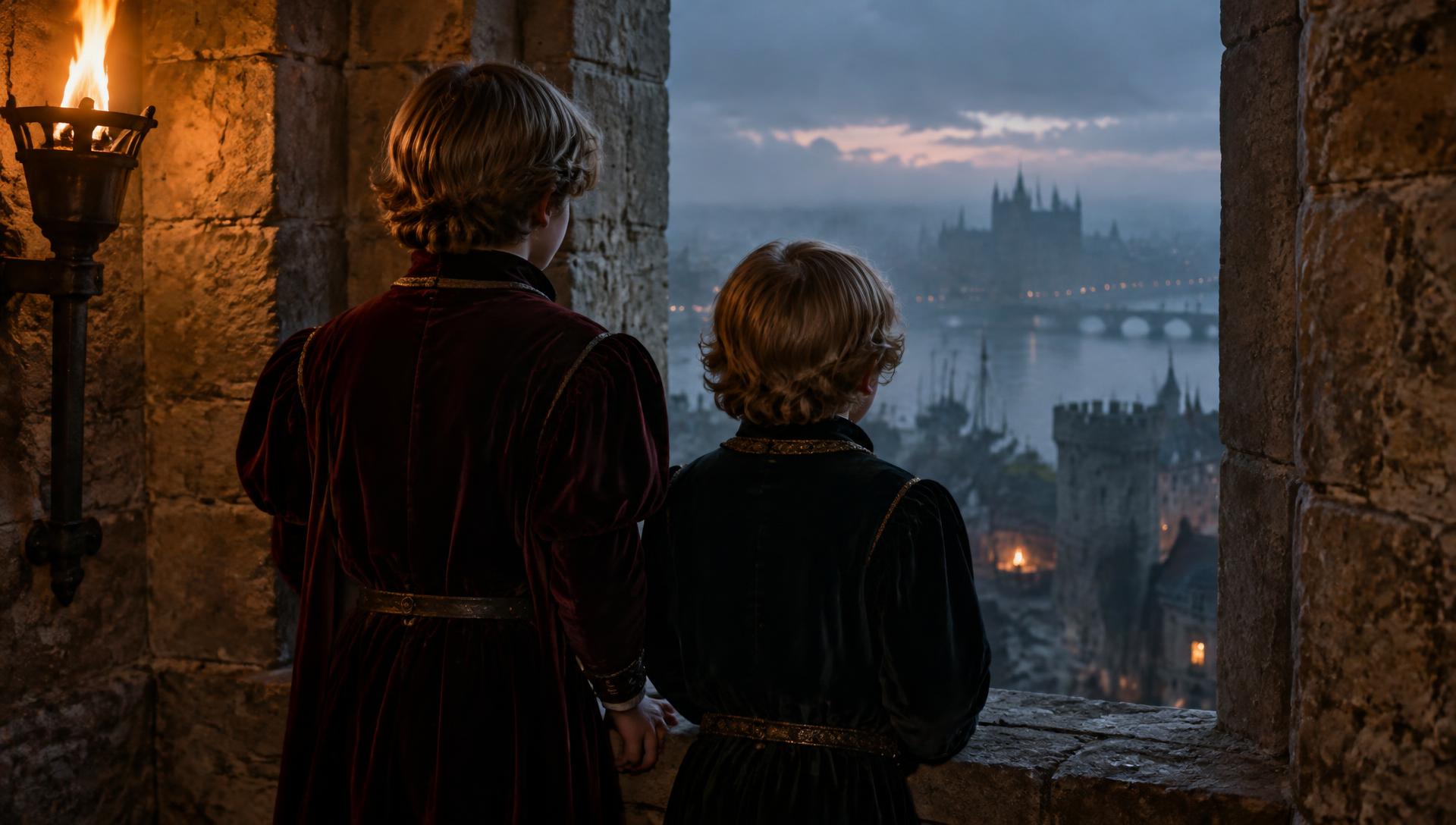
Illustrative reconstruction; not an archival photograph.
Most disappearances in this archive involve people nobody was watching. This one involves the two most watched children in England. They were heirs to the throne, lodged in the kingdom's most famous fortress, surrounded by guards and servants — and still, within a few months, they were simply no longer there. More than five centuries later, historians agree on almost everything about the case except the only thing that matters: who, if anyone, killed them.
A boy king and a protector
Edward IV died unexpectedly on 9 April 1483. His elder son, also Edward, was twelve and living at Ludlow in the Welsh Marches. The late king's brother, Richard, Duke of Gloucester, had been named Lord Protector. At Stony Stratford at the end of April, Gloucester intercepted the young king's party, arrested his maternal relatives Earl Rivers and Sir Richard Grey (both later executed), and escorted Edward to London himself.
Edward was lodged in the royal apartments of the Tower — at the time a normal residence for a monarch awaiting coronation, not yet the prison of popular imagination. His mother, Elizabeth Woodville, fled into sanctuary at Westminster Abbey with her younger children. On 16 June she was persuaded, under pressure, to release nine-year-old Richard, Duke of York, to join his brother.
The crown changes hands
Within days the coronation was postponed. On 22 June a sermon at St Paul's Cross put forward the claim that Edward IV's marriage to Elizabeth Woodville had been invalid because of an earlier pre-contract with Lady Eleanor Butler — making all their children illegitimate. An assembly of lords and commons petitioned Gloucester to take the throne, and he was crowned Richard III on 6 July 1483. Parliament later set out the claim formally in the act known as Titulus Regius (1484).
The Italian visitor Dominic Mancini, who left England in July 1483, reported that the boys were withdrawn into the inner apartments of the Tower and seen less and less often behind its windows, until they ceased to appear at all. His account, written by December 1483 and rediscovered only in 1934, is the closest thing to an eyewitness record we have. He also noted that people already feared the elder boy had been done away with — while being careful to say he did not know how, or whether, it had happened.
The Tudor account
The version most people know comes from Sir Thomas More's unfinished History of King Richard III, written around 1513, some thirty years after the events. More claimed that Sir James Tyrell, acting for the king, arranged for the boys to be smothered in their beds and buried at the foot of a staircase, and that Tyrell confessed before his execution in 1502. No record of that confession has ever been found. More was a child in 1483, wrote under the Tudor dynasty that had overthrown Richard, and his book is shaped as a moral drama; historians treat it as important but far from neutral. Shakespeare's Richard III, built largely on Tudor chronicles, fixed the image of a murderous uncle for centuries.
The bones under the stairs
In 1674, workmen demolishing a staircase near the White Tower found a wooden chest containing the bones of two children. Given More's story, they were assumed to be the princes, and on the orders of Charles II they were placed in an urn designed by Christopher Wren in Westminster Abbey. In 1933 the urn was opened and the bones examined by anatomist William Wright and dentist George Northcroft, who concluded they belonged to two children of roughly the right ages.
That examination is now considered inconclusive. The sex of the children could not be established, the dating methods of the time could not rule out bones from earlier centuries, and the remains may be incomplete or mixed with animal bones. Requests to re-examine them with modern techniques, including DNA comparison with the Richard III remains identified in Leicester in 2013, have so far not been granted by the Crown and the Church.
The suspects
Richard III is the traditional suspect: he had custody, motive and opportunity, and he never produced the boys alive to silence the rumours spreading against him. Defenders — organised today as the Richard III Society — argue that the boys had already been declared illegitimate, that no contemporary charge was formally made against Richard, and that Henry VII's Act of Attainder listing Richard's crimes after Bosworth did not explicitly name the murder of the princes.
Henry Stafford, Duke of Buckingham, Richard's chief ally in 1483, rebelled against him that autumn and has been proposed by some writers as an independent culprit. Henry VII, who took the throne in 1485 and married the boys' sister Elizabeth of York, had strong reasons to want them dead — but only if they were still alive in 1485, which is unproven. Two later pretenders, Lambert Simnel and Perkin Warbeck (who claimed to be Richard, Duke of York), show how uncertain their fate still seemed to contemporaries.
A more recent line of research, including the Missing Princes Project led by Philippa Langley, argues that one or both boys survived and were smuggled abroad. Its documentary claims have drawn serious attention and equally serious criticism from academic historians; for now it remains a contested theory rather than an established finding.
Why the file stays open
What is documented is narrow: two boys entered the Tower in 1483, stopped being seen that summer, and never reappeared. Everything else — the smothering, the staircase, the killer's name — rests on sources written later, by people with interests, or on bones no one has been allowed to test. Until the urn in Westminster Abbey is opened again, the Princes in the Tower remain the most famous missing children in English history, and one of its oldest unsolved cases.
Sources & record
- 01Dominic Mancini, De occupatione regni Anglie per Riccardum tercium (1483).
- 02Sir Thomas More, The History of King Richard III (c. 1513).
- 03L. Tanner and W. Wright, 'Recent Investigations Regarding the Fate of the Princes in the Tower', Archaeologia 84 (1935).
- 04Titulus Regius, Parliament of England (1484).
Online citations
- →Historic Royal Palaces — The Princes in the Tower
- →Westminster Abbey — Edward V and Richard, Duke of York
- →Britannica — Edward V, king of England
- →Britannica — Richard III, king of England
- →Richard III Society — The Princes in the Tower
- →Thomas More, History of King Richard III — full text (Luminarium)
- →Wikipedia — Princes in the Tower, sourced overview