The Battle of Los Angeles: When a City Fired Into the Dark
Before dawn on February 25, 1942, antiaircraft batteries opened fire over Los Angeles. The barrage was real; the enemy aircraft were never established. War nerves, balloons and an altered newspaper photograph explain more than the later flying-saucer legend.
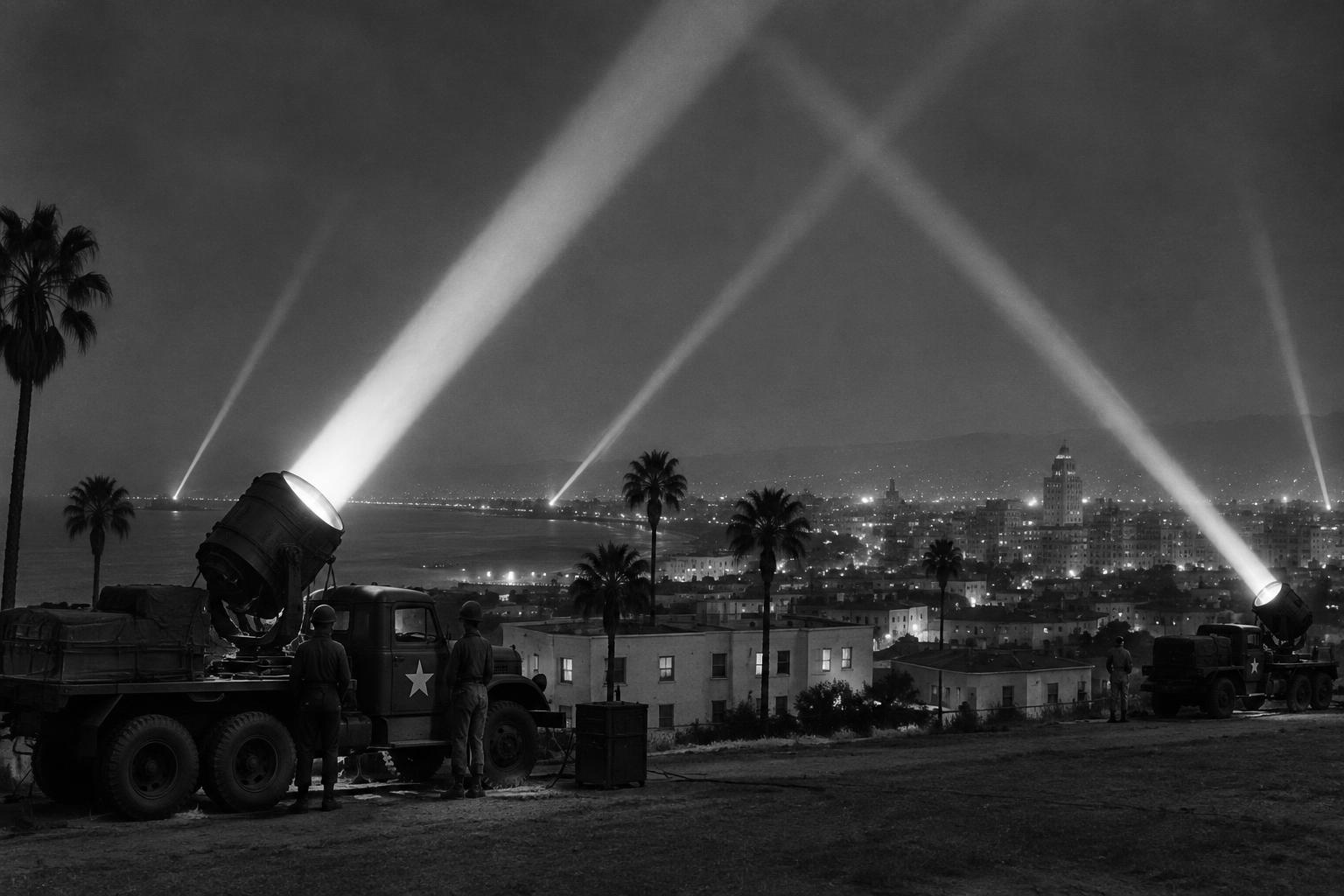
Illustrative reconstruction; not an archival photograph.
A coast already expecting an attack
Los Angeles did not enter the night of February 24, 1942, with a neutral view of its skies. Pearl Harbor had brought the United States into the war less than three months earlier. Southern California contained aircraft factories, military facilities and a coastline that seemed newly exposed. Civil-defense preparations gave residents a vocabulary of blackouts, spotters, sirens and anticipated bombers. An alarm would arrive inside an existing expectation, not in an informational vacuum.
The immediate provocation was genuine. On February 23, a Japanese submarine shelled the Ellwood oil facilities near Santa Barbara. The Los Angeles Times archive places that attack directly before the Los Angeles alarm. It demonstrated that hostile forces could reach the California coast, but it did not establish that an aerial attack followed. The distinction matters: a real submarine attack supplied the emotional setting for a false or misinterpreted air warning.
February 24: the first warning passes
The official Army Air Forces history describes a naval-intelligence warning on February 24 that an attack might occur within ten hours. Reports of flares and blinking lights near defense plants followed. Authorities called an alert at 7:18 p.m. and lifted it at 10:23 p.m. For several hours, the machinery of emergency response had already been operating before the famous shooting began.
These details complicate the familiar picture of a peaceful city suddenly surprised by a mysterious object. Observation was already directed toward possible enemy action. Ambiguous lights were being reported within a military warning system, where a missed attack could have catastrophic consequences. That setting does not make every witness unreliable. It does mean that reports cannot be treated as independent confirmations merely because several observers used similar language. Their expectations and information channels overlapped. The chronology comes from the Army history, rather than from later UFO reconstructions.
February 25: radar, blackout and disappearing certainty
Early on February 25, radar operators reported an unidentified target about 120 miles west of Los Angeles. Antiaircraft batteries were alerted at 2:15 a.m.; a blackout order followed at 2:21. The Army history says the target appeared to approach the coast and then disappeared from the tracking narrative. Meanwhile, the information center received increasing numbers of reports of enemy airplanes.
Radar detection is significant, but it is not equivalent to an identified aircraft. The surviving historical summary does not establish a continuous, verified track from that offshore return to a physical object above the city. At 2:43, aircraft were reported near Long Beach. Another report described roughly twenty-five planes over Los Angeles. These reports helped create urgency, yet they did not produce wreckage, identifiable attackers or a coherent flight path. The California State Library reproduces this official sequence, including the important break between the radar target and subsequent visual claims.
The balloon and the opening barrage
At 3:06 a.m., according to the Army account, observers saw a balloon carrying a red flare over Santa Monica. Four antiaircraft batteries opened fire. Other guns joined, and searchlights illuminated a sky increasingly populated by the products of the defenses themselves. Shell bursts, smoke and drifting material became potential targets for people already searching for airplanes.
This is the central feedback mechanism in the historical explanation. Firing could generate apparent objects; those apparent objects could encourage more firing. The Army history explicitly identifies illuminated shell bursts as a likely source of mistaken aircraft reports. Balloon involvement therefore is not an explanation invented only after flying-saucer stories became fashionable. It appears in the military reconstruction of the event. Nevertheless, identifying a balloon in that sequence does not identify every light, radar return or shape reported across the county. A plausible initiating stimulus and a complete reconstruction are different standards of explanation.
What the guns actually accomplished
Approximately 1,440 antiaircraft rounds were fired during the episode. The California State Library records five civilian deaths associated with the emergency: three in traffic accidents and two from heart attacks. Falling shell fragments and the disruption of the blackout made this a dangerous event even without a demonstrated attacker. Calling it a false alarm should not be mistaken for calling it harmless.
What the batteries did not produce was equally important. No verified enemy aircraft was brought down, and no confirmed bombing attack explained the barrage. Claims of numerous planes or successful interceptions did not mature into corresponding physical evidence. Nor did American fighters furnish an aerial identification: the Army history says pursuit aircraft were held on the ground while commanders awaited clearer indications of the scale and direction of an attack. The city heard an engagement, but the sound of gunfire could not establish that an enemy was answering it.
Army and Navy accounts pull apart
Public reassurance did not arrive as one consistent explanation. Secretary of the Navy Frank Knox characterized the episode as a false alarm. The War Department subsequently offered the Army position that at least one, and possibly several, unidentified aircraft had been present. Military Times summarizes that disagreement in its anniversary reporting. For residents who had endured the blackout, incompatible official accounts were hardly an invitation to stop asking questions.
The disagreement is evidence of uncertainty, not by itself evidence of a cover-up. Different services had different reports, responsibilities and reputations at stake. Early statements emerged before a stable reconstruction existed. Equally, the later balloon explanation should not be misrepresented as a contemporaneous consensus. The record contains an initial argument over what happened, followed by historical attempts to interpret the accumulated reports. Preserving that sequence is more informative than pretending that officials either knew everything immediately or admitted nothing at all.
The photograph that acquired an object
The best-known photograph shows searchlight beams converging above Los Angeles, with bright patches around their intersection. In later UFO retellings, that bright center becomes a solid craft apparently surviving concentrated gunfire. Yet a newspaper reproduction is not a direct measurement of an object's outline. Exposure, overlapping beams, smoke, shell flashes and reproduction all affect what viewers see.
The Los Angeles Times archive discusses the altered image, and Military Times notes that the famous photograph was retouched before publication. The Los Angeles Almanac also presents an unretouched photograph credited to the Times collection at UCLA. Retouching was used to make images reproduce more clearly in newsprint; in this case, it strengthened details that later viewers treated as evidence of a discrete vehicle. That does not make the entire night a photographic fabrication. It means the doctored newspaper image cannot independently prove an aircraft, much less an extraterrestrial one.
How the air raid became a UFO story
The people on the ground in 1942 were primarily afraid of Japanese aircraft, not visitors from another planet. In Military Times, Fort MacArthur Museum director Stephen Nelson distinguishes the contemporary military scare from the later extraterrestrial interpretation. The photograph became especially useful to that interpretation because it seemed to offer a fixed object where the written reports offered incompatible descriptions.
That shift changes the burden of proof without necessarily adding evidence. An unidentified report becomes an unidentified craft; the craft then becomes something extraordinary because conventional aircraft seem inconsistent with the reported firing. Each step requires support that the previous step does not automatically supply. The absence of a downed airplane is consistent with guns firing at balloons, bursts or imagined formations. It is not a positive demonstration of an invulnerable vehicle. Later storytelling often preserved the most spectacular possibilities while dropping the wartime conditions that made misidentification likely.
What the sources can and cannot settle
The Army Air Forces history is valuable because it assembles operational times, reports and official reactions. It is nevertheless a retrospective synthesis, not a complete public release of every radar record and every battery log. Its reproduction by a museum should be distinguished from the institutional California State Library summary that quotes it. These are related sources, not two wholly independent discoveries of the same facts.
The Times archive is particularly useful for the newspaper's images and contemporary reporting; Military Times adds a museum specialist's interpretation. The Almanac offers accessible photographic context, but its broader historical wording should not outrank military documentation. Taken together, the sources support an alarm, a barrage, contradictory sightings and a serious identification failure. They do not permit an exact assignment of every shot to a particular balloon or light. Responsible skepticism does not require claiming that level of precision. It requires keeping an unresolved detail separate from a proven extraordinary explanation.
From one target to incompatible formations
The Army history’s sequence contains a striking change in the kind of information reaching the defenses. First comes a radar target offshore; later come visual reports of airplanes near Long Beach and above Los Angeles; after the firing begins come descriptions of everything from a single object to very large formations. The history gives reported heights from a few thousand feet to more than 20,000, with claimed speeds ranging from very slow movement to more than 200 miles per hour. These are descriptions received, not verified performance measurements.
A collection that broad cannot simply be averaged into one aircraft’s dimensions and flight path. It may combine different stimuli, repeated reports of the same stimulus and interpretations changed by gunfire. That is why a chronological account should preserve when a description entered the record. An observation made before the first shots has a different relationship to shell smoke from one made during the barrage. The famous photograph cannot reconcile all those reports merely by presenting one memorable bright area where searchlight beams intersect.
3:06 is an important boundary, not a complete answer
The report of a balloon carrying a red flare at 3:06 a.m. supplies a specific stimulus immediately before four batteries opened fire. It does not explain the earlier offshore radar return simply by occupying a later place in the narrative. Nor does the account establish that the very same balloon remained the object of every subsequent searchlight or gun. Its importance is that a documented balloon report appears at the transition from expectation to an actual barrage.
Once firing started, the observing environment changed. Smoke drifted, bursts appeared at different locations and searchlights illuminated material not present at the start of the alert. A theory of escalating misidentification therefore has a physical basis beyond the general phrase war nerves. The theory does not require every witness to imagine the same nonexistent object independently. Real lights and real bursts could be interpreted as aircraft, and a battery’s action could encourage another observer to believe a target had already been confirmed. The military history offers that explanation while leaving the precise contribution of each stimulus uncertain.
Reports of victories that did not survive daylight
The Army history records claims that four enemy aircraft had been brought down, including a story that one had landed in flames at a Hollywood intersection. These are particularly useful examples because they imply consequences that should have been checkable on the ground. Yet the historical account reports no confirmed enemy losses. The claim of a burning aircraft is thus evidence of the night’s reporting, not evidence that such an aircraft was recovered or that its destruction was concealed.
The distinction between a sighting and its expected aftermath is essential. A witness might sincerely interpret a descending flash as a stricken airplane. Verification would require an aircraft, a crash site or another reliable trace consistent with that interpretation. The absence of those consequences weakens a claimed victory without establishing that the witness was lying. It also prevents the stories from being repurposed as proof that a mysterious craft shed wreckage. Nothing in the cited history identifies recovered material from an extraordinary vehicle or a confirmed Japanese airplane destroyed above the city.
A forty-mile audience watched the defenses
The military synthesis describes residents watching from hills and rooftops along a coastal arc of approximately forty miles. That geographical scale helps explain how the event could generate so many accounts without establishing that all observers had a common view of one target. Different neighborhoods could see different beams, bursts and smoke layers. The visible drama was unquestionably real: a blackout city had become the setting for sustained antiaircraft fire.
The audience’s size is therefore evidence for a major public event, not a direct measurement of the number or nature of objects overhead. A person could accurately report hearing guns and seeing lights without being able to distinguish an attacking aircraft from the effects of defensive fire. Later summaries sometimes merge those two levels of observation, turning everyone who witnessed the barrage into a witness to its supposed target. The historical record supports a large audience for the defenses’ actions more securely than a large body of independent identifications of enemy aircraft.
Two correspondents who could not identify a plane
The Army history names Ernie Pyle and Bill Henry among correspondents who watched the shooting but wrote that they could not make out an airplane. Their negative observations are worth retaining alongside the spectacular positive reports. They do not establish that no airplane could have existed anywhere in the county; visibility and viewpoint limit any observer. They do show that experienced reporters could witness the same major emergency without seeing the attackers others believed were present.
This is a stronger way to handle testimony than dividing witnesses into believers and skeptics after the fact. The relevant questions are what each person could see, when they watched and which interpretation they attached to it. The correspondents’ inability to identify aircraft belongs in the evidential balance even though it produces no dramatic silhouette. It also explains why gunfire alone cannot settle the case. Observers could confirm an engagement by the defenses while remaining unable to confirm an enemy participant, a distinction that later use of the word battle tends to obscure.
A commander revises his own impression
The retrospective account also describes testimony from the acting commander of the local antiaircraft artillery brigade. He had initially believed that he could see fifteen airplanes, but soon concluded that he was seeing smoke. This is not a finding that every reported formation was smoke. It is a documented example of an observer with military responsibility revising a confident interpretation as he evaluated the scene.
Such a revision matters because it supplies a contemporary pathway from apparent aircraft to an ordinary explanation. One need not invent a later psychologist’s diagnosis or assume that witnesses were unusually credulous. Smoke, darkness and concentrated expectation were enough to make an identification unstable even for someone professionally engaged in the response. The episode also cautions against freezing the earliest version of a witness’s statement as the only authentic one. A subsequent correction can be relevant evidence, particularly when it concerns an identifiable source of confusion produced by the guns themselves.
The Army’s first doubts preceded its public position
The Army history does not present the services as two internally uniform camps from the beginning. It says an early Western Defense Command report to Washington anticipated that previous reports would prove exaggerated. The Fourth Air Force also expressed the belief that there had been no planes over Los Angeles. Those doubts were not initially published as the Army’s settled explanation. Local commanders subsequently reviewed witnesses and adopted the view that one to five unidentified airplanes had been present.
That progression complicates any simple contrast between a Navy denial and an Army admission. The Army’s own information changed and its public account did not simply repeat its earliest internal assessment. It also places responsibility for certainty where it belongs: the subsequent announcement was a judgment based on the reports then accepted, not an identification confirmed by wreckage or an intercepted crew. Disagreement can make an episode look secretive, but the documented sequence also supports a more ordinary interpretation of officials trying to stabilize an uncertain account while protecting confidence in the defenses.
Stimson’s competing wartime theories
Secretary of War Henry Stimson advanced two possibilities for the unidentified aircraft suggested by the Army position. One was commercial aircraft operated by an enemy from concealed fields in California or Mexico; the other was light aircraft launched from Japanese submarines. The proposed purposes were reconnaissance of antiaircraft defenses or an attack on civilian morale. The Army history records these as contemporary conjectures, not as operations subsequently proved to have happened.
Both proposals illustrate how officials tried to fit a lack of bombing into the aircraft interpretation. If attackers had dropped no bombs and suffered no verified losses, perhaps they had come to observe or frighten rather than destroy. That reasoning supplied a possible motive, but motive alone could not establish the planes’ existence. It would still require evidence of launch points, crews, flight paths or a hostile mission. Preserving these explanations as theories offered at the time is more accurate than either deleting them from the record or describing them as an official confirmation of a Japanese reconnaissance flight.
February 26: calls for an explanation
According to the Army history, a Los Angeles Times front-page editorial on February 26 pressed for a careful explanation of the alert and the official confusion surrounding it. Concern extended beyond identifying whatever had been overhead. Repeated false alarms could weaken civilian volunteers’ confidence in the aircraft-warning system. A public explanation therefore had operational value: the next warning would depend partly on whether people still trusted the institutions asking them to act.
The same historical account records criticism from Representative Leland Ford and from Wendell Willkie, who was speaking in Los Angeles that day. Their objections concerned the character of the alarm and the lack of agreement between the services. These were not later UFO campaigners imposing a new controversy on a forgotten night. Public skepticism was already present within days, directed principally at preparedness, communications and credibility. The immediate aftermath belongs to the history of wartime civil defense even before the photograph acquired its later extraterrestrial associations.
February 27 and 28: a national credibility problem
The Army synthesis describes a Washington Post editorial on February 27 criticizing the official handling of the incident and the continuing uncertainty. On February 28, the New York Times questioned both alternatives: if there had been no aircraft, the barrage suggested serious misjudgment; if aircraft had been present, the failure to engage them successfully or identify them demanded explanation. These are the newspapers’ contemporary criticisms as summarized in the military history, not conclusions derived from a recovered operational record.
The questions reveal why neither a quick dismissal nor an unsupported assurance could restore confidence. A city had been blacked out, ammunition expended and civilians endangered. Even an ordinary explanation left a substantial institutional failure to examine. This is one reason the episode should not be reduced to a contest between aliens and balloons. The consequences existed regardless of the target’s identity. A well-supported false-alarm reconstruction can explain the sky while still leaving legitimate questions about coordination, restraint and the quality of public information after the shooting stopped.
After the war: testing the enemy hypothesis
The Army history reports that, after the war, the Japanese said they had sent no aircraft over the area during this alert. That statement is relevant to the proposed enemy mission but is not a substitute for evaluating American evidence. It gains meaning alongside the absence of confirmed bombing, enemy wreckage or identified attackers. The history’s retrospective judgment instead treats known meteorological balloon releases as a plausible source of the original alarm.
This later synthesis should not be described as a secret discovery that closed every aspect of the case. It assembled a more prosaic explanation from contradictory reports and the known operating conditions. Its treatment also notes official criticism of batteries for wasting ammunition on objects moving too slowly to be airplanes. That criticism bears directly on the identification problem without telling us which gun fired at which stimulus. The surviving uncertainty is therefore narrower than a demonstrated unknown aircraft: it concerns the sequence and mixture of misidentified targets during an increasingly confused defensive response.
Publication history is not declassification history
The version reproduced by the San Francisco museum identifies its source as volume one of The Army Air Forces in World War II, edited by Wesley Frank Craven and James Lea Cate, in an Office of Air Force History edition published in 1983. The California State Library’s account draws on the same historical narrative. Their agreement should therefore be understood as the circulation of a shared synthesis, not two wholly separate investigations independently confirming every minute.
Likewise, an official history’s publication or a newspaper archive’s digitization is not automatically a declassification. The dossier should not attach the authority of a newly released secret to material simply because it is now accessible online. The sources here establish a usable chronology and several contemporary interpretations, but not a complete archive of every radar trace, firing order and photographic negative. Acknowledging that limit does not revive extraordinary theories. It identifies the boundary between a documented historical reconstruction and the fuller operational reconstruction that the surviving public material cannot support.
The battle without a demonstrated enemy
The strongest reconstruction is a wartime alarm amplified by expectation, balloons and the defenses' own shell bursts. The real submarine attack at Ellwood made another attack seem plausible. Radar and visual reports activated the system; the shooting then made the sky harder to interpret. Conflicting public statements and a dramatically retouched photograph gave later generations material for a different kind of mystery.
There is no proven hostile aircraft in the evidence assembled here, and no reliable demonstration of an alien craft. What remains uncertain is the exact contribution of each stimulus to the night’s unfolding confusion. That narrower uncertainty should survive without being inflated. The Battle of Los Angeles matters because a modern city and its military defenses could create a frightening, physically consequential event from incomplete information. The mystery is not simply what people thought they saw overhead. It is how quickly a warning, a report and a burst of gunfire could become apparent confirmation of one another.
Sources & record
- 01California State Library — The Battle of Los Angeles
- 02The Army Air Forces in World War II — air-defense history, reproduced by the Museum of the City of San Francisco
- 03Los Angeles Times — From the Archives: The 1942 Battle of L.A.
- 04Military Times — UFOs or no, Battle of Los Angeles nears 75th anniversary
- 05Los Angeles Almanac — The Mysterious Battle of Los Angeles, 1942
Online citations
- →California State Library — The Battle of Los Angeles
- →The Army Air Forces in World War II — air-defense history, reproduced by the Museum of the City of San Francisco
- →Los Angeles Times — From the Archives: The 1942 Battle of L.A.
- →Military Times — UFOs or no, Battle of Los Angeles nears 75th anniversary
- →Los Angeles Almanac — The Mysterious Battle of Los Angeles, 1942