The Bélmez Faces: The Kitchen Floor That Became a Laboratory
In 1971, face-like marks on a Spanish kitchen floor became an international paranormal sensation. Photographs, disputed pigment tests and imperfect experiments left a durable controversy—but no reliable proof that the faces had a supernatural origin.
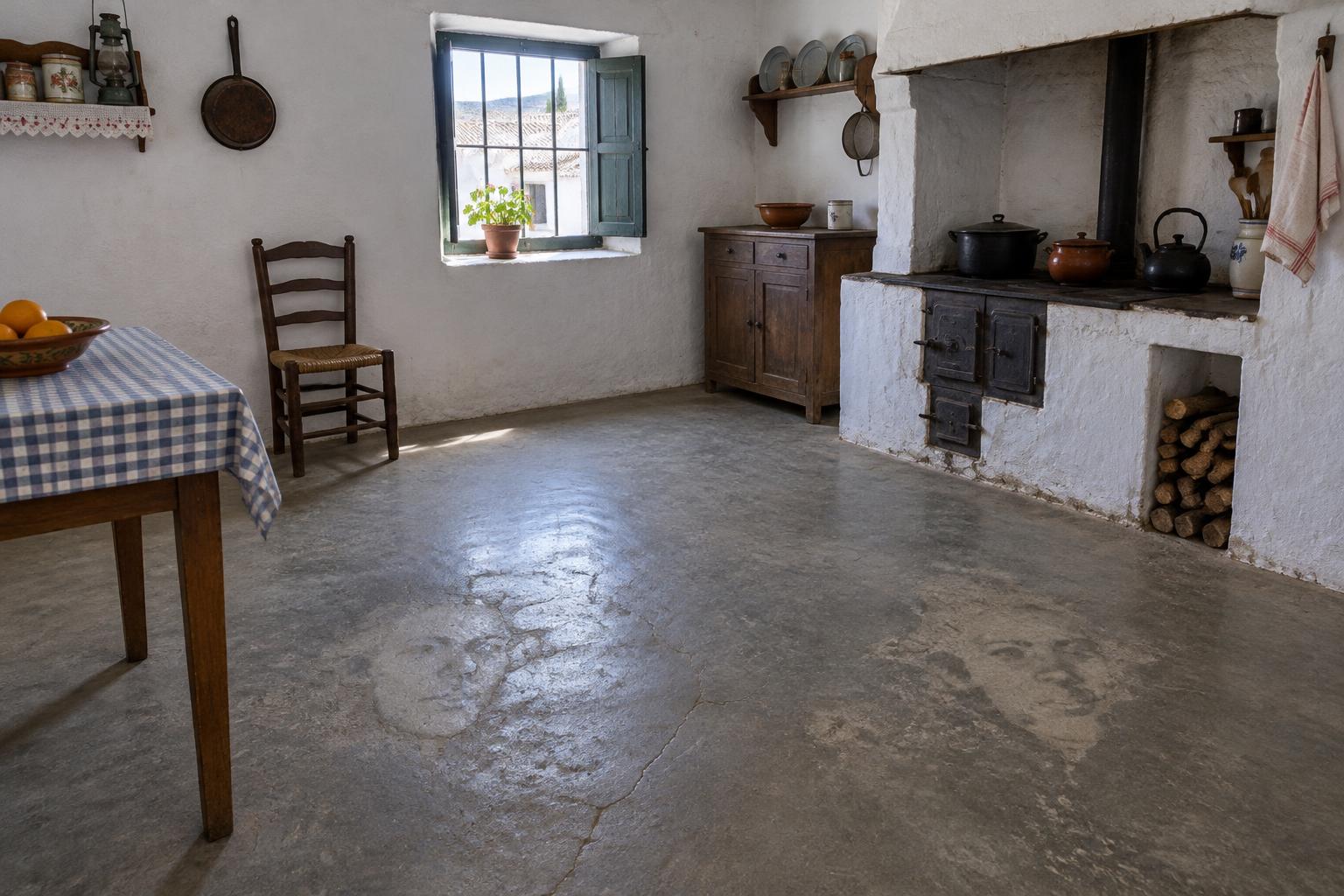
Illustrative reconstruction; not an archival photograph.
August 1971: a face in the kitchen
The story begins in the home of María Gómez Cámara in Bélmez de la Moraleda, a village in the Spanish province of Jaén. The date generally given for the first face is August 23, 1971. According to the household's account, a dark, face-like image appeared on the kitchen floor. Attempts to remove it did not end the phenomenon: another face was said to emerge after the surface was repaired.
That opening sequence is a reported domestic experience, not a continuously documented experiment. Manuel Gómez Ruiz's critical review gives the August date while examining how poorly some celebrated claims were supported. The physical marks and the attention they attracted are not in question. What needs separate demonstration is their alleged spontaneous formation. A photograph taken after a mark exists can establish its appearance, but not the process by which it came to be there. That distinction governs the whole case.
The Pereira household before the laboratory
The house belonged to a family, not to a research institution. Accounts identify María's husband as Juan Pereira Sánchez and the son who removed the first mark as Miguel Pereira. The Encyclopedia of Occultism and Parapsychology entry preserved by Encyclopedia.com describes the son's intervention with a pickaxe and the replacement of the damaged surface with cement and sand. Those details place the beginning of the controversy inside an ordinary cycle of household observation, attempted removal and repair, rather than inside a prepared scientific demonstration.
The family relationship matters because later narratives often reduce everyone in the building to supporting witnesses for María. Miguel's reported removal of a mark was a material intervention. The household's access to the floor was continuous in a way that an outside investigator's access could never be. Neither circumstance establishes deception. Both mean that a visitor arriving days or months later inherited an object with an existing history of handling, cleaning and alteration. That history cannot be recovered simply by asking whether a particular face looked convincing.
The domestic setting also complicated the meaning of cooperation. Allowing visitors to inspect a kitchen, accepting a covering or answering repeated questions could demonstrate willingness to participate. It could not turn all the preceding hours into observed time. Conversely, impatience with sightseers would not show consciousness of guilt. The family's conduct needs to be separated from the physical proposition under investigation: whether a new, identifiable image formed without ordinary intervention. The record is strongest when it describes particular actions and weakest when it converts personality, piety or hospitality into proof.
The kitchen becomes a public attraction
As word spread, the small domestic setting became a destination for reporters, visitors and investigators. Accounts described additional faces appearing, fading or changing. The same surface could be presented as a haunting, a psychic production, an unsolved material puzzle or a fraud, depending on who was describing it. The competing interpretations developed alongside the spectacle rather than after a neutral inquiry had finished.
The skeptical account preserved by the Center for Inquiry identifies September 16, 1971, coverage in the newspaper Ideal and discusses the sale of photographs to visitors. That is relevant evidence of early commercialization, but commerce alone cannot establish who made a mark or how. It supplies a possible incentive and a reason to insist on independent controls. It is not a substitute for those controls. Once crowds and cameras arrived, preserving a trustworthy record of access, treatment and alteration became harder, not easier.
December 1971: the excavation beneath the floor
Mayer's archival reconstruction supplies a more detailed sequence for the floor's early disturbance. He dates the cutting out of the second face to November 2, 1971, after the mayor intervened to prevent its destruction. The extracted piece was displayed behind glass on the wall. He then dates an excavation in the kitchen to December 2 and reports that human bones, without skulls, were encountered at a depth of 2.80 metres. The hole was subsequently filled and covered with cement. These are details in a historical reconstruction, not findings from an archaeological report reproduced with this dossier.
The bones gave the story an apparent connection to the dead. The encyclopedia account describes the property as occupying the site of an old cemetery and says that the removal of the remains did not end the reported appearances. That account helps explain why a domestic stain became a haunting narrative. It does not establish whose remains were recovered, their dates or any relationship between a buried individual and a particular image. Those would require identification evidence, not resemblance interpreted after the discovery.
There is another consequence of the excavation that receives less attention than the burial story. Digging, refilling and laying fresh cement changed the object being examined. The kitchen floor was no longer a single untouched surface stretching back to the first report. Any comparison across those stages must account for replacement material, disturbed ground and different drying histories. That observation does not supply a chemical explanation for the faces. It establishes why the phrase the same floor can conceal materially different surfaces, and why an account of the excavation belongs in the evidence history rather than only in the folklore.
Investigators arrive with different questions
Paranormal investigators including Germán de Argumosa and the German parapsychologist Hans Bender became involved. Some proposed that the images represented an unusual psychic process associated with María, rather than ordinary painting or a conventional haunting. Terms such as teleplasty supplied a name for the proposed production of forms by unknown psychic agency. A name, however, did not identify a measurable mechanism.
Gerhard Mayer's historical reconstruction, drawing on the Freiburg research context and archival material, is useful for understanding Bender's involvement. It shows that the investigation had a history of changing judgments, publicity and methodological difficulties, rather than a single decisive encounter with the impossible. The archive matters because later summaries often flatten that history into endorsements by famous researchers. An investigator's interest establishes that a case was investigated. It does not establish that the investigator successfully excluded natural processes, deliberate intervention or failures of observation.
1972–1973: what Bender actually investigated
Bender's involvement is better understood as a sequence of visits and correspondence than as a permanent scientific watch. Mayer identifies three visits, in May and October 1972 and September 1973. Between them, Germán de Argumosa supplied information and Bender offered methodological advice from Germany. Their collaboration connected the kitchen to the Freiburg parapsychological research environment, but neither investigator was continuously present throughout the period. Claims about events between visits therefore depended on reports, photographs and the reliability of arrangements made on site.
Mayer also reconstructs the role of broadcasting. A proposed six-part German television series, Psi, created a reason to seek film that would show something more persuasive than an already existing mark. This is not evidence that the researchers fabricated results for television. It is evidence that the inquiry had simultaneous scientific and production objectives. A television crew needs an observable event within a shooting schedule; a phenomenon said to occur unpredictably in a household does not necessarily provide one. The resulting pressure is part of the research history, not a reason to omit it.
The historical paper's summary notes that an experiment conducted for this purpose did not meet expectations. That qualification is important beside later assertions that investigators witnessed an overwhelming demonstration. Interest, expectation and an unsuccessful attempt at documentation can coexist. The appropriate question is what the particular experiment recorded, rather than what the reputation of its participants implies. Mayer's value here is not that he closes the case for either side, but that his archive-based reconstruction restores the difference between the researchers' ambitions and the evidence their arrangements actually produced.
A sealed floor is not automatically a controlled experiment
One of the most striking elements in the research history is the effort to cover and seal portions of the floor. Mayer's reconstruction includes documentation of a plexiglass covering. Such measures are more informative than casual viewing because they attempt to restrict access. Their evidential strength nevertheless depends on exactly when the covering was installed, what it enclosed and how its integrity was checked.
A genuinely persuasive formation experiment would begin with a characterized surface, documented before sealing, and would record humidity, temperature, lighting and every authorized intervention. Continuous monitoring would need to cover the whole relevant area, not merely occasional visits. Investigators would also need to exclude delayed chemical reactions initiated before observation. These are methodological requirements, not allegations that a specific person defeated a particular seal. Without that level of documentation, a statement that faces changed under observation leaves open what was actually observed and which alternative mechanisms were tested.
The chemistry dispute: what was sampled?
Pigment analysis is often presented as the case's final verdict, but the published arguments point in opposing directions. In the Center for Inquiry archive, Frías Sánchez and García-Trío San Martin discuss analyses attributed to Spanish scientific investigators. Their account says samples submitted in 1991 contained elements including zinc, chromium, lead, copper or barium, interpreted by the analysts as consistent with paints or enamels. It also discusses a 1975 examination of a particular image.
These are claims reported in a skeptical secondary discussion, not an institutional CSIC declaration reproduced here. They should not become a blanket assertion that every face was conclusively proved to be painted. Elemental detections require context: the floor's composition, previous coatings, contamination and nearby unmarked comparison samples. Equally, the mere invocation of CSIC cannot responsibly be used as a scientific certificate that no pigment was present. Both popular shortcuts conceal the sampling questions on which interpretation depends.
The 1972 chemical explanation and its afterlife
On February 25, 1972, according to Mayer, the newspaper Pueblo presented a chemical explanation involving silver compounds and light. His reconstruction distinguishes a laboratory possibility from proof that the household used that method. He also describes subsequent reporting that treated the proposed recipe as though the relevant substances had actually been detected in the kitchen. That distinction is a concrete example of how a cautious proposition can acquire false certainty as it passes between newspapers and languages.
A demonstration of a similar-looking image would be relevant because it challenges the claim that no ordinary method could produce such a mark. Its relevance does not depend on identifying an actual maker. But historical attribution is a separate step. To establish that a recipe explains Bélmez, investigators would need evidence connecting its materials or application to the sampled surface. The absence of that connection does not make the recipe useless; it limits which question the demonstration can answer. A possibility test and a reconstruction of a specific event are not interchangeable.
Mayer further reports a later journalist's account of pressure to end the publicity on public-order grounds. That is a reported explanation of editorial decisions, not a reason to assume that every unfavorable scientific assessment was politically manufactured. An official desire for quiet could distort coverage without validating psychic claims. Equally, newspaper confidence in a solution could exceed the underlying laboratory evidence without establishing a coordinated conspiracy. The durable lesson is to follow the sample and the experiment past the headline, especially when a story announces a final answer.
Why other analysts reached different conclusions
Mayer and Pilar Ramiro de Pano's 2018 review of material analyses argues that the combined results weaken the two familiar explanations involving silver-salt solutions and applied coloring substances. That conclusion conflicts with the more categorical skeptical reading. It deserves to be represented accurately rather than hidden because it complicates an easy debunking. Their paper is an anomalistics review, however, not a demonstration of paranormal image production.
The disagreement cannot be settled by counting institutional names. Different samples, collection dates, analytical techniques and thresholds can produce findings that are not directly comparable. Failure to detect a proposed pigment in one sample excludes only what that test could detect in that sample. Detection of a potentially pigment-associated element elsewhere does not reconstruct an artist's actions. A useful synthesis must preserve those limitations in both directions. The published conflict supports caution about sweeping chemical claims; it does not leave the supernatural explanation as the only surviving possibility.
Faces, stains and the human observer
The images matter as objects of perception as well as chemistry. Human vision is highly responsive to eye-like pairs, mouth-like lines and roughly symmetrical patches. Pareidolia names that ordinary tendency to recognize meaningful forms in ambiguous material. A stain can look like a face without being a portrait, and agreement that it looks facial does not establish how the stain originated.
That explanation has limits too. Pareidolia concerns interpretation; it does not by itself account for every dark patch, alteration or reported new image. Ordinary staining, deliberate additions and changes in moisture or photographic contrast would require their own evidence. The important point is that the alternatives need not be mutually exclusive. A chemically unremarkable mark could be read as a face, photographed selectively and later described as changing expression. Gómez Ruiz's review emphasizes weaknesses in the evidential record and the need for systematic study, which is more useful than assuming either universal credulity or universal fraud.
Delusion, painting and the disputed confession story
Three propositions are often blurred in this controversy: that people perceived faces in ambiguous stains, that somebody deliberately applied an image, and that the household sincerely interpreted an ordinary event as extraordinary. They are not rival medical diagnoses or interchangeable accusations. Pareidolia is a normal perceptual tendency, not evidence that María or another witness was delusional. No clinical conclusion about a participant follows from believing that a floor image had supernatural significance. The evidential problem can be examined without assigning an illness to anyone.
The confession story requires similar care. Claims sometimes attached to the name María Pérez should not silently be treated as an authenticated admission by María Gómez Cámara, the woman identified in the principal case literature. Mayer discusses accusations and allegedly false confessions within the hostile early press environment. His account establishes that confession claims were part of the controversy; it does not provide grounds here to print a verified statement by María acknowledging that she painted the faces. There is no authenticated confession text reproduced in this dossier, and none should be reconstructed from recollection.
That leaves painting as an ordinary hypothesis to test rather than a personal admission to presume. A convincing case for manufacture might combine appropriate materials, a credible opportunity, a documented technique and evidence linking a person to a particular intervention. A convincing case for spontaneous production would require reliable observation excluding those interventions. Failure on one side does not complete the other side's proof. The language of confession is especially consequential because it appears to settle intention and authorship at once. Without a traceable statement and circumstances, repeating it as fact merely adds another unsupported certainty to an already crowded record.
Hoax allegations need evidence of their own
The Center for Inquiry article argues strongly for ordinary manufacture and discusses allegations of manipulation, publicity and financial incentives. Those arguments are part of the case's documented controversy. They should be attributed to the authors, not transformed into an unqualified statement that a named household member was caught creating every image. Showing that a method can produce a similar result is not the same as proving who used it on a specific occasion.
Conversely, the lack of a fully reconstructed hoax does not validate a paranormal claim. The claimant still needs reliable positive evidence of the extraordinary process. This is especially important in a long-running domestic case where material can be altered, cleaned, dampened, sampled or photographed under changing conditions. Historical uncertainty may make a final personal attribution impossible. It does not require treating psychic action and familiar mechanisms as equally supported explanations. Skepticism about the claim can remain firm without pretending that every allegation against the people involved has been established.
Later parapsychology and the search for a continuing case
The case did not remain frozen at the level of early newspaper coverage. Mayer's reconstruction and the later material-analysis review revisit observations that advocates had preserved across decades. Their work shows an enduring effort within anomalistics to distinguish the original images, particular sampling episodes and later claims. That continued attention is historically significant. It also explains why a reader can encounter technically detailed defenses long after popular summaries have declared that the case was exposed or conclusively authenticated. Neither summary accurately represents the range of published argument.
Mayer also reports renewed analysis associated with a 2014 television investigation, describing its failure to find expected signs of fraudulent production. The qualification is essential: this is a result reported through the historical literature, not a complete laboratory package independently evaluated here. It cannot validate all earlier surfaces or all proposed mechanisms. Later techniques can improve the examination of surviving material, but they cannot restore an absent observation of the moment an image first formed. The case's age makes that difference between retrospective analysis and contemporary control increasingly important.
2004: another chapter, not a fresh validation
María Gómez Cámara died in 2004. Later that year, publicity focused on new claimed faces in another house associated with her earlier life. The Center for Inquiry account treats this renewed episode as a separate controversy and criticizes the methods and promotional claims surrounding it. The sequence matters: an image reported at another property decades later cannot retrospectively authenticate an image in the original kitchen.
Nor should disputes over the newer faces automatically settle every earlier observation. Different locations, surfaces and participants require separate chains of evidence. Folding all episodes into one continuous miracle—or one fully demonstrated scheme—makes the narrative simpler at the cost of accuracy. The renewed attention shows how a famous mystery can reproduce its own expectations. Once a village is associated with faces in floors, another ambiguous face arrives with a ready-made audience, vocabulary and set of competing experts. Public continuity is not experimental replication.
The house and the public record are different exhibits
The private house associated with the original reports and the public interpretation center should not be collapsed into a single institution. The provincial tourism listing documents a center devoted to the faces and their cultural impact. It is a source for how the municipality presents the story, not an independent catalogue authenticating every mark at the original property. Visitors encountering the house through photographs, television or a local account are seeing the survival of a famous setting as well as the survival of a disputed claim.
The distinction also limits what can responsibly be promised about the house today. A heritage listing is not evidence of continuous scientific custody, unchanged floor conditions or unrestricted public access to a private building. Those arrangements may change and need direct confirmation before a visit. What can be established from the institutional record is that Bélmez has incorporated the episode into its public identity. Preserving the controversy has value in its own right: it records how a family kitchen became a national argument about expertise, belief and the meaning of scientific examination.
What the surviving photographs can establish
The photographic record is indispensable, but it answers a narrower question than many accounts ask of it. It preserves the appearance of selected marks at particular moments. A photograph can help establish that a recognizable image existed before a sample was removed or that investigators examined a particular area. Without consistent scale, lighting, exposure and surface conditions, however, two photographs cannot automatically establish that a face changed expression or that new lines developed between visits. Apparent changes require a documented comparison rather than an impression produced by images reproduced in different publications.
The extracted second face presents a related problem. Displaying a piece behind glass can protect an existing object and make later inspection possible. It cannot retrospectively observe that object's formation. The floor excavation, the mounted fragment and the later covered areas therefore belong to different evidential categories. One is a reported discovery context, another a preserved specimen, and another an attempted observation arrangement. Calling all three scientific evidence is not necessarily wrong, but failing to distinguish their functions makes the overall case look more controlled than its history warrants.
This is also why the strongest future contribution would not necessarily be another confident verdict. A clearly indexed archive connecting each photograph to a location, date, sample and intervention would allow narrower claims to be tested. It could identify which published analyses concern the same material and which concern different episodes. Such a reconstruction might leave the original formation unresolved while removing avoidable confusion around later examinations. Historical rigor does not depend on producing a supernatural explanation or naming a maker. It depends on making the limits of the surviving record visible enough that another reader can check them.
What Bélmez preserves today
The provincial tourism service Jaén Paraíso Interior describes the interpretation center as a place to understand the phenomenon's history, media impact and importance to the village's identity. That institutional source confirms a cultural legacy. Its existence should not be confused with scientific certification of a paranormal origin. Museums can document a controversy without resolving the underlying claim.
The strongest conclusion is deliberately narrower than either promotional certainty or total retrospective accusation. Face-like marks were photographed and investigated. Their alleged spontaneous formation was not established by reliable, reproducible controls. Published accounts of material testing conflict, and broad claims that science proved either complete purity or universal painting exceed what the accessible record supports. There is no reliable proof of paranormal agency. Bélmez remains interesting because its kitchen floor became a meeting point for perception, publicity, imperfect experimentation and incompatible standards of proof—not because uncertainty itself can supply the missing evidence.
Sources & record
- 01Jaén Paraíso Interior — Centro de Interpretación de las Caras de Bélmez
- 02Manuel Gómez Ruiz — Las caras de Bélmez: revisión crítica de las supuestas pruebas realizadas en su investigación
- 03Gerhard Mayer — The Bélmez Faces: An Investigation of a Supposedly Strong Case
- 04Gerhard Mayer and Pilar Ramiro de Pano — Faces without end: material analyses, 2018
- 05Fernando L. Frías Sánchez and Gerardo García-Trío San Martin — Las caras de Bélmez, CFI archive
- 06Gerhard Mayer — Die Gesichter von Bélmez, historical reconstruction, 2018
- 07Encyclopedia of Occultism and Parapsychology — Bélmez Faces, via Encyclopedia.com
Online citations
- →Jaén Paraíso Interior — Centro de Interpretación de las Caras de Bélmez
- →Manuel Gómez Ruiz — Las caras de Bélmez: revisión crítica de las supuestas pruebas realizadas en su investigación
- →Gerhard Mayer — The Bélmez Faces: An Investigation of a Supposedly Strong Case
- →Gerhard Mayer and Pilar Ramiro de Pano — Faces without end: material analyses, 2018
- →Fernando L. Frías Sánchez and Gerardo García-Trío San Martin — Las caras de Bélmez, CFI archive
- →Gerhard Mayer — Die Gesichter von Bélmez, historical reconstruction, 2018
- →Encyclopedia of Occultism and Parapsychology — Bélmez Faces, via Encyclopedia.com