Sarah Winchester: The Rifle Heiress Who Built Stairs Into Ceilings
In 1886, Sarah Winchester — heiress to the Winchester repeating-rifle fortune — bought an eight-room farmhouse on the outskirts of San Jose, California, and began to build. She did not stop until the day she died, thirty-six years later. What grew out of the farmhouse is a 160-room mansion with staircases that rise into ceilings, doors that open onto blank walls and a door in the floor. The ghost stories came later. The documented record underneath them is, in its own way, stranger.
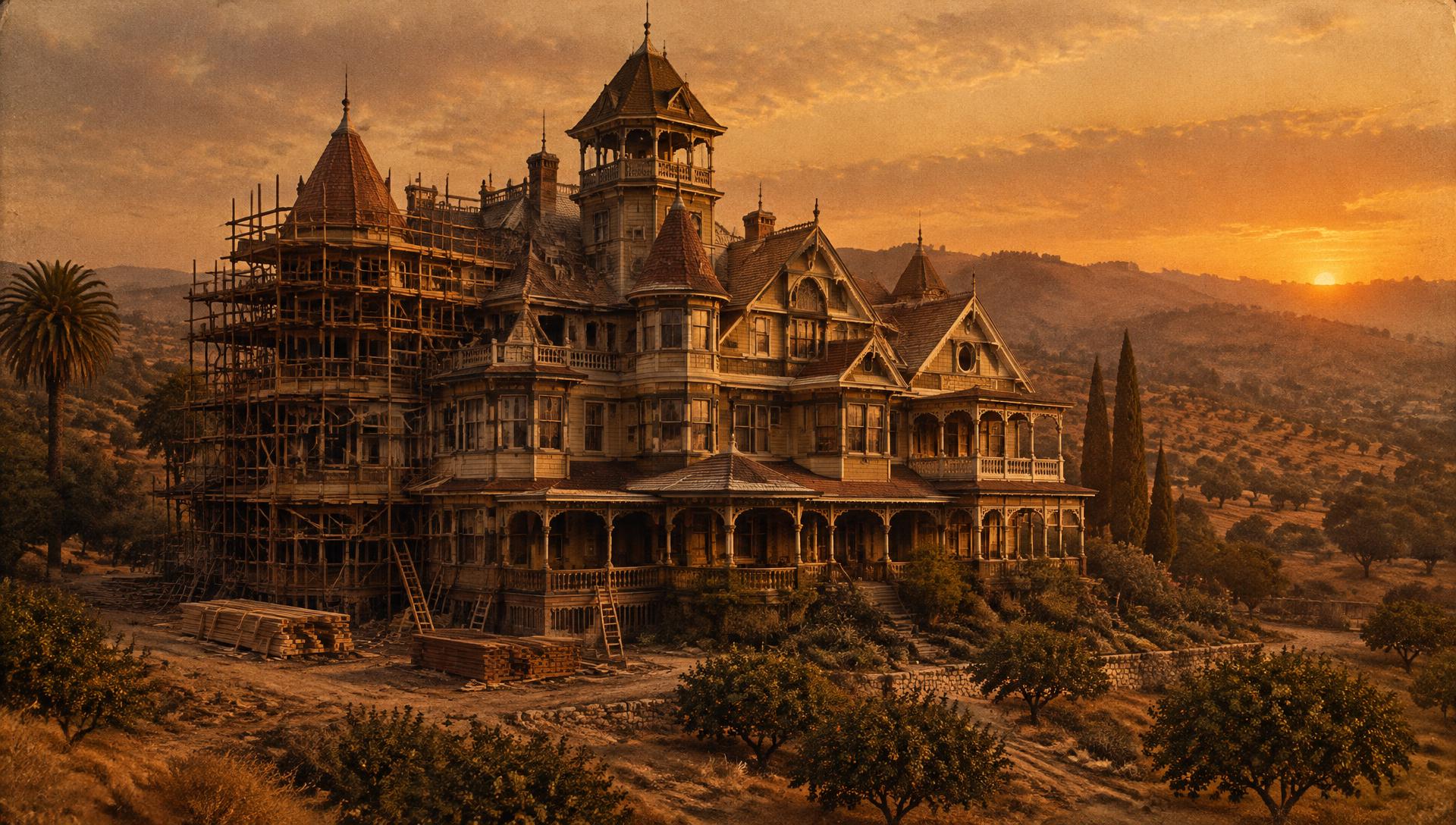
Illustrative reconstruction; not an archival photograph.
Today the house at 525 South Winchester Boulevard in San Jose is a museum, and the first thing most visitors ask about is the staircase. It climbs a full flight and ends squarely at a ceiling. Nearby there are doors that swing open onto nothing but solid wall, a window set flush into the floor, and a door that, when opened, reveals a straight drop of more than a storey. For nearly a century, tour guides have told visitors these were the whims of a terrified widow who believed that if construction on her house ever stopped, she would die. Some of that story is legend. But the house itself — 160 rooms, 47 stairways, built continuously for thirty-six years by one woman — is fully documented.
The rifle fortune
Sarah's future was built on a machine. Her father-in-law, Oliver Winchester, was a prosperous New Haven shirt manufacturer who, in the 1850s, began putting his money behind a series of troubled repeating-arms ventures — first the Volcanic Repeating Arms Company, then the New Haven Arms Company, where the engineer Benjamin Tyler Henry designed the lever-action rifle that carried his name. The Civil War turned the Henry rifle's ability to fire again and again without reloading into a fortune, and when Oliver reorganised the business as the Winchester Repeating Arms Company in 1866, he controlled one of the most profitable arms makers in America. The Model 1873 that followed eventually sold in the hundreds of thousands, and the money flowed to a single family in New Haven. Sarah's husband, William Wirt Winchester, served as the company's treasurer.
The Pardees of New Haven
Sarah Lockwood Pardee was born on June 4, 1839, at 29 Orange Street in New Haven, Connecticut, the fourth daughter in a well-off family; everyone who knew her called her Sallie. In September 1862 she married William Wirt Winchester, the only son of Oliver Winchester, owner of the Winchester Repeating Arms Company. The company's Model 1873 repeating rifle — marketed ever after as 'the gun that won the West' — was making the family one of the richest in America.
In July 1866 Sarah gave birth to a daughter, Annie Pardee Winchester. The baby had marasmus, a wasting condition that 1860s medicine could not treat, and she died five and a half weeks after her birth. The couple had no other children. Sarah was in her twenties, wealthy and apparently happy — photographs from the period show a composed, well-dressed New Haven socialite — and then, over the following fifteen years, her family was removed piece by piece.
Three deaths in seven months
Between the fall of 1880 and the spring of 1881, Sarah lost her mother, her father-in-law and her husband. Oliver Winchester died in December 1880, leaving the company to William — who was already dying of tuberculosis. William Wirt Winchester died on March 7, 1881, at the age of 43. Sarah, at 41, was a widow with no children and almost no family left.
She was also, suddenly, one of the richest women in America. Her inheritance was reportedly around $20 million in cash and property — several billion in today's money — together with just under half of the Winchester Repeating Arms Company's stock. Newspapers later put her income at something close to $1,000 a day, a figure repeated so often that it has hardened into the record; the precise accounting varies between sources, but every account agrees on the scale. She never remarried and never had another child. She could have done anything. Within a few years she left New Haven and moved to California.
The medium and the curse
The story that has followed the house ever since goes like this: shattered by grief, Sarah consulted a spiritualist medium — versions name a 'Boston medium' — who told her that her family was cursed by the spirits of everyone ever killed by a Winchester rifle. The spirits, the medium said, demanded she move west and build a house for them, and that the sound of hammering must never stop: if construction ever ceased, she would die.
It is a perfect story, and its paper trail is thin. The National Park Service's own registration entry for the house records only that Sarah 'reportedly consulted a spiritualist' after her husband's death. The tale does not appear in contemporary 1880s records, and the house's own historians concede there is no documentary evidence that Sarah ever believed she was haunted. Modern accounts of her life, drawing on the testimony of people who actually knew her, describe her as intelligent, kind and decidedly not superstitious. The medium story attached itself to the house decades after she began building — and it stuck, because it answered the only question the house poses: why would anyone build like this?
The spiritualist century
Spiritualism — the movement the medium story belongs to — was real, and it was enormous. It began in 1848 in upstate New York, when two young sisters, Margaretta and Kate Fox, persuaded listeners that mysterious rapping in their farmhouse was messages from the dead. Within a few decades the belief had spread across the country, and the Civil War supercharged it: a nation full of grieving parents and widows, desperate for one more word from the dead, filled the séance rooms. By the time Sarah Winchester lost her husband, spiritualism counted its followers in the millions, and consulting a medium was an ordinary thing for a grieving widow to do. That history is what keeps the story plausible to this day. What is missing is any evidence that Sarah did it — and any mention, before the twentieth century, of a curse.
West, for her health
The record offers a more mundane reason for the move. In the years after William's death, Sarah developed rheumatoid arthritis, and her doctors recommended a warmer, drier climate. In the mid-1880s she travelled west, and in 1886 she bought a two-storey, eight-room farmhouse on 161 acres of orchard land in the Santa Clara Valley, a few miles outside San Jose. She named the place Llanada Villa. Then she began to remodel it — and the remodelling never stopped.
Thirty-six years of building
From 1886 until 1922, construction at Llanada Villa effectively never ceased. There was no master plan. Sarah worked with her carpenters day by day, sketching rooms on brown paper, adding wings, tearing out finished work and rebuilding it, running chimneys into dead ends and staircases into roofs. By the 1890s the eight-room farmhouse had swollen into a seven-storey Victorian giant, staffed by servants and ringed with the noise of a permanent building crew. Contemporary accounts describe her as a considerate and generous employer — the workmen were well paid, and many stayed for decades.
How the building actually ran
The practical answer to the house is that Sarah Winchester became, in effect, her own developer. No architect is recorded as ever having worked on it. Sarah briefed her permanent crew of carpenters directly, day by day, and the result shows it: additions that ignore the rooms beneath them, walls that block other walls, whole sections built, abandoned and built over again. A line attributed to her — 'paper talks' — surfaces only in later tellings and cannot be verified, but it describes exactly the pattern the building records. The work went on six days a week, in whatever direction the day's sketching suggested, for as long as she lived.
In April 1906 the great San Francisco earthquake shook the Santa Clara Valley hard. The mansion's crowning seven-storey tower crashed down, taking most of the fourth floor with it. According to the legend, Sarah declared the disaster the spirits' anger at the way the house had grown; what is documented is what she did next. She had the tower and the ruined floor demolished rather than rebuilt, and the damaged front thirty rooms — which, the house's historians note, stayed sealed and unused for the rest of her life, and were only opened up again when the house became a tourist attraction — were left as the earthquake made them. The house never again reached its full height. She continued for another sixteen years.
Sarah Winchester died in her sleep on September 5, 1922, at the age of 83, at her second home in Atherton, which she had kept since 1910 to be near her sister and her niece Daisy. The hammering stopped the same day. Her funeral was held at the mansion, and she was buried in Evergreen Cemetery in New Haven, beside her husband and her daughter — more than 3,000 miles from the house that had consumed her fortune. Construction on it had cost, by the estate's own accounting, around $5 million at a time when that figure would buy a city block.
The house itself
The numbers, from the house's own historians, are these: 24,000 square feet, 160 rooms, around 10,000 windows, around 2,000 doors, 47 stairways, 47 fireplaces, 52 skylights, 17 chimneys, 13 bathrooms and 6 kitchens. Against that inventory sit the famous oddities: a staircase that rises into the ceiling; a door on the second floor that opens onto an exterior drop; doors that open onto walls; a window installed in the floor. There is also, running through the house, the number 13 — the bathroom count is documented, and guide lore extends it to 13-paned windows and a séance room with 13 hooks, some of which later scholarship treats as embellishment.
A few of the oddities repay a closer look, because they show how the reputation was assembled. The switchback staircase near the main hall climbs 44 steps, each only a few inches high, to rise barely nine feet — a design the house's guides attribute to Sarah's worsening arthritis. The 'door to nowhere' on an upper floor is said to have opened onto a small balcony that an earlier remodelling removed, leaving a door with a straight drop behind it. Read that way, the strangeness looks less like a riddle and more like a building that kept being edited by one person, with nobody able to say no.
The house was not only strange. The National Park Service's registration entry notes craftsmanship of real quality — Tiffany glass set in silver, gold-plated fixtures, and household heating and plumbing innovations years ahead of their time. Which returns the question: was any of it deliberate? The ghost story says the maze was built to confuse spirits. The architectural record suggests something more human: a wealthy woman with a consuming interest in building, no architect overriding her, a worsening arthritis that made stairs a daily problem, earthquake damage to absorb, and thirty-six years in which stopping was never once required of her.
The woman behind the legend
Almost everything popular culture believes about Sarah Winchester's mind comes from the legend, and the legend gets her backwards. The testimonies and records left by people who knew her describe a shrewd financial manager who kept her half of the Winchester company's fortune intact and productive, a generous philanthropist, a hostess who was sharp-witted into old age, and a woman who was grieving — not delirious. She was genuinely reclusive in her last decades, dressing in dark, old-fashioned clothes and receiving few visitors, but rheumatoid arthritis, widowhood and constant construction will each do that without any help from ghosts.
The house after Sarah
In 1923, the year after her death, the house opened to paying visitors — it has never closed since. It was added to the National Register of Historic Places in 1974, and it now operates as the Winchester Mystery House, one of California's most visited private landmarks.
The legend, and what feeds it
The legend has long since outgrown the woman. The tours still tell the medium story, because it is what the crowds come for, and Hollywood has told it too — most famously in the 2018 film Winchester, with Helen Mirren playing Sarah as a haunted architect of her own terror. The film's Sarah bears almost no relation to the woman in the record. The house's own guides now draw the line openly for visitors: the séance room, the number thirteen, the curse and the medium are presented as the story that surrounds the house, while the rooms, the dates and the construction costs are presented as the record. The strange thing is that the record needs no help. A widow with one of the largest private fortunes of her day, a painful incurable illness, no children left to her, and thirty-six years of nonstop construction is, on its own, one of the strangest stories American architecture has produced.
Sources & record
- 01Winchester Mystery House — official history and Sarah Winchester timeline
- 02National Park Service — National Register of Historic Places nomination, Winchester House
- 03Encyclopaedia Britannica — Winchester Mystery House
- 04Contemporary press and later biographical accounts as summarised in modern scholarship
Online citations
- →Winchester Mystery House — the house's official history
- →Winchester Mystery House — the Sarah Winchester story, year by year
- →National Park Service — Winchester House, National Register entry
- →Britannica — Winchester Mystery House
- →HISTORY.com — why people believe the Winchester House is haunted
- →Wikipedia — Sarah Winchester
- →Wikipedia — Winchester Mystery House