Borley Rectory: England's Most Documented Haunted House
A red-brick rectory in an Essex village became the most famous haunted house in England — a reputation built on footsteps, a spectral nun, wall-writing, and one tireless investigator. Then a later inquiry asked how much of it had ever been there at all.
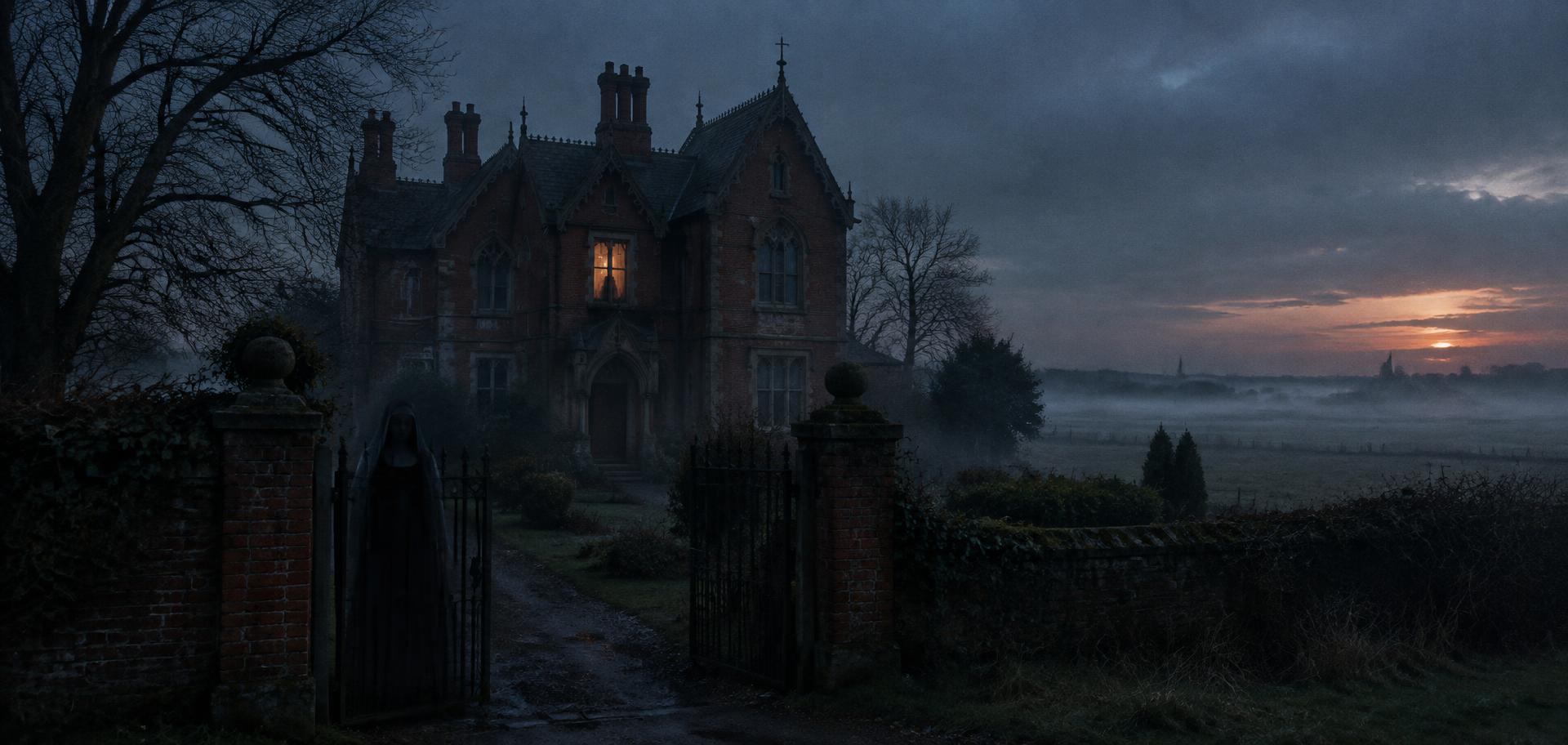
Illustrative reconstruction; not an archival photograph.
Borley Rectory stood in the village of Borley, on the Essex side of the Essex–Suffolk border, opposite the medieval parish church. It was not an old house. It was built in 1863 — sources vary, some giving 1862 — by the Reverend Henry Dawson Ellis Bull, Borley's first rector, to house his family. It was a large, two-storey red-brick Gothic building with dozens of rooms, four staircases, and grounds of several acres: comfortable, draughty, and, within a few years of its going up, already acquiring the stories that would outlive it.
What was reported at Borley Rectory?
The first reports predate the investigators by decades. Members of the Bull family said they had seen a spectral nun walking the grounds, and heard the rumble of a phantom coach in the lane. Harry Bull, the rector's son, who lived in the house for much of his life, told guests of footsteps, bell-ringing that no one could explain, and the same nun, which he said he had watched from the garden. These were family stories, repeated to visitors, not collected as evidence. When Bull died in 1927 and the living passed out of the family, the rectory stood empty — and the stories waited for someone to listen to them.
Who brought Harry Price to Borley?
In 1928 a new rector, the Reverend Guy Eric Smith, and his wife moved in. They reported thrown stones, keys that vanished and reappeared, footsteps, and a sense of being watched. Mrs Smith wrote to the Daily Mirror, and the paper sent a reporter — whose visit, in June 1929, brought Harry Price with it. Price was a self-taught psychical researcher, a showman, and a relentless publicist. He arrived at Borley on 12 June 1929, installed observers, and within days was reporting the hallmarks that would define the case: stones thrown in empty rooms, a pebble that landed at his feet, a locked door that opened itself. He left convinced Borley was a genuine poltergeist. The Mirror's coverage made the rectory famous overnight.
It is as though the house were trying to write its own record, in a hand no one living could read.
Editorial summary of the reported wall-writing, after the contemporary accounts — Interesting Files
The Foyster years, 1930–1935
In October 1930 a new rector arrived: the Reverend Lionel Foyster, his wife Marianne, and a small daughter. It is during the Foyster incumbency that the case explodes. Price later counted roughly two thousand reported incidents between 1930 and 1935 — footsteps, thrown objects that sometimes struck Marianne, small fires, booby-traps, furniture overturned, doors locking and unlocking, and the most famous feature: writing that appeared on the walls. Scratched into plaster, scrawled in what witnesses took to be charcoal or pencil, the messages were addressed to Marianne by name and pleaded for help, prayers, and mass. 'Marianne, please help get' and 'Marianne light mass prayers' are the phrases most often quoted.
The Foysters left Borley in October 1935, Lionel's health broken. The rectory was let again, briefly, and the reports did not stop. Price, who had kept the case alive in print, returned in 1937 with a formal team of observers from his National Laboratory of Psychical Research, installing them in the empty house in shifts for months. They reported thrown pebbles, a floating luminous object, a woman's shoe that appeared and disappeared, and more wall-writing. Price's 1940 book, The Most Haunted House in England, fixed the rectory's reputation — and its title — in the language. The label 'most documented' is Price's own: no other haunted house, he argued, had been watched by so many observers for so long.
The fire, 1939
In 1939 the house burned. Captain W. H. Gregson, a recent tenant, was storing books; an oil lamp is said to have overturned. The fire gutted the interior. By the accounts of those who came afterward, the destruction did not quiet the house. Sightings continued among the ruins — and, in a much-repeated detail, a human skull was reportedly recovered from the debris in 1943, an event later researchers struggled to confirm. The rectory was demolished in 1944. Today the site is empty; the church beside it remains, and a small cottage that once belonged to the stable block still stands.
What did the Society for Psychical Research find?
The reckoning came in 1956, with the publication of The Haunting of Borley Rectory: A Critical Survey of the Evidence, by Eric J. Dingwall, Kathleen M. Goldney and Trevor H. Hall — the report the SPR commissioned after Price's death in 1948. Its conclusion was damning. The investigators examined Price's records and found that many of the celebrated phenomena could not be corroborated; some, they argued, had been produced by the occupants themselves. They concluded that a great deal of the 'haunting' was either misreported, imagined, or fabricated, and they accused Price of serious dishonesty — of manufacturing phenomena, suppressing contradictory evidence, and inflating the case for money and fame.
The report did not end the argument. Later writers — Paul Tabori in his 1956 biography of Price, and more recently the Harry Price website's archivists — pushed back, arguing that the SPR had its own agenda and that Hall's prosecution of Price was unfair and at times inaccurate. They point out that some of the Foyster-era events were witnessed by people with no obvious motive, and that Price's early observers included respectable figures. The division is real and, on the present evidence, unbridgeable: Borley is either a house where something genuine happened and was then discredited by an overzealous critique, or a house where very little happened and was inflated into a legend by an investigator who needed a story. The record supports both readings, which is itself the puzzle.
Was Marianne Foyster responsible?
A specific question sits inside the larger one. The SPR report and later critics argued that many of the Foyster-era phenomena — the thrown objects, the wall-writing, the small fires — were produced by Marianne Foyster herself, possibly with help. Marianne, who outlived her husband and was living quietly by the time the controversy peaked, denied the accusations. She was a young woman in a remote house under enormous strain, and some later writers have read the poltergeist claims as, in part, a cry for help that an investigator was eager to transcribe rather than treat. What is established is that no one was ever caught producing the phenomena in a way that closed the question, and no one ever confessed. The accusation remains an accusation.
Is Borley Rectory still there?
The rectory has been gone for eighty years. What remains is the record — and the record is the real artifact of Borley. No other alleged haunting generated so many written pages, so many named witnesses, so much argument over what each of them actually saw. Whatever happened in those rooms between 1863 and 1944, it produced one of the most thoroughly documented cases of its kind, and then one of the most thorough dismantlings of that documentation. That dual record — the haunting and the debunking — is what makes Borley useful to a file like this one. It is not a case where something happened and was explained. It is a case where the question of what happened, if anything, has never stopped being argued.
Sources & record
- 01Harry Price, The Most Haunted House in England (Country Life, 1940) — Price's own account of the 1929 and 1937–38 investigations.
- 02Harry Price, The End of Borley Rectory (Hutchinson, 1946) — the post-fire investigation.
- 03Eric J. Dingwall, Kathleen M. Goldney & Trevor H. Hall, The Haunting of Borley Rectory: A Critical Survey of the Evidence (Society for Psychical Research, 1956) — the SPR 'Borley Report'.
- 04Paul Tabori, Harry Price: The Biography of a Ghost-Hunter (T. V. Boardman, 1956) — the first major defence of Price against the SPR report.
- 05Robert Hastings, 'Borley Rectory: An Affair of Hypnotic Influence?', and the Harry Price website archive at harrypricewebsite.co.uk.
- 06Society for Psychical Research, Psi Encyclopedia entry on Borley Rectory (psi-encyclopedia.spr.ac.uk).
Online citations