Why Do Dogs Keep Jumping Off This Scottish Bridge?
An ornamental Victorian bridge on a quiet estate above Dumbarton has a reputation no bridge should have: dogs walk onto it, spring over the parapet and fall around fifteen metres onto the rocks of the burn below. Owners describe the same thing again and again — no warning, no hesitation, no obvious cause. The behaviour is real and repeated. The explanation is still argued over.
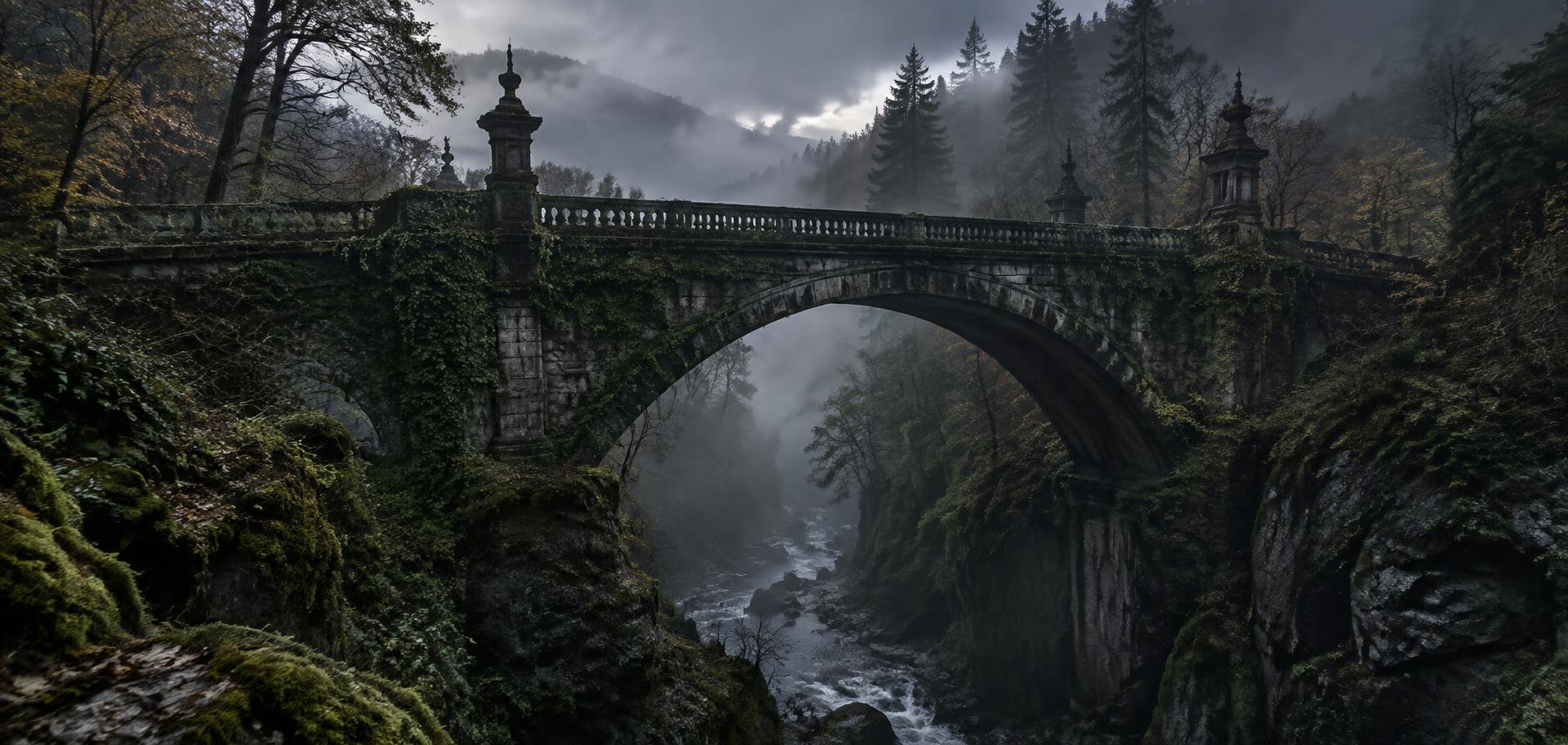
Illustrative reconstruction; not an archival photograph.
Overtoun Bridge is not a remote or sinister place to look at. It carries the drive up to Overtoun House, a Victorian mansion above the town of Milton, near Dumbarton in West Dunbartonshire. The bridge was completed in 1895 as part of the estate's designed landscape, and it crosses the deep, wooded gorge of the Overtoun Burn. The drop from the parapet to the rocks below is around fifteen metres.
What brings visitors is not the architecture. It is the dogs. For decades owners walking across the bridge have described their dog suddenly climbing or springing over the granite parapet and falling into the gorge. Many die. Some survive, and a number of those are reported to have gone back and jumped again.
How many dogs have actually jumped?
This is where the story needs care. The figures that circulate — fifty deaths, six hundred jumps — are estimates repeated between news articles, not counts kept by any authority. Nobody has maintained an official register of incidents at the bridge. Local accounts go back to at least the 1950s and 1960s, and reports have continued steadily enough for the local authority to put up a warning sign asking owners to keep dogs on a lead.
So the honest position is this: the phenomenon is well attested by many separate owners over many decades, and the precise totals are not. Treat any specific number you see as an estimate.
What did the behaviour study find?
In 2005 the Scottish SPCA asked the animal behaviourist Dr David Sands to look at the bridge. He examined the incidents, the site and the dogs involved, and reported a consistent pattern: almost all the animals were long-nosed breeds with a strong sense of smell — collies, retrievers, labradors — and they tended to jump from the same side of the bridge, on the right, close to the last few parapet stones before the far end.
Sands concluded that the most likely trigger was scent. Beneath the bridge the gorge holds mink, along with mice and squirrels, and mink in particular leave a powerful musk. His proposal was that a dog picks up a strong animal scent rising from the gorge, follows it in a straight line, and hits a solid parapet rather than a railing — so the drop is invisible to a dog at eye level. What looks like a leap into space is, from the dog's point of view, a jump over a low wall towards prey.
Acoustics and sightlines have been offered as contributing factors as well. The bridge's solid stone sides, the enclosed gorge and the sound of water may all conspire to remove the cues a dog would normally use to judge what is on the other side.
Why is the explanation not settled?
The mink hypothesis is plausible and it is the best-supported account on offer, but it has never been demonstrated experimentally. Mink were not established in that part of Scotland as early as some of the oldest reports, which weakens a purely mink-based timeline. Dogs cross hundreds of similar stone bridges over wooded burns in Scotland without doing this. And the reported cases of a surviving dog returning to jump a second time do not sit easily with a one-off scent distraction.
None of that makes the bridge supernatural. It means the cause is probably a combination of site-specific factors — scent, the parapet height and solidity, the way sound behaves in the gorge — that nobody has yet isolated. It also means reporting bias plays a part: once a place is famous for dogs jumping, every incident there is recorded and shared, while the same event elsewhere is a private tragedy nobody hears about.
The legends, and one real tragedy
Local tradition calls the area a 'thin place', a Celtic idea of a spot where the boundary between worlds is close, and some retellings attach a ghostly 'White Lady of Overtoun' to the estate. These are folklore, offered here as folklore; there is no evidence behind them and they explain nothing about canine behaviour.
One dark event at the bridge is not folklore. In October 1994 a man named Kevin Moy threw his infant son from Overtoun Bridge, killing him, and then attempted to take his own life; he was found to have been suffering from severe delusional illness and was detained in a psychiatric hospital rather than convicted. It is a documented court matter and it has nothing to do with the dogs, but it is frequently blended into the bridge's mythology online, and it is worth separating out.
What to do if you visit
Overtoun House and its grounds are open to the public and the bridge is on the main approach. The practical advice from the estate and the local council has not changed in years and does not depend on which theory is right: keep your dog on a short lead while crossing. Whatever is pulling at them on that parapet, a lead removes the chance to answer it.
That is the whole of the documented file. A Victorian ornamental bridge, a gorge full of scent, a parapet at exactly the wrong height for a dog's eyeline, and seventy years of owners describing the same sudden, silent jump. The behaviour is not in doubt. The reason is still open.
Sources & record
- 01Scottish SPCA-commissioned assessment of the Overtoun Bridge incidents by animal behaviourist Dr David Sands, 2005.
- 02West Dunbartonshire Council signage and guidance advising owners to keep dogs leashed on the bridge.
- 03Historic Environment Scotland / Overtoun estate records on the construction of the bridge and house, 1890s.
- 04Contemporary Scottish press reporting on incidents at Overtoun Bridge, 1990s onward.
Online citations