The Catalina Island UFO Reports, 1949–1955: What the Air Force Files Actually Say
Six objects passing singly, a silver apparition above a Scout hike, and a purplish light over the channel: Catalina’s early UFO history survives in four short Air Force files. Read closely, they reveal not one continuous wave but a mixture of incomplete testimony and recorded astronomical explanations.
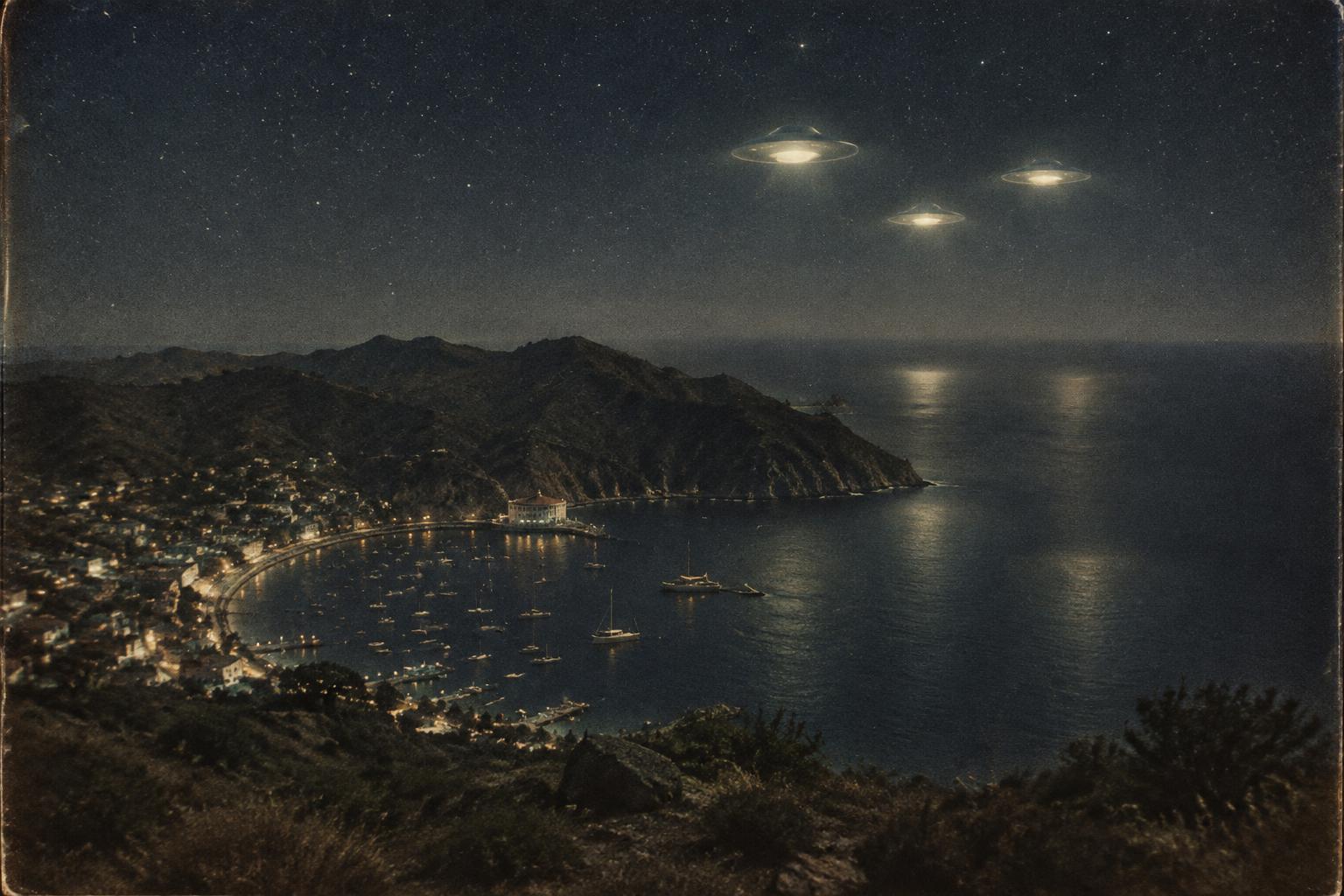
Illustrative reconstruction; not an archival photograph.
The dossier: four reports, not a proven continuous wave
Santa Catalina Island enters the early flying-saucer record through a small, uneven collection of civilian correspondence and Air Force reporting. Four surviving files concern observations dated 28 April 1949, 25 June 1952, 16 November 1953 and 15 March 1955. They describe very different things: successive objects at night, a silver object seen by Scouts on a mountain hike, a purplish-white light observed from the mainland, and a brief orange-red descending object. Their shared geography is real; a shared physical cause is not established.
The date range 1949–1955 is therefore defensible as the span of these documented reports, but not as evidence of an uninterrupted local outbreak. The inspected documents do not establish yearly sightings, a coordinated investigation of an island-wide wave, or a statistical excess over comparable coastal locations. Calling the collection a wave is a retrospective convenience. A more accurate description is four Catalina-associated reports preserved in the Air Force UFO record, with different evidentiary strengths and different official dispositions.
The documentary distinction matters because modern publication can flatten those differences. The reproduced PDFs carry identifiers DOW-UAP-D181, D179, D178 and D177, with filenames describing unresolved reports. Those are retrieval identifiers for this publication, not verified original Blue Book case numbers. Within the pages, however, the Air Force recorded insufficient information in 1949, no evaluation in the 1952 narrative, Jupiter in 1953, and a probable meteor in 1955. This dossier does not assign historical case numbers that cannot be securely read or independently verified.
28 April 1949: successive objects above Avalon
The earliest account is a handwritten letter from Percy E. Wackey in Avalon, dated 1 May 1949 and addressed to Kenneth Arnold in Boise, Idaho. Wackey wrote that at about eight on the evening of 28 April his wife and a schoolteacher saw six objects in the sky. Crucially, they were not reported as a formation: they appeared singly. A few minutes later, after his wife went to their daughter’s nearby home, she, the daughter and Wackey’s grandson reportedly saw four more, all travelling in the same direction. 1
This is a contemporary report, written within days, but it is not Wackey’s own eyewitness narrative. He relayed observations attributed to members of his family and a teacher. The letter offers to provide fuller information if Arnold remained interested in flying disks and saucers. It does not supply measured bearings, elevations, durations, distances or a developed description of the objects’ appearance. Nor does its use of flying-saucer vocabulary establish that the witnesses actually resolved disk-shaped craft.
The accompanying Air Force record card compresses the account to six objects, each flying by alone. It lists the observation as ground-visual, gives no reported duration or course, and records no photographs or physical evidence. The additional four objects in the letter should not disappear from a historical reconstruction, but neither should they be converted into ten independently tracked vehicles. What survives is one correspondent’s account of two short sequences of observations, not instrumentally confirmed counts of distinct machines.
The official disposition was insufficient data for evaluation. An annotation on the letter repeats the insufficiency judgment; another notes that the letter was not acknowledged by the office named in the annotation. A transmittal card shows the correspondence entering military channels in May. These administrative traces demonstrate receipt and filing, not a completed field inquiry. Aircraft, astronomical objects or other causes cannot be selected responsibly from the sparse description. The unresolved element is chiefly missing information, not a documented performance that defeated conventional physics.
25 June 1952: three Scouts at Camp Fox
The most developed Catalina narrative concerns three Boy Scouts attending Camp Fox. The Air Intelligence Information Report was prepared by Lieutenant Colonel E. D. H. Maddox of the 807th Air Base Group at March Air Force Base and dated 28 August 1952. Its date-of-information field places the event on or about 25 June; the narrative gives 25 June 1952. This distinction corrects a recurring chronological trap: August is the report date, not the date of the hike. 2
According to the report, the Scouts were hiking up one of the island’s mountains at about noon, with the time labelled PSDT on the form. They were together and had no observing instruments. Conditions were described as clear and unlimited, while wind information was absent. The report does not identify the precise summit, give a triangulated position for the object, or record how long the sighting lasted. Camp Fox identifies their summer camp, not necessarily their exact viewing point when the object appeared.
The summary describes one silver object at an uncertain altitude. Its speed was estimated to exceed that of a conventional jet; no sound was heard. The observers reported one maneuver, apparently a climbing turn, immediately before disappearance in what the report characterized as disintegration. These are striking descriptions, but the evidentiary verbs are important: speed was estimated, the maneuver was apparent, and disintegration was an interpretation of disappearance. There is no recovered material or photographic sequence establishing an actual breakup.
An object’s physical speed cannot be derived securely from its apparent motion without knowing distance. Likewise, an unresolved bright object can vanish from sight without breaking apart. Those are methodological cautions, not retrospective identifications of what the Scouts saw. The surviving summary lacks the angular measurements, timing and range information needed to demonstrate extraordinary velocity or reconstruct a flight path. Silence is part of the testimony, but its meaning also depends on distance and surrounding conditions that were not adequately documented.
The report lists four letter enclosures, from Clyde Vrooman, Howard Howell, Sam Gates and Forrest E. Spriggs; the last is dated 1 July 1952. It also says rough sketches appeared on two enclosures. The two-page published file inspected for this dossier does not reproduce that full supporting package. Listing four correspondents is not proof of four eyewitnesses: the narrative expressly identifies three Scouts together. Their individual ages, roles and separate wording cannot safely be reconstructed from the enclosure list alone.
Maddox made no reliability estimate and characterized the observers’ experience as probably limited. The report’s evaluation field reads None. It also explains that delayed receipt of the information prevented an earlier electrical report. These qualifications suggest an administrative collection of testimony rather than an immediate instrument-supported investigation. A copy went to the Air Technical Intelligence Center at Wright-Patterson. The faint accompanying card does not justify a confident reading of its conclusion mark, so this dossier does not claim a verified final Blue Book identification for the Scouts’ object.
The 1952 flap: why such a report reached the Air Force
The Scouts’ observation belongs to the year of the much broader American UFO flap. The National Archives’ history situates Blue Book’s creation in 1952 within Cold War concerns, following the earlier Sign and Grudge programs. Officials were interested not only in unusual natural phenomena but in the possibility of hostile aircraft or Soviet weapons and the public alarm generated by unexplained aerial reports. The Catalina report’s routing to military intelligence fits that wider effort; it does not itself indicate that intelligence officers endorsed an extraterrestrial explanation. 6
The same Archives history reproduces material associated with the Washington sightings of 19 July 1952 and a December 1952 Blue Book status report. Catalina’s June event preceded that famous July episode. The sequence argues against retelling the Scouts’ experience as a direct response to the Washington excitement, although the broader flying-saucer vocabulary was already circulating. The August paperwork belongs to a period when the Air Force was trying to turn diverse civilian impressions into standardized reports with dates, weather information, drawings and assessments.
The national context also supplies ordinary categories of explanation without settling Catalina individually. The Archives notes that many reports investigated by the Air Force proved to involve aircraft or weather balloons. Such outcomes make comparison with familiar aerial objects necessary, but they are not transferable verdicts. A silver daytime appearance might invite an aircraft or balloon hypothesis; the surviving Camp Fox report does not contain the flight records, balloon-release data or reliable motion measurements needed to establish either one.
16 November 1953: a mainland observer and an astronomical conclusion
The 1953 case is often described as a sighting on Catalina, but the observer was on the mainland. Technical Sergeant Robert J. Currie, identified as an Air Force clerk, reported the object from Tenth Street and Gaffey in San Pedro. The case card dates the observation to 16 November 1953 and gives 16/1305Z; the underlying message records a ten-minute interval beginning at 0505 local time. A teletype was sent the following day through Air Force reporting channels. 3
Currie described one round, saucer-shaped object with an apparent size compared to a pea. It was initially purplish white, becoming whiter before fading away. He said it first appeared stationary over Catalina and then moved northwest toward Los Angeles on an apparently straight, level path. The record gives an elevation of approximately 45 degrees and describes clear conditions. This was not an account of a squadron, a close encounter, a landing or repeated violent changes of direction.
Over Catalina is an observer’s placement against a distant landscape, not a measured position above the island. A mainland witness could not determine distance merely from a light’s direction. The report’s color and apparent-size language similarly cannot establish the diameter or material of an object. Keeping those distinctions visible prevents a relatively modest light observation from becoming, in retelling, a large metallic vehicle hovering directly above island residents.
The reporting officer considered Currie fairly reliable because of his association with jet-aircraft activity at Long Beach. The same message records advice attributed to astronomers at Griffith Observatory: objects of this sort might be planets, especially conspicuous after rainfall. That is a general explanatory suggestion, not a quoted astronomical calculation. Reliability in this context concerns the witness’s apparent credibility and experience; it does not guarantee that his identification or impression of motion was correct.
The accompanying card goes further than the message: its conclusion explicitly identifies an astronomical object, Jupiter. It notes that the apparent movement did not match winds aloft, says angular velocity was unknown, and summarizes a Jupiter position for 15 November at about 45 degrees elevation in the west. The sighting itself is dated 16 November. That one-day difference belongs in the record rather than being silently corrected. The documented conclusion is Jupiter, while the short file does not preserve enough calculation to reproduce the entire assessment independently.
Venus is therefore not the verified official explanation for this Catalina case. Substituting the more familiar planet would overwrite the card. Nor does the description of apparent movement automatically invalidate an astronomical explanation: the file lacks a measured angular rate. The appropriate historical conclusion is narrower than either wholehearted acceptance or categorical rejection. Currie reported an unusual light; Air Force evaluators classified it as Jupiter; the surviving paperwork records their result more fully than their reasoning.
15 March 1955: two seconds of orange-red light
The last report in this sequence is also the briefest observation. The record places it at Avalon on 15 March 1955. One civilian reported a single round, very bright object, orange changing toward red, descending straight down and fading out of sight in approximately two seconds. Its apparent size was compared to a nickel held at arm’s length. The published teletype came from the 670th Aircraft Control and Warning Squadron at San Pedro and was sent through air-defense and intelligence channels. 4
Captain Clifford E. Brant’s intelligence assessment connected the reported flight path and short duration with a probable meteor. The principal record card likewise gives a meteor explanation, while the accompanying UFOB index card marks the more cautious category possibly astronomical. The index card states that the brevity of the observation made further investigation unwarranted in the judgment of the organization recording that comment. These formulations are compatible degrees of confidence, not proof that investigators discovered a manufactured object and then concealed it.
The meteor explanation fits the recorded combination of brightness, color, descending motion and extremely short visibility, but the file is not a meteorite recovery or a calculated trajectory. There is no basis here for inventing an impact site or treating the apparent coin-sized diameter as a physical measurement. Nor does the report document a craft entering the sea. The warranted result is a contemporary probable-meteor assessment attached to a very brief visual report, not a proven vehicle maneuver or an underwater disappearance.
What the paperwork proves—and what later stories add
These cases survive in the record commonly grouped under Project Blue Book, but that label can obscure chronology. The 1949 correspondence predates Blue Book’s establishment in 1952 and belongs to the earlier Air Force UFO-investigation era. Later summary cards can accompany older observations: the 1953 card inspected here is printed on a form edition dated September 1963. A card is evidence of later administrative summarizing as well as of the original report; its form date is not the date the object was seen. 5
The National Archives identifies the retired Blue Book records as declassified and gives the overall Air Force total as 12,618 reported sightings, with 701 remaining unidentified. It also preserves the Air Force’s conclusions that the investigated reports did not demonstrate extraterrestrial vehicles, technology beyond contemporary scientific knowledge, or a national-security threat. Those are the program’s institutional findings, not a claim that every eyewitness experience was completely reconstructed. They also warn against treating every surviving UFO file as an officially unexplained case.
Modern coverage illustrates how distinctions can erode without deliberate fabrication. CBS Los Angeles, reporting on 23 October 2026, described the Scouts’ case as a report from August 1952. That matches the document’s preparation month but not the event date in its narrative. The same story summarized the purplish-white light without giving the Jupiter conclusion. A reader relying only on that account could reasonably but incorrectly imagine an August encounter followed by another wholly unresolved object. The primary pages supply the necessary corrections. 7
Other embellishments require a firmer boundary. The inspected files do not document an underwater base, a recurring fleet using Catalina as a rendezvous, recovered alien material, occupants, abductions, photographs proving exotic craft, or a multi-year military pursuit of the same objects. Neither do they establish a common link with later offshore encounters. Geographic resemblance is a starting point for a question, not evidence of continuity. Any such larger story needs its own dated sources and cannot borrow certainty from these four administrative files.
Hoaxes likewise remain a possibility in the abstract, not a demonstrated conclusion in these records. The Scouts’ limited experience does not prove deception; Wackey’s secondhand letter does not prove invention. Conversely, a military witness’s rank or an intelligence form’s official appearance cannot establish an extraordinary cause. Aircraft, balloons and Venus should be discussed as general sources of misidentification, with Jupiter and a meteor distinguished as the specific explanations actually recorded for two of the cases.
Assessment: unresolved information, not established extraordinary craft
What remains open is uneven. The 1949 report lacks enough descriptive detail to identify the successive objects. The 1952 account preserves a more interesting visual narrative but no measured speed, duration or altitude, and its listed letters and sketches are absent from the inspected short publication. Recovering those materials could improve the historical reconstruction. The 1953 and 1955 cases have recorded astronomical explanations, although the surviving files leave limits on how independently those conclusions can now be tested.
The archive status Unresolved used for this combined dossier should therefore be read as an editorial description of incomplete historical reconstruction, not a blanket quotation of Air Force findings. Four people’s or groups’ reports entered official files; that fact is secure. A continuous Catalina wave, one underlying phenomenon, or extraordinary machines operating above the island is not. The durable mystery lies in the gap between brief human observations and the information needed to explain them—not in evidence that the documents never actually contained.
Sources & record
- 011949 Catalina correspondence and Air Force record card (archival scan, The Black Vault)
- 021952 Camp Fox Air Intelligence Information Report (archival scan, The Black Vault)
- 031953 San Pedro observation, teletype and Jupiter conclusion (archival scan, The Black Vault)
- 041955 Avalon report and probable-meteor assessment (archival scan, The Black Vault)
- 05National Archives: Project BLUE BOOK records and Air Force fact sheet
- 06National Archives: Saucers Over Washington and the history of Project Blue Book
- 07CBS Los Angeles: New Pentagon UFO files detail sightings over Catalina Island
Online citations
- →1949 Catalina correspondence and Air Force record card (archival scan, The Black Vault)
- →1952 Camp Fox Air Intelligence Information Report (archival scan, The Black Vault)
- →1953 San Pedro observation, teletype and Jupiter conclusion (archival scan, The Black Vault)
- →1955 Avalon report and probable-meteor assessment (archival scan, The Black Vault)
- →National Archives: Project BLUE BOOK records and Air Force fact sheet
- →National Archives: Saucers Over Washington and the history of Project Blue Book
- →CBS Los Angeles: New Pentagon UFO files detail sightings over Catalina Island