The Phoenix Lights: Two Events Beneath One Name
Arizona’s famous lights combine an early moving formation with later filmed lights consistent with military flares. The two records must be assessed separately.
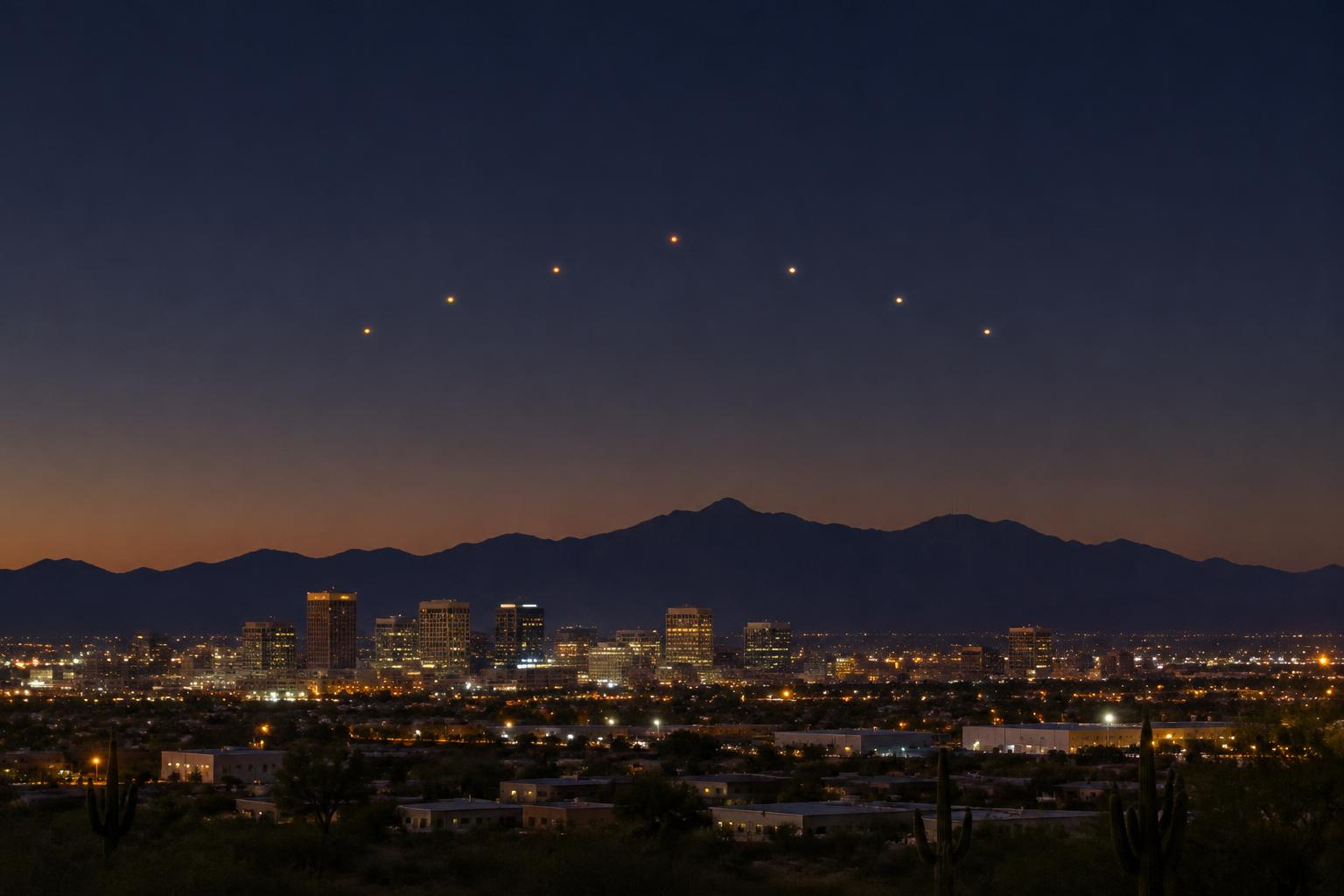
Illustrative reconstruction; not an archival photograph.
The first necessary separation
The Phoenix Lights are often presented as one enormous object crossing Arizona before pausing over the state’s largest city. The surviving reports do not justify joining the events so neatly. On March 13, 1997, observers described a moving formation during the earlier evening. Later, cameras recorded a row of bright lights toward the southwest of Phoenix. Those are distinct evidential groups, not consecutive shots in a demonstrated journey.
Phoenix New Times has repeatedly emphasized this separation, placing the moving formation around the eight o’clock hour and the widely circulated later display around 10 p.m. It matters because the famous footage is frequently used to illustrate testimony about something else. An explanation for the later lights cannot automatically identify an earlier formation, while an unresolved feature of the earlier reports cannot cancel physical evidence about the later display. A responsible account begins with two questions, not one.
An evening of reports across Arizona
Observers in different parts of Arizona described lights moving generally southward. Accounts varied in number, arrangement, apparent altitude and whether the lights belonged to a single dark body. Some witnesses described a V or boomerang; others reported separate lights. Times were not uniformly recorded, and a broad geographical sequence must not be mistaken for a continuous instrument track.
Richard F. Motzer, an Arizona MUFON field investigator writing in July 1997, criticized premature claims within the UFO-investigation community itself. His account notes changing descriptions and difficulties reconciling a single object with the reported distances and timing. As a participant’s contemporary report, it is useful primary evidence for how the investigation developed, but it does not independently verify each witness’s interpretation. Even investigators sympathetic to UFO reports recognized that the available observations could not simply be compressed into a consistent outline of one extraordinary machine.
Lights are not measured dimensions
Some witnesses experienced the moving formation as vast, low and silent. Such reports deserve accurate representation without changing their status from impression to measurement. At night, a bright point provides little direct information about distance. A formation occupying a large angle in the sky could be close and modest in size or distant and spread over a much greater physical area.
The same problem affects reported silence. Without established distance, altitude, wind and background noise, the absence of an audible engine cannot determine propulsion. Nor does an apparent dark region between lights necessarily establish a continuous solid surface. The visual system can group separate points into a single shape against a poorly resolved sky. These limitations do not prove that every witness saw aircraft. They explain why descriptions alone cannot securely establish a mile-wide craft. A genuine observation and an incorrect inference about its size can coexist without dishonesty or ridicule.
The telescope witness and the aircraft hypothesis
Amateur astronomer Mitch Stanley reported examining the earlier formation through a telescope and seeing individual aircraft, including wings and paired lights. Phoenix New Times’s later summary reproduces the account from its original reporting. Magnification gives this observation a different evidential character from naked-eye estimates, although it remains a reported observation rather than a recovered flight recorder.
A formation of aircraft offers an ordinary explanation for multiple moving lights, apparent shape and varying descriptions along a route. Skeptical investigator Robert Sheaffer identifies returning A-10s associated with Operation Snowbird as the early formation. That is his historical reconstruction and should be attributed accordingly. The telescope account supports aircraft more directly than it establishes a particular unit, route or pilot roster. Identifying those additional details requires operational documentation, and it is important not to let a persuasive general explanation silently supply every missing particular.
Around 10 p.m.: a different visual record
The later lights became the recognizable public image of the case. Seen from the Phoenix area toward the southwest, bright points appeared in a loose row and disappeared individually. Unlike most earlier testimony, this event had video that could be compared with terrain, viewing directions and the behavior of illumination flares.
A camera records projected position and brightness, not distance by itself. The footage therefore cannot establish that the lights hovered directly above the city or that they formed the edge of a single vehicle. Nor does apparent stationarity mean that an object had no motion: a distant descending light can change angular position slowly. These distinctions make the video useful rather than useless. It preserves patterns that competing explanations must account for, while also restricting what can legitimately be inferred. Its value is weakened when broadcast edits detach it from location, time and the horizon visible from the original camera position.
What the military acknowledged
By July, reporting connected the later display with visiting Maryland Air National Guard A-10 aircraft conducting training at the Barry M. Goldwater Range. A July 25 Las Vegas Sun report quoted military spokespeople describing high-intensity parachute flares released from approximately 15,000 feet. It explicitly noted that this activity would not cover all the geographically dispersed sightings.
That contemporary qualification is important. The acknowledgment supplies a documented human source for unusual lights in the relevant direction; it is not a declaration that every caller across Arizona saw the same flare drop. The delayed explanation also reflected the difficulty of checking visiting units rather than only locally based aircraft. Delay understandably reduced public confidence, but slow or incomplete communication is not itself evidence that the military concealed a nonhuman vehicle. Institutional confusion and an extraordinary cover-up are different claims requiring different evidence.
Why descending flares can seem to vanish
Illumination flares descend under parachutes while remaining bright enough to be seen at considerable distances. From a suitable viewpoint, terrain can hide them as they fall. The Estrella Mountains provide the relevant southwestern skyline in analyses of the Phoenix recordings. Lights disappearing behind that skyline can look like lamps being switched off along a vehicle, especially when darkness prevents viewers from seeing the mountain outline clearly.
Tim Printy’s compilation assembles reporting and arguments about the Maryland unit, release timing and the flare interpretation. It is a skeptical investigator’s source collection, not a military board’s final finding. Its value lies in testable relationships among viewpoint, terrain and light behavior. A convincing explanation should fit those relationships, not merely identify something that can glow. The flare account is strongest for the later filmed display precisely because there is both acknowledged activity and a plausible match to the recorded pattern.
Why early reporting needs careful handling
Contemporary journalism is indispensable here, but it contains provisional conclusions and timing problems. Tucson Weekly’s July 1997 account helped bring visiting military flights into the discussion and reported the telescope observation. Its attempt to connect flight movements, formations and flares reflects an investigation still being assembled.
This is why a date-stamped article should not be treated as a single definitive operational timeline. Reporters were receiving revised explanations, comparing statements from different bases and discussing more than one event. Later reconstructions may clarify those accounts, but they too require attribution and supporting records. The safest chronology distinguishes an early moving formation, the later filmed lights and the subsequent public acknowledgment of flare activity. It resists stitching every aircraft reference into one sortie simply because all appeared beneath the same headline. Precision sometimes means leaving a flight identification less specific than popular summaries prefer.
Publicity, authority and remembered certainty
The case grew through repeated broadcasts, anniversary coverage and increasingly familiar images. Once the footage became iconic, it offered a ready visual accompaniment for any recollection of that evening. That process can create apparent agreement without deliberate invention: people may have seen different things but later describe them through the same public vocabulary.
Public disagreement also outlasted the military explanation. Some observers maintained that what they saw did not resemble flares or conventional aircraft. Their disagreement is part of the record, but it is not positive evidence for extraterrestrial technology. An explanation need not persuade everyone to be supported, and a witness’s confidence cannot by itself settle distance, structure or origin. Conversely, a skeptical conclusion does not permit changing what witnesses actually reported. The analytical task is to preserve testimony, compare it with independent evidence and avoid equating either official authority or personal conviction with an automatically complete account.
The June reporting and the March evening
Tony Ortega’s June 26, 1997, New Times investigation supplies a useful intermediate record: close enough to the sightings to preserve contemporary disagreements, but late enough for a reporter to compare accounts. It should not be read as a transcript made during the event. Ortega was interviewing people after publicity had begun, and some of his proposed identifications remained tentative. His article is particularly valuable where it distinguishes what people observed from what they concluded.
Ortega placed reports north of Prescott at approximately 8:15 p.m. and reports south of Tucson at approximately 8:45. That half-hour bracket describes the reported progression, not a verified schedule for one tracked formation. Even if the endpoints belonged to the same flight, observers’ clocks and locations would need checking before deriving an exact speed. The early-event chronology is therefore minute-marked in the sources but not minute-resolved in the instrumental sense. Filling every interval with an imagined movement would make it appear more complete than it is.
Two reporters, one formation, different structures
New Times writers David Holthouse and Michael Kiefer were among the witnesses Ortega interviewed. They had observed from different parts of the Phoenix area and each described five bright, yellow-white lights moving from north to south in a V. Both regarded them as apparently high and heard no accompanying sound. Yet their accounts diverged on the detail most important to the giant-craft interpretation: Holthouse perceived a connection between the lights, while Kiefer did not.
This is not a reason to dismiss either account. It shows that agreement about a visible arrangement need not extend to agreement about an underlying physical object. A V-shaped configuration can be reported accurately by two people even if one experiences it as the edge of a surface and another sees separate points. Treating those witnesses as two confirmations of a solid boomerang would erase their actual disagreement. Treating them as having seen nothing would be equally inaccurate. Their testimony supports a moving light formation more securely than a measured outline.
What Stanley’s telescope account actually contains
Ortega described Stanley using a ten-inch telescope with an eyepiece giving approximately sixty-power magnification. Stanley said he acquired the approaching lights, fitted the leading three into the field of view and resolved what looked like single points into paired lights beneath squarish wings. He reportedly watched for about a minute. These details make the observation assessable: it involved a specified instrument, a limited part of the formation and a brief viewing interval, rather than an unlimited survey of every sighting that evening.
There is also a corroboration limit. His mother Linda was present and asked about the lights, but according to the article she did not look through the telescope herself. Her presence supports the circumstances of his observation, not an independent telescopic identification of wings. Stanley’s own description made the aircraft seem relatively small to him; subsequent identifications of military types were additional inferences. Separating those layers preserves the account’s strongest feature, resolved aircraft-like details, without exaggerating what a second observer or the instrument independently established.
A report that struggled to enter the investigation
The same June article followed how Stanley’s account reached journalists and local officials. Linda Stanley discussed it with fellow Honeywell employee and amateur astronomer Jack Jones. Jones said he contacted both an Arizona Republic representative and Phoenix councilwoman Frances Emma Barwood after the sightings became a public issue. Ortega reported differing explanations of what happened next: Barwood said she passed the information to Village Labs, while Jones said he received no follow-up call from that organization.
This episode is evidence about the handling of information, not proof of anyone’s motive. A dropped callback, a referral and a disputed recollection can produce an incomplete public record without a coordinated suppression campaign. It also complicates the assumption that only extraordinary testimony was ignored. The aircraft-identification witness said his information had difficulty getting attention too. Investigative completeness requires seeking reports that challenge a preferred account as carefully as reports that support it. Public calls for an inquiry are not themselves evidence that every relevant witness was successfully interviewed.
Radar absence and the limits of a negative
Air traffic controller Bill Grava told Ortega that he saw lights low on the southern horizon, disappearing behind South Mountain, and thought their brightness suggested flares. The article also reported statements from Grava and Luke Air Force Base representative Stacey Cotton that the lights had not registered on radar, while recording their qualification that this did not exclude aircraft. These statements describe what the named sources told the reporter; they are not the publication of a complete set of radar tapes.
A negative detection claim requires information about the equipment and coverage before it can become evidence of unusual technology. Secondary surveillance dependent on transponders answers a different question from a primary radar return, and an airport display does not monitor every possible object equally. The June reporting discussed those distinctions in ordinary aviation terms. It does not support the more dramatic claim that an enormous vehicle was demonstrated to be invisible to every military and civilian radar in Arizona. Nor should Grava’s southern-horizon observation automatically be assigned to the same episode as every overhead report.
Identification was not settled in June
Ortega’s article considered conventional aircraft with suitable wing shapes and reported inquiries to military bases. It also examined a rumor about the Canadian Snowbirds, whose representative said the team had not been in Arizona that March. These were leads under discussion in June, not interchangeable names for an established flight. The similarly named Operation Snowbird training program should not be confused with the Canadian display team merely because both labels contain the same word.
The distinction helps explain why readers encounter apparently contradictory histories. An early newspaper account can correctly report that no contacted unit had claimed a formation, while later research can propose a military identification using additional material. Neither proposition authorizes rewriting the earlier article as if it had already proved the later conclusion. In this dossier the aircraft explanation is supported principally by observational detail; the precise military attribution remains an attributed reconstruction. That hierarchy prevents an attractive name from replacing the evidence it is supposed to explain.
July: acknowledgment is not a universal solution
The July reporting represents another stage, with attention shifting to visiting Maryland aircraft and flare releases over the range. It is important to retain that sequence rather than imply that the flare explanation was immediately available to every witness on March 13. The Las Vegas Sun report of July 25 is a contemporary record of what military representatives were then acknowledging. The Tucson Weekly investigation belongs to the same developing public inquiry, with its own efforts to reconcile flights and observations.
There are two different historical questions here. One asks whether a proposed activity could account for a recorded display. The other asks why that explanation took months to emerge in a persuasive public form. A slow answer to the second does not invalidate a strong answer to the first. Conversely, a good physical explanation does not erase the communications failure or witnesses’ understandable frustration. Keeping institutional performance separate from identification permits criticism of the response without converting criticism into evidence for an extraordinary vehicle.
The governor’s two public roles
The Associated Press reported in March 2007 that former Arizona governor Fife Symington was publicly describing his own sighting ten years earlier. The report contrasted that account with his June 1997 press event, when his chief of staff Jay Heiler appeared in an alien costume. Symington said that he had initially kept his personal experience largely private and explained his earlier conduct in terms of avoiding panic and additional political problems. Those are his retrospective explanations, not independently demonstrated reasons for the press performance.
Symington’s later description emphasized an enormous, unfamiliar object. His experience as a pilot makes the account historically notable, but office and experience cannot supply an absent distance measurement. Nor does the later testimony retroactively turn the costume appearance into an official scientific finding. The two episodes illuminate how public authority became part of the story: a governor first appeared to ridicule a mystery and later presented himself as a witness to it. They do not establish a chain of military custody, recovered material or a verified extraterrestrial origin.
A ten-year recollection is a different source
The 2007 AP story documents what Symington was then willing to say publicly. It is not a contemporaneous March 1997 observing log. That difference need not imply deliberate fabrication. It simply places his account in the category of retrospective testimony, alongside the intervening decade of publicity that a researcher must consider. His later conviction is evidence of his interpretation, not independent confirmation that all the early witnesses shared his view or saw the identical object.
This evidential distinction also applies to anniversary documentaries and interviews generally. They can recover neglected experiences and reveal how witnesses understood an event, but they cannot recreate missing contemporaneous measurements. An editor should preserve when a statement was first recorded, what the observer could directly see, and which conclusions were added later. Otherwise, the accumulation of confident retellings can look like an accumulation of separate physical observations. In Phoenix, where two episodes already share one name, that risk is especially pronounced.
What a stronger reconstruction would require
For the early formation, the most valuable additional evidence would connect a known flight’s times and route with independently located witnesses, rather than merely place aircraft somewhere over Arizona that night. For the later display, original recording times, camera positions and terrain relationships bear directly on the flare explanation. These are proposed evidential tests, not a claim that this dossier possesses an undisclosed operational archive. The existing material offers uneven coverage, and the two groups of observations have to be assessed on their own terms.
None of the sources assembled here establishes a later declassification that reveals a secretly identified nonhuman craft. Public acknowledgment of military training, a witness’s later disclosure and a document’s subsequent online circulation are not the same thing as a declassification. The distinction is worth making because the language of a newly released secret can make familiar material seem more decisive than it is. The durable finding is less theatrical: a widely remembered Arizona night contains different observations, different explanations and persistent gaps that should not be merged into one certainty.
What is explained, and what is not
For the later filmed lights, military flare activity provides a strong, documented explanation consistent with the direction and disappearance pattern. For the earlier moving formation, aircraft are supported by the telescope account and skeptical reconstructions, although matching every scattered report to a particular flight is less secure. No single label should erase that difference in evidential strength.
The residual uncertainty is ordinary historical uncertainty about a night of imperfectly recorded observations. It is not a measured residue of alien activity. There is no publicly established physical evidence from this case demonstrating an extraterrestrial vehicle. The Phoenix Lights remain culturally powerful because their central image is simple while their actual record is divided. Keeping the two events apart does not impoverish the story. It restores the chronology, allows explanations to be tested against the right observations and prevents a famous mystery from becoming more unified than the evidence ever was.
Sources & record
- 01Richard F. Motzer, The Phoenix Lights, the Real Investigation, MUFON UFO Journal, July 1997
- 02Las Vegas Sun, July 25, 1997: military acknowledgment of flare activity
- 03Jim Nintzel and Julian Grajewski, Tucson Weekly, Case Closed?, July 1997
- 04Matthew Hendley, Phoenix New Times, The 1997 Phoenix Lights are no mystery
- 05Robert Sheaffer, Skeptical Inquirer, The Phoenix Lights Become an Incident, 2016
- 06Tim Printy, The flares and the Maryland Air National Guard, documentary compilation
Online citations
- →Richard F. Motzer, The Phoenix Lights, the Real Investigation, MUFON UFO Journal, July 1997
- →Las Vegas Sun, July 25, 1997: military acknowledgment of flare activity
- →Jim Nintzel and Julian Grajewski, Tucson Weekly, Case Closed?, July 1997
- →Matthew Hendley, Phoenix New Times, The 1997 Phoenix Lights are no mystery
- →Robert Sheaffer, Skeptical Inquirer, The Phoenix Lights Become an Incident, 2016
- →Tim Printy, The flares and the Maryland Air National Guard, documentary compilation
- →Tony Ortega, Phoenix New Times, The Great UFO Cover-up, June 26, 1997
- →Associated Press, Former Arizona Governor Comes Forward About UFO Sighting From 10 Years Ago, March 24, 2007