Champ: Lake Champlain's Monster With 300 Years of Sightings
For two centuries, witnesses around Lake Champlain have described something long, dark and serpentine moving through the water. The stories now number in the hundreds. But the monster's oldest sighting is a modern misquotation, its most famous photograph has no negative, and every piece of evidence leaves room for something ordinary.
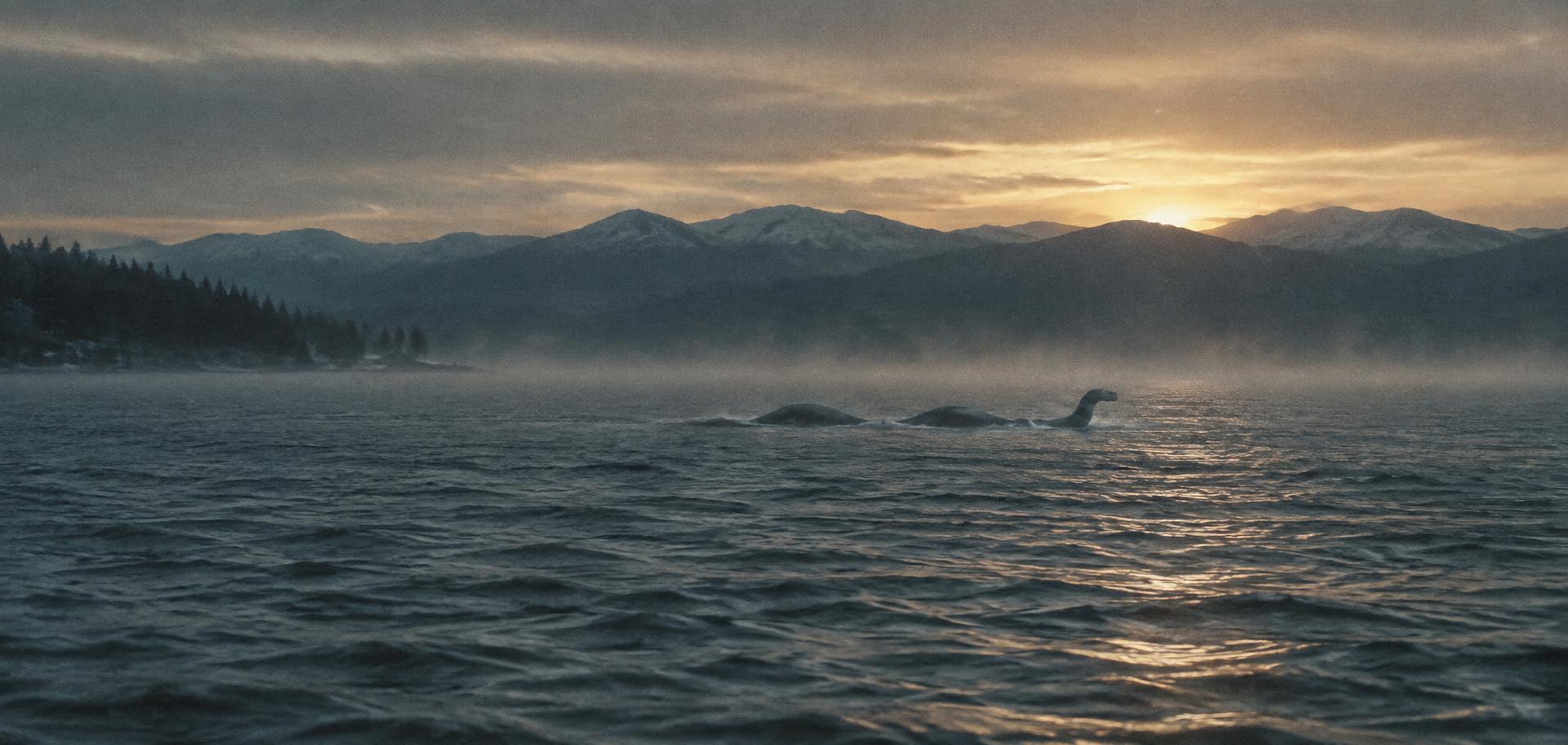
Illustrative reconstruction; not an archival photograph.
Lake Champlain is large enough to make uncertainty feel reasonable. It runs roughly 125 miles from Whitehall, New York, toward the Richelieu River in Quebec, with the Adirondacks rising on one shore and Vermont's Green Mountains beyond the other. Its deepest water reaches about 400 feet. Fog erases distance; boat wakes travel far after the boat has gone; timber washed from the watershed can rise, turn and sink. Against that landscape, more than three hundred sightings have been attributed to a creature called Champ — usually a long neck, a dark head, or several humps crossing otherwise open water. That count is a collection of reports, not three hundred verified encounters, and the descriptions do not establish that every witness saw the same thing.
The story before the newspaper record
Modern retellings often begin with Indigenous traditions. Abenaki and Haudenosaunee peoples have stories involving powerful horned or giant serpents, and regional histories connect names including Gitaskog and Onyare'kowa with the waters around Lake Champlain. Those traditions deserve care: they are not eyewitness affidavits for a modern cryptozoological animal, and collapsing distinct nations' stories into a single 'Champ legend' strips them of their own meaning. What can be said safely is that serpent beings existed in the region's oral traditions long before the tourist mascot did. The claim that those traditions describe exactly the same creature reported today is an interpretation, not a demonstrated chain of evidence.
Samuel de Champlain did not describe Champ
The most repeated origin story says the lake's French namesake saw a twenty-foot serpent with a horse-like head in 1609. No such sentence appears in Samuel de Champlain's surviving account. The wording can be traced only to a 1970 issue of Vermont Life, more than three and a half centuries after the supposed event. Champlain did write about a large armoured fish called chaousarou: he said specimens could reach eight or ten feet, that he had seen one about five feet long, and described a long snout and sharp teeth. The passage concerns a fish, probably a gar, and the sighting was not presented as a monster encounter on Lake Champlain. The celebrated 1609 sighting is therefore not the beginning of the documented record. It is a twentieth-century legend attached to an authentic but different passage.
The black monster of 1819
The earliest widely cited published report appeared in 1819. A Captain Crum was said to have seen a black monster near Bulwagga Bay, south of Port Henry on the New York side. Newspaper summaries gave it spectacular dimensions — a neck or head rising above the water, a white star on its forehead, red around the neck and a body said to be nearly two hundred feet long. The description reads like the sea-serpent journalism common to the period, and it survives through retellings rather than physical evidence. It matters because it fixes the public story in print, but its extravagant scale also shows why a sighting report cannot be treated as a measurement.
Reports multiplied during the nineteenth century as steamboat traffic grew. Passengers and crews described a large animal, an undulating body or a head and neck. In 1873 the New York press carried another burst of lake-serpent stories. Showman P. T. Barnum understood their value perfectly: accounts say he offered a reward, later reported as $20,000, for the creature's capture for his exhibition. Whether every version of the reward is exact matters less than what it reveals. By the late nineteenth century Champ was already both mystery and commodity — a story capable of filling newspapers, attracting visitors and selling a spectacle.
The photograph that changed the case
On 5 July 1977, Sandra Mansi was on the Vermont shore with her family when she photographed a dark form in the lake. The image appears to show a small head on a curved neck with a broad mass behind it. Mansi said the object remained visible for several minutes before going down. Unlike a distant verbal report, the photograph offered a fixed shape that could be reproduced, enlarged and argued over. It became the best-known image of Champ and helped carry the legend into national television and books.
The photograph is real in the limited sense that investigators found no obvious alteration to the print. That does not identify its subject. Mansi did not reveal the exact location at the time, and the original negative was lost, preventing stronger photographic analysis. Later researchers reconstructed a probable site and argued that water depth and perspective had been badly estimated. One skeptical explanation is a partly submerged tree trunk or root mass, briefly shifting or rolling in the water. The form's bark-like surface, its apparent stillness and the absence of a wake are consistent with that possibility. It is not a proven solution, but neither is the photograph proof of an unknown species.
Video, underwater sound and what they establish
Other recordings have kept the file open. In 2005 fishermen Dick Affolter and his stepson Pete Bodette made video near Oakledge Park in Burlington of a dark shape moving at the surface. The low-resolution sequence is intriguing but too indistinct to identify. Underwater recordings made during expeditions in 2003 and later years captured rapid clicks that researchers compared with cetacean echolocation. A 2010 conference abstract in the Journal of the Acoustical Society of America described the signals as unexpected and within the structure of sounds made by belugas, killer whales and dolphins. It did not identify the source as Champ, establish that it came from an unknown animal, or report the discovery of a freshwater cetacean. An unexplained sound is evidence of an unexplained sound — no more, and no less.
Could a large unknown animal live in the lake?
Lake Champlain is deep, productive and connected northward to the St. Lawrence through the Richelieu River, but a breeding population of very large air-breathing animals would need food, mates and repeated access to the surface. It should leave more than ambiguous silhouettes: carcasses, bones, environmental DNA, clear sonar tracks or consistent close-range photographs. None has been produced. The idea that a plesiosaur survived from the age of dinosaurs fails outright; non-avian dinosaurs and marine reptiles disappeared about 66 million years ago, while the modern lake was shaped by glaciers only thousands of years ago.
The lake was briefly part of the saltwater Champlain Sea after the last ice sheet retreated, and beluga remains have been found in Vermont. That geological fact is sometimes used to propose a trapped marine mammal lineage. But the sea connection ended roughly ten thousand years ago, and no fossil, body or genetic trace shows that such a population survived the transition into the present freshwater lake. Known animals offer less dramatic possibilities. Lake sturgeon can grow large and surface unexpectedly; groups of swimming otters can create a chain of apparent humps; diving birds, deer, moose, schools of fish and boat wakes can all look extraordinary when distance is uncertain. Floating logs are especially persuasive in cold water because they can rise as gases build, roll, trail roots and sink again.
Why the reports keep coming
Calling every witness dishonest would explain nothing. Human vision is forced to make fast decisions from partial information, and water removes the usual clues to size and distance. Once an observer knows the local legend, an unfamiliar wake already has a name. Reports then influence later reports: the long neck made famous by the Mansi photograph becomes the shape people expect to see. This does not mean witnesses saw nothing. It means sincere observation and mistaken identification can exist together.
Champ also survives because the communities around the lake chose to keep the creature. Vermont and New York legislators passed resolutions protecting Champ from harm, symbolic measures that treated the monster as a valued regional icon rather than verified wildlife. Champ became the mascot of Vermont's minor-league baseball team, appeared on signs and souvenirs, and gave the lake a friendly mystery shared across state and national borders. The legal language is often presented as official recognition; it is better understood as folklore made civic — an agreement that, real or not, the creature belongs to the place.
What remains in the water
There is no reliable zoological evidence that an undiscovered giant animal inhabits Lake Champlain. The famous 1609 account is misquoted, the 1819 report is sensational and secondhand, the Mansi photograph is ambiguous, and the underwater clicks have no identified source. Yet those failures do not empty the story. Champ is a record of how people interpret a difficult surface: a black curve at dusk, three humps beyond a boat, a wake moving against the wind. For more than two hundred years of print — and longer in stories now folded into the legend — the lake has offered just enough distance to prevent certainty. Whatever made each sighting, that uncertainty is the one thing Champ has never lacked.
Sources & record
- 01Samuel de Champlain's published voyages — the chaousarou passage describing a large armoured fish, not a twenty-foot lake serpent.
- 02The Plattsburgh Republican and later newspaper retellings of Captain Crum's 1819 Bulwagga Bay report.
- 03Robert E. Bartholomew, The Untold Story of Champ: A Social History of America's Loch Ness Monster (SUNY Press, 2012).
- 04Sandra Mansi's account and 1977 photograph, with later site analysis discussed by skeptical investigators Benjamin Radford and Joe Nickell.
- 05Elizabeth von Muggenthaler, Joseph Gregory and Scott Mardis, 'Echolocation in a fresh water lake,' Journal of the Acoustical Society of America conference abstract (2010).
- 06Lake Champlain Basin Program publications on the lake's natural and human history and the postglacial Champlain Sea.
Online citations
- →SUNY Press — The Untold Story of Champ by Robert E. Bartholomew
- →Lake Champlain Basin Program — A Natural and Human History of Lake Champlain
- →Lake Champlain Region — the Champlain misquotation and history of the legend
- →Skeptical Inquirer — new research on the Sandra Mansi photograph
- →Journal of the Acoustical Society of America — Echolocation in a fresh water lake
- →WAMC — Champ folklore marker and New York's protective resolution
- →ECHO Leahy Center — Champ: America's Lake Monster exhibit