D.B. Cooper: The Man Who Hijacked a Plane, Took $200,000, and Stepped Into the Dark
On the afternoon before Thanksgiving in 1971, a quiet man in a business suit bought a one-way ticket under the name Dan Cooper, sat down in seat 18C of a Boeing 727, and ordered a bourbon and soda. By eight o'clock that night he had $200,000 in cash strapped to his body and was standing at the bottom of the plane's rear stairs, in a rainstorm, somewhere over southwestern Washington. Then he jumped. Neither he nor most of the money has ever been found. It remains the only unsolved skyjacking in American history.
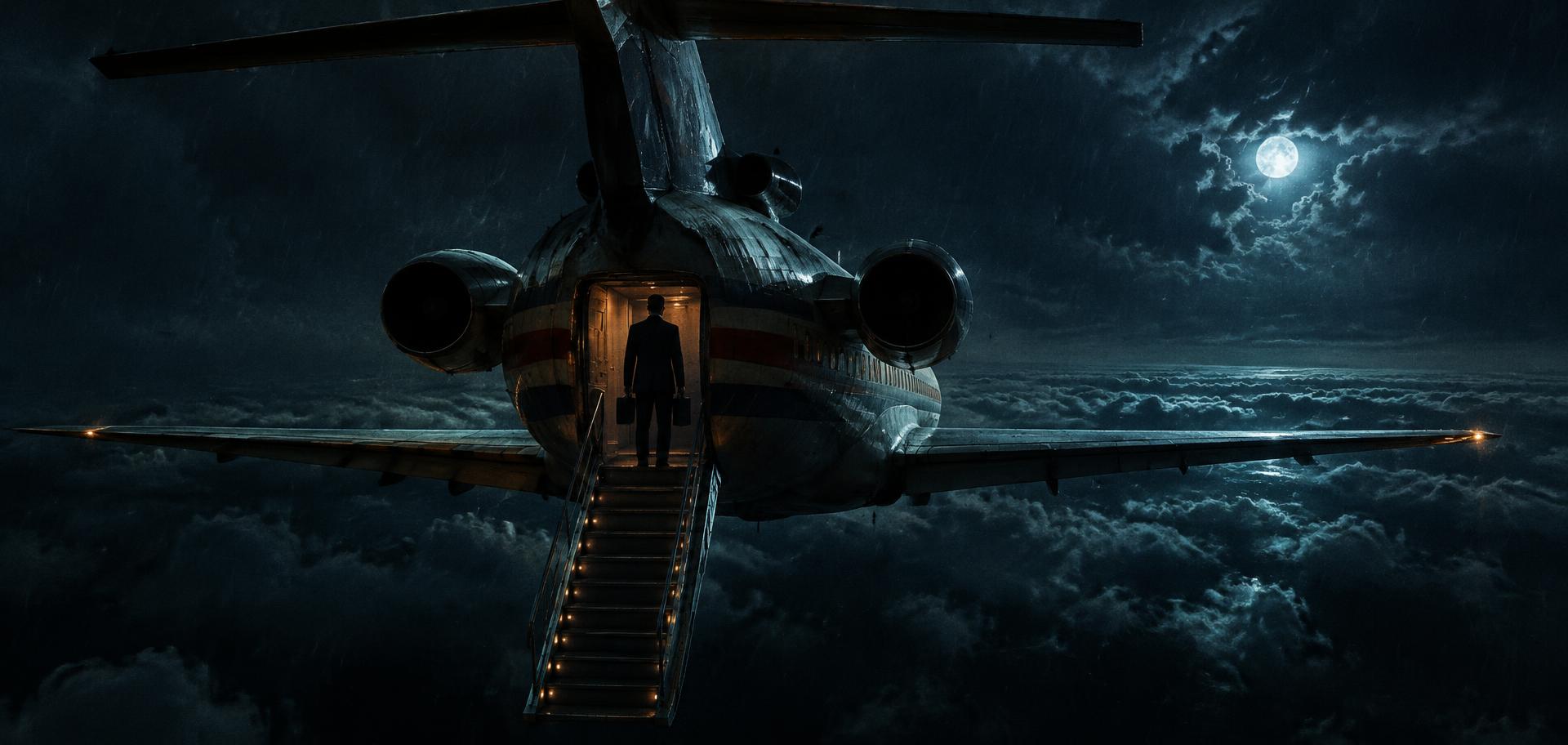
Illustrative reconstruction; not an archival photograph.
Between 1968 and 1972, American aviation lived through what newspapers called the golden age of skyjacking. More than 130 airliners were hijacked in the United States in those four years — at one point, planes were being taken to Havana roughly once a week. Airport metal detectors did not exist yet; boarding a plane meant walking up to a counter with cash and a one-way ticket, and stepping aboard. Nearly all of those hijackings ended the same way: a surrender, an arrest, a shootout, or a forced landing in Cuba. Exactly one of them did not. The man who hijacked Northwest Orient Flight 305 on the afternoon of 24 November 1971 committed the crime politely, collected $200,000, released every passenger unharmed, and then did something no hijacker before or since has managed: he vanished completely.
The aeroplane that made it possible
The crime could only have been committed on one type of aircraft. The Boeing 727 was the only American airliner with a rear airstair — a set of folding stairs that lowered from beneath the tail — and the only one from which a person could exit in flight without a jet engine in the way. When Cooper specifically requested a 727 during the negotiation, the crew understood immediately what he was doing. The industry understood too: after 1971, airlines fitted the stairs with a small spring-loaded locking pin — officially called a flight-lock latch, but known to this day throughout aviation as the Cooper vane — which prevents the stairs from being lowered in the air. The man who hijacked Flight 305 is the reason that part exists.
A man named Cooper
He bought his ticket at the Northwest Orient counter at Portland International Airport for eighteen dollars and fifty cents, in cash, under the name Dan Cooper — a wire-service mix-up with an early suspect actually named D.B. Cooper is what stuck the wrong initials to him forever. Flight 305 departed for Seattle at 2:50 p.m. Witnesses described a white man in his mid-forties, around six feet tall, in a dark business suit, white shirt, narrow black tie with a mother-of-pearl clip, and a black raincoat. He sat alone in the rear of the 727, ordered a bourbon and soda, paid for it, and lit a cigarette. Shortly after takeoff he handed a folded note to flight attendant Florence Schaffner, who slipped it into her purse unopened — hijack notes were common enough by then to be routine. He leaned toward her and told her, quietly, that she had better look at it, because he had a bomb.
When Schaffner opened the note, the handwriting in felt-tip capitals told her to sit beside him; the second line said he had a bomb. When she sat, the note's demands were explicit: $200,000 in negotiable American currency and four parachutes — two main, two reserve. When she asked to see the bomb, Cooper opened his briefcase long enough for her to see red cylinders, tangled wires and a large battery, then closed it. The crew relayed the demands to the airline, whose president approved payment without hesitation — the note had warned of retaliation against other flights. The plane circled the Seattle area for roughly two hours while the FBI assembled the ransom: 10,000 twenty-dollar bills, every serial number recorded on microfilm before the bag left the bank. That list would become one of the most important pieces of evidence in the case — and one of the most tantalising, because almost none of those bills has ever surfaced.
The exchange at Seattle
Flight 305 landed at Seattle-Tacoma just after 5:30 p.m. Cooper released all 36 passengers and two of the crew in exchange for the money and parachutes, keeping four crew members aboard: pilot William Scott, co-pilot William Rataczak, flight engineer Harold Anderson, and flight attendant Tina Mucklow, who spent the next hours beside him and later gave the FBI its most detailed account of the man. He asked for civilian parachutes and refused military-issue gear — he knew, or behaved as if he knew, the difference. He asked Mucklow how a reserve chute was opened. He drank another bourbon, smoked, and at one point observed that his face was already known and that the money could buy him out of that. Whether that was bravado, a warning or a glimpse of a plan has never been established.
He was calm throughout — courteous, even — and gave the crew precise flight instructions: fly to Mexico City at the lowest possible speed, roughly 170 knots, landing gear down, flaps at 15 degrees, cabin unpressurised, altitude no higher than 10,000 feet. The crew negotiated a refuelling stop in Reno. He accepted. Then he told them to take off with the rear stairs down, and to keep the cabin dim. Everyone aboard understood what those instructions meant. Nobody flies low, slow and unpressurised with the airstair of a 727 hanging open unless they intend to leave the aircraft in flight.
8:13 p.m.
The plane took off again at about 7:40 p.m., trailed at a distance by military jets. Cooper sent Mucklow to the cockpit and shut the partition between the cabin and the cockpit door — remaining, as far as the crew knew, alone in the rear cabin with the money, the briefcase and the parachutes. At approximately 8:13 p.m., somewhere over the wooded, rain-swept terrain north of Portland, the crew felt a distinct change in air pressure — the same sensation a door opening in flight produces — and saw the warning light indicating the aft airstair had been lowered. The tail of the plane pitched upward noticeably. When the aircraft landed in Reno at about 10:15 p.m., with the stairs still extended and dragging in the slipstream, the rear cabin was empty. Cooper, the briefcase, and two of the four parachutes were gone.
What he left behind became the entire physical case: a black clip-on tie with its mother-of-pearl tie pin, eight cigarette butts of the same brand, and 66 fingerprints that matched no one on file. No bomb has ever been found. No parachute has ever been positively identified as his. No one matching his description was seen alive again.
NORJAK
The FBI's file on the case, known internally as NORJAK — Northwest Hijacking — eventually ran to some 60 volumes and thousands of pages, one of the largest investigations in the bureau's history. Agents searched the suspected drop zone around Ariel and the Lewis River basin on foot and from the air, by ground teams, helicopters and infrared sensors flown over the forest at night. The bureau tested the physics of the jump itself, at one point dropping instrumented sleds from a 727 with its airstair open to reconstruct what Cooper's fall would have been like. More than a thousand suspects were interviewed and eliminated. The recorded serial numbers were circulated to banks, casinos and law enforcement worldwide. Nothing came back. A parachute discovered near Amboy, Washington, was examined and judged not to be Cooper's. For nine years the case produced exactly one piece of physical evidence — the tie — and then, in February 1980, it produced a second.
The money at Tena Bar
On 10 February 1980, an eight-year-old boy named Brian Ingram was digging a fire pit on a sandy Columbia River beach called Tena Bar, a few miles downstream from Portland, when his hands found something that was not driftwood: three bundles of decaying twenty-dollar bills, held together by rubber bands that fell apart at his touch. The FBI confirmed it within days — 5,800 dollars in ransom bills, their serial numbers matching the microfilm list made in Seattle eight years earlier. The bundles had been separated and partially buried in the sand; two of the three original packets were never located.
The find solved almost nothing, because nobody could explain how the money got there. The beach sits below the river's normal winter level, on a stretch of bank that had been dredged by the Army Corps of Engineers after the hijacking — a fact that supports theories in which the packets floated downstream from a crash site or washout somewhere on the river. Other researchers have argued the sandbar's currents could never have carried the bundles there intact, and that Cooper himself must have buried or dropped the money near the river. Geologists, hydrologists and amateur investigators have argued about the hydraulic modelling of Tena Bar ever since, and the argument has never been settled. What the bills do prove is that at least part of the ransom was in or near the Columbia River within years of the jump — and that the other 194,200 dollars, in recorded serial numbers, has never appeared in circulation anywhere in the world.
Did he survive?
The central question has never changed: could the jump have been survived? The conditions were brutal — night, rain, wind chill well below freezing, over dense forest with no visibility to a jumper, in a business suit and loafers, with a parachute he may not have been able to steer. One of the four chutes the airline supplied had been delivered with its cords sewn shut — a non-functional training dummy sent by mistake — although the evidence suggests Cooper selected working chutes before the dummy could matter. The FBI's eventual position combined two claims: that Cooper was probably an experienced parachutist, because his specific demands, his familiarity with the aircraft and his chute selection suggested it, but that the jump itself was likely not survivable, and that he died somewhere in the Washington wilderness, his remains never found.
That second claim has always sat awkwardly with the first. Not one of the 10,000 recorded ransom bills has ever surfaced in the money supply — not from a bank, not from a cash register, not from a collector — which is exactly what you would expect if the money was lost with the man who took it. It is also, investigators have conceded, what you would expect from someone disciplined enough to never spend a single bill of it. A body was never found in one of the most intensively searched wilderness areas in American history. Neither was the briefcase, either parachute, or any trace of the man. The FBI's own conclusion — that he probably died in the fall — remains a probability, not a finding.
The suspects
Over five decades the case has accumulated a small army of proposed suspects, and it is important to be precise: none has ever been proven, and the FBI never officially identified anyone as Cooper. The most persistent candidates include Richard Floyd McCoy Jr., a National Guard veteran and parachutist who hijacked a United Airlines 727 in April 1972 in a strikingly similar copycat crime — demanding $500,000, jumping over Utah — and was caught within days, convicted, and later killed in 1974 in a shootout with FBI agents after escaping prison. Most investigators, including the FBI agents closest to the case, concluded he was not Cooper; the physical descriptions and parachuting skill did not align, and McCoy's jump used different methods.
There is Duane Weber, a veteran with a prison record who died of kidney disease in 1995 after reportedly telling his wife, in his final months, that he was Dan Cooper; his widow Jo spent years pressing the claim after finding his name written in her book on the case. The FBI obtained Weber's DNA from his exhumed remains and tested it against material on the tie; the result did not match, and the bureau ruled him out as a contributor — his widow continued to believe otherwise. There is Robert Rackstraw, a Vietnam veteran with parachute and explosives training, dismissed from the Army, who was publicly named by a private investigative team in 2016–2018 as their prime candidate and always denied it; he died in 2019. In 2011, a woman named Marla Cooper came forward claiming her late uncle, Lynn Doyle Cooper, had told her as a child he was involved; the FBI took DNA samples from relatives and never confirmed any match. In 2024, amateur researchers publicised new claims about yet another deceased suspect. Each wave of names follows the same pattern: circumstantial detail, media attention, and no conclusive evidence.
The tie
The most promising modern lead is physical rather than testimonial. The FBI released the case evidence to civilian researchers, and in 2017 a private team of scientists calling themselves Citizen Sleuths announced what particle analysis of Cooper's clip-on tie had found: titanium particles, stainless steel, and — most distinctively — traces of cerium and strontium sulfide, chemicals used in metal smelting and high-temperature manufacturing. The combination suggests the wearer worked in or around the metals trade — a machinist, a welder, a metallurgical engineer — possibly in the aerospace industry, possibly at a plant such as Boeing, which had enormous operations in the Pacific Northwest. It is the closest thing to a profile the case has ever produced. It narrows the man to a trade and an industry, and it has never been confirmed by any official finding. The tie remains the only object Cooper ever owned that the world knows he touched.
The case is closed. It is not solved.
In July 2016, forty-five years after the hijacking, the FBI announced it was closing its active investigation, citing the need to redirect resources to higher-priority cases, and preserving the physical evidence — the tie, the fingerprints, the recovered bills — in case new evidence ever emerges. The bureau's statement was careful: the case was being suspended, not solved. Whoever Dan Cooper was, he got away with it in the only sense the record can measure. His crime triggered the security systems that now guard every airport in the world, gave a permanent name to a part on every 727 still flying, and left behind something stranger than a body or a confession would have been: a perfect outline of a man, drawn from a few hours of witness testimony, a tie, some fingerprints and 5,800 waterlogged dollars — and then nothing, for more than half a century. Every Thanksgiving, a small gathering of enthusiasts still meets at the general store in Ariel, Washington, near the suspected drop zone, to mark the night a man in a business suit stepped off the back of an airliner and into American folklore. They have never had a name to write on the cake.
Sources & record
- 01FBI case file NORJAK (Northwest Hijacking), released in part under the Freedom of Information Act.
- 02FBI public statements on the 2016 suspension of the active investigation.
- 03Contemporary reporting from November 1971 and later retrospectives.
- 04Citizen Sleuths' published particle analysis of the tie (2017).
Online citations
- →FBI — D.B. Cooper hijacking, famous cases overview
- →FBI Seattle — 2016 update on the investigation
- →Smithsonian Magazine — after 45 years, the FBI stops looking for D.B. Cooper
- →History.com — the D.B. Cooper case
- →History.com — the Tena Bar money find
- →History.com — why the D.B. Cooper mystery endures
- →All That's Interesting — inside the D.B. Cooper investigation
- →Wikipedia — D. B. Cooper, sourced overview