The Roanoke Colony: 117 People Vanished and Left One Word
When John White returned to Roanoke after three years, every colonist was gone. The houses had been dismantled, the boats had vanished, and CROATOAN had been carved into a palisade post. It looked less like a sudden disappearance than a message — but storms prevented White from following it.
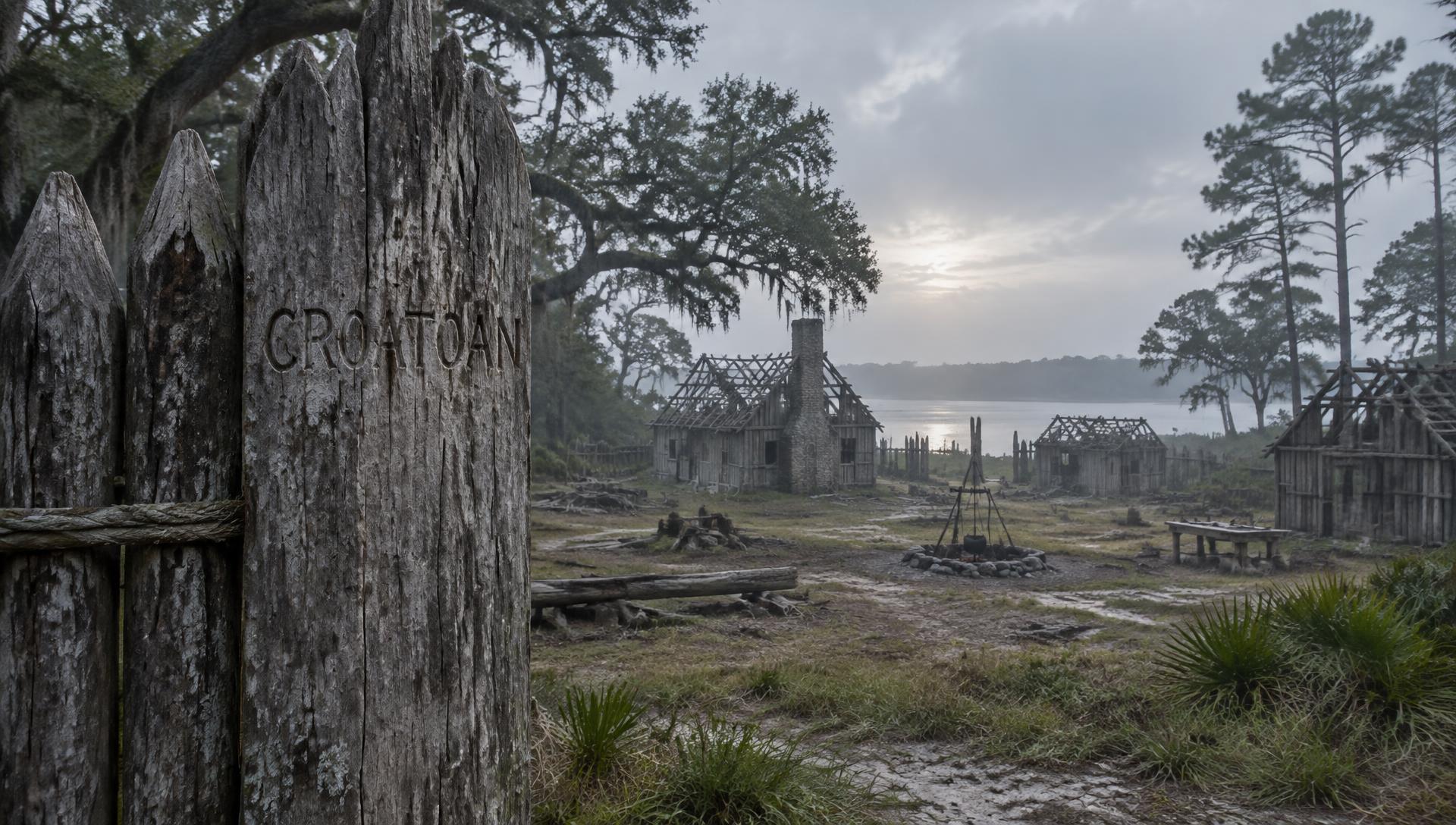
Illustrative reconstruction; not an archival photograph.
On 18 August 1590, Governor John White stepped onto Roanoke Island expecting to find the English colony he had left three years earlier. Instead he found an empty enclosure. No settler came to the shore. The houses had been taken down, the colony's small boats were gone, and the place had been surrounded by a new timber palisade. On one tree White saw three letters, CRO, cut into the bark. On a post at the entrance, he found the full word CROATOAN. There were no bodies and no sign that the settlement had been burned. The colonists had not vanished without a clue. They had left a destination — but White never reached it.
Why the number 117 is not exact
The headline number is the familiar modern count, but it should not be mistaken for a perfect census. The National Park Service itself describes White's company as 117 people on one page and 118 on another. Surviving lists are incomplete, and totals depend on whether unnamed children, crew members or late changes are included. A commonly repeated reconstruction gives 91 men, 17 women and nine children — 117 people — while other histories offer larger estimates. The safest statement is that roughly 117 men, women and children established the 1587 colony. Their disappearance was not merely the loss of soldiers or explorers; this was an attempted civilian settlement containing families.
A colony placed in the wrong location
Roanoke was already a damaged experiment. Sir Walter Raleigh's first colony there, established in 1585 under Ralph Lane, had collapsed after hunger and worsening conflict with the region's Algonquian communities. English soldiers killed the Roanoke leader Wingina, also called Pemisapan, before abandoning the island in 1586. That violence mattered when the next group arrived. The new colonists were supposed to establish a permanent settlement farther north around Chesapeake Bay, where conditions appeared better. Their pilot, Simon Fernandes, instead put them ashore at Roanoke in July 1587 and refused to carry them onward.
The settlers repaired what remained and tried to rebuild relations. Manteo, an Indigenous man who had travelled to England and remained allied with the English, was baptized and granted the title Lord of Roanoke and Dasamunkepeuc. But another colonist, George Howe, was killed while gathering shellfish, and attempts to renew contact with neighbouring communities brought little security. On 18 August, White's daughter Eleanor Dare gave birth to Virginia Dare, the first English child recorded as born in the Americas. Nine days later, the colonists persuaded White to sail for England and secure supplies. It was the last confirmed time anyone outside the colony saw them.
The relief voyage that took three years
White did not intend to remain away. England's war with Spain made returning extraordinarily difficult. A small 1588 relief attempt was attacked by French privateers and turned back, while the threat of the Spanish Armada kept larger English vessels in home waters. By 1590 Raleigh's priorities had shifted and White obtained passage only with a privateering fleet whose commanders treated Roanoke as a detour. The three-year delay was catastrophic: whatever happened at the colony occurred beyond outside observation, and any trail was already old when help arrived.
Even the final approach went wrong. Storms battered the fleet off the Outer Banks. During a landing attempt on 17 August 1590, one boat overturned in the surf and its captain and several sailors drowned. White finally reached the settlement the next day — Virginia Dare's third birthday. His written account, later published by Richard Hakluyt, is the central surviving record of what the search party found.
CROATOAN was a place, not a warning
Before White left in 1587, he and the colonists agreed on a simple code. If they moved, they would carve the name of their destination into a tree or post. If they departed under force or distress, they would add a cross above the name. White found no cross. He wrote that this made him greatly relieved, because Croatoan was not an unknown or ominous word. It named both an island about fifty miles south — now Hatteras Island — and the people who lived there. Manteo came from that community, which had maintained friendlier relations with the English than the people around Roanoke.
The popular version compresses the evidence into one cryptic carving. In fact there were two: CRO on a tree and CROATOAN on a palisade post. White also observed that the houses had been dismantled rather than burned or smashed, and that heavy objects he had buried were later exposed and spoiled. The missing boats, removed buildings, new defensive wall and agreed message point toward an organized relocation. They do not prove that every colonist reached Croatoan safely, but they argue strongly against an entire settlement disappearing instantaneously.
The search ended within hours
White wanted to sail directly to Croatoan. Weather and the condition of the ships prevented it. Rough seas had cost the fleet anchors and cables; another storm drove the vessels away from the coast. The commanders abandoned the attempt and sailed first toward the Caribbean and then England. White never returned. The decisive search — following the colonists' own written instruction to the island they had named — was never completed in his lifetime.
Did the colonists join the Croatoan?
Relocation to Croatoan Island is the most direct reading of the surviving evidence. The colonists knew the community, had an ally from it, named it without the agreed distress mark, and removed useful structures and boats before leaving. English objects found on Hatteras Island include gun parts, metal fragments, ceramics and a signet ring, some recovered from contexts associated with Indigenous settlement. Archaeologists have argued that the mixture is consistent with at least some colonists living among the Croatoan people.
Those finds are suggestive rather than conclusive. European objects could arrive through trade, salvage or later contact, and no excavated object carries the name of a known colonist. A single colony also need not have shared one fate. Some people may have gone to Croatoan while others moved inland toward the Albemarle Sound or Chesapeake region. Later Jamestown accounts recorded Indigenous people with European features and stories of English survivors living among Native communities, but these reports were secondhand, politically useful and recorded decades after the disappearance. They cannot identify individual Roanoke colonists with certainty.
The inland clue and competing explanations
A patch on one of John White's maps concealed the symbol of a small fort near the head of Albemarle Sound. Archaeological work at a location known as Site X has found small quantities of late-sixteenth-century English pottery, prompting a proposal that part of the colony moved inland. Critics note that the material is sparse and could have come from trade or an English scouting party. Like the Hatteras finds, it fits dispersal but does not prove the identity or fate of the people who carried it.
Other explanations remain possible. Drought, hunger and disease could have weakened the settlement; tree-ring research indicates severe regional drought during the broader period of the Roanoke ventures. Hostile groups might have attacked some colonists after they relocated. Spanish forces knew of English activity but left no record of destroying this colony, despite usually documenting such operations. The so-called Dare Stones, which appeared in the 1930s and claimed to narrate Eleanor Dare's journey and the colonists' deaths, were exposed largely as modern fabrications. They are part of the mystery's history, not reliable evidence for its solution.
What probably happened
The evidence supports a movement, not a magical disappearance. Facing inadequate supplies and little prospect of immediate relief, the colonists dismantled their homes, took their boats, fortified the site and left the destination agreed with their governor. At least some probably moved south to live with or near the Croatoan community; others may have dispersed inland. Assimilation, hunger, disease and violence are not mutually exclusive outcomes across a group of more than one hundred people over several years.
What remains unresolved is not whether they left a clue, but what happened after they followed it. No verified grave, roster of survivors or archaeological discovery accounts for the whole colony. White arrived close enough to read their message and too late — by weather, war and circumstance — to act on it. CROATOAN survives because it is both answer and dead end: the colonists said where they intended to go, and history never recorded whether they arrived.
Sources & record
- 01John White, 'The Fifth Voyage of M. John White into the West Indies and Parts of America called Virginia,' written 1593 and published in Richard Hakluyt's Principal Navigations.
- 02National Park Service, Fort Raleigh National Historic Site histories of the 1587 colony and 1590 rescue voyage.
- 03Brendan Wolfe, 'Roanoke Colonies, The,' Encyclopedia Virginia, Virginia Humanities.
- 04Phillip W. Evans, 'Lost Colony,' Encyclopedia of North Carolina, University of North Carolina Press, 2006.
- 05Archaeological reporting from the First Colony Foundation and Croatoan Archaeological Society, considered alongside scholarly criticism of provenance and dating.
Online citations
- →National Park Service — 1587: The Lost Colony
- →National Park Service — the 1590 rescue voyage
- →National Park Service — John White and the CROATOAN discovery
- →National Humanities Center — John White's 1590 primary account (PDF)
- →Encyclopedia Virginia — the Roanoke Colonies
- →NCpedia — Lost Colony
- →Library of Congress — Jamestown and Roanoke primary-source guide
- →National Geographic — archaeology and the search for the Lost Colony