The Somerton Man, Named at Last
A well-dressed man was found dead on an Australian beach without identification. A torn line of Persian poetry, an undeciphered sequence of letters and a missing name turned him into a national mystery. Genetic genealogists now say he was Carl Webb — but the official file is not yet fully closed.
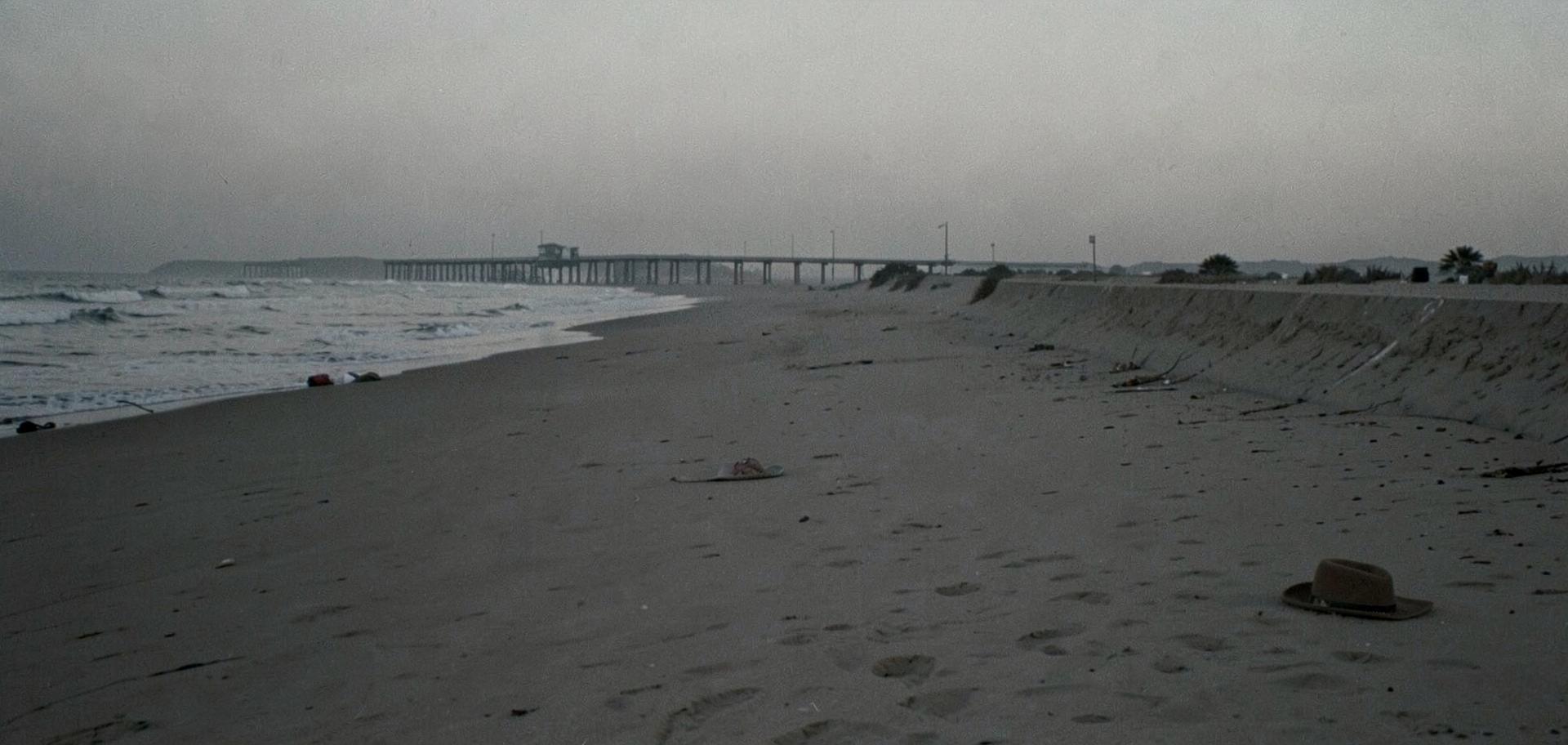
Illustrative reconstruction; not an archival photograph.
At about 6:30 on the morning of 1 December 1948, two horse riders found a man dead against the seawall at Somerton Beach, south of Adelaide. He was neatly dressed in a jacket, tie, trousers and polished shoes. He carried no wallet or identification. A cigarette lay against his collar. People who had passed the same place the previous evening remembered a man lifting an arm and then lying still; none understood that they may have been watching his final hours.
Police photographed him, took fingerprints and circulated descriptions, but no match restored his name. Most identifying labels had been cut from his clothes. The post-mortem examination found congestion in several organs and blood mixed with food in the stomach. Pathologists considered a fast-acting poison possible, yet chemical tests identified none. The inquests did not establish a cause of death: poisoning remained a suspicion, not a finding.
A journey reconstructed from two tickets
His pockets contained an unused second-class rail ticket from Adelaide to Henley Beach and a used bus ticket from the city toward Glenelg. Investigators believed he arrived at Adelaide railway station on 30 November, left a suitcase in the cloakroom, used the station baths and later took the bus toward the coast. That is a reconstruction from the tickets and luggage, not a witnessed itinerary.
The brown suitcase, recovered in January 1949, held clothing, slippers, toiletries, scissors, a table knife altered into a sharp instrument, and stencilling brushes of a kind associated with marking cargo. Labels had again been removed. Several surviving marks read Keane, Kean or T. Keane, but searches found no missing man who fit. A distinctive orange-brown thread in the case matched a repair in the trousers he wore. The link to the dead man was persuasive; the names were not.
The paper hidden in the fob pocket
In April 1949, pathologist John Cleland re-examined the clothing and found a tiny rolled scrap in a watch pocket that earlier searches had missed. It bore the printed words Tamám Shud — commonly translated as 'ended' or 'finished' — from the final page of Edward FitzGerald's Rubáiyát of Omar Khayyám. The phrase gave the case the name by which it was known for decades: the Tamám Shud mystery.
After police appealed for the missing book, a local man produced a copy reportedly found in an unlocked car near Glenelg. Its final page matched the scrap. On the back were faint lines of capital letters, one line crossed through, and a telephone number. The marks have inspired claims of an espionage cipher, but no solution has been verified. Their brevity may make a unique solution impossible: they could be a code, initials, a memory aid or meaningless notation.
The telephone number and the nurse
The number led to a woman living close to the beach, later publicly identified as Jessica Thomson and often called 'Jestyn' in accounts of the case. She had trained as a nurse, although claims about her exact employment in December 1948 should be treated cautiously. She told police that during the war she had given a copy of the Rubáiyát to Lieutenant Alf Boxall. Investigators initially wondered whether the dead man was Boxall, until Boxall was found alive in Sydney with his copy intact.
Accounts say Thomson reacted strongly when shown the plaster bust made from the dead man's face, but that reaction cannot establish recognition or a relationship. Her number in the book is evidence of some connection to its owner, not proof that she knew the man on the beach. Later theories linking the Somerton Man to Thomson's family attracted enormous attention; genetic research announced in 2022 ruled out the specific claim that researcher Derek Abbott's wife was the man's granddaughter.
What the inquests could not decide
The first inquest opened in 1949, and the case returned to the coroner in 1958. The evidence did not identify the man or explain his death. Suggestions that an undetectable cardiac glycoside had been used remained hypothetical. So did theories of suicide, murder and intelligence work. The removed labels, foreign-sounding literary clue and unreadable letters made a spy story tempting in the early Cold War, but no service record, handler, mission or verified cipher has ever supported it.
He was embalmed while inquiries continued, a plaster cast was taken of his head and upper torso, and he was buried in Adelaide's West Terrace Cemetery in June 1949. His grave marker read 'Here lies the Unknown Man who was found at Somerton Beach.' The cast, created because police expected the body itself would soon be inaccessible, eventually carried the biological material that reopened the identity question.
Exhumation and a separate DNA search
South Australia Police exhumed the remains on 19 May 2021. The grave was deeper than expected, but investigators recovered remains described as complete and in reasonable condition. Forensic Science SA began its own examination under formal evidentiary controls. That official process was separate from a long-running private investigation led by University of Adelaide professor Derek Abbott.
Abbott's team worked instead with hairs trapped in the plaster bust. American forensic genealogist Colleen Fitzpatrick helped obtain a usable DNA profile from a rootless hair. They compared inherited segments with matches in genealogical databases, built overlapping family trees containing thousands of people and searched for a man of the right age and circumstances who lacked a recorded death. The trail converged on one person: Carl Webb.
Carl Webb emerges from the records
Abbott and Fitzpatrick announced their conclusion in July 2022. Carl 'Charles' Webb was born in Footscray, Victoria, on 16 November 1905, one of six children of Richard and Eliza Webb. Records described him as an electrical instrument maker. He married Dorothy Jean Robertson in Melbourne in 1941. Their relationship ended, and Dorothy later sought a divorce on the ground of desertion. She moved to South Australia, offering a plausible reason Webb might have travelled there, though no document proves that was his purpose.
Webb had disappeared from ordinary records in the late 1940s and had no known death certificate. Genetic matches connected the bust hair to descendants on both sides of his family tree. Abbott said the combined result made him 99.99 per cent confident. The researchers also found a family connection to the name Keane: one of Webb's brothers-in-law was Thomas Keane. That may explain the marked clothing, but it does not show why Webb possessed it or why other labels were removed.
A persuasive name is not yet a coronial name
The distinction matters. Carl Webb is the identification reached by Abbott and Fitzpatrick from hair associated with the bust; it was not announced as the result of the police examination of the exhumed remains. South Australia Police said in 2022 that it was cautiously optimistic and that the identity would ultimately be determined by the coroner. Reporting in July 2026 said the police report was still approaching completion. No public coronial finding had yet formally named Webb.
The genetic-genealogy result is therefore strong and widely accepted, but the evidentiary routes should not be blurred. A private family-tree identification and a forensic identification from exhumed remains answer different standards of proof and chain of custody. Until the coroner rules, the careful formulation is that the Somerton Man has been persuasively identified as Carl Webb, not officially declared to be him.
The name closes only one part of the file
Naming Webb replaces the blank at the centre of the case with a documented life, but it does not tell us what happened on the beach. His cause of death remains undetermined. No verified explanation exists for the pencilled letters, the removed labels or the Rubáiyát's path into the car. The nature of any connection to Jessica Thomson remains unknown. Espionage has never advanced beyond conjecture.
The deepest change is less theatrical. The man in the grave was not merely a cipher, a plaster face or a vehicle for somebody else's theory. He appears to have been Carl Webb: a son, brother, husband and instrument maker whose final movements are still missing. Genetic genealogy may have returned his name. History has not yet returned his last day.
Sources & record
- 01South Australian coronial inquests into the death of the unidentified man found at Somerton Beach, 1949 and 1958.
- 02Derek Abbott and Colleen Fitzpatrick, genetic-genealogy investigation announced in July 2022.
- 03South Australia Police and Forensic Science SA statements concerning the 2021 exhumation and continuing investigation.
- 04Gerry Feltus, The Unknown Man: A Possible Solution to the Mystery of the Somerton Man (2010).
- 05Contemporary South Australian newspaper reporting and police appeals, 1948–1949.
Online citations
- →ABC News — six central clues in the Somerton Man investigation (2021)
- →ABC News — remains exhumed from West Terrace Cemetery (2021)
- →ABC News — the forensic process after the exhumation (2021)
- →ABC News — researcher announces Carl Webb identification (2022)
- →ABC News — Colleen Fitzpatrick explains the genetic-genealogy search (2022)
- →ABC News — what records reveal about Carl Webb (2022)
- →Nine News — South Australia Police response to the identity claim (2022)
- →Cipher Foundation — the Rubáiyát markings and attempted cryptanalysis
- →ABC News — police report to the coroner remained pending in July 2026