The Max Headroom Incident: Someone Hijacked Two Chicago TV Stations — and Was Never Caught
On a Sunday night in November 1987, viewers in Chicago watched their television screens glitch, roll, and resolve into something no station had scheduled: a figure in a rubber mask, swaying in front of a spinning sheet of corrugated metal. It happened twice, on two different stations, within two hours. The intruder was never found.
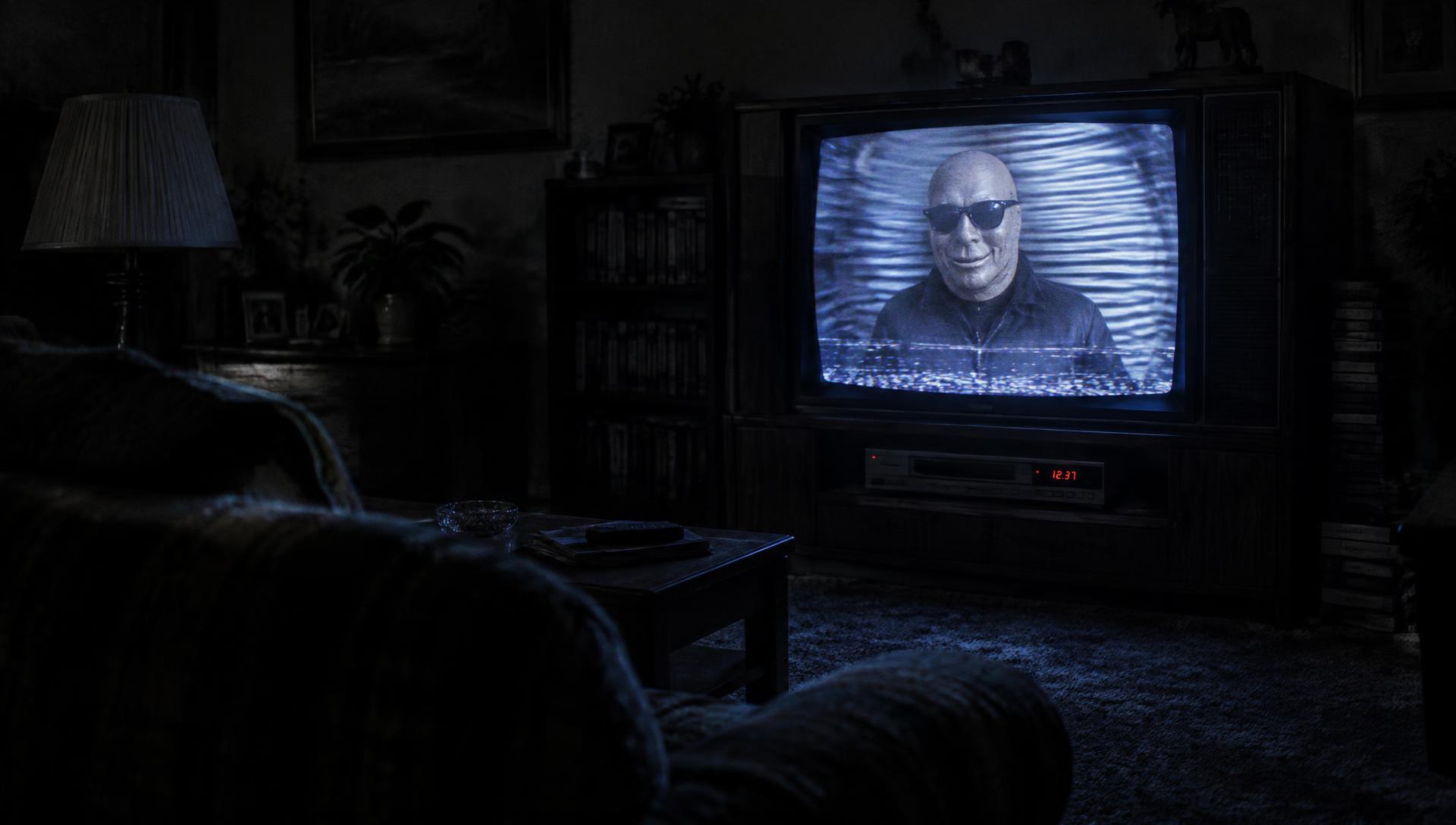
Illustrative reconstruction; not an archival photograph.
Broadcast signal intrusion — breaking into a television station's live feed — is one of the rarest crimes in media history, because it is genuinely hard to do. It requires technical knowledge, transmission equipment, and a position that lets you overpower a station's own signal path. It has been successfully pulled off only a handful of times anywhere in the world. The most famous of all of them happened in Chicago on the night of 22 November 1987, and it remains officially unsolved.
9:14 p.m. — Channel 9
The first intrusion came during WGN-TV's Nine O'Clock News. Sports anchor Dan Roan was partway through the night's highlights when the picture broke up. For a few seconds the screen rolled with static; then it settled on a man in a mask. The mask was instantly recognisable to anyone watching television in 1987: Max Headroom, the glitching, computer-generated talk-show character played by actor Matt Frewer, then at the height of his fame as a pitchman for New Coke. Behind the figure, a sheet of corrugated metal rotated slowly, catching the light. The figure swayed, bobbed, and said nothing — this first hijack had no audio. WGN's engineers, watching from the studio, were unable to stop it; the intrusion was not coming through any equipment they controlled. After roughly 25 seconds, the signal cut out and the broadcast returned to a visibly shaken Roan, who told viewers, accurately, that he had no idea what had just happened.
11:15 p.m. — Channel 11
Two hours later, the intruder struck again — this time at WTTW, Chicago's public television station, during a late-night broadcast of the Doctor Who serial 'Horror of Fang Rock'. This second intrusion lasted about 90 seconds and this time it had sound. The audio was heavily distorted, but enough of it survived for transcripts to be assembled over the years. The masked figure mocked WGN sports commentator Chuck Swirsky, hummed the theme from the cartoon Clutch Cargo, held up a Pepsi can while delivering the Coca-Cola slogan 'Catch the Wave' — a jab at Max Headroom's own Coke commercials — and at one point appeared to raise his middle finger, extended with a rubber prosthetic. The broadcast ended with the figure bent over, trousers down, being spanked with a flyswatter by an accomplice in a French maid costume, before the signal cut to static. WTTW's engineers were not on duty at the transmitter that night; by the time anyone could have responded, it was over. An editor at the station later described watching it happen with no way to intervene.
How do you steal a television station?
The technical core of the case is what makes it so strange. Both stations beamed their programming from studio to transmitter — WGN to the John Hancock Center, WTTW to the Sears Tower — over microwave studio-to-transmitter links. To hijack the broadcast, the intruder did not need to break into the studios. They needed to aim a more powerful microwave signal at the stations' receiving dishes from a position with line of sight, swamping the legitimate feed. That meant real transmission equipment, real expertise, and a location somewhere in the city with a clear shot at two different towers. Whoever did it knew exactly how Chicago television worked.
There was a precedent. In April 1986, a Florida satellite-dealer engineer named John R. MacDougall — 'Captain Midnight' — had overpowered HBO's satellite feed for several minutes to protest its scrambling of signals. He was caught, fined $5,000, and put on probation. The Captain Midnight case proved it could be done and showed what happened when the culprit was found. The Chicago intruder, by contrast, was careful: the intrusion was brief, the location never betrayed, the equipment never traced.
The investigation that went nowhere
The Federal Communications Commission and the FBI both investigated. Signal piracy was — and is — a federal offence; at the time it carried a potential fine of up to $100,000 and up to a year in prison. Investigators had the recordings, the technical requirements, and a city full of broadcast engineers to work through. They had almost nothing else. The distorted audio defeated easy voice identification, the mask defeated everything else, and no equipment was ever seized in connection with the case. No suspect was ever publicly named by authorities.
In 1992, the five-year federal statute of limitations expired. From that point on, the person on the tape could have confessed in full and faced no prosecution for the hijack itself. Nobody did.
The theories
In the decades since, the case has become one of the internet's favourite cold cases, and the theories have converged on a plausible profile rather than a name: someone from Chicago's broadcast or independent-video scene of the mid-1980s, with access to professional transmission gear and a taste for performance art. Researchers and journalists have re-examined the tape frame by frame — the corrugated backdrop, the flyswatter, the accomplice, the specific in-jokes about Chicago media figures — and various online sleuths have proposed candidates, including members of the city's underground video and hacking communities. None of it has ever been confirmed, and the people sometimes named in forum threads have never been charged with anything. It is worth being precise: every named 'suspect' in this case is speculation, not evidence.
What the tape does prove is intent. The intruder hijacked two stations, not one; came prepared with a costume, a prop, a script of in-jokes and an accomplice; and stopped on their own terms both times. This was not a prank of opportunity. It was a produced piece of television, broadcast over the top of two real ones, by someone who then never claimed it — no manifesto, no follow-up, no credit. Whoever was behind the mask built one of the most famous unsolved broadcasts in history and then simply walked away from it.
Why it still matters
The Max Headroom incident sits at a strange crossroads: part crime, part performance, part warning. It exposed how fragile the broadcast chain was in the analogue era — a vulnerability stations quietly hardened afterwards — and it arrived decades before 'hacking the feed' became a stock plot in fiction. The surviving 90 seconds of tape are studied, remixed and argued over to this day, and the figure in the mask has become a folk character in its own right: the person who seized the airwaves of a major American city twice in one night, said their piece, and vanished. Nearly forty years on, the file is still open in every sense that matters except the legal one.
Sources & record
- 01Contemporary reporting on the 22 November 1987 intrusions, including the Chicago Tribune's coverage.
- 02FCC and FBI statements on the investigation, as reported at the time.
- 03WTTW and WGN staff recollections of the night, published in later retrospectives.
- 04The surviving off-air recording of the WTTW intrusion and published transcripts.
Online citations
- →Wikipedia — Max Headroom signal hijacking, sourced overview
- →NBC Chicago — retrospective on the unsolved hijacking
- →History.com — the 1987 Chicago broadcast intrusion
- →All That's Interesting — inside the Max Headroom incident
- →Wikipedia — Captain Midnight broadcast signal intrusion (the 1986 HBO precedent)