Three Lighthouse Keepers Vanished Into the North Atlantic
A lighthouse on an uninhabited rock twenty miles into the Atlantic went dark in the middle of December 1900. When a relief boat finally reached it eleven days later, the station was in order, the lamp was ready to light, and all three keepers were gone. The official investigation blamed the sea. Almost everything else attached to the case since then was invented.
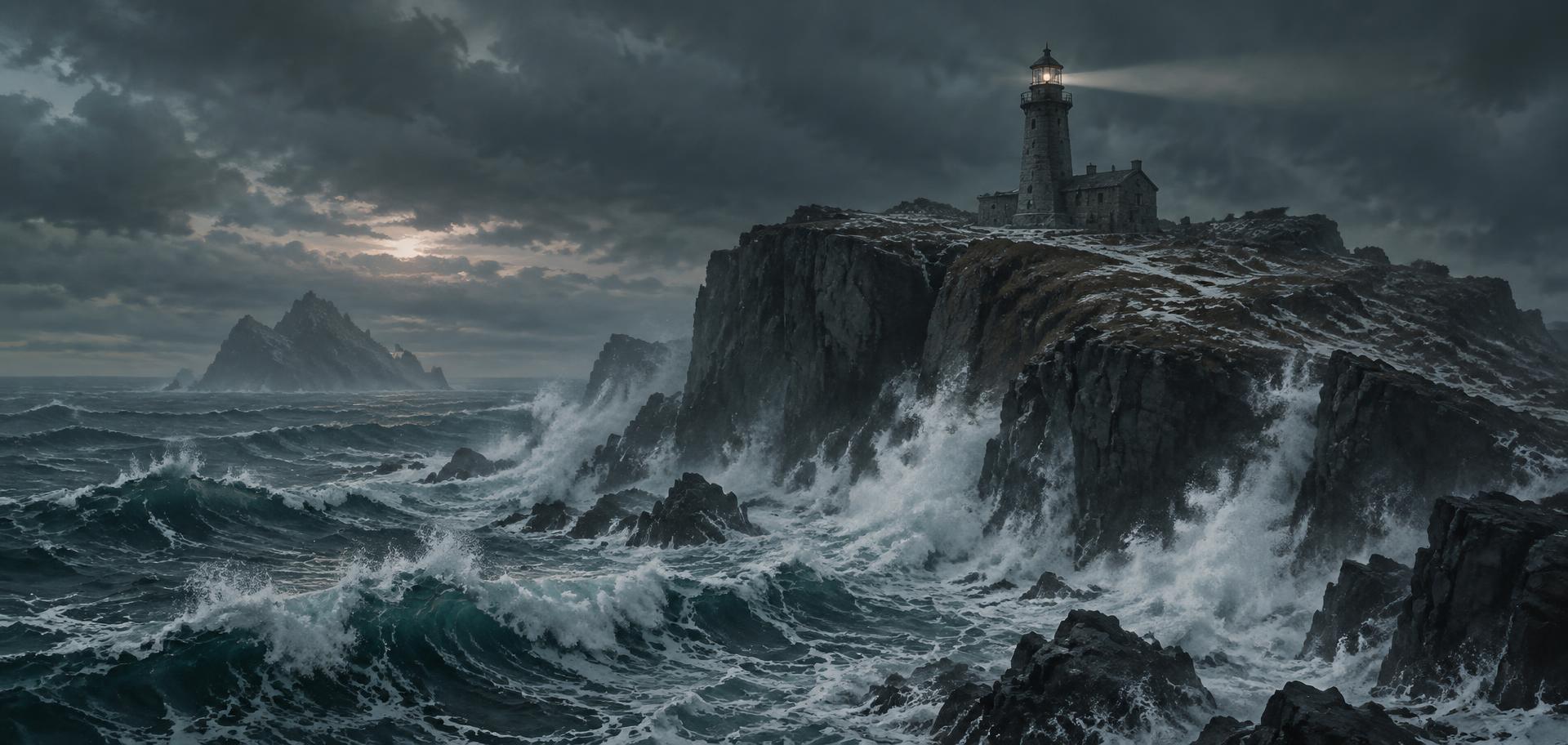
Illustrative reconstruction; not an archival photograph.
What happened at the Flannan Isles lighthouse?
The Flannan Isles lie about twenty miles west of Lewis in the Outer Hebrides, a scatter of uninhabited rock in open Atlantic water. The Northern Lighthouse Board completed a station on the largest island, Eilean Mòr, and first lit the lamp in December 1899. It was manned by three keepers at a time, with a fourth ashore on rotation, relieved by boat whenever the weather allowed — which in winter was rarely.
On the night of 15 December 1900 the light did not show. The steamer Archtor, passing on its way to Leith, later reported seeing no beam. Storms kept the relief vessel Hesperus in port for days. When it finally reached the island on 26 December, no flag answered its signals, no keeper came to the landing, and no provision boxes had been left out for collection. The station was empty.
Who were the three missing keepers?
James Ducat was the principal keeper, an experienced man with a wife and children ashore. Thomas Marshall was the second assistant. The third man, Donald McArthur, was an occasional keeper standing in for a colleague on leave — a local man rather than a career lighthouse servant. All three had families, and none of them was ever found.
The fourth keeper, Joseph Moore, was ashore during the disappearance and was the first man up the steps on 26 December. His account of what he found inside the station is the foundation of every reliable version of this story, and it is considerably plainer than the versions that followed.
What did the relief party find inside the station?
Moore found the entrance gate and the outer doors closed, the beds unmade, and the clock stopped. The kitchen was tidy and the dishes had been washed. The lamp had been cleaned and refilled, ready to be lit. Of the three sets of oilskins and sea boots kept at the station, two were missing. The third — McArthur's — was still hanging on its peg.
The logbook and the daily slate had been kept up in the normal way until 15 December. The final entries recorded severe weather and the ordinary business of the station. There was no message, no note of alarm and no sign of a struggle or of anything having been taken. To the men who searched the island that day, the place looked as though its occupants had stepped outside and simply not come back.
What damage was found at the west landing?
The one part of Eilean Mòr that was not in order was the west landing, the exposed stair and crane platform on the Atlantic side. Investigators recorded iron railings bent out of shape, a rope left strewn across rocks, a life-buoy torn from its fastenings, and turf ripped from the cliff edge well above the normal reach of the waves. A wooden supply box kept in a crevice roughly 110 feet above sea level had been burst open and its contents scattered.
Damage at that height is unusual but not unknown on Atlantic rock stations. The islands funnel swell into narrow gullies, and in a heavy westerly the water can climb far higher than the sea state alone suggests. The pattern of the damage indicated that a very large body of water had come over the landing at some point during the storm period.
What did the official investigation conclude?
Robert Muirhead, the Northern Lighthouse Board superintendent who had personally hired all three men, went to the island and reported in January 1901. He concluded that the keepers had gone down to the west landing to secure gear threatened by the rising sea, and that they had been swept away by an exceptionally heavy wave or by the backwash of one.
The missing oilskins fitted that reading: two men had dressed for foul weather. McArthur's coat left behind suggested to Muirhead that the third man had run out after them without stopping to dress — the response of someone who saw danger from the station and went to help. Muirhead's report is the only contemporary official account, and it does not claim certainty about the sequence, only about the cause.
I am of opinion that the three men have been blown into the sea, or have been washed away by a heavy sea while engaged in securing the west landing gear.
Robert Muirhead, Northern Lighthouse Board report, January 1901
Which parts of the Flannan Isles story were invented?
Much of what circulates about this case has no source in the 1900 record. There was no half-eaten meal on the table and no overturned chair; those images come from Wilfrid Wilson Gibson's 1912 poem 'Flannan Isle', which was written as fiction and has been quoted as evidence ever since.
The dramatic log entries often reproduced online — days of storm, Ducat 'very quiet', McArthur weeping, a final line reading 'God is over all' — do not appear in the station records reported at the time. They are a twentieth-century invention, repeated so widely that they are now the most familiar part of the story. Later additions about sea monsters, foreign agents, abduction and a phantom boat belong to entertainment rather than to the file.
What alternative explanations have been proposed?
Within the plausible range, the main variations are about sequence rather than cause. One version has all three men caught together at the landing. Another, closer to Muirhead's, has two men at work and a third following and being taken with them. A further suggestion is that one keeper was swept off, a second died attempting a rescue, and the third was lost from the cliff path while searching.
Less supported theories have circulated: a quarrel ending in violence and suicide, or one man deliberately killing the others. Nothing found on the island supported either, and the men's records gave no hint of it. Muirhead specifically noted the keepers' good standing. The absence of bodies is not evidence of anything unusual in Atlantic conditions — a body taken from that coast in a December gale would not be expected to return.
Why does the case still matter?
The Flannan Isles disappearance is unusual less for what happened than for how completely it was erased. There were no witnesses, no wreckage of a boat, no bodies and no last words. What remains is a clean kitchen, a trimmed lamp, a stopped clock and a wrecked landing stage — enough to make a confident guess and not enough to prove it.
The station was automated in 1971 and no one lives on Eilean Mòr now. A memorial at Breasclete on Lewis records the three names. The most likely explanation has been on file since 1901 and is almost certainly right; it simply cannot be shown. That gap is what the poem filled, and what has kept the case alive for well over a century.
Sources & record
- 01Robert Muirhead, Northern Lighthouse Board report on the Flannan Isles, January 1901.
- 02Northern Lighthouse Board, Flannan Isles lighthouse station history.
- 03Joseph Moore's account of the relief landing, 26 December 1900, as recorded in the Board's papers.
- 04Wilfrid Wilson Gibson, 'Flannan Isle' (1912) — a poem, frequently and wrongly cited as evidence.
- 05Contemporary press reports, including The Scotsman and the Glasgow Herald, December 1900 – January 1901.
Online citations