Frederick Valentich: The Pilot Who Vanished After Reporting an Unidentified Aircraft
Twenty-year-old Frederick Valentich radioed Melbourne to ask about another aircraft near his Cessna. For six minutes he described lights, speed and circling movements. Then his transmission ended, and neither pilot nor aircraft was found.
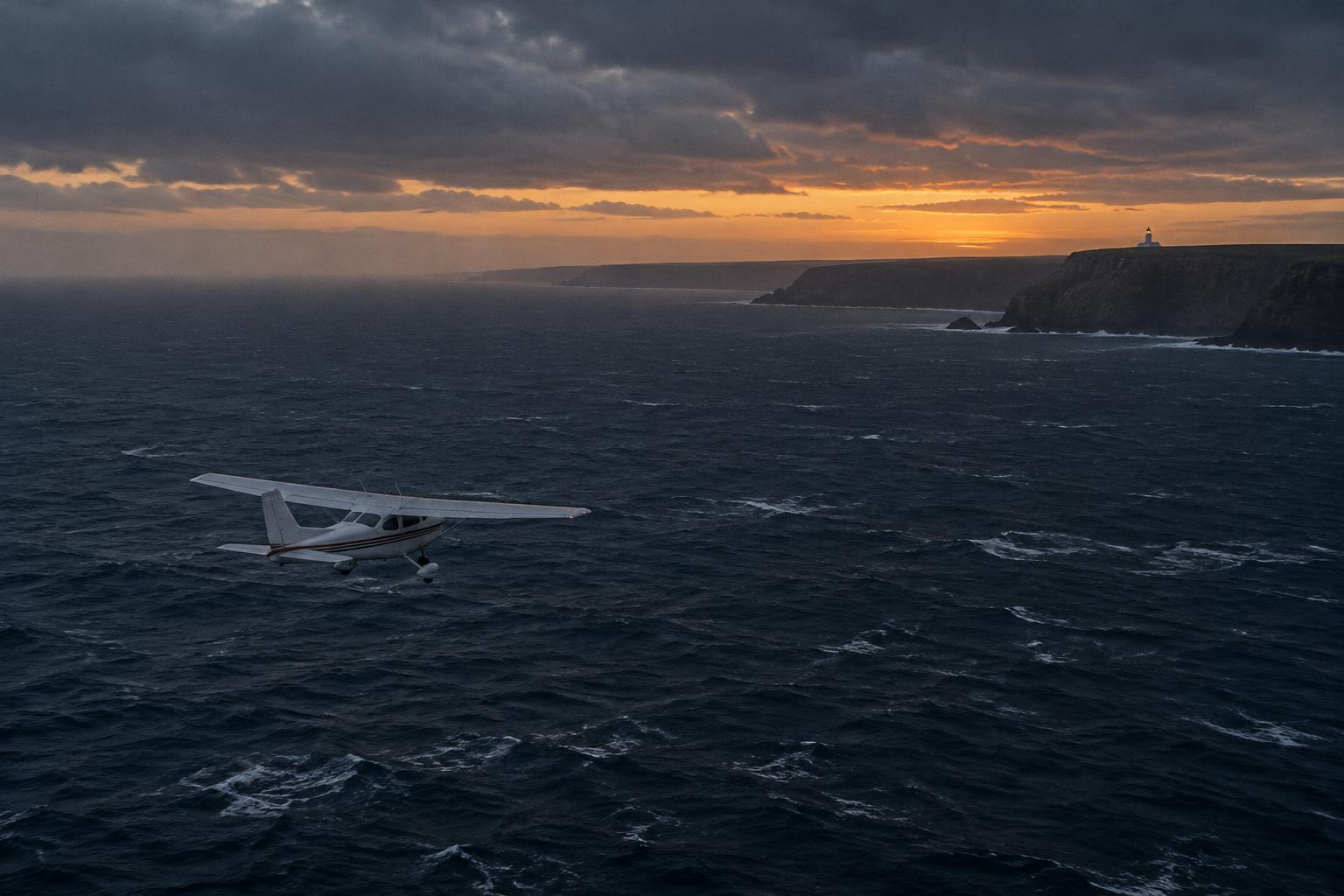
Illustrative reconstruction; not an archival photograph.
The disappearance of Frederick Valentich is often introduced as a UFO story. The surviving record begins somewhere more ordinary: a young pilot, a single-engine Cessna, an evening flight over water and a flight service officer answering a radio call. What makes the case extraordinary is that the pilot's own account of his final minutes was recorded. His words are evidence. What those words described remains unidentified.
Who was Frederick Valentich?
Frederick Valentich was twenty years old and held a private pilot licence. The Department of Transport's investigation summary put his total flying experience at about 150 hours. On Saturday 21 October 1978 he was flying a Cessna 182L registered VH-DSJ, using the radio call sign Delta Sierra Juliet. The aircraft left Moorabbin Airport, near Melbourne, at 6:19 p.m. for King Island in Bass Strait. The flight plan covered a night visual-meteorological-conditions flight to King Island and back. According to the official summary, the Cessna carried full fuel tanks and four life jackets.
Valentich was not a passenger on an airliner whose final messages were reconstructed second-hand. He was the only person aboard, and he was speaking directly with Melbourne Flight Service. That makes the case unusually immediate, but it also means there was no second occupant to describe his actions, his heading changes or what happened inside the cockpit.
The flight toward King Island
At 7:00 p.m., Valentich reported at Cape Otway on the Victorian coast. Beyond it lay Bass Strait, the broad and often rough stretch of water separating mainland Australia from Tasmania. King Island sits in the western part of the strait. The official report recorded clear weather near Cape Otway, excellent visibility and light winds. Those conditions rule out a simple account in which a storm abruptly swallowed the aircraft. They do not remove the challenges of flying a light aircraft at night over open water, where a visible horizon and reliable visual references can disappear.
Nothing in the record indicates a distress call before 7:06. The sequence that followed lasted roughly six minutes. It is preserved in the Department of Transport transcript, which uses timestamps in Greenwich Mean Time; local time was ten hours ahead. The transcript also warns that words placed in parentheses were open to interpretation because they were not clearly audible. Later retellings have often removed that uncertainty, turning uncertain phrases into settled quotations.
“Is there any known traffic below five thousand?”
At 7:06:14 p.m. local time, Valentich asked Melbourne whether there was any known traffic below 5,000 feet. The flight service officer answered that there was no known traffic. Valentich then said there seemed to be a large aircraft below that altitude. Asked what type it was, he replied that he could not identify it. He described four bright lights that looked to him like landing lights.
The phrase “no known traffic” is sometimes rewritten as “radar showed nothing.” Those are not the same statement. The transcript records what the flight service officer said; it does not supply a radar track that independently confirms or contradicts the pilot's account. No verified radar record has established what, if anything, was near the Cessna.
At 7:07:32, Valentich reported that the aircraft had passed at least a thousand feet above him. When the officer asked him to confirm that it was large, Valentich answered that its speed made that difficult to determine and asked whether any air force aircraft were nearby. Again, Melbourne replied that there were no known aircraft in the vicinity. Soon afterwards, Valentich said it was approaching from the east.
Six minutes of lights and movement
Valentich's descriptions changed as he continued watching. He said the thing seemed to be playing a game, flying over him two or three times at speeds he could not identify. At 7:09:06 he gave his own altitude as 4,500 feet. He confirmed that he still could not identify the other aircraft. Fourteen seconds later came the first version of the sentence that would define the case: “It's not an aircraft.”
Asked for a description, Valentich referred to a long shape and again to its speed. He said it was in front of him, then appeared stationary. A disputed word in the transcript was later interpreted by researcher Richard Haines as “chasing me,” but that was an analyst's enhanced reading, not an uncontested phrase. The next part is clearer: Valentich said he was orbiting and that the thing was orbiting above him as well. He described a green light and a shiny, metallic-looking exterior.
At about 7:10:48 he said it had vanished. Less than a minute later he was asking whether Melbourne knew what kind of aircraft he had encountered and whether it could be military. He then reported it approaching again, this time from the south-west. The account is not a calm, continuous observation of one clearly visible object. It is a series of partial impressions — lights, speed, position, shine and movement — made by a pilot who was also flying his own aircraft.
The engine report and final transmission
At 7:11:52, Valentich reported that his engine was rough-idling and coughing. Melbourne asked what he intended to do. He answered that he intended to continue to King Island. He then returned to the object above him. His final intelligible account is preserved in the official transcript.
That strange aircraft is hovering on top of me again … it is hovering and it's not an aircraft.
Frederick Valentich to Melbourne Flight Service, approximately 7:12 p.m., 21 October 1978. Ellipsis marks an open-microphone interval in the transcript.
At 7:12:28, Valentich transmitted his call sign and “Melbourne.” The microphone remained open for seventeen seconds. The transcript notes a strange pulsed noise during that interval. Popular accounts frequently call it metallic scraping and treat it as the sound of an object taking the aircraft. The recording does not establish that interpretation. The official summary simply records the open microphone and the end of useful communication. Melbourne called Delta Sierra Juliet again. There was no answer.
What did the official search find?
When the Cessna failed to arrive at King Island, a distress phase was declared at 7:33 p.m. An air, sea and land search continued until 25 October. The Department of Transport summary states that it found no trace of Valentich or his aircraft. The water below the route offered no confirmed wreckage, no body and no floating debris that investigators could conclusively connect to VH-DSJ.
That absence is central to the mystery, but it is not evidence of an extraordinary departure from the sky. An aircraft striking water can break apart, sink or scatter small debris across a large and moving search area. The lack of a confirmed crash site prevents investigators from reconstructing the final descent. It also means there is no physical evidence with which to test the more dramatic explanations.
The investigation did not conclude that Valentich had been abducted, that he had encountered a secret military craft or even that the reported object caused an accident. Its formal opinion, approved for publication on 27 April 1982, was narrower: “The reason for the disappearance of the aircraft has not been determined.” Valentich's death was presumed. The event remains an aviation loss with an unresolved cause, not an officially recognised extraterrestrial encounter.
Could Valentich have become disoriented?
One widely discussed conventional explanation is spatial disorientation followed by loss of control. A pilot flying at night over water may have few reliable visual references. Under those conditions, the inner ear can produce convincing but misleading sensations of motion and attitude. A turn can feel like level flight; a descending spiral can develop without the pilot recognising it. This is sometimes called a graveyard spiral. It is a real aviation hazard, not a diagnosis made from the Valentich recording.
Supporters of this reconstruction suggest that Valentich may have misidentified distant lights, celestial objects or reflections, then manoeuvred while trying to understand them. In some versions, his reported orbiting describes his own aircraft turning. In others, the lights belong to another ordinary aircraft seen from confusing angles. These proposals can account for parts of the transcript, but the surviving evidence cannot demonstrate which lights he saw or how the Cessna moved. The official investigation did not adopt disorientation as its determined cause.
Did the Cessna suffer engine failure?
The rough-idling and coughing report provides a more immediate mechanical clue. A pilot dealing with an engine problem over dark water would face an emergency with few safe landing options. Yet the transcript does not identify a mechanical fault, and no recovered engine has been examined. It is not known whether the reported roughness reflected a developing failure, a temporary condition, a power-setting issue or something else. The final radio silence could fit a loss of control, a forced ditching or an electrical failure, but none can be proved from the sound alone.
The proximity of the engine report to the final transmission has encouraged two competing readings. One treats the unidentified object as a distraction during a conventional emergency. The other treats the engine problem as part of the same unexplained encounter. The record supports the sequence, not either conclusion.
Was the disappearance staged?
Because no confirmed wreckage was found, another theory proposes that Valentich deliberately disappeared. ABC coverage has noted questions about his plans and the late departure, but questions about a person's schedule are not evidence that he survived. Such a scheme would require the pilot to land or hide the aircraft, leave his former life and remain undetected. No verified subsequent sighting, financial trail or concealed aircraft has established that outcome. Family members quoted in later coverage did not believe he intended to vanish.
The staged-disappearance theory therefore remains speculation built largely from the absence of debris. It should not be presented as equal to the documented facts: Valentich filed a flight plan, departed, spoke with Melbourne, failed to arrive and was never found.
What about a UFO?
Valentich unquestionably reported something he could not identify. In that limited sense, the case contains a genuine unidentified flying object report. The word “unidentified” describes the limits of the observer's identification; it does not identify the object as an alien spacecraft. No recovered material, verified radar return or independent observation has established what he saw. The official file records his description without converting it into a conclusion about its origin.
Other people in the region reported unusual lights around the same period, and researchers have catalogued those accounts. They add context to the public fascination but do not provide a confirmed track linking another sighting to Valentich's Cessna. Separate reports made at different places and times cannot simply be merged into one object. The strongest evidence remains the recorded exchange itself, with all its ambiguities intact.
The aircraft part found five years later
On 15 May 1983, almost five years after the disappearance, an engine cowl flap from a Cessna 182 washed up at Parry's Bay on Flinders Island. A Department of Aviation letter dated 6 July 1983 noted that VH-DSJ's serial number fell within the range applicable to the part. The department asked the Royal Australian Navy Research Laboratory whether such an item could have drifted there in the intervening years.
The discovery is often described as wreckage from Valentich's plane. The archival wording is more cautious. A serial range including VH-DSJ is not a unique match, and the cited pages do not conclusively link the component to his aircraft. The cowl flap is a possible lead, not proof of where or how the Cessna went down.
Why the Valentich mystery endures
Many aviation mysteries leave only silence. This one left a voice describing events as they seemed to unfold. That recording gives listeners the feeling that an explanation must be just beyond reach: identify the lights, interpret the noise, locate the aircraft, and the story might close. Instead, each proposed answer explains some details while leaving others unresolved.
In 1998 Valentich's family erected a memorial plaque near Cape Otway, close to his last reported coastal position. It commemorates a twenty-year-old pilot who did not return, rather than any particular theory about his fate. The honest conclusion is the one left by the Department of Transport: Frederick Valentich and VH-DSJ disappeared over Bass Strait after he reported an unidentified aircraft, and the reason for their disappearance has not been determined.
Sources & record
- 01Department of Transport, Aircraft Accident Investigation Summary Report V116/783/1047, 27 April 1982.
- 02Department of Transport transcript of communications between VH-DSJ and Melbourne Flight Service, 21 October 1978.
- 03ABC, Last Light: The Valentich Disappearance, including interviews with the flight service officer and people who knew Valentich.
- 04ABC News, retrospective coverage of the disappearance and the questions surrounding the flight.
- 05Department of Aviation correspondence concerning the Cessna cowl flap found in May 1983.
Online citations
- →Department of Transport investigation summary — transcription of the official 1982 report and 1983 cowl-flap letter
- →Final radio communications — archived transcript with timestamps and uncertain-word annotations (PDF)
- →ABC — Last Light: the Valentich disappearance
- →ABC News — Frederick Valentich's disappearance and the enduring UFO interpretation
- →ABC Radio National — Aviation Mystery, with the investigator who transcribed the tape