The Kaz II: A Ghost Yacht Found With the Engine Running and No One Aboard
Three men sailed a 12-metre catamaran out of Airlie Beach. Days later it was found drifting off the reef with its engine running, a laptop switched on and life jackets still aboard. The men were never seen again, and Australia's 'ghost yacht' became a modern Mary Celeste.
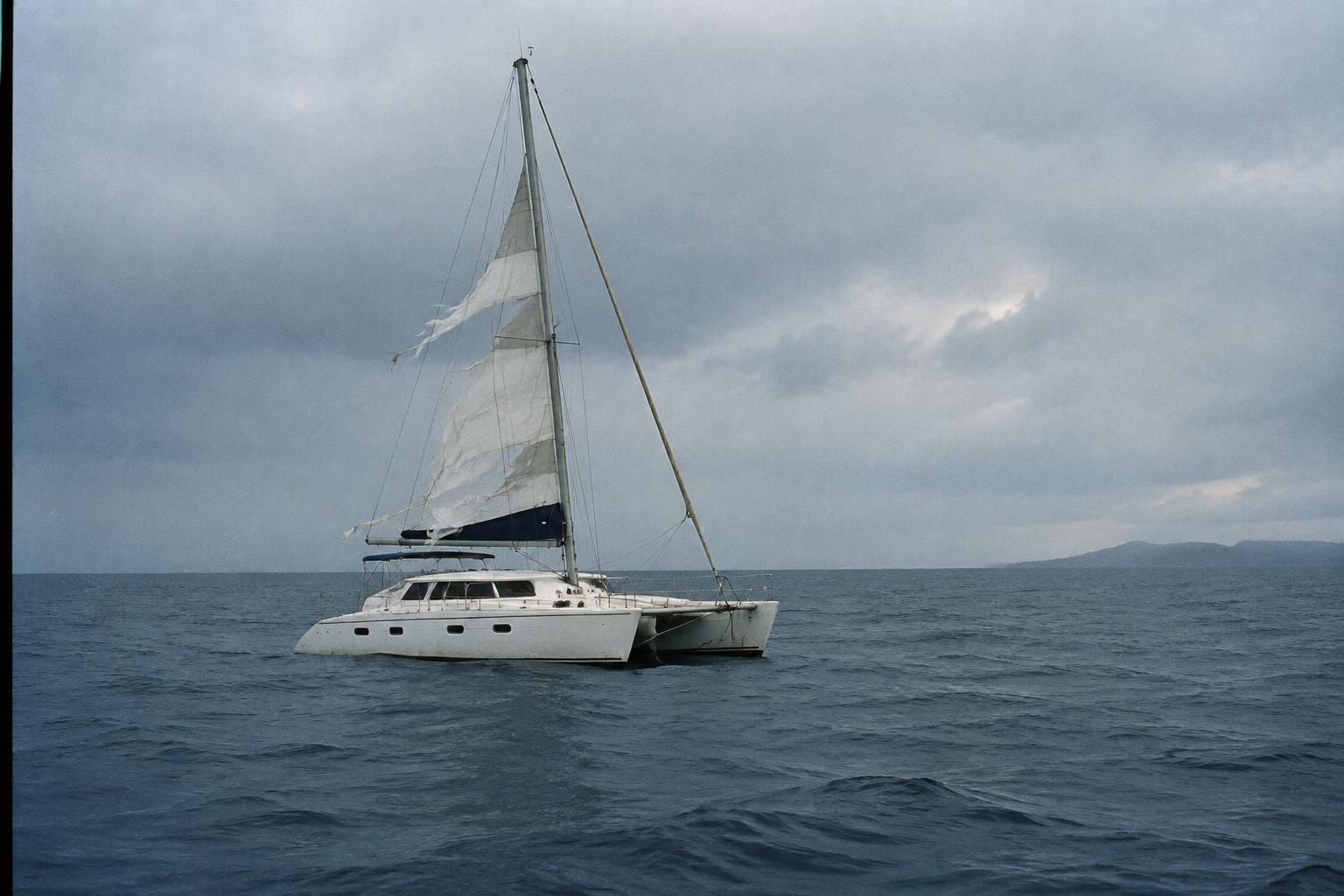
Illustrative reconstruction; not an archival photograph.
Three friends and a new boat
Derek Batten and the brothers Peter and James Tunstead were friends from Western Australia. Batten had recently bought the Kaz II, a 12-metre catamaran, and the three planned to sail it from the Whitsundays around the top of Queensland and on towards Western Australia. None of them was a highly experienced ocean sailor. They left Airlie Beach on Sunday 15 April 2007.
The boat no one was sailing
On 18 April a coastwatch helicopter spotted the catamaran drifting near the Great Barrier Reef, east of Townsville, with no one visible on deck and a torn sail. Because of conditions it was not boarded until 20 April. What the boarding crew found is the reason the story spread worldwide.
The engine was running. A laptop was on. Food was out and the table appeared to have been set for a meal. Life jackets, the dinghy and the emergency beacon were still aboard, and there was no sign of a struggle, damage or distress call. The three men were simply gone.
The search and the video camera
An air and sea search was launched but called off after several days without finding any trace of the men. Investigators examined the yacht's GPS, which showed its track, and a video camera recovered on board. The footage showed the men in good spirits earlier on the voyage, on what appeared to be the day they disappeared, with nothing to suggest trouble.
Speculation filled the gap: piracy, drug smuggling, a staged insurance disappearance, or something stranger. Police found no evidence for any of these. The comparison with the Mary Celeste, found adrift in 1872, was made almost immediately in the press.
What the coroner concluded
At the 2008 inquest, Queensland's state coroner Michael Barnes found that the three men had probably died after going overboard in sequence. His reconstruction, based on the GPS track, the condition of the boat and evidence about the men's experience, was that one man likely went to the stern to free a fouled fishing line or other gear and fell in; a second probably went into the water or fell while trying to help; and the third, alone and unable to handle the sails quickly enough to turn the boat back, was likely thrown overboard as well.
The coroner stressed that this was the most probable explanation, not a certainty, and he noted that the men's inexperience and the lack of life jackets in use made such an accident more likely. He ruled out foul play on the available evidence.
Why it still feels unresolved
No bodies were ever found, and no one saw what happened. The coroner's reconstruction fits the evidence, but it cannot be confirmed. That gap — a running engine, a set table, and an empty sea — is why the Kaz II is still described as one of Australia's great maritime mysteries, even though the most likely explanation is a chain of ordinary accidents.
Sources & record
- 01Wikipedia — Kaz II
- 02ABC News — Ghost ship mystery deepens (2007)
- 03ABC News — Kaz II crew probably fell overboard: coroner (2008)
- 04Sydney Morning Herald — Ghost ship crew probably fell overboard (2008)
- 05Wikipedia — Mary Celeste
Online citations