Gilles de Rais: War Hero Turned Medieval Monster
In 1429, Gilles de Rais rode in the army that broke the siege of Orléans and carried Charles VII toward his coronation. Eleven years later, the marshal stood before two courts in Nantes, accused of crimes against children on a scale that made his earlier glory almost impossible to comprehend. The surviving record is extensive, horrifying and shaped by a justice system very different from our own.
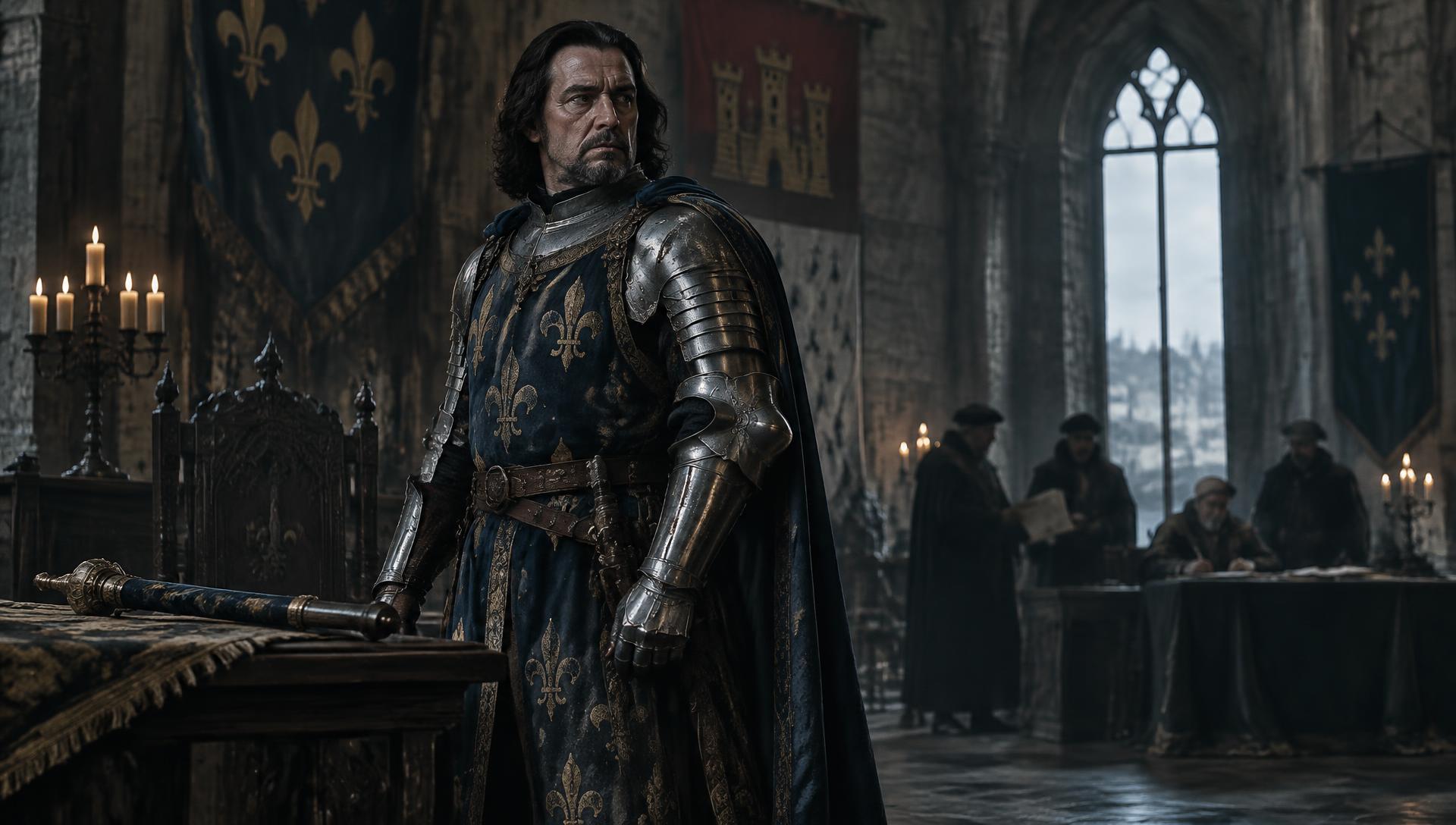
Illustrative reconstruction; not an archival photograph.
The two lives attached to the name Gilles de Rais seem to resist belonging to the same person. One is a wealthy Breton-Angevin lord and celebrated captain of the Hundred Years' War, present during Joan of Arc's decisive campaign of 1429 and elevated to one of France's highest military offices. The other emerges from court records compiled at Nantes in 1440: an accused abductor and murderer whose servants described years of crimes against children. Any responsible account has to hold both records together without turning either into legend.
An inheritance large enough to build an army
Gilles was born around 1404 into the Montmorency-Laval and Craon families, among the richest noble networks in western France. Sources disagree over his exact birthday and whether he was born at Champtocé or another family holding. Orphaned while still young, he came under the control of his maternal grandfather, Jean de Craon, an ambitious lord who arranged the boy's future around land, marriage and dynastic advantage.
His 1420 marriage to Catherine de Thouars added another concentration of estates to his inheritance. The household could support soldiers, fortified residences and the conspicuous display expected of a great lord. It also placed Gilles inside the unstable politics of a France divided among the forces of Charles VII, the English crown and their Burgundian allies.
Beside Joan of Arc in 1429
Gilles had begun campaigning by the late 1420s. In 1429 he joined the French force associated with Joan of Arc during the relief of Orléans and the Loire campaign. He was present in the military movement that carried Charles VII to Reims, where the king was crowned on 17 July. These events are the documented foundation of Gilles's reputation as Joan's comrade in arms. Later stories often turn that association into an intimate friendship, but the evidence supports military proximity more securely than personal closeness.
That year Charles VII made him Marshal of France. The office confirmed his standing at court and his value as a commander, although the precise date is reported differently in modern accounts. His subsequent public career never matched the intensity of 1429. Joan was captured in 1430 and executed in 1431; there is no reliable evidence that Gilles attempted to rescue her, and theories that her death caused his later conduct go beyond what the documents can establish.
A fortune consumed
During the 1430s, Gilles sold and mortgaged estates at a rate that alarmed his relatives. His household maintained costly clerics, musicians and retainers. He sponsored elaborate religious display and theatrical spectacle, including a production celebrating the siege of Orléans. Trial testimony later connected him with alchemists and attempts to summon a demon in search of wealth. Those occult claims belong chiefly to the prosecution record and should not be treated as independently verified descriptions of every experiment at his castles.
The financial collapse was real enough for the king to intervene. In 1435, Charles VII prohibited Gilles from making further sales of his lands. Buyers and political rivals nevertheless continued to circle the remaining properties. This matters because Duke John V of Brittany and people connected to his administration stood to benefit from Gilles's ruin—a conflict later used by revisionists to argue that the entire prosecution was a seizure disguised as justice.
The raid that opened the case
On 15 May 1440, Gilles crossed a boundary even his rank could not protect. In a dispute over the estate of Saint-Étienne-de-Mer-Morte, he and armed followers entered a church during Mass and seized the cleric Jean Le Ferron. The act violated ecclesiastical immunity and challenged ducal authority. It gave Jean de Malestroit, bishop of Nantes, and the government of Duke John V a clear basis to investigate and arrest him.
The church seizure did not itself prove murder. It did, however, break the shield around a powerful man. Investigators gathered depositions from families whose children had disappeared near his residences. In September 1440, Gilles and several members of his household were taken into custody and brought before courts at Nantes.
Two trials in Nantes
The prosecution ran on parallel tracks. An ecclesiastical court under Bishop Malestroit and the inquisitorial representative Jean Blouyn addressed accusations including heresy, apostasy, demonic invocation and sexual crimes. A secular court under ducal authority dealt with murder. The proceedings survive in Latin and French copies and include formal charges, statements from parents and other witnesses, testimony attributed to servants, and Gilles's confession.
Many depositions came from poor parents describing a son or daughter who had gone to one of Gilles's households, sometimes seeking food or service, and had not returned. Servants named in the record included Henriet Griart and Étienne Corrillaut, known as Poitou. Their statements described obtaining children and concealing what happened. The accumulated testimony is a central reason most historians do not accept that the case was invented from nothing, even while recognizing serious defects in the process.
A confession under medieval pressure
Gilles first rejected the court's authority, insulted his judges and denied the accusations. The ecclesiastical court excommunicated him. After he was threatened with torture, he changed course and confessed in October, before the threatened torture was formally applied according to the surviving minutes. He then repeated a public confession and sought reconciliation with the Church. Calling that confession simply voluntary ignores the threat, spiritual terror and power imbalance surrounding it; calling it demonstrably fabricated ignores the supporting depositions and the testimony of his own household.
The most extreme details come through a record created by prosecutors in an inquisitorial system. Questions about sorcery and demons reflected categories the church court expected to find. The documents are therefore evidence, not a transparent recording of events. Historians can compare converging statements and administrative facts, but they cannot cross-examine the witnesses, test physical remains or recover a complete chain of evidence six centuries later.
How many children disappeared?
No secure victim total survives. The court record contains individual missing-child complaints and broader estimates, while later writers have proposed numbers ranging from dozens to several hundred. Figures such as 600 or 800 are especially difficult to support. Even commonly repeated totals of 100 or 200 should be presented as estimates rather than a body count established by names or forensic evidence.
The uncertainty does not make the missing children interchangeable or imaginary. It reveals the limits of medieval record keeping and the social position of families whose children vanished. The strongest historical claim is narrower than the popular legend: numerous disappearances were reported around Gilles's properties, household witnesses implicated him, and he confessed in a coercive proceeding whose surviving record cannot provide a modern standard of proof for every alleged act.
Judgment and execution
The courts convicted Gilles of heresy and murder. On 26 October 1440, he, Henriet and Poitou were hanged and their bodies committed to the fire at the Île de Biesse near Nantes. Contemporary accounts say Gilles's body was removed before it was completely burned and given burial, a final privilege of rank denied to many condemned people. He was about 35 or 36 years old.
Was Gilles de Rais framed?
The case has attracted repeated attempts at rehabilitation. Critics point to the Duke of Brittany's interest in Gilles's lands, the bishop's political position, the threat of torture, the absence of surviving physical evidence and the formulas shared by inquisitorial confessions. In 1992, a privately organized mock retrial in France declared him not guilty. That event had no legal standing and did not reverse the 1440 judgment, but it helped return procedural questions to public debate.
Those objections expose reasons not to repeat the trial narrative uncritically. They do not, by themselves, explain away the many families reporting missing children or the mutually reinforcing testimony attributed to members of Gilles's household. The broad historical position remains that political and financial interests may have shaped the prosecution without proving that its central accusation was false. A compromised court can prosecute a guilty person; procedural injustice and factual guilt are not opposites.
The monster and the man in the record
Gilles was later linked to Bluebeard, the murderous husband of folklore, although the tale was not a factual biography and the connection developed after his death. Novels, occult histories and true-crime retellings turned him into an archetype. At the opposite extreme, romantic accounts made him a loyal knight destroyed for his wealth. Both versions flatten the surviving evidence into a cleaner story than the documents allow.
What remains is disturbing enough without embroidery: a war hero whose status once placed him beside a king, a trail of reported disappearances around his castles, servants who described a system of procurement and concealment, and a confession obtained beneath the machinery of medieval church and state. The trial cannot be treated as modern forensic proof. Nor can its contradictions erase the children whose families entered the record because they had vanished.
Sources & record
- 01The surviving ecclesiastical and secular trial proceedings, as published in French editions including Le procès inquisitorial de Gilles de Rais.
- 02Encyclopaedia Britannica, 'Gilles de Rais,' biographical and trial overview.
- 03Arthur Charles Howland, 'Criminal Procedure in the Church Courts of the Fifteenth Century as Illustrated by the Trial of Gilles de Rais.'
- 04Georges Bataille, The Trial of Gilles de Rais, English translation by Richard Robinson.
- 05Joan of Arc campaign chronology and biography, Encyclopaedia Britannica.
Online citations
- →Encyclopaedia Britannica — Gilles de Rais biography and trial overview
- →Internet Archive — 1921 edition of the inquisitorial trial record
- →Cambridge University Press — fifteenth-century church procedure in the Gilles de Rais trial
- →Famous Trials — translated confession of 22 October 1440
- →Famous Trials — documented chronology of the 1440 prosecution
- →Encyclopaedia Britannica — Joan of Arc biography and the 1429 campaign
- →Château de Tiffauges — official heritage site for one of Gilles's principal castles
- →Gallica, Bibliothèque nationale de France — digitized historical collections