Tarrare: The Man Who Could Never Stop Eating
He could swallow a basket of apples, a live cat, or a meal meant for fifteen men — and he weighed less than most of the people watching. Two centuries later, doctors still cannot agree on what was wrong with Tarrare.
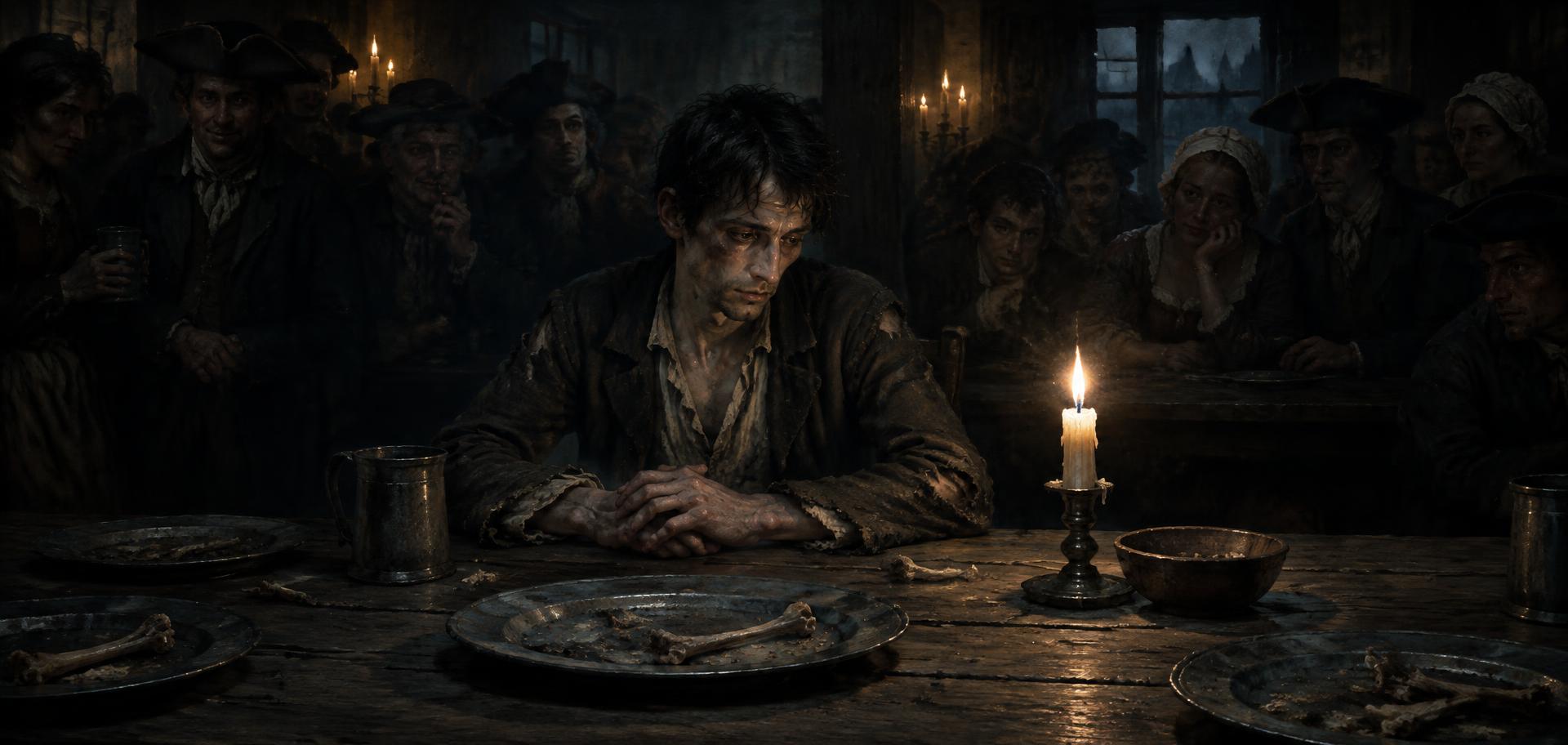
Illustrative reconstruction; not an archival photograph.
Almost everything we know about Tarrare comes from the men who tried to cure him. The primary source is a memoir read before the Society of Medicine in Paris in 1805 by Pierre-François Percy, chief surgeon of Napoleon's armies, who had studied the man at a military hospital in Soultz years earlier. Percy wrote carefully and with some sympathy, but he wrote about a patient, not a person: even Tarrare's real name, if he had another, was not recorded. 'Tarrare' was almost certainly a stage name — 'bom-bom tarrare' was a French slang expression of the era for powerful explosions. What follows is the record as the doctors left it, with the uncertain parts marked as uncertain.
A boy no table could fill
Tarrare was born around 1772 in the countryside near Lyon. According to Percy's account, his appetite was abnormal from childhood: by his teens he could reportedly eat his own weight in meat in a day, and his family — poor people facing a famine-era food bill — turned him out. He drifted with bands of travelling thieves and performers, and eventually reached Paris, where he made his living on the street as an eater of things. For coins and scraps he would swallow corks, stones, live animals and entire baskets of apples, taking them one after another like a man shelling peas.
The strange part, and the part the doctors could not explain, was his body. A man who ate like this should have been enormous; Tarrare was thin to the point of deformity. Percy recorded that he weighed about a hundred pounds. His mouth was unnaturally wide, his teeth stained, his lips so loose that when he had not eaten he could wrap the skin of his face around his jaw. His abdomen hung in folds when empty and swelled like a balloon when full. His skin was hot to the touch, he sweated constantly, and Percy noted that he gave off a smell so powerful it filled the hospital room — a detail repeated, with distaste, in nearly every line of the medical record. He reportedly suffered from chronic, violent diarrhoea, and whatever he ate seemed to pass through him without nourishing him at all.
The hospital experiments
When war came in the 1790s, Tarrare joined the Army of the Rhine. Soldier's rations could not begin to feed him; he scavenged gutters and rubbish heaps, fought other men for scraps, and collapsed from exhaustion. He was admitted to the military hospital at Soultz, where the surgeons Courville and Percy took an interest in him. It was there that the documented measurements were made. In one recorded test, Tarrare was given a meal prepared for fifteen labourers and ate the entire thing at a sitting, then fell asleep. He was offered a live cat; according to Percy, he tore it open with his teeth, drank its blood, and ate everything but the bones, later vomiting the fur and skin like an owl casting a pellet. He ate snakes and lizards. In the most often-repeated demonstration, he swallowed a whole live eel without chewing — in some versions, after first biting through its head.
It is worth pausing here, because this is where fact and theatre begin to blur. Percy was writing from notes years later, for an audience of fellow doctors, and the 1805 memoir is the root of nearly every Tarrare story in circulation. The general picture — a young man of normal intelligence, quiet and reportedly docile in temperament, with a bottomless, pathological hunger — is consistent and credible. The more theatrical feats were performances the patient was paid or fed to repeat, and should be read as observed stunts, not measured biology.
The army's human courier
The doctors' curiosity found a practical use. General Alexandre de Beauharnais — later famous as Josephine's first husband — heard of the hospital's remarkable patient and saw a military application: a courier who could carry a message inside his own body. A wooden box containing a document was swallowed by Tarrare and recovered intact from his stool two days later, still legible. He was then sent across enemy lines toward Neustadt, posing as a peasant, carrying a message intended for an imprisoned French colonel — though Percy himself noted the message may have been bait, a test of a fictitious informant.
The mission failed almost immediately. Tarrare spoke no German and attracted attention; Prussian soldiers stopped him, found nothing on him, and beat him anyway. He was held until the box passed, interrogated, and — by his own account to Percy — subjected to a mock execution, led to a gallows with a noose around his neck before being released at the border. He returned to the hospital at Soultz shaken, and this time he begged to be cured.
Nothing worked
The physicians tried everything the medicine of 1794 had to offer. Laudanum — opium in alcohol — in large doses. Tobacco pills. Soft-boiled eggs by the dozen, a regimen of one theory of digestion. Nothing dented the appetite. The record grows darker here. Tarrare was caught drinking from the hospital's blood-letting room and scavenging in the morgue and the refuse heaps outside the butcher's stalls. He was beaten away from the apothecary's stores. Percy reports these episodes clinically, but between the lines is a patient the staff had stopped treating as entirely in control of himself.
Then came the event that ended his stay. A fourteen-month-old child disappeared from the hospital. No body was found and no evidence was ever produced, but suspicion settled on Tarrare, and Percy records that he was driven from the hospital by staff and attendants. It is essential to be precise about this, because later retellings often are not: Tarrare was accused, never charged, and never proven to have done anything. What the record shows is that a child vanished and a man the staff already feared was blamed and expelled.
The autopsy
Four years later, in 1798, Tarrare reappeared at a hospital in Versailles, gravely ill and asking for Percy. He told the surgeon he had swallowed a golden fork two years earlier and believed it was lodged inside him. Percy found no fork. What he found was a man dying — Percy believed of advanced tuberculosis — weakened by the purulent, uncontrollable diarrhoea that had dogged him for years. Tarrare died soon after, at about twenty-six years old. His body reportedly began to rot with unusual speed, and several surgeons refused to dissect it.
The autopsy that was performed is the most concrete piece of evidence in the whole file. Percy recorded that the gullet was abnormally wide — when the jaws were opened, the surgeons could see down a broad canal into the stomach. The stomach itself was enormous, filling much of the abdominal cavity, ulcerated and covered in pus. The liver and gallbladder were also grossly enlarged. There was no fork. Whatever had driven Tarrare's hunger, it had physically remodelled his digestive tract.
What was wrong with him?
Modern medicine can only guess across two centuries, and every guess is a retrospective diagnosis — an educated label, not an answer. Hyperthyroidism is the most commonly proposed: an overactive thyroid produces exactly the combination Percy described — ravenous appetite, weight loss, heat, sweating, constant hunger. Damage to the hypothalamus, the brain region that registers satiety, has also been suggested; a tumour or injury there can erase the feeling of fullness entirely, producing what is now called polyphagia. Some writers have noted resemblances to extreme forms of Prader-Willi syndrome. What the record rules out is the simple explanation: Tarrare was not a glutton in the moral sense his audiences assumed. He begged to be cured, submitted to opium and egg regimens, and wept, Percy wrote, when the army's mission failed. Something in him was broken, and neither he nor the best military surgeons of France ever found out what.
Sources & record
- 01Pierre-François Percy, 'Mémoire sur la polyphagie', read before the Société de Médecine de Paris, 1805 — the primary medical record of Tarrare's case.
- 02M. Courville's observations at the Hôtel-Dieu military hospital, Soultz, 1793–94, as reported by Percy.
- 03Jan Bondeson, 'The Two-Headed Boy, and Other Medical Marvels' (Cornell University Press), for modern medical-historical context.
- 04Retrospective diagnoses discussed in modern medical literature: hyperthyroidism, hypothalamic injury, polyphagia.
Online citations