The Green Children of Woolpit: What the Medieval Chronicles Say
Two medieval chroniclers described green-skinned children in Suffolk. Their accounts preserve a remarkable story, not verified evidence of a supernatural arrival.
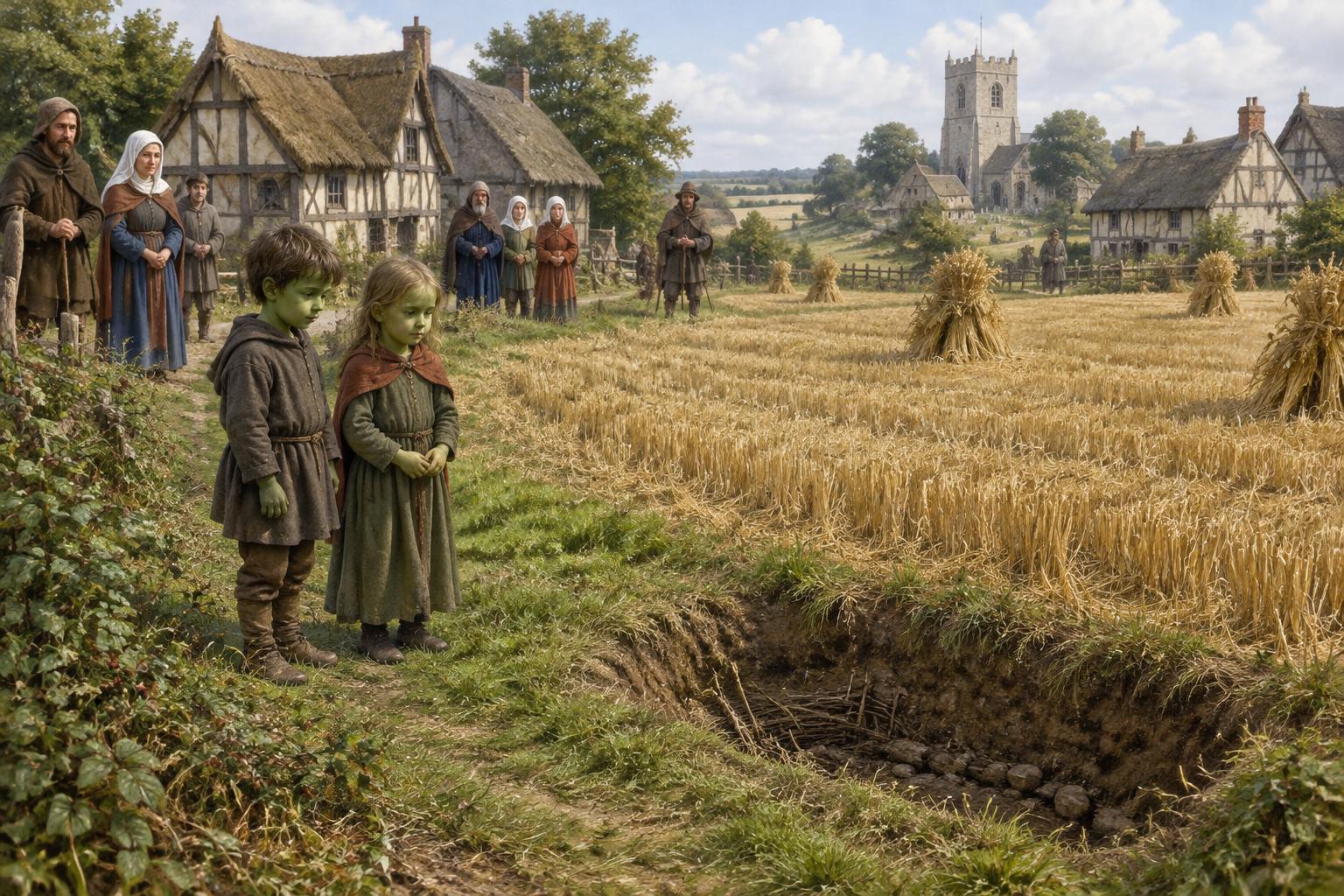
Illustrative reconstruction; not an archival photograph.
A story preserved, not an arrival proved
At harvest time, according to William of Newburgh, workers near Woolpit encountered two children with green bodies, unfamiliar clothing and speech they could not understand. The boy and girl would not eat the food offered to them. Beans finally broke the impasse. These are details in a medieval historical narrative, not observations preserved in a modern investigation. William’s account can be read in Book I, chapter 27 of his History of English Affairs.
The distinction is not a dismissal. The narrative is genuine evidence that medieval writers recorded and discussed this extraordinary report. It is not equivalent evidence that green people emerged from a hidden world. The central historical question is therefore double: what, if anything, happened in Suffolk, and what happened to that event as it became a story? Neither question can be answered by repeating the most picturesque details with greater confidence.
Woolpit and an uncertain date
Woolpit is a real Suffolk village, and the tale’s local setting is important. William connects the place-name to ancient pits associated with wolves. In his narrative the children appear near these features while reapers are working. A named settlement and a recognizable agricultural activity give the account a concrete landscape without providing an independently verified date.
The episode is usually placed in the middle of the twelfth century, often during King Stephen’s reign, 1135–1154. That range should not be silently converted into an exact year. The accounts were written later, and their relationship to the supposed event is more secure as literary chronology than as a day-by-day historical timeline. Modern Woolpit’s parish council presents the children explicitly as a legend associated with the village sign. This is valuable evidence of local remembrance, not a contemporary record of their discovery.
Two chroniclers, not two depositions
William of Newburgh wrote in the late twelfth century. Ralph of Coggeshall, an Essex abbot, recorded another version in a chronicle associated with the early thirteenth century. Neither text is a transcript of questioning conducted when the children supposedly appeared. Their narratives come through informants, memory, selection and the conventions of medieval historical writing.
The existence of two versions has often been treated as automatic independent corroboration. That is too simple. The University of Exeter Press’s study of the story reports that comparison of the original Latin accounts points toward both writers drawing on the same source. Agreement could therefore reflect a shared narrative channel rather than two separate investigations. Differences remain informative, but the number of chroniclers cannot be used as a shortcut to certainty. Two written tellings can preserve a real incident, an established local story or some mixture of the two.
Beans, hunger and adaptation
The children’s first crisis is food. In William’s version they reject what is offered until beans arrive from the fields. They initially search the stalks, then eat once someone shows them the pods. Later they accept other foods, learn the local language and lose their unusual coloring. The sequence supplies the narrative with a progression from strangeness to partial incorporation.
It is tempting to treat the bean episode as a diagnostic clue. Perhaps they recognized a familiar crop; perhaps the confusion about stalks was a misunderstanding enlarged in retelling. But the text does not let us choose between those possibilities. It also does not establish how long the refusal lasted, what the children had previously eaten or whether adults accurately understood their behavior. The detail is precise in a storytelling sense while remaining medically and linguistically incomplete. Its vividness is one reason the narrative survives, not proof that its implications have been solved.
The boy dies; the girl remains
The two lives do not proceed together. The boy becomes ill and dies, while the girl survives and enters the surrounding society. Baptism appears in the narrative tradition, as does her eventual ability to describe her origins. Ralph’s version connects the children with the household of Richard de Calne; accounts of the girl’s later life also include a marriage at Lynn, now King’s Lynn.
These details should not be expanded into a securely documented biography. The children’s original names are not established, and popular attempts to give the girl a complete identity exceed the surviving evidence. Even the chronicler’s criticism of her later behavior tells us about an adult narrator’s moral judgment, not simply her character. Carolyne Larrington’s discussion emphasizes the story’s resemblance to the experience of displaced children: incomprehension, food refusal, dependence and unequal survival. That is an illuminating reading of the narrative, not independent confirmation of the children’s origins.
Saint Martin’s Land and the missing route
Once communication becomes possible, the surviving child is said to describe a homeland without ordinary sunlight, associated with twilight and, in William’s account, Saint Martin. The versions differ in details of the landscape and the route by which the children reached Suffolk. Features include tending animals, following sounds or passing through an obscure way before emerging into an unfamiliar place.
These are not directions that can reliably be plotted on a map. They are descriptions transmitted through translation into English, retold by others and ultimately written in Latin. Every stage allows misunderstanding and embellishment. Calling the homeland subterranean or extraterrestrial therefore adds an interpretation to the source. The narrative contains an apparently otherworldly geography, but it supplies no independently checkable entrance, route or community. A modern investigator cannot reconstruct a physical journey merely by treating every image as literal topographical information.
The refugee explanation and its limits
One recurrent naturalistic proposal identifies the children as displaced Flemish speakers. Medieval England contained migrant communities, and a language unfamiliar to nearby villagers need not have been unknown everywhere. Combined with hunger, disorientation and the girl’s later adaptation, the proposal makes a human story possible without requiring another world.
Possibility is not identification. The chronicle does not preserve enough of the children’s speech to determine a language, and an unfamiliar accent alone cannot locate a village of origin. Attempts to attach the story to a particular massacre or migration must also fit its uncertain dating, rather than selecting a convenient episode afterward. Larrington’s refugee comparison is useful precisely because it directs attention to vulnerability without claiming to have recovered a passport. James Plumtree’s study likewise places the children within historical and textual contexts, reminding readers that location and transmission belong in the analysis alongside the sensational color.
Can illness explain green skin?
Another common explanation invokes malnutrition or the historical condition called chlorosis, sometimes labeled green sickness. The apparent improvement after a broader diet encourages the association. But the old diagnostic category was imprecise, and a medieval description of greenness cannot be translated directly into a modern laboratory finding.
There is no clinical examination, blood test, reliable dietary history or preserved tissue. No one can establish the children’s actual skin tone from the text, let alone its cause. Poisoning theories face the same problem: they require a particular exposure without evidence of that exposure. A retrospective medical suggestion may show that unusual appearance need not be supernatural. It does not demonstrate what happened to these particular children. Nor should a hypothesis explain only the color and leave the transmitted homeland story untouched, while claiming to have solved the entire case. Different features may have different origins in experience and storytelling.
Fairy worlds, theology and modern aliens
The story’s twilight country and threshold crossing make it attractive to readers of fairy lore. Such motifs can help explain its imaginative force and its compatibility with other otherworld narratives. They do not establish that the chroniclers simply copied a known fairy tale, any more than a plausible illness establishes that they described a medically documented event.
Modern alien interpretations add a much later framework. A 2024 Theology and Science article by Rosamund M. Gammie and Adam Foxon instead proposes a theological reading involving early Catharism and medieval ideas of humanity. The authors present an interpretive hypothesis, not an archival discovery identifying the children. The variety of readings is itself revealing. Readers repeatedly make the children embody the boundaries that most interest their own period: Christian and outsider, native and refugee, human and nonhuman. That adaptability explains cultural longevity better than it proves any single proposed origin.
William's hesitation belongs to the evidence
William did not introduce the children as something he had personally witnessed. He explained that he had hesitated to accept the report before being persuaded by the weight of testimony reaching him. That framing is an important part of the source. The author wanted readers to understand that he recognized the difficulty of the account. His eventual acceptance tells us about his assessment of informants, not about an examination of the children that can now be independently repeated.
The distinction also prevents a simplistic opposition between a supposedly credulous Middle Ages and a skeptical modern reader. William could question reports and still believe that an unexplained marvel had occurred. The question is what counted as sufficient evidence within his practice as a historian. Reputation, repeated testimony and the perceived standing of informants could persuade him where a modern investigator would seek contemporary documentation and direct interviews. Understanding that difference is more useful than treating his belief either as proof or as a reason to dismiss everything he wrote.
His introductory hesitation also shapes the reader's response. It makes the eventual account appear considered rather than casually repeated. That is a feature of the narrative's presentation, whether or not an unusual encounter lay behind it. A careful reading therefore preserves two layers at once: William reports that people persuaded him, and he writes his own persuasion into the story. Neither layer licenses an invented eyewitness scene. We cannot recover the conversations he heard, the questions he asked or the degree to which his informants shared their information with one another.
Richard de Calne and the household channel
Ralph's account is more specific about an informant. It connects the children with Richard de Calne's household at Wykes and presents that household as a source of knowledge. In his comparative study, Michał Madej emphasizes the importance of this named connection. It gives the narrative a social route: strange children are taken into a recognizable household, and information about them subsequently reaches a chronicler. That is more substantial than a story with no identified setting or transmitter.
It is still not a deposition from the surviving girl. A household could preserve observations, memories, judgments and explanations together. Its members might remember the same event differently or repeat one authoritative version. The girl's reported behavior reaches us through adults whose standards and interests are not hers. Her incorporation into their account therefore does not give us unmediated access to her childhood. The named informant strengthens our understanding of transmission without eliminating transmission as a problem.
Madej discusses John Clark's proposal that William's information may also have come, indirectly, from the same household through Augustinian connections at Thetford. This remains a reconstruction of the route by which the story traveled, not a newly recovered letter proving every stage. It helps explain why two writers could preserve similar material without copying each other's wording. Their geographical separation would not by itself make their evidence independent. A shared origin can produce two distinct texts, each shaped for a different readership.
Keeping the versions apart
A familiar modern retelling often combines every memorable detail into one seamless sequence. The children tend cattle, hear bells, pass through a cavern, emerge into sunlight and describe Saint Martin's Land as a green country. That synthesis may be convenient, but it conceals the fact that the surviving accounts distribute these elements differently. A composite narrative is a modern editorial construction, not a third medieval witness with a more complete view.
In William's version, the homeland is Christian and particularly associated with Saint Martin. It has churches, a dim light and a brighter country visible across a great river. The children remember hearing a sound like bells while attending their father's cattle, followed by their bewildering presence in the fields. William does not turn that account into a clearly mapped cave journey. The lack of an intelligible route is part of what makes the episode a marvel in his telling.
Ralph gives the cave a more explicit role and attributes to the girl a country in which people and things were green. His version also emphasizes her placement in Richard's service. The differences need not show deliberate fabrication by either writer. They could reflect variant reports, selection or narrative shaping. But they do prevent an investigator from treating all details as mutually confirmed. A feature found in one account has one textual attestation, even when the surrounding story appears in two. Preserving that distinction is essential when a theory depends on a particular landscape or mode of arrival.
Dating before explaining
William explicitly assigns the episode to Stephen's reign. Ralph does not give the same direct dating statement. Madej notes that Ralph places the tale among material that need not follow a strict chronology. It is therefore unsafe to take its position in the chronicle as a precise year. A digression can be arranged by subject or association rather than by date. The two accounts create a chronological problem, not permission to select whatever moment best fits a favored solution.
This matters especially for the Flemish explanation. Madej discusses the proposed connection with the Battle of Fornham in 1173, when Flemish forces fought during rebellion against Henry II. The suggestion draws strength from regional geography and the appeal of a real violent disruption. But 1173 falls after Stephen's death in 1154. A theory connecting the children to that battle must therefore explain why William's dating should be rejected. It cannot quietly retain the authority of his account for the color and language while discarding his chronology without argument.
A broader displacement hypothesis does not depend on that specific battle. Children could become separated from familiar people in many circumstances, and multilingual medieval England provides a plausible general context. Yet broad plausibility and a precise historical identification remain different achievements. The first can demonstrate that an apparently inexplicable encounter has conceivable human explanations. The second would require evidence tying these children to a particular community and event. At present, the surviving narrative does not supply that link. The strongest naturalistic reading should be clear about which of those claims it is making.
Language without a recorded sentence
The children's language is one of the most important missing pieces. The chroniclers report incomprehension but do not preserve a usable sample from which a modern linguist could identify it. Unknown to the people in the story does not mean unknown to the entire medieval world. It could describe a foreign language, an unfamiliar variety of speech or a breakdown in communication that retelling made more absolute. The text cannot decide among those possibilities.
The same limitation applies to the explanation supposedly given after the children learned English. We do not have their original words, a bilingual intermediary's notes or a record of how questions were phrased. A statement about a dim homeland could be a remembered description, an imperfect translation or a narrative motif. Treating it as literal geography assumes that all those intervening stages preserved exactly the meaning a modern reader assigns to the English translation of the Latin chronicle.
A responsible reconstruction therefore cannot supply an accent, identify the children as Flemish speakers or write dialogue for their first encounter. Such additions would produce the illusion that the central evidential gap had been filled. The language barrier is instead evidence of how the narrative defines unfamiliarity: the children cannot initially explain themselves, and adults explain them afterward. That structure gives the surviving girl a voice only through reported speech. It invites attention to vulnerability and interpretation, but it does not let a historian recover the lost language by selecting the most convenient regional origin.
Food as observation and narrative structure
The broad beans are both a practical detail and the turning point of the account. Until recognizable food arrives, the children remain almost unreachable; after it arrives, a process of adaptation can begin. William's description of their search through the stalks heightens their strangeness even at the moment they recognize something familiar. It offers an action readers can picture without furnishing the background needed to explain why they acted that way.
Several explanations are possible, but none is established. Children unfamiliar with the preparation of a crop might search the wrong part of a plant. Frightened or ill children might refuse foods they would otherwise accept. A storyteller might preserve or heighten an unusual action because it made a memorable episode. These possibilities operate at different levels. Some concern an imagined original encounter, others the transmission of the narrative. The sources do not permit a confident choice, and combining them does not turn possibility into diagnosis.
The later acceptance of bread also belongs to the story's movement toward incorporation. A change of diet accompanies a change of color and an improvement in communication. This sequence encourages modern readers to infer a single medical cause. But a narrative sequence is not a controlled observation of cause and effect. It contains no measurements and no reliable account of everything else that changed. Better nutrition is conceivable; it is not demonstrated as the explanation of the reported greenness. The beans should remain a documented detail of the text, rather than a laboratory result disguised as picturesque medieval evidence.
Baptism and the boundary of belonging
Baptism is not an incidental ornament in a story written by religious authors. It places the children within the Christian community as the narrators understood it. William's account also describes their homeland as Christian, with churches and devotion to Saint Martin. This creates a more complicated boundary than a simple encounter between Christian villagers and wholly alien beings. Their difference is substantial, but the reported explanation gives them recognizable religious institutions as well.
The two accounts do not organize baptism and the boy's death identically. Madej's comparison notes the different sequences rather than forcing them into one timetable. That difference matters because a modern summary can easily suggest that both authors confirm an exact progression from dietary recovery to baptism and then death. They do not provide a shared clinical or sacramental register. They offer related narratives in which incorporation, survival and loss carry different emphases.
The theological interpretation proposed by Gammie and Foxon approaches these boundaries through medieval understandings of humanity and religious difference. It is a reading of what the children's otherness might signify, not proof that two identifiable Cathar children appeared in Suffolk. Its value lies in asking what categories the story could activate for medieval audiences. The hypothesis should therefore remain beside, rather than replace, the textual facts. A possible theological meaning does not establish a physical origin, just as a possible illness does not exhaust the significance of baptism in a monastic chronicle.
The surviving girl's incomplete afterlife
The girl's reported survival makes her the principal bridge between the encounter and its explanation. Yet she remains unnamed in the central evidence. The report of marriage at Lynn gives a destination, not a securely traced family history. Attempts to identify her through later genealogies must demonstrate the connection rather than infer it from a compatible place or name. Without that bridge, an attractive biography is still an addition to the medieval account.
Ralph's adverse judgment of her behavior requires particular restraint. It is evidence that an adult narrator or his informants judged her against social expectations. It is not a neutral psychological assessment and should not be expanded into a record of specific conduct. We cannot determine her relationships, motives or later wellbeing from that characterization. A history of the girl must leave room for the fact that the surviving description was controlled by people with greater authority over both her circumstances and her reputation.
Larrington's child-refugee reading brings that inequality into focus without resolving her identity. It asks readers to consider the dependence of children who cannot explain themselves, and the unequal outcomes for two siblings. This is a humane interpretive frame, but it remains important not to diagnose trauma or invent remembered grief. The boy's death and the girl's survival are features of the chronicles. The private emotional lives behind those features cannot now be documented. Restraint here preserves the distinction between recognizing a human possibility and claiming access to a person the sources scarcely allow us to hear.
The story's changing uses
Madej traces early modern responses that did not agree about what kind of account this was. William Camden treated the tale skeptically, while Robert Burton and Francis Godwin connected its possibilities with speculation about other inhabited worlds. Godwin's imaginative use belongs to the history of literary reception, not to a medieval report of a spacecraft. The change of framework shows how a stable set of strange details could be made to serve new intellectual interests.
Later folklore study gave the threshold, the twilight country and the unusual food another set of meanings. Such comparisons can reveal narrative relationships without proving that the chroniclers invented the episode from an identifiable folktale. Equally, a lack of an exact matching tale would not prove that every feature originated in eyewitness observation. Stories can combine local memories, familiar motifs and new elaboration. The evidence here does not require a choice between an entirely literal report and an entirely fabricated narrative.
Modern Woolpit's commemoration gives the children a visible place in village identity. That local afterlife is real and documentable even though their original identities are not. A sign or heritage account records what a community remembers and presents to visitors; it cannot retrospectively authenticate a twelfth-century arrival. The distinction allows the legend's cultural importance to be taken seriously without using its popularity as evidence of its factual content. The most durable result of the case is the story itself: a transmitted account continually reinterpreted, with its uncertain human origin still outside secure historical reach.
What the green children can still tell us
The evidence supports a restrained conclusion. Two medieval chronicles preserve related accounts of extraordinary children at Woolpit. They describe food refusal, linguistic difference, changing appearance, a boy’s death and a girl’s survival. Their common narrative core deserves study, but their distance from the alleged event and possible shared source prevent simple corroboration.
The most defensible mystery is not whether a portal can now be found beneath Suffolk. It is how much human experience survives inside a carefully shaped medieval marvel. Displaced children, illness and folklore are possibilities of different kinds, not mutually confirmed discoveries. The story’s power comes partly from that incomplete recovery. We can recognize the emotional reality of hungry children facing strangers without claiming to know their birthplace. Woolpit’s legend remains a window into medieval reporting and later imagination, while the identities and experiences of any children behind it remain beyond secure reconstruction.
Sources & record
- 01William of Newburgh, History of English Affairs, Book I, chapter 27; Fordham Medieval Sourcebook
- 02University of Exeter Press: The Green Children of Woolpit, Chronicles, Fairies and Facts in Medieval England
- 03Carolyne Larrington, Green Growing Pains, Cambridge University Press
- 04Woolpit Parish Council: Green Children
- 05James Plumtree, Placing the Green Children of Woolpit, Brill, 2022
- 06Rosamund M. Gammie and Adam Foxon, Extraterrestrials or Terrestrial Heretics? Theology and Science
- 07Fordham Internet Medieval Sourcebook: William of Newburgh, Book I
- 08Michał Madej, Res Historica (2020): the Green Children in the medieval chronicles
Online citations
- →William of Newburgh, History of English Affairs, Book I, chapter 27; Fordham Medieval Sourcebook
- →University of Exeter Press: The Green Children of Woolpit, Chronicles, Fairies and Facts in Medieval England
- →Carolyne Larrington, Green Growing Pains, Cambridge University Press
- →Woolpit Parish Council: Green Children
- →James Plumtree, Placing the Green Children of Woolpit, Brill, 2022
- →Rosamund M. Gammie and Adam Foxon, Extraterrestrials or Terrestrial Heretics? Theology and Science
- →Fordham Internet Medieval Sourcebook: William of Newburgh, Book I
- →Michał Madej, Res Historica (2020): the Green Children in the medieval chronicles