Kaspar Hauser, the Boy from Nowhere
A teenager appeared in a Nuremberg square in 1828 barely able to speak, claiming he had spent his life alone in a dark cell. Five years later he was stabbed in a public garden, and the question of who he was died with him.
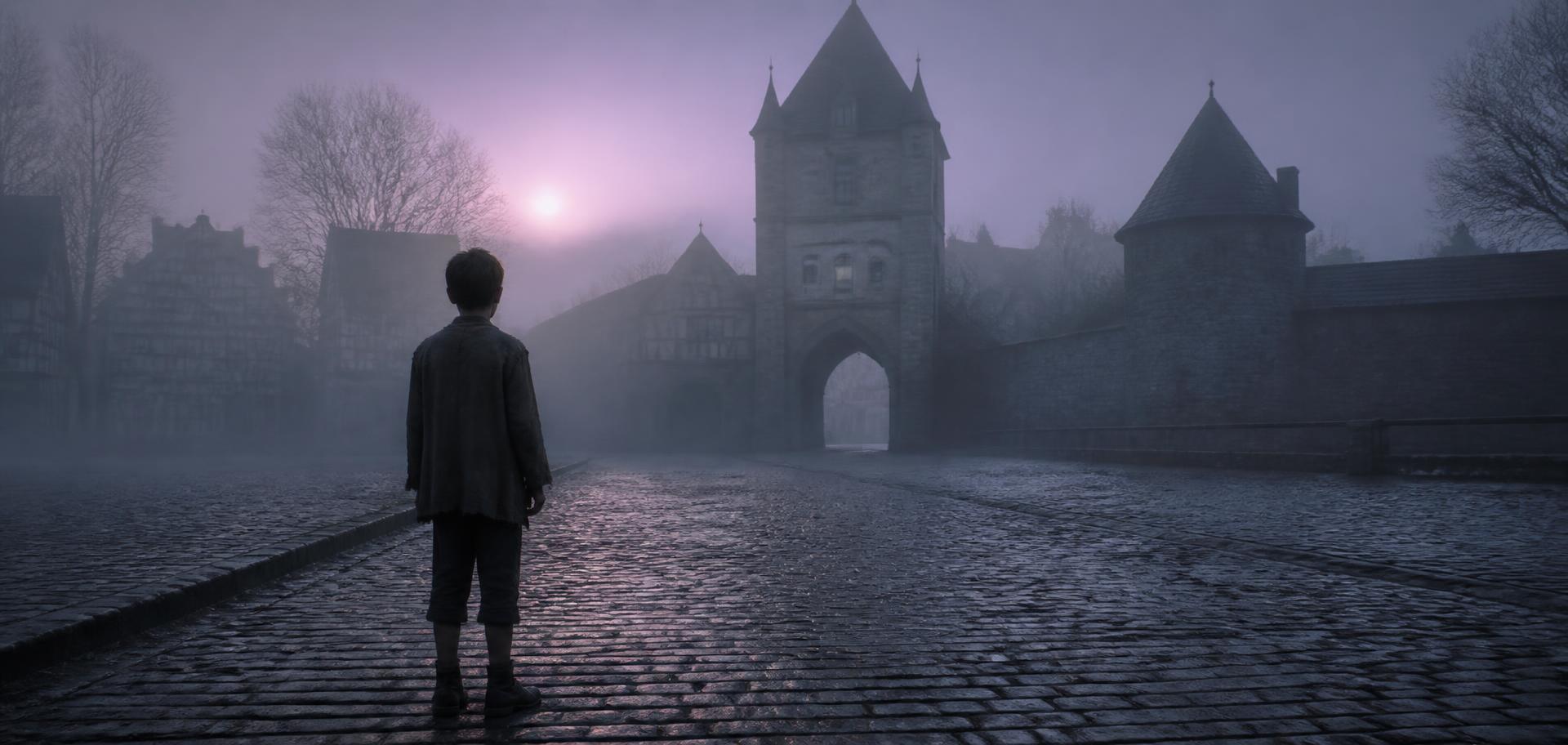
Illustrative reconstruction; not an archival photograph.
On Whit Monday, 26 May 1828, a shoemaker crossing Unschlittplatz in Nuremberg found a boy of about sixteen standing in the square, unsteady on his feet, holding a letter addressed to the captain of a local cavalry regiment. He could barely walk. He wept when spoken to and could produce only a few phrases, chief among them a sentence about wanting to be a soldier as his father had been. Taken to the guardhouse, he was given meat and beer and refused both, violently; he would eat only bread and water. Handed a pen, he wrote a name in a clear, practised hand: Kaspar Hauser.
The account he gave
As his speech developed over the following months, he described a life spent entirely in a cell roughly two metres long, dark, where he sat on straw and could not stand upright. He said he had never seen the man who kept him. Bread and water appeared while he slept; occasionally the water tasted bitter and he slept longer, waking to find his hair and nails cut. He had two wooden horses and a ribbon to play with. Shortly before his release, he said, the man taught him to write his name and to say the soldier sentence, then carried him out of the cell and brought him to Nuremberg.
The physical observations recorded at the time were consistent enough with such a story to disturb the people examining him. He had extraordinary night vision and could distinguish colours in darkness. Ordinary daylight and loud sound caused him pain. He reacted to metals held near him, and to certain foods as though poisoned. His gait was awkward, his knee joints unusual in a way physicians attributed to prolonged sitting. He was not, however, unintelligent: he learned rapidly, drew well, and within two years was writing an autobiography.
The men who took him in
The city of Nuremberg assumed responsibility for him and placed him with Georg Friedrich Daumer, a schoolmaster who documented his education in detail. His case attracted Anselm von Feuerbach, the jurist and president of the Bavarian court of appeal, who investigated him personally and became convinced that he was the victim of a deliberate crime — that a child had been removed from the world by someone with a reason. Feuerbach's 1832 monograph gave the case its enduring title: an account of a crime against the life of the soul of a man.
A crime against the life of the soul of a man.
Anselm von Feuerbach, 1832
In October 1829 Hauser was found in Daumer's cellar with a cut to his forehead, saying he had been attacked by a hooded man with the words that he must die before he left Nuremberg. Sceptics thought the wound self-inflicted after a reprimand. He was moved between guardians, and eventually came under the patronage of the English aristocrat Lord Stanhope, who paid for his upkeep, made much of him, and then abruptly cooled, placing him with a strict schoolmaster in Ansbach and later publishing a book arguing that the whole thing had been an imposture.
Ansbach, 1833
On 14 December 1833 Hauser came home to Ansbach with a deep stab wound in his left breast. He said a stranger had lured him to the Hofgarten with the promise of information about his mother and stabbed him while handing over a bag. A violet silk purse was found at the spot, containing a note written in mirror script — a message claiming to be from the Bavarian border and giving initials for a name. He died three days later. Investigators noted that the note contained a spelling error Hauser was known to make, and that the footprints in the snow at the scene appeared to be his alone. Whether he was murdered or wounded himself and misjudged the depth has never been settled.
The prince theory, and the DNA
Almost from the beginning it was rumoured that Hauser was the hereditary prince of Baden, born in 1812 and officially dead in infancy, swapped in the cradle to change the line of succession in favour of a rival branch. The theory accounts for the money spent on keeping him alive, the interest of well-connected men, and the shape of a threat that follows him from Nuremberg to Ansbach. It has never been proven.
In 1996 a German magazine had bloodstains from Hauser's preserved underclothes analysed and reported that the DNA did not match a descendant of the House of Baden. In 2002 a second team tested hair and other clothing samples from items with better provenance and found a profile that was compatible with the Baden line, while noting that the earlier sample's chain of custody was poor. The two results are not reconcilable with the material available, and the family's tomb has not been opened.
What the file holds
There are two coherent readings of Kaspar Hauser, and the evidence has never separated them. Either a child was deliberately confined for over a decade and later killed to keep the fact quiet, or an unusually gifted adolescent invented a life and then, having been believed by the finest legal mind in Bavaria, could not put it down and staged one wound too many. The stone in the Ansbach Hofgarten where he was struck carries an inscription in Latin that concedes everything the case will ever concede: here a stranger was killed by a stranger.
Sources & record
- 01Anselm Ritter von Feuerbach, Kaspar Hauser: Beispiel eines Verbrechens am Seelenleben des Menschen (1832).
- 02Georg Friedrich Daumer, Mitteilungen über Kaspar Hauser (1832).
- 03Ansbach and Nuremberg municipal and judicial records concerning Kaspar Hauser, 1828–1834.
- 04Philip Henry, Earl Stanhope, Materialien zur Geschichte Kaspar Hausers (1835).
- 05Institut für Rechtsmedizin, University of Munich, DNA analysis reported in Der Spiegel, 1996.
- 06B. Brinkmann et al., mitochondrial DNA study of Kaspar Hauser relics, University of Münster, 2002.
- 07Jeffrey Moussaieff Masson, Lost Prince: The Unsolved Mystery of Kaspar Hauser (Free Press, 1996).
Online citations