A German Farm Family Was Found Dead — Six Days After
Six people were killed with a mattock at an isolated Bavarian farmstead at the end of March 1922. For several days afterwards the animals were fed, smoke rose from the chimney and neighbours saw nothing wrong. When the bodies were finally found on 4 April, the killer had been gone long enough to leave almost nothing behind. More than a century later the case is still open.
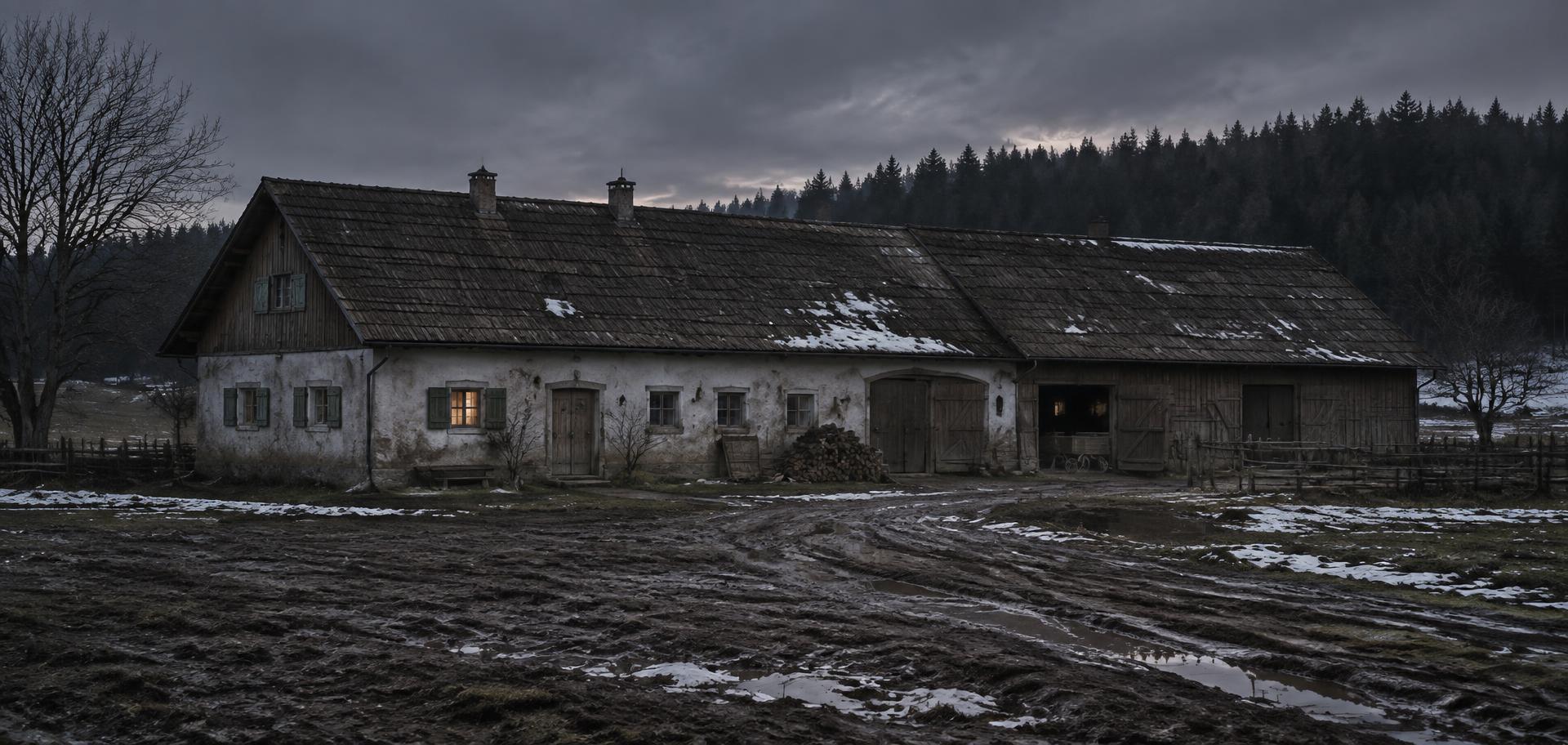
Illustrative reconstruction; not an archival photograph.
What was Hinterkaifeck?
Hinterkaifeck was not a village. It was a single farmstead standing alone in fields between the hamlets of Kaifeck and Gröbern, in the Bavarian district now part of Schrobenhausen, roughly seventy kilometres north of Munich. The nearest neighbours were a walk away across open ground. The house, stable and barn were joined into one long building, so that a person could move from the animals to the living quarters without stepping outside.
Six people lived there in the spring of 1922: the farmer Andreas Gruber, aged 63, and his wife Cäzilia; their widowed daughter Viktoria Gabriel, 35; her children Cäzilia, 7, and Josef, 2; and a maid, Maria Baumgartner, who had arrived to take up the post only hours before she died.
What happened in the days before the killings?
In the weeks before the murders, Andreas Gruber told several people about strange occurrences at the farm. He described footprints in the snow leading from the edge of the forest to the farmstead with none returning, sounds in the attic, a missing house key, and a newspaper on the property that nobody had bought. The previous maid had left the post some months earlier; relatives later said she believed the house was haunted.
These accounts come from what neighbours and relatives told investigators after the bodies were found, not from anything Gruber wrote down. They are consistent in outline and were recorded early, which makes them worth taking seriously as reports. They are not proof that someone was living in the attic, and no evidence was ever produced that established who, if anyone, had been on the property.
How were the murders discovered?
Nobody from the farm appeared in church on Sunday 2 April. The children did not come to school. The postman left mail that was not collected. A mechanic who came to the farm on 1 April to work on a machine spent hours there, saw nobody, and thought little of it. It was only on Tuesday 4 April that neighbours went to look.
They found four bodies in the barn — Andreas and Cäzilia Gruber, their daughter Viktoria and the child Cäzilia — laid together under hay and a door. In the house, the toddler Josef lay dead in his cot in the room he shared with his mother, and the maid Maria Baumgartner lay dead in her bed in her own small chamber. All six had been struck repeatedly about the head. The injuries were consistent with a mattock, a heavy hoe-like tool for breaking ground, which was later found at the farm.
Why was the crime scene almost useless to investigators?
Before the police arrived and for days afterwards, large numbers of people came to Hinterkaifeck. Neighbours moved through the building, the farm continued to be worked, and curious visitors walked the site. The Munich police did send officers, and the bodies were examined, but the surrounding ground and the interior had been comprehensively disturbed.
The examinations were carried out on the farm itself. In keeping with the forensic practice of the time, the victims' heads were removed and taken to Munich for further study; they were lost during the Second World War. The remaining forensic material from 1922 is therefore thin by any modern standard, and it is one reason the case has never yielded to later review.
Who fed the animals after the family was dead?
This detail is what turns the case from a murder into something harder to hold. Neighbours reported seeing smoke from the chimney over the weekend. The cattle were found fed and watered, and there was evidence that food in the kitchen had been eaten after the night of 31 March. Whoever killed the household appears to have stayed at the farm, or returned to it, for some days afterwards.
There is no innocent explanation on record for who did that work. It is the single strongest indication that the killer knew the farm, its routine and its animals, and was not afraid of being seen there. It is also, frustratingly, an inference from what the neighbours observed rather than something any witness saw directly.
Who were the suspects?
Robbery was largely discounted: money was found in the house. Investigators looked hard at the family itself. Andreas Gruber and his daughter Viktoria were widely reported to have had an incestuous relationship, and both had been convicted in connection with it before the war; the paternity of the youngest child was a subject of local talk. Viktoria's husband Karl Gabriel had been reported killed in France in 1914, and a persistent theory held that he had survived and returned — a claim investigators pursued and never substantiated.
Over the following decades Bavarian police questioned more than a hundred people. Several neighbours were investigated, including men said to have had disputes or claims involving the Gruber property. One later suspect confessed and then withdrew the confession. No charge was ever brought. A review by the Bavarian police academy in the 2000s is reported to have arrived at a preferred suspect, but the name was withheld out of consideration for living relatives, and no evidence was published that would allow anyone outside the review to test the conclusion.
What can and cannot be said about Hinterkaifeck today?
What is established: six people were killed at the farmstead on or about the night of 31 March 1922; the weapon was consistent with a mattock found on the property; four bodies were stacked in the barn and two were killed in their beds; the bodies were discovered on 4 April; and the farm showed clear signs of someone present in the days between. The buildings were demolished in 1923. A memorial stands near the site.
What is not established: who was in the attic, if anyone; whether Karl Gabriel survived the war; the identity of the killer; and the motive. A century of retelling has attached details to Hinterkaifeck that the file does not support, and the internet has added more. The documented case is disturbing enough without them — a household killed one by one in a building where the animals never stopped being fed.
Sources & record
- 01Bavarian State Police files on the Hinterkaifeck murders, 1922 onward (contemporary investigation records).
- 02Peter Leuschner, Der Mordfall Hinterkaifeck (documentary history of the case and its investigation).
- 03Contemporary Bavarian press reporting, April 1922, on the discovery at the Hinterkaifeck farmstead.
- 04Bayerische Polizei / Polizeifachhochschule Fürstenfeldbruck review of the case in the 2000s, as reported in the German press.
Online citations