The Inca Children Found Frozen at 22,000 Feet
Near the summit of one of the world's highest volcanoes, archaeologists found three Inca children whose clothing, hair and bodies had remained frozen for about five centuries. Their preservation opened an extraordinary record of life and ritual in the final decades of the Inca Empire — and difficult questions about how that record should be studied and shown.
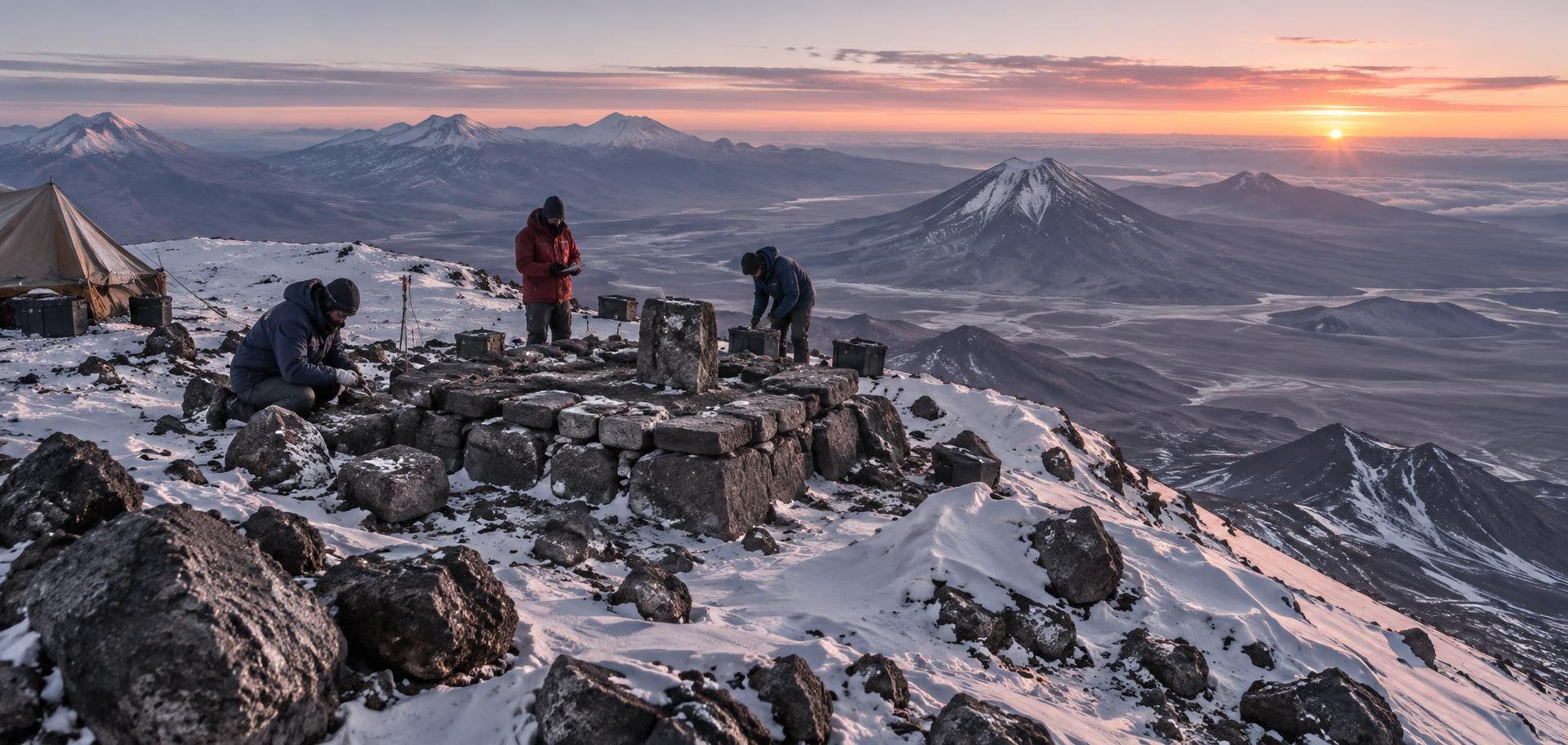
Illustrative reconstruction; not an archival photograph.
What was found on Llullaillaco in 1999?
In March 1999, an expedition led by anthropologist Johan Reinhard and Argentine archaeologist María Constanza Ceruti excavated an Inca ceremonial platform near the summit of Llullaillaco, a 6,739-metre volcano on the Argentina–Chile border. Beneath the platform were three naturally frozen children accompanied by textiles, feathered headdresses, miniature figures, pottery, food and other offerings. The cold, dry, low-oxygen environment had preserved soft tissue, hair, clothing and internal organs to an exceptional degree.
The platform is commonly described as the world's highest archaeological site. Accounts often round its elevation to 22,000 feet; the summit itself is measured at about 6,739 metres, or 22,110 feet, while published measurements for the burial complex vary slightly. At that height, the excavators worked in severe cold with less than half the oxygen available at sea level. Every object had to be exposed and stabilised without allowing the frozen context to thaw.
Who were the three Inca children?
Their personal names were not recorded. Researchers and museum literature identify them by descriptive names: the Maiden, an adolescent estimated to have been about 13 to 15; the Boy, about four or five; and the Lightning Girl, about six or seven. The last name refers to lightning damage that affected her burial after death, not to the cause of her death. Ages are estimates based on teeth, bones and physical development rather than written records.
The children's finely made garments and carefully arranged offerings place them within an official Inca ceremony rather than an accidental death or ordinary burial. Their clothing also carried regional distinctions. Archaeologists use those textiles, hairstyles and associated objects to investigate where the children may have come from and how people from distant communities were incorporated into an imperial rite.
What was the Inca capacocha ceremony?
The burials are understood as part of capacocha, also written qhapaq hucha: a state ceremony documented by Spanish colonial chroniclers and supported by archaeology across the Andes. Selected children and valuable offerings were sent from different regions toward Cusco and then to sacred places, including major mountain summits. Ceremonies could mark an emperor's death or accession, a military victory, a natural disaster, or an appeal for fertility and protection.
Mountains were not empty scenery in Andean belief. They were powerful beings and places of exchange, often described as apus. Capacocha therefore linked the imperial centre, local communities and sacred geography. Colonial sources suggest that selection could bring honour or status to a family, but those accounts came through conquest-era observers and elite institutions. They cannot tell us how each child understood the journey, and ceremonial status does not erase the coercive reality of children's deaths within an imperial system.
What did their hair reveal about their final year?
Hair grows in a sequence that preserves a chemical timeline. Stable-isotope studies published in 2007 found substantial dietary changes in the months before death. Earlier sections of hair reflected diets based more heavily on local plant foods. Later sections showed increased maize and animal protein, foods associated with higher status and ceremonial preparation in the Inca world. The pattern suggests that selection altered the children's lives months before they reached the mountain.
The changes were clearest in the Maiden, whose hair records roughly two years. Researchers interpreted a marked shift about twelve months before death as evidence that she entered a new social and ritual role. The chemistry cannot identify a particular meal or emotion, but it can show that the final journey was a prolonged process rather than a single event at the summit.
What do coca and alcohol findings mean?
Later analysis detected metabolites associated with coca leaves and alcohol in the children's hair. In the Maiden, coca use rose during the final year and alcohol exposure increased sharply in the final weeks. Coca and chicha, a fermented maize drink, had ordinary, medicinal and ceremonial roles in the Andes. At extreme altitude they may also have reduced fatigue, anxiety and awareness, but chemical evidence cannot establish exactly why they were administered or how the children experienced their effects.
The findings have sometimes been compressed into claims that all three children were simply drugged before death. The published evidence is more specific and less certain: exposure varied between the children, the strongest pattern appears in the Maiden, and ritual consumption may have served several purposes at once. Scientific measurements reveal what entered their bodies; intention remains an interpretation.
How did the children die?
There is no single confirmed clinical cause of death for all three children. The burials, body positions and lack of major trauma have led researchers to propose that cold exposure, perhaps combined with the sedating effects of alcohol and the exhaustion of altitude, played a central role. Some Inca capacocha victims at other sites show lethal injuries, but the Llullaillaco evidence should not be made to say more than it does.
The Maiden was found seated with her legs crossed and head inclined, still wrapped in textiles. The Boy was tightly bundled; staining on his clothing and evidence from his condition have prompted several medical interpretations, none of which produces a complete reconstruction of his final moments. The Lightning Girl had been altered by a lightning strike that reached her burial long after it was sealed. These are human remains, not a tableau, and uncertainty is part of an accurate account.
Why were the bodies so well preserved?
Llullaillaco's summit created a natural conservation chamber. Persistent freezing slowed biological decay, aridity limited moisture, and low oxygen restricted microbial activity. Unlike deliberately embalmed bodies, the children were preserved primarily by their environment. Skin, blood, organs, stomach contents and hair survived alongside fragile feathers and textiles — material that would normally disappear within years.
That preservation is also precarious. Once removed from the mountain, the remains required engineered conditions that reproduce its cold, dry stability. The Museum of High Altitude Archaeology in Salta uses specially designed cases and monitors temperature, humidity, pressure and oxygen. Only one of the three is displayed at a time, while the others remain in controlled storage.
What did the offerings reveal?
The assemblage included small human and animal figures made from gold, silver and shell, elaborately woven garments, featherwork, sandals, pottery and food. Such objects recur at other capacocha sites and formed a visual language of status, place and imperial authority. Spondylus shell, brought from warm Pacific waters far to the north, and metals drawn from other regions made the burial a map of the empire's reach.
The expedition also documented the route and architecture leading to the summit shrine. Inca builders established camps and ceremonial structures on a mountain where ordinary survival is difficult. The labour needed to transport people, fuel, textiles, food and offerings above 6,000 metres is evidence of planning on an imperial scale — and of the religious importance attached to the peak.
Should the Llullaillaco children be displayed?
The scientific value of the find does not settle the ethics of possession and display. The children could not consent to excavation, study or public viewing. Some Indigenous representatives and other critics regard the remains as ancestors or sacred persons who should not be exhibited. Supporters of the museum argue that careful display can communicate Inca history and preserve the children under safer conditions. Both positions involve dignity, stewardship and authority over the dead.
A responsible account should not treat exceptional preservation as permission to stare. The lasting significance of Llullaillaco lies in the children as people: their diets changed, they travelled far, they took part in a ceremony organised by one of the world's largest premodern states, and their bodies became evidence centuries later. What science can learn from them must remain connected to what was taken from them.
What remains unknown about the children of Llullaillaco?
Researchers can reconstruct diet, movement, health and ritual sequence with unusual precision. They still cannot recover the children's names, the exact communities of every child, the political event that prompted this particular ceremony, the words spoken on the summit, or each child's understanding of what would happen. The archaeological record is extraordinarily intimate and permanently incomplete.
That combination makes the Llullaillaco discovery more than a story of survival in ice. It is evidence of how the Inca state joined distant landscapes through ceremony, how modern science can read a life from hair and textiles, and how easily discovery can become possession. Five centuries after the summit was sealed, the central question is no longer only what the children can tell us. It is how we choose to listen.
Sources & record
- 01María Constanza Ceruti, 'Overview of the Inca Frozen Mummies from Mount Llullaillaco, Argentina,' Journal of Glacial Archaeology (2013).
- 02Andrew S. Wilson et al., 'Stable isotope and DNA evidence for ritual sequences in Inca child sacrifice,' Proceedings of the National Academy of Sciences (2007).
- 03Andrew S. Wilson et al., 'Archaeological, radiological, and biological evidence offer insight into Inca child sacrifice,' Proceedings of the National Academy of Sciences (2013).
- 04Museo de Arqueología de Alta Montaña, Salta, Llullaillaco collection and conservation information.
- 05Johan Reinhard and María Constanza Ceruti, Sacred Mountains, Ceremonial Sites and Human Sacrifice Among the Incas (2005).
Online citations
- →MAAM — The Children of Llullaillaco and museum conservation
- →PNAS 2007 — isotope and DNA evidence for the ritual sequence
- →PNAS 2013 — archaeological, radiological and biological evidence
- →Journal of Glacial Archaeology — Ceruti's overview of the Llullaillaco mummies
- →UNESCO — Qhapaq Ñan, Andean Road System and Inca ceremonial landscape