The Isdal Woman: An Unknown Traveller and a Disputed Death
A woman found burned in a valley outside Bergen left behind hotel registrations, luggage and a trail of false names. Police treated her death as suicide, but her identity and the circumstances of her final journey remain unresolved.
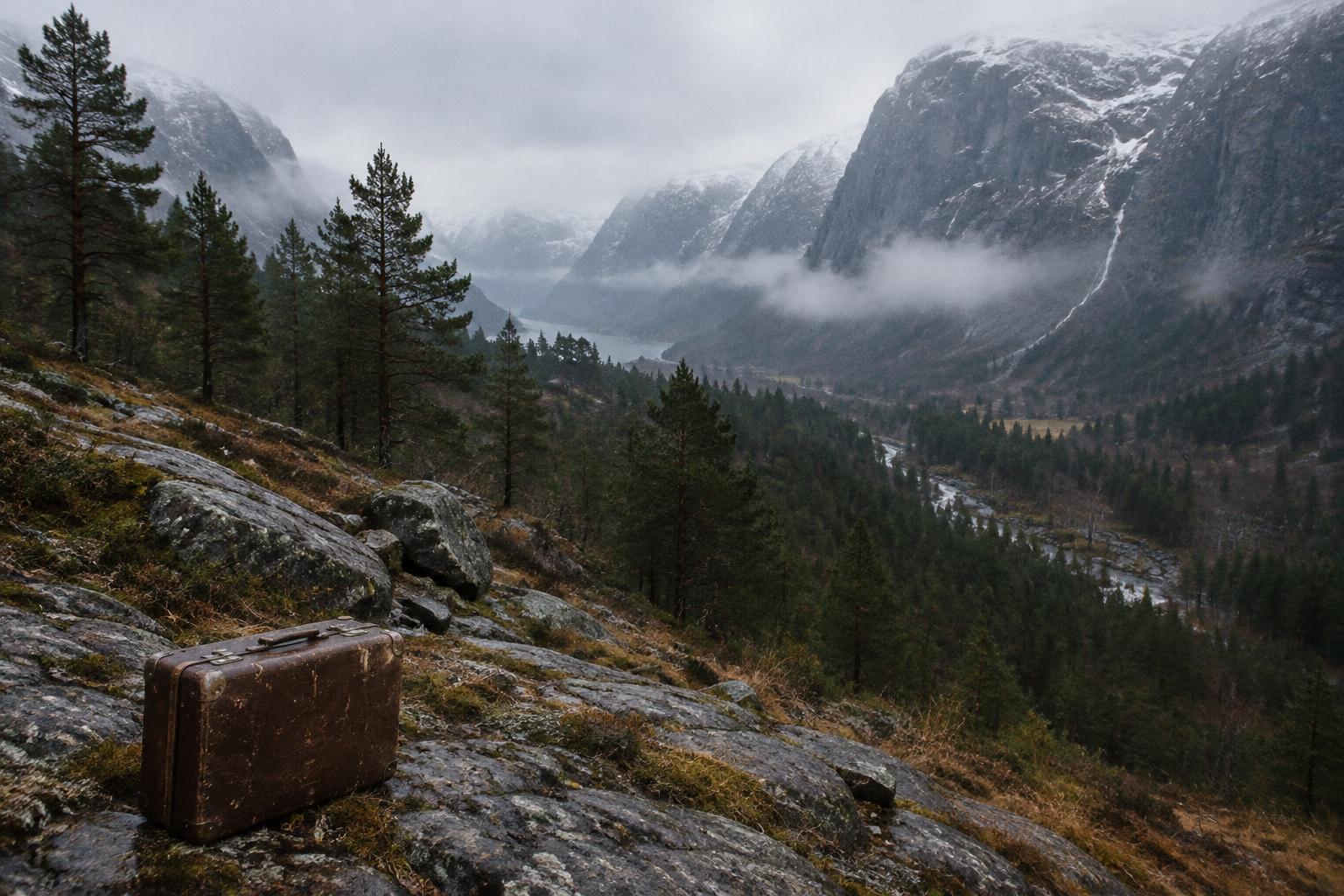
Illustrative reconstruction; not an archival photograph.
A body above Bergen
On 29 November 1970, a man walking with his two daughters found a woman's body among rocks in Isdalen, near Bergen on Norway's western coast. The body was badly burned, particularly on the front. Objects lay nearby, but the woman had no readily usable identification. Police began investigating a death whose setting seemed difficult to reconcile with an ordinary walk in the hills.
The location supplied the name by which she would become known: the Isdal Woman. It did not supply a biography. Later accounts often call the surroundings Death Valley, using a local association with earlier deaths to deepen the atmosphere. That history is not evidence about this woman's intentions. Bergen was a substantial port city with international connections, and the valley was accessible from it. The meaningful question was how this particular traveller reached the rocks and died there, not whether the landscape itself had a sinister reputation.
The scene and the medical findings
Investigators found personal effects near the body, including items associated with clothing and travel. Labels and identifying marks had been removed from numerous possessions. That pattern became one of the case's defining facts, suggesting that somebody wanted to make identification harder. It does not, without further evidence, identify who removed the marks or when they did so.
The BBC's reconstruction describes sleeping medication in her system and stomach, together with evidence that she had breathed during the fire. Carbon monoxide exposure and the drugs were central to the medical assessment. Such findings help establish physiological events, but they do not reveal whether medication was taken freely, under coercion or without full understanding. The characteristic flexed posture of a burned body is also a response to heat, not proof of fighting. Reading the scene requires separating observations from interpretations that became attached to them during decades of retelling.
Two suitcases and a recoverable journey
Police traced two suitcases left at Bergen railway station to the unknown woman. Their contents provided a much richer picture than the hillside alone: clothing, personal belongings and a written sequence of letters and numbers. Fingerprint comparisons helped connect the luggage to the body. Labels and manufacturers' marks had also been removed from belongings in the cases.
The written sequence was interpreted as a shorthand record of travel dates and places. Calling it a code is reasonable, but calling it an intelligence cipher goes beyond what the deciphered itinerary established. Travellers can abbreviate their own movements for ordinary personal reasons. The luggage nevertheless transformed the investigation. Instead of searching only for a missing local resident, police could work backward through hotels and journeys. Every recovered registration offered a possible witness or document, even though the names attached to those registrations proved to be another obstacle rather than a solution.
False names on hotel forms
The woman's hotel trail showed repeated use of false identities. NRK's public appeal describes at least eight identities during European travel, while accounts differ in how they count individual names and registrations. Staff and guests remembered a well-dressed foreign visitor who sometimes changed rooms. Witnesses reported hearing languages they identified as German or Flemish; impressions of her English varied.
These memories helped investigators connect apparently separate hotel stays, but they were not recordings. An employee's impression of nationality or accent is a lead, not a passport record. Reports about changing appearance and disguises likewise deserve more care than the popular image of a bag full of theatrical identities. The strongest underlying fact is repeated concealment of a legal name. That behaviour invites several explanations, including clandestine work, illicit activity and private difficulties. It does not select one explanation merely because a Cold War setting makes espionage seem natural.
The final days in November
By comparing registrations and witness accounts, investigators reconstructed substantial parts of the woman's Norwegian itinerary during 1970. Her last documented Bergen hotel stay ended before the discovery in Isdalen. The gap between leaving accommodation and being found dead became crucial: it was there that a journey that could partly be checked against paperwork gave way to uncertain recollection and inference.
Later witnesses have described possible encounters with a woman resembling her, sometimes in the company of men. Such accounts deserve investigation, particularly when they contain independently checkable details. They cannot simply be inserted into the chronology as established events. A memory offered many years later can be influenced by published photographs and a now-famous narrative. There is no securely demonstrated public reconstruction of every movement to the death scene. Any account that supplies a complete final meeting, a named handler or a precise killing sequence is offering a theory rather than a documented itinerary.
Why the official conclusion is disputed
The police ultimately treated the death as suicide. The sleeping medication, fire and absence of a proven assailant contributed to that assessment. Her identity remained unknown, and she was buried in Bergen in 1971. Describing the case accurately requires stating this official conclusion rather than presenting homicide as the established cause or manner of death.
The suicide assessment has been challenged by people involved in the original inquiry and by later journalists and commentators. They question the setting, the removal of identifying marks, the mechanics of the fire and whether every relevant lead received adequate attention. Those are legitimate reasons to examine the record. They are not independently proof of murder. Nor does the investigation's relatively early closure establish a hidden order from an intelligence service. No unsupported claim about a sealed report is necessary to explain the uncertainty: the publicly discussed evidence already leaves substantial questions about identity and circumstances.
The espionage theory and its boundaries
Norway's strategic position during the Cold War gives the espionage hypothesis a plausible background. A foreign traveller using aliases and moving through coastal cities could attract the interest of security authorities. BBC and NRK reporting has explored possible military connections and accounts of encounters involving naval personnel. These are strands of an inquiry, not a verified assignment or identification.
A strong espionage explanation would need more than behaviour compatible with secrecy. It would require a reliable connection to an organisation, corroborated operational records or evidence connecting her movements to specific work. None of the cited reporting establishes such a chain. The same outward behaviour might fit a courier, someone involved in fraud or a person hiding from a private threat. Conversely, an ordinary explanation should not dismiss the aliases as meaningless. The task is to explain the unusual facts without promoting their most dramatic possible interpretation into the only available answer.
What teeth can tell investigators
NRK renewed attention to the case in 2016 and worked with police and specialists to examine retained dental material. The teeth and jaw offered opportunities that had not existed in 1970. Dental workmanship could help exclude some origins or suggest where treatment might have occurred, although a person can receive dental care far from where she was born.
Isotope analysis provided another route. Ratios of elements incorporated into developing teeth can reflect food, water and geology during childhood. NRK and the BBC reported results compatible with parts of continental Europe, including Germany, France and the Benelux region. The 2017 reporting emphasised the French-German border area; later work discussed a possible connection with Nuremberg. These are probabilistic geographical clues, not a chemical address. Different regions can overlap, diets move across borders and historical baseline data have limitations. A narrowing of possibilities is valuable even when it is not an identification.
New science, older memories
The BBC–NRK collaboration developed into the podcast Death in Ice Valley. Its reporting revisited witnesses, travel documents and physical evidence while inviting public help. A 2019 update described a revised likely age closer to forty than thirty and explored fresh interpretations of the itinerary and an ordinary spoon recovered from the luggage. Small objects can become productive leads when their manufacture or distribution can be independently checked.
Public participation also carries risks. Listeners can recognise a person, locate a record or identify an object, but they can equally reinforce a persuasive error. A proposed face or family connection requires documentary and, where possible, genetic testing. DNA work reported by NRK indicated broad European ancestry; that is not a personal match. The woman's appearance in reconstructed illustrations must also remain distinct from a verified portrait. Reconstructions are investigative aids built from remains and descriptions, not photographs of a living traveller whose identity has already been established.
An identity before an explanation
The surviving evidence supports an unknown European traveller who used multiple false identities, stayed in Norwegian hotels and died after exposure to sleeping medication and fire. The official suicide conclusion is disputed. Homicide, clandestine activity and private crisis remain possible interpretive directions, but none has become an established, complete explanation in the sources examined here. Her name is still the most consequential missing fact.
Identification could connect dental treatment, relatives, languages and journeys in ways that speculation cannot. It might resolve the death, or it might reveal a life while leaving the final events uncertain. Either outcome would be more substantial than adding another unverified agency or suspect. The case's enduring strangeness lies in how much administrative evidence one traveller left while avoiding a recoverable identity. The respectful ending is therefore provisional: not a nameless spy declared murdered, but a woman whose documented concealment and disputed death still require an explanation.
The distinction between a scene and a sequence
The first discovery established a place where the woman had died or been left, together with objects that might help explain her presence. It did not provide a witnessed account of the events. Photographs and inventories can preserve relationships between a body, clothing and belongings; they cannot independently disclose intention. A scattered object might have been placed, dropped or displaced during the fire or subsequent activity. Where the public record does not establish the mechanism, an account should not silently choose the explanation that makes the scene appear most deliberately arranged.
This distinction becomes important when the hillside is described as an execution site or a place selected for suicide. Either description incorporates a conclusion before the evidence has been assessed. The documented discovery is compatible with questions about both possibilities, but it does not supply the answers. The valley's accessibility also complicates the familiar contrast between an ordinary traveller and an impossibly remote destination. Difficulty, unfamiliarity and apparent isolation are matters to investigate, not substitutes for evidence of how she arrived. The surviving hotel trail offers firmer ground for reconstructing her activities than an imagined final walk.
What the fire establishes, and what it does not
The BBC's account of the medical evidence places drugs, carbon monoxide and burning within the same death investigation. Their coexistence is crucial, but the order and significance of events require care. Evidence of breathing during a fire shows that some exposure occurred before death. It does not tell us whether the woman was conscious, able to move freely or aware of what was happening. Nor does the presence of medication establish the circumstances in which it entered her body. Those questions extend beyond identifying substances to reconstructing human actions.
It is therefore possible to reject a simplistic description without replacing it with another unsupported one. The medical findings do not justify saying that the body was merely burned after death to conceal a murder. Equally, they cannot by themselves demonstrate a deliberate act of self-destruction. The official suicide assessment is a conclusion reached from the wider investigation, not a word chemically encoded in the remains. Later disagreement should address the evidence and the reasoning behind that assessment rather than treat a disturbing scene as self-evident proof of an assailant.
Numbers attached to the medication often acquire a false precision in retelling. Tablets found in a stomach, an estimate of tablets swallowed and an interpretation of their physiological effects are not interchangeable descriptions. Without reproducing the underlying medical documentation in full, a public account is better served by the defensible conclusion that sleeping medication was a significant finding. It need not supply a theatrical countdown or an exact period of unconsciousness. The important unresolved issue is how the documented substances and fire came together in this woman's final hours.
Luggage as an administrative fingerprint
The suitcases mattered because belongings could be examined at leisure and compared with a journey already recorded elsewhere. The connection made through fingerprints was stronger than a general resemblance between luggage and the possessions of an international traveller. It tied a particular collection of objects to the unidentified body. That relationship allowed police to move from an anonymous death scene to registrations and encounters associated with one person. It did not restore her civil identity, but it made the case more than a search for anybody who might be missing.
The removal of labels has a similar double character. It obstructed identification while becoming a recognisable feature of the investigation. Repetition across different objects supports deliberate removal more strongly than a single missing tag would. Nevertheless, deliberate concealment does not establish a profession or motive. Someone avoiding family, creditors or officials might also remove identifying details. Those are alternative hypotheses, not documented accounts of this traveller. Their value is to show why an act can be significant without its explanation being uniquely determined.
A suitcase also creates a misleading impression of completeness. It holds what a traveller chose to carry and leave there, not necessarily every document or possession she had owned. The absence of a legal name among the recovered contents is an obstacle to identification. It does not demonstrate that she had never travelled under that name elsewhere. Investigators had a recoverable segment of a life, unusually rich in small details but detached from the records that might connect it to a birth, family or permanent address.
Reading an itinerary without inventing a mission
The note of letters and numbers invited decipherment because police could compare it with known stays. An interpretation that corresponds to dates and places has an external test: registration evidence can support or challenge the proposed reading. This is a different evidential situation from a reader discovering a supposed hidden message with no independent key. Calling the note coded should describe its abbreviated form, not imply that it required an intelligence service's specialist methods or that its author must have been transmitting operational instructions.
Once some movements are known, there is a further risk of finding a pattern that exceeds the evidence. Coastal travel may coincide with military facilities because ports and major transport connections are located along the coast. A serious operational theory would need dates, access or encounters that distinguish purposeful surveillance from travel through populated places. The appropriate comparison is not between a secretive traveller and an abstract ordinary citizen who never travels. It is between the itinerary and plausible journeys available to people using the same transport and accommodation networks.
The note's omissions matter too. A record of stays cannot automatically be read as a diary of every meeting. An unrecorded interval is not proof of a clandestine appointment, while a listed destination does not disclose what happened there. The police reconstruction remains valuable precisely when its limits are retained. It supplies verifiable points around which new evidence might be organised. Filling every gap with a handler, courier exchange or surveillance assignment would make the story more continuous while making it less demonstrable.
Accent, handwriting and an assumed nationality
NRK's identification appeal separates several kinds of clues that are often compressed into a single claim about origin. Witnesses reported hearing languages they believed were German and Flemish. Dental work appeared unlike Scandinavian treatment. Later handwriting examination suggested possible French schooling. Each observation concerns a different part of a life: language use, medical care and learned writing habits. None must correspond to citizenship. A multilingual person might have grown up in one country, attended school in another and received treatment during later travel.
The distinction is especially relevant to the reported limitations of her English. Poor English does not establish an inability to travel internationally, and competent use of another language does not identify the country whose documents she held. Witnesses' impressions remain useful as descriptions of encounters, but they should not become a verified linguistic profile more elaborate than the reporting supports. The woman who spoke to hotel staff is recoverable only through their recollections and surviving paperwork, not through an audio recording that modern listeners can reassess.
Handwriting requires comparable caution. A style consistent with a schooling tradition can direct an appeal towards an audience more likely to recognise her. It does not identify a school, prove a childhood address or authenticate the names written on the forms. In fact, the contrast between apparently ordinary administrative writing and repeated false details is central to this case. The documents show a person communicating efficiently with institutions while preventing those institutions from connecting her to a legal identity. They preserve behaviour more securely than nationality.
Childhood in the chemistry of enamel
NRK's May 2017 account describes the work of Kripos and specialists including Jurian Hoogewerff at the University of Canberra. The analysis used chemical traces in teeth to produce probability maps of childhood origins. Strontium and oxygen were especially important to the public explanation. Their value is that they can retain information from the period in which a tooth formed. That makes them potentially relevant to a woman whose adult travel records were deceptive: the biological evidence was not supplied through a hotel form she could choose to falsify.
The comparison between teeth formed at different ages offers a possible sequence rather than a single point on a map. NRK reported that material representing early childhood and teenage years suggested a geographical change. This gives investigators a more useful question than nationality alone: might someone remember a girl who moved between relevant regions? But the inference remains dependent on overlapping environmental signatures and the interpretation of historical diets and water sources. A probability map should not be turned into a border-crossing record bearing an exact date.
The later tentative Nuremberg connection, reported by the BBC, refines a search direction without cancelling those limitations. Different rounds of testing and interpretation can change the emphasis of an inquiry. That is not necessarily a contradiction or evidence that the laboratory is unreliable; it can reflect additional information. The responsible account names the result's tentative status and does not quietly upgrade a likely region into an established birthplace. Identifying a family would still require documentary connections or genetic comparison beyond the geographical clues.
Revising an age changes the search
The BBC's 2019 update described a likely age closer to forty than thirty. In an unidentified-person inquiry, that adjustment has practical consequences. It shifts the probable birth period, changes the classmates or contemporaries who might remember the woman and alters which missing-person reports deserve comparison. A proposed match can look convincing within one assumed age range and become less likely when the assessment changes. Age should therefore be treated as an evidential estimate subject to revision, not a fixed detail inherited from the first publicity.
It also affects theories about the woman's early life. Broad claims about wartime displacement or post-war migration are historically plausible for many Europeans, but a revised birth period does not prove that this individual experienced either. Those possibilities become useful only when connected to records or relatives. Otherwise the backdrop risks becoming a substitute biography: a narrative that could fit a large population but identifies nobody. The purpose of the scientific revision is to improve the search for a person, not to provide a dramatic childhood that the sources have not recovered.
A spoon, a listener and the scale of a clue
The ordinary spoon discussed in the 2019 BBC reporting illustrates what public participation can contribute. Identifying an object's origin may connect it to a manufacturer, place or period and suggest a new comparison with the itinerary. Such work is often more productive than trying to recognise a secret agent in a composite image. It produces a proposition that specialists can check. Yet an object's manufacture and a person's possession are separate events. Distribution, second-hand exchange and travel can carry household items well beyond the location associated with their production.
The proper next step is therefore corroboration, not identification by association. A spoon might support a connection already indicated by documents or yield an institution worth asking about. It cannot establish that the woman lived in the place where the spoon was made, much less that she worked for an organisation located there. This is a useful measure of the whole inquiry. Small findings need not solve the case to be worthwhile, but their scale should remain visible as they pass from specialist discussion into a headline or a social-media theory.
Recognition is the beginning of a test
The public appeal's reconstructed face may bring the case to someone who remembers a missing relative, colleague or guest. Such a response would be a lead with a clear route towards testing. Photographs, dates, dental information and family DNA could establish whether a resemblance represents the same person. The absence of an immediate match does not mean there was nobody to miss her. Different languages, borders, changed surnames and incomplete family knowledge can prevent two accounts of one life from meeting for decades.
Nor would an identification automatically settle the manner of death. A recovered name could explain the languages, dental treatment or aliases while leaving the final journey uncertain. It might also generate entirely new records that change the interpretation of the scene. Keeping these outcomes separate protects the inquiry from an unnecessary demand that one discovery solve everything at once. Restoring the woman's place in a family or civil record would be a substantial result in its own right, even if the final events in Isdalen continued to resist reconstruction.
Sources & record
- 01NRK — public identification appeal and forensic findings
- 02NRK — renewed investigation with police, October 2016
- 03NRK — examination of retained teeth, December 2016
- 04BBC News — scene, medical evidence and official conclusion, 2017
- 05BBC News — isotope analysis and geographical limitations, 2017
- 06BBC — Death in Ice Valley, programme description
- 07BBC — new clues and revised age assessment, 2019
Online citations
- →NRK — public identification appeal and forensic findings
- →NRK — renewed investigation with police, October 2016
- →NRK — examination of retained teeth, December 2016
- →BBC News — scene, medical evidence and official conclusion, 2017
- →BBC News — isotope analysis and geographical limitations, 2017
- →BBC — Death in Ice Valley, programme description
- →BBC — new clues and revised age assessment, 2019