The Yuba County Five: Five Men Drove Into the Mountains. One Was Never Found
On a Friday night in February 1978, five young men from Yuba City drove to Chico to watch a college basketball game. They never came home. Their car turned up days later, abandoned on a snowy mountain road some seventy miles from where they should have been. When the snow melted in June, four of them were found dead. One had survived for weeks inside a stocked Forest Service trailer without opening the food around him. The fifth man, Gary Mathias, has never been found.
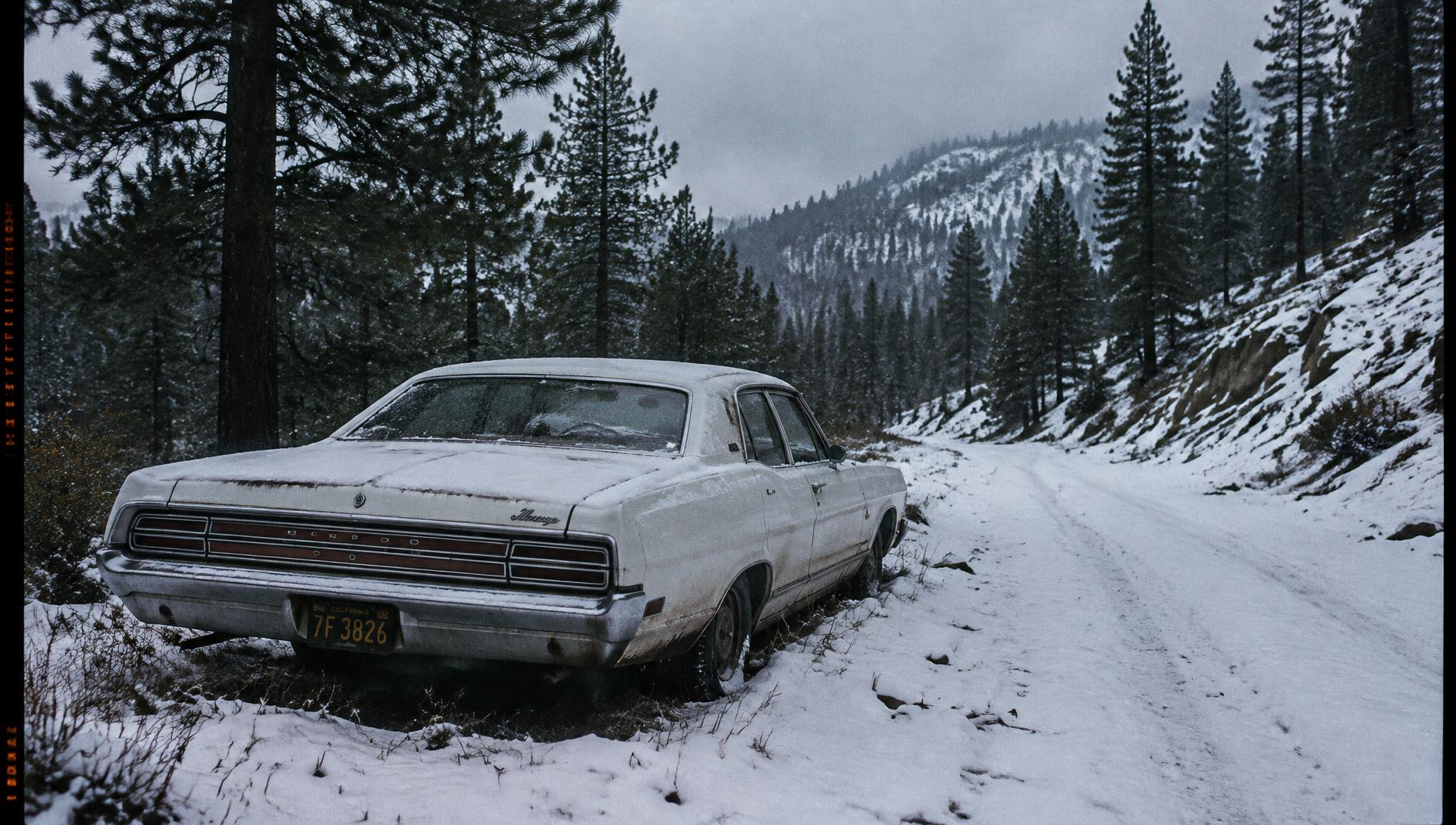
Illustrative reconstruction; not an archival photograph.
Five friends and a basketball game
The five men lived with their families in and around Yuba City and Marysville in California's Sacramento Valley. Four of them had intellectual disabilities and attended a local day programme together; Gary Mathias had been diagnosed with schizophrenia after military service and was taking medication that relatives described as keeping him stable. They played on a basketball team together and were looking forward to a tournament. Relatives consistently described them as dependable, close to their families and unlikely to wander off on an impulse.
On the evening of 24 February 1978 they drove north in Jack Madruga's turquoise-and-white 1969 Mercury Montego to watch UC Davis play California State University, Chico. After the game they stopped at a market in Chico, bought snacks, and were seen leaving shortly before it closed. The drive home to Yuba City was roughly fifty miles of flat valley road.
A car where it should not have been
On 28 February a Forest Service employee found the Montego on a remote road in the Plumas National Forest, high in the Sierra foothills and far to the east of any sensible route home. It was stuck in snow but not badly damaged. Investigators later said it could probably have been pushed free by five men. The keys were missing, the windows were rolled down, the snacks had been eaten, and the fuel tank was reported to be about a quarter full. There was no sign of violence. Nobody knew why the car had been driven up a narrow, rising mountain road at night, or why it had then been left behind.
The motorist on the mountain
A man named Joseph Schons later told investigators that he had been on the same road that night when his own car got stuck. While trying to dig it out, he suffered what he believed was a heart attack and sheltered in his car. He reported hearing whistling and seeing figures and lights, including what he thought were people walking near a car; he called for help but no one answered. His account has been interpreted in several ways, and investigators never established what he actually saw. It remains one of the few eyewitness fragments in the case.
The search that winter could not finish
Once the car was found, the search became one of the largest in the county's history. Deputies, volunteers, dogs and aircraft combed the forest, but the same weather that had stranded the men now hid them. Storms dumped fresh snow over the search area, and by March the operation was scaled back to occasional patrols. The families kept driving the mountain roads themselves. What the searchers did not know was that at least one of the men was almost certainly still alive during those weeks, inside a Forest Service trailer the search had not reached.
June 1978: the snow gives the answers it can
Heavy snowfall stopped the search. On 4 June 1978 a group of motorcyclists entered a Forest Service trailer about twenty miles from where the car had been found. Inside was the body of Ted Weiher. He had lost a great deal of weight, had grown a beard, and his feet showed signs of severe frostbite. Investigators estimated that he had survived for weeks. Nearby, in a storage shed or locker, were supplies of dried and canned food — enough, it was reported, to have sustained the men for a long time. Matches and fuel were present, and the fireplace was reportedly not used. A pair of tennis shoes belonging to Gary Mathias was found in the trailer, and Weiher's own shoes were missing.
The remains of Jack Madruga and Bill Sterling were found the same day along the road between the car and the trailer. Jack Huett's remains were found nearby a few days later. Gary Mathias was not found, then or since.
The trailer's strange inventory
The trailer where Ted Weiher died became the centre of the mystery. According to investigators' accounts reported at the time, it contained a supply of food in a nearby storage locker, matches, and material that could have been burned for heat. A heating system existed but was not used. Weiher had survived long enough to lose roughly half his body weight, yet the food around him was largely untouched. One detail hardened the puzzle: Gary Mathias's tennis shoes were in the trailer, suggesting Mathias had been there too — and had possibly taken Weiher's heavier boots. Two men, weeks of survival, and a stocked shelter that was barely used: investigators could not reconcile it.
Gary Mathias, the fifth man
Mathias is the case's open wound. Unlike his four friends, he had no intellectual disability; his schizophrenia was managed with medication, and relatives said he had been doing well. He also knew the mountain area better than the others, having worked and had acquaintances in the region. That combination has driven every theory since: that he led the group there deliberately, that he was fleeing something, or that he simply walked on alone and died where the search never looked. His disappearance is still an active missing-person record, and if alive he would be in his seventies. No trace of him — no remains, no clothing, no confirmed sighting — has ever been found.
The questions that never closed
Why did five men, heading home to the south, drive to a snowbound road to the east? Why abandon a car that could probably have been freed, and why walk uphill, away from the nearest lights and help, through roughly twenty miles of deep snow? Why did a starving man in a stocked shelter not eat or light a fire? Each question has partial answers. Disorientation, cold and panic can produce irrational choices. The men may not have known the trailer's stores were there or how to open them. Hypothermia can cloud judgement quickly. But no single explanation accounts for everything investigators found.
Theories have filled the gap. Some relatives believed someone else was involved — that the men were frightened, followed, or forced up the mountain. Others have suggested that Mathias, the one member who had friends in the region, may have guided the group toward someone he knew, or that he survived and left. None of these scenarios has been supported by public evidence, and investigators found no proof of foul play. They remain theories, not findings.
What remains
Four families buried their sons in 1978. A fifth family never had that chance. The documented facts are few and stark: a game, a market, an abandoned car in the snow, and a trailer full of food that was not eaten. Everything between those points is reconstruction. The Yuba County Five case is one of the rare disappearances where nearly every person was found, and the mystery got deeper anyway.
Sources & record
- 01Yuba County and Butte County Sheriff's Office statements as summarised in contemporary reporting, 1978
- 02Contemporary reporting in California newspapers, February–June 1978
- 03Later retrospective reporting and family interviews
Online citations