Jack the Ripper: Five Murders and the Limits of the Evidence
Five women murdered in London in 1888 became the centre of a worldwide hunt for an unidentified killer. The surviving record is substantial, but the familiar name conceals uncertainty about the letters, the suspects and even the boundaries of the series.
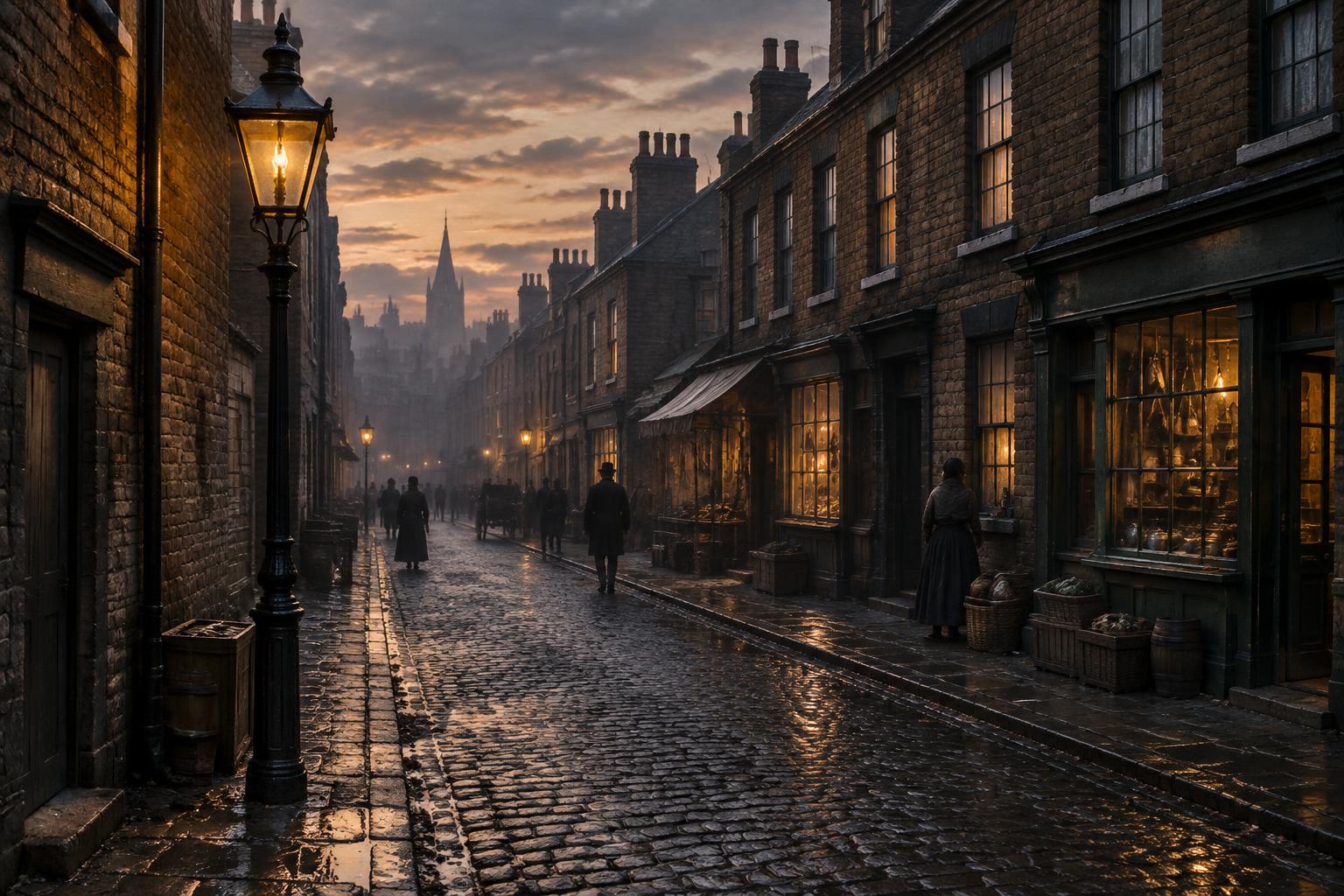
Illustrative reconstruction; not an archival photograph.
Before the name, a neighbourhood
Whitechapel in 1888 was not simply the theatrical landscape of fog and gaslight that later entertainment made it. It was a densely inhabited district of workshops, markets, immigrant communities and common lodging houses. Casual employment and insecure accommodation left many residents exposed to violence. The women later grouped as the Ripper's victims had families, working lives and personal histories before they became entries in police files.
The National Archives identifies poverty as a shared circumstance of the five principal victims. Describing them all exclusively through prostitution, as much contemporary reporting did, compresses uncertain and varied lives into an investigative stereotype. Some had sold sex; evidence about each woman's activity on the night she died differs. Neither poverty nor an assumed occupation explains away the violence committed against them. These distinctions matter because the case's popular mythology often begins by stripping the victims of everything except their supposed usefulness to a killer's story.
31 August: Mary Ann Nichols
Mary Ann Nichols, known as Polly, was discovered in Buck's Row in the early hours of 31 August 1888. Her throat had been cut, and examination revealed abdominal injuries. The inquest reconstructed movements through lodging houses and streets, drawing on people who had encountered her and those who found her body. It did not identify her murderer.
The surviving newspaper account of Nichols's inquest also records a life outside the crime scene: her marriage, separation and correspondence with her father. That testimony is valuable both as biography and as evidence, but readers are usually encountering a contemporary newspaper transcription rather than a complete original court file. Casebook's archive explicitly explains this limitation. Investigators were already dealing with other recent attacks, including the death of Martha Tabram earlier in August. Whether those cases belonged to the same offender was a question, not a fact that Nichols's murder automatically settled.
8 September: Annie Chapman
Annie Chapman was found in the backyard of 29 Hanbury Street on 8 September. Like Nichols, she had suffered a cut throat and abdominal mutilation; organs had been removed. The enclosed yard, adjoining houses and possible witnesses created an apparently promising setting for reconstructing the crime. Yet estimates of when Chapman died and accounts of who had been nearby did not produce an agreed, reliable identification.
Medical discussion of the injuries helped generate the enduring image of a killer with anatomical expertise. Contemporary practitioners did not speak with one voice about how much skill the wounds demonstrated. Working quickly with a knife is not, by itself, proof of medical training. The distinction matters when later writers eliminate ordinary suspects or promote surgeons on the basis of presumed expertise. The crime establishes what happened to Chapman more securely than it establishes the education, occupation or social standing of the person responsible.
30 September: two deaths, one disputed link
Elizabeth Stride was found in Dutfield's Yard off Berner Street shortly after midnight on 30 September. Catherine Eddowes was found later that night in Mitre Square. Stride had suffered a fatal throat wound but lacked the extensive abdominal injuries associated with several other victims. One interpretation is that her murderer was interrupted. Another is that she was killed by someone else. The absence of mutilation cannot independently choose between those explanations.
Eddowes had been released from police custody earlier that night after being detained for drunkenness. Her subsequent murder brought the City of London Police into an investigation already involving the Metropolitan Police. A piece of her apron was subsequently found in Goulston Street. Nearby writing was erased on Commissioner Charles Warren's instructions because he feared that its wording might provoke anti-Jewish disorder. Whether the writing had any connection to the murderer was never established. Its destruction removed the possibility of a fuller contemporary assessment.
9 November: Mary Jane Kelly
Mary Jane Kelly was found dead in her room at Miller's Court on 9 November. Unlike the other four principal victims, she was murdered indoors, in a private space where an attacker could apparently remain longer. The injuries were exceptionally extensive. Dr Thomas Bond's surviving report is an important medical document, but the condition of the body and the limits of nineteenth-century pathology restrict what can be reconstructed confidently.
Witness accounts of Kelly's movements, voices and possible companions became central to later theories. Those accounts vary in timing and reliability. A person seen with a woman believed to be Kelly was not necessarily her murderer, and an uncertain identification cannot acquire certainty merely by being repeated in books. Kelly is conventionally treated as the final victim of the canonical series. That description marks a historical grouping rather than proof that the offender stopped, died, left London or was confined immediately afterward.
What the canonical five actually means
Nichols, Chapman, Stride, Eddowes and Kelly are conventionally called the canonical five. They should not be confused with the broader Whitechapel murders file, which included other killings between 1888 and 1891. Emma Smith, Martha Tabram, Alice McKenzie and Frances Coles are among the women discussed in arguments over the series' boundaries. Inclusion in an administrative investigation is not proof of a common killer.
A frequently cited statement supporting the five-victim grouping appears in Melville Macnaghten's 1894 memorandum. That document was written years after the murders, not during the crucial autumn, and contains errors about proposed suspects. It is evidence of a senior official's later assessment, not an infallible contemporaneous summary. The canonical five remains a useful framework because of the geographical, chronological and injury patterns. It is nevertheless a framework whose individual links, especially Stride's, must remain open to examination rather than becoming assumptions that every new theory is required to inherit.
The police inquiry and its missing tools
Police interviewed witnesses, checked lodging houses, followed suspects and examined suggestions from across the country. The National Archives' teaching collection reproduces correspondence about investigative methods and public proposals, including the use of bloodhounds. These records show activity rather than an inquiry consisting only of baffled men walking through fog. They also reveal how much time could be consumed by untestable information.
Investigators lacked modern DNA profiling, routine forensic fingerprint comparison and dependable crime-scene preservation. Identification depended heavily on human observation in crowded streets, often at night. The split between Metropolitan and City jurisdictions complicated administration, although claims that the forces simply refused to cooperate are too sweeping. Public pressure, sensational reporting and antisemitism further distorted the environment in which evidence was assessed. Lost papers and incomplete surviving inquests now add a second layer of difficulty: modern researchers must reconstruct an already uncertain investigation through a record that is itself incomplete.
Letters that created a public character
The name Jack the Ripper became famous through the Dear Boss letter sent to the Central News Agency in September. The Saucy Jacky postcard and the From Hell communication later acquired particular notoriety. None has been securely authenticated as a message from the murderer. The National Archives describes hundreds of purported Ripper letters and presents an October example explicitly as a hoax.
The distinction between a document being genuine nineteenth-century material and being genuinely written by the killer is fundamental. A period envelope can authenticate a communication's existence without authenticating its claims. A human kidney sent to vigilante committee chairman George Lusk with the From Hell letter cannot now be definitively linked to Eddowes through surviving biological evidence. The letters shaped newspaper coverage and burdened the investigation regardless of their authorship. They reveal public fascination, cruelty and imitation more securely than they reveal a murderer's voice or personality.
Suspects, retrospective memories and DNA claims
Macnaghten named Montague John Druitt, a man called Kosminski and Michael Ostrog as candidates worth considering. Other officials later advanced their own recollections and suspicions. Those accounts do not form a single, consistent police identification. Druitt's death after the murders, for example, makes a possible narrative of cessation; it does not supply evidence placing him at a crime scene. Mental illness likewise cannot substitute for a demonstrated connection to violence.
Modern claims about Aaron Kosminski often centre on testing a shawl alleged to have belonged to Eddowes. Science reported substantial criticism of the 2019 genetic analysis, including questions about provenance and whether the findings could uniquely identify anyone. The journal's article page also records an expression of concern and a subsequent correction. Even potentially informative DNA cannot repair a broken chain of custody by itself. A maternally inherited genetic similarity is not a unique personal identification, and an object's uncertain connection to the murder remains uncertain after laboratory testing.
What remains unsolved
The strongest conclusion is narrower than the most famous headlines: several women were murdered in a closely concentrated period and area, five deaths are conventionally linked, and no offender has been conclusively identified. Royal conspiracies, celebrated artists and elaborate cover-ups offer memorable plots, but no such theory has displaced the basic evidential problems. Selecting a suspect first and interpreting every silence in the archive as concealment produces a story, not a demonstration.
A meaningful advance would require securely provenanced material, genuinely new documentation or independently corroborated evidence capable of distinguishing one candidate from others. Repetition is not corroboration, and a confident book title is not a judicial finding. The case endures partly because so many fragments survive, inviting reconstruction while resisting completion. Its unresolved centre is not simply the missing name of a notorious man. It is the failure to establish responsibility for the deaths of Nichols, Chapman, Stride, Eddowes and Kelly.
A lodging-house bed and the limits of a biography
Nichols's inquest makes the lodging house part of the evidential geography. Testimony about whether she had money for a bed helped reconstruct why she was still outside during the night. That immediate problem should not be mistaken for a complete explanation of her life. The same proceedings heard from people who knew her through family relationships, rather than through the last hours that made her a public subject. Those strands sit alongside one another in the record: a woman struggling for accommodation and a daughter, wife and mother whose history extended far beyond Buck's Row.
There is a particular danger in turning financial need into a reconstructed transaction with the murderer. A witness can establish that Nichols lacked lodging money without establishing how she intended to obtain it, who subsequently approached her or what she believed about that person. The temptation is to join these fragments into an uninterrupted narrative because a continuous story is easier to read. The evidence does not warrant that continuity. Her movements contain gaps, and the circumstances of the meeting that ended her life remain among them.
The newspaper inquest archive also shows why apparently simple biographical facts require care. A witness might report something personally observed, repeat information received from somebody else or estimate a time without consulting a clock. All three can appear in the same column of print. Preserving those differences is not an academic obstacle to telling Nichols's story. It is how her documented experience can be recovered without filling the missing portions with assumptions inherited from later crime writing.
Hanbury Street: witnesses who did not see the murder
Chapman's inquest offers an unusually clear example of how several useful observations can resist combination. John Davis described discovering the body and the passage through the house to the yard. According to the newspaper transcript, the doors were not ordinarily secured against entry. The site was therefore more accessible than an enclosed yard might initially suggest. Its position behind a house does not prove that the attacker lived there, possessed a key or had arranged access with a resident. An apparently private crime scene could be reached through an ordinary passage.
Elizabeth Long described seeing a woman she subsequently identified as Chapman talking to a man outside the house at about half past five. Albert Cadosch, living next door, described hearing a voice and, on a separate visit to his yard, a noise against the dividing fence. He did not look over and witness an assault. Their evidence supplies possible fragments of the setting, not two independent views of the same killing. Long's identification of the woman and her estimate of time are essential qualifications, while Cadosch's sounds cannot independently identify their source.
Dr George Bagster Phillips's assessment of the body created a further difficulty for the chronology. His estimate appeared to favour an earlier death, although the inquest discussion acknowledged the effects of the conditions and blood loss on the body's cooling. The evidence cannot responsibly be resolved by selecting whichever witness best supports a preferred suspect. Nor can all the estimates be treated as exact and then fitted into a minute-by-minute account. The disagreement is itself a feature of the record: the yard generated several leads, but no unambiguous clock for the murder.
Two police forces, two kinds of proximity
The discovery of Eddowes in Mitre Square placed one of the killings inside the City of London's jurisdiction. That boundary mattered administratively, but it did not divide two completely separate populations. People, markets and routes crossed it constantly. A murderer could cross a police boundary without undertaking a conspicuous journey. Maps are useful for showing this concentration, provided that the lines on them are not allowed to imply a level of offender planning that the evidence cannot establish.
The apron fragment in Goulston Street is more concrete than most proposed routes. Its relationship to Eddowes gives investigators a physical connection between two places, but not a continuous trail between them. It does not establish every turning taken, the location of a home or the point at which the offender first noticed blood on the cloth. Arguments that derive a precise residence from the find risk giving one surviving object more geographical precision than it can bear. Movement away from Mitre Square is not equivalent to proof of a destination.
The nearby wall writing created a different problem: proximity without a demonstrated connection. Warren's decision to erase it must be understood against his stated fear of anti-Jewish violence, while remaining open to criticism as the destruction of potentially relevant material. Those propositions do not cancel one another. It is possible to recognise a serious public-order concern without deciding that the words were the killer's message. Conversely, the fact that the writing was erased does not make its author more identifiable. Later theories must work with the contemporary descriptions rather than an original surface that no longer survives.
Miller's Court and the uncertain last sighting
Kelly's murder altered the physical setting, not merely the severity of the injuries. A room could shield an attacker from passing witnesses and provide more time than an open street. That is a reasonable interpretation of opportunity, but it is not a measurement of how long the offender remained or proof that the attack followed a different psychological plan. A change in circumstances can produce a change in conduct. So can a different offender. The scene alone does not decide between those larger explanations.
Bond's report records medical observations from the examination of Kelly and provides a basis for comparing injuries across the proposed series. It cannot establish the identity of a visitor or validate every witness who claimed to have seen her. In this case, as elsewhere, medical and eyewitness evidence answer different questions. A recollection of a companion may suggest somebody to trace; a medical opinion may constrain possibilities about death. Neither becomes a complete narrative simply because the other leaves room for it.
The familiar claim that the killer's violence reached a final culmination in Miller's Court also depends on looking backwards from the conventional end of the series. Investigators did not possess a certificate that this was the last attack. Later Whitechapel deaths still required examination, and the surviving records do not tell us why the canonical sequence stopped. Departure, detention, death and a change in behaviour are proposed explanations. None follows automatically from the absence of a sixth universally accepted victim. A chronological endpoint in a modern article is not evidence of an endpoint in an offender's life.
The memorandum is a source, not a verdict
Macnaghten's memorandum matters partly because of its official origin and partly because of its date. Written in 1894, it demonstrates that a senior police official held a particular retrospective view of the murders and named three possible suspects. It does not show that police in September 1888 possessed the same information. Macnaghten joined Scotland Yard after the canonical murders. His later access to institutional knowledge deserves attention, but access and accuracy are separate questions, particularly where the document's personal details can be checked and found wanting.
Druitt is a useful test of that distinction. The memorandum's description does not accurately reflect his age and occupation. Its suspicion rests in part on information said to have come through private channels, rather than on a surviving evidential chain placing him with a victim. A later official's belief can be genuine even when the grounds for it are unavailable or mistaken. The responsible formulation is therefore that Macnaghten suspected Druitt, not that the police solved the murders privately and merely neglected to announce the result.
The name Kosminski presents a related challenge. A surname in a retrospective police document is not equivalent to a complete identification supported by surviving crime-scene evidence. Later researchers have attempted to reconcile that reference with institutional records and other officials' accounts. Such work can clarify who may have been meant without proving that the person was the murderer. Ostrog's appearance in the same memorandum further warns against treating the list as a final shortlist whose weakest candidate can be removed to establish the strongest. Eliminating alternatives does not manufacture positive evidence against whoever remains.
How the correspondence changes the archive
The letters did more than introduce a memorable name. They created material that authorities had to receive, sort, compare and sometimes publicise. A document claiming special knowledge could demand attention even if its author was seeking amusement or publicity. That burden belongs to the history of the investigation: false material can have real operational consequences. The National Archives' surviving hoax example is valuable precisely because it shows the impersonation surrounding the crimes, not because it permits a new glimpse into the murderer's private thoughts.
Authorship arguments must distinguish features available to any newspaper reader from details that only an offender might know. Timing is important here. A claim that appears unusually informed may have been written after relevant information entered public circulation. Handwriting similarities are also limited by the absence of an authenticated sample from the killer against which to compare them. Comparing one disputed letter with another may suggest a shared writer. It does not establish that either writer committed a murder. The chain of inference still needs an independent link.
The kidney sent to Lusk is especially resistant to a neat conclusion because a biological object sounds more decisive than an ordinary letter. Yet the important questions are its origin, its handling and its demonstrable relationship to a victim. The surviving material cannot now answer those questions through a secure modern comparison. The communication may remain historically significant without becoming an authenticated confession. To quote or imitate its language as if the murderer were speaking would erase that central distinction between the existence of the package and the truth of its accompanying claim.
What a modern laboratory cannot restore
The shawl controversy exposes two different requirements for identification. A laboratory must produce interpretable results, and the submitted object must have a demonstrable relationship to the event under investigation. Success on one requirement cannot compensate for failure on the other. Even a technically sound genetic result from an old textile would need to be assessed against the possibility of later handling and the uncertainty over when biological material reached it. Without provenance, the result risks answering a question other than the one posed by the murder inquiry.
Mitochondrial DNA adds another limitation because it is inherited through the maternal line and shared among people who are not the same individual. Its usefulness depends on the precise comparison and the strength of the surrounding evidence. It should not be described as a uniquely identifying genetic signature merely because the analysis is modern. The criticisms reported by Science and the editorial notices attached to the journal paper belong in the account of the claim, not in a footnote beneath a headline announcing a solution.
There is also an imbalance between what survives and what attracts attention. A spectacular laboratory announcement may travel further than a careful discussion of an object's history. Reassessment of Victorian documents can be less dramatic but more decisive if it corrects a date, challenges an alibi or identifies the origin of a later anecdote. Neither method deserves automatic preference. The common standard is whether the evidence can be independently checked and whether it actually discriminates among competing explanations, rather than merely making one of them seem imaginable.
Returning the file to the women
The case's enormous afterlife can obscure a basic asymmetry. The killer has a stable popular persona, while the women are often reduced to a list of dates and injuries. The inquest material reverses that emphasis when read patiently. It contains accommodation problems, family contact, work, illness and ordinary encounters. These details are incomplete and sometimes conflicting, but they restore dimensions of lives that the brand name Jack the Ripper does not convey. They are not peripheral decoration around the investigation; they explain the human circumstances in which the crimes occurred.
A victim-centred account does not require inventing private thoughts or replacing one certainty with another. Where an occupation, encounter or intention is uncertain, it should remain uncertain. Where testimony preserves a relationship or a practical difficulty, it can be included without making it part of the murderer's supposed design. That restraint is especially important in a case whose entertainment history rewards an ingenious offender more readily than an accurate portrait of the people attacked. The archive can support attention to their lives without pretending to recover everything it has lost.
Sources & record
- 01The National Archives — hoax Ripper letter and historical context
- 02The National Archives — original police correspondence teaching collection
- 03Casebook — contemporary newspaper transcriptions of the inquests
- 04Casebook — Macnaghten memorandum, 1894, transcription
- 05Casebook — official documents including Bond and Warren reports
- 06Science — criticism of the shawl DNA identification claim, 2019
- 07Journal of Forensic Sciences — shawl paper, with editorial notices
Online citations
- →The National Archives — hoax Ripper letter and historical context
- →The National Archives — original police correspondence teaching collection
- →Casebook — contemporary newspaper transcriptions of the inquests
- →Casebook — Macnaghten memorandum, 1894, transcription
- →Casebook — official documents including Bond and Warren reports
- →Science — criticism of the shawl DNA identification claim, 2019
- →Journal of Forensic Sciences — shawl paper, with editorial notices