The Zodiac Killer: Five Murders, Four Ciphers, and a Name Never Proven
In ten months between December 1968 and October 1969, a gunman and knife attacker killed five people and wounded two more across Northern California. Then he began writing to the newspapers. He named himself the Zodiac, mailed coded ciphers, sent a scrap of a victim's bloodied shirt as proof, and claimed far more killings than police could ever confirm. Half a century later, one of his ciphers has finally been broken — but the man who wrote it has never been identified.
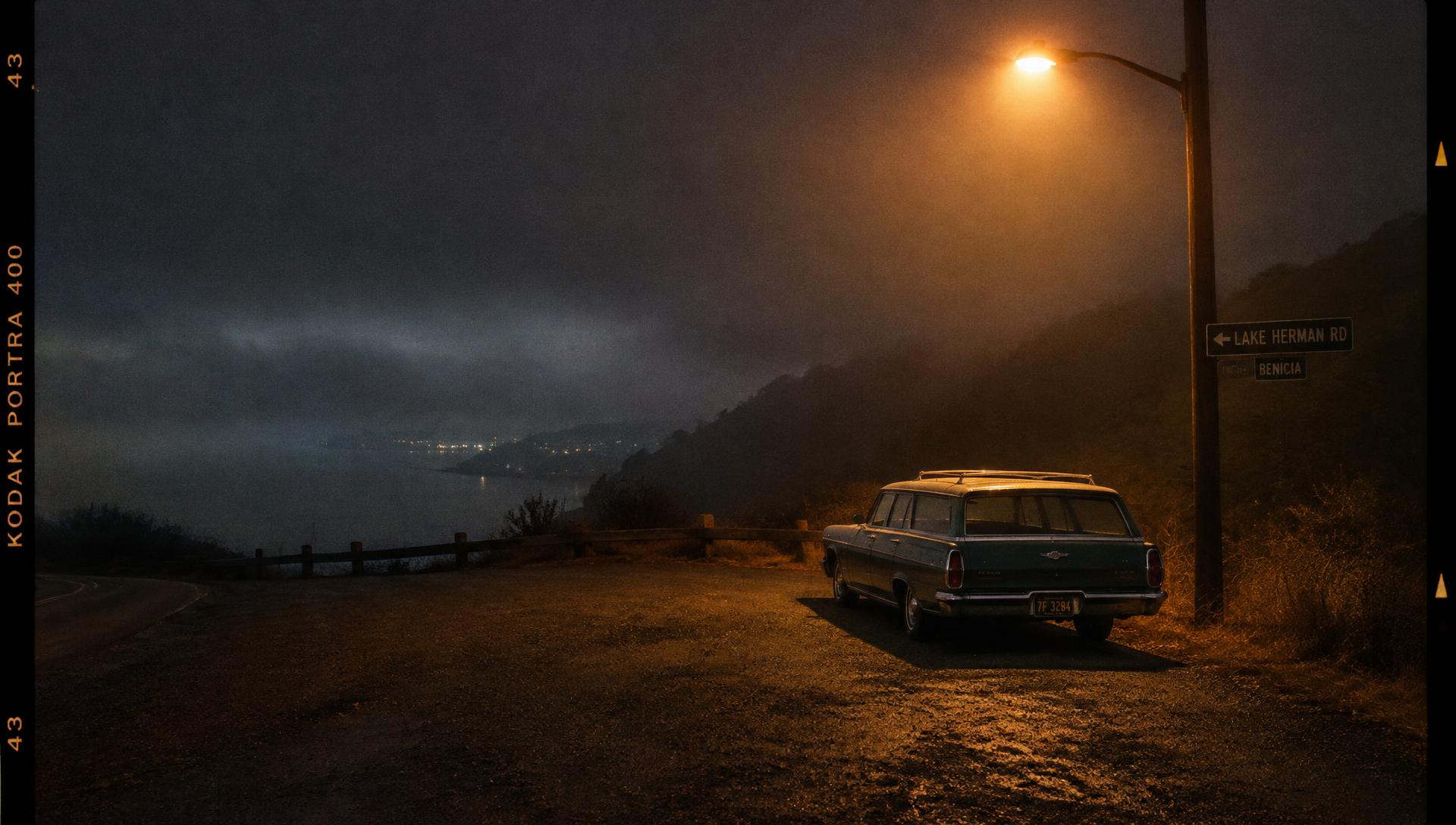
Illustrative reconstruction; not an archival photograph.
Lake Herman Road, 20 December 1968
The first attack attributed to the Zodiac happened on a dark turnout on Lake Herman Road, on the outskirts of Benicia and Vallejo. David Faraday, 17, and Betty Lou Jensen, 16, were on their first date and had parked a Rambler station wagon in a spot known locally as a lovers' lane. Shortly after 11 p.m. both were shot with a .22-calibre weapon. Faraday was found beside the car; Jensen had run some distance before she was struck. There were no witnesses to the shooting itself, and for months the killings were treated as a local, motiveless crime.
Blue Rock Springs, 4 July 1969
Just after midnight on Independence Day, Darlene Ferrin, 22, and Michael Mageau, 19, were sitting in her car in the parking lot of Blue Rock Springs Park, about four miles from the first scene. Another vehicle pulled up behind them, left, and returned. A man approached with a flashlight and opened fire with a 9mm pistol. Ferrin died; Mageau, shot in the face, neck and body, survived and gave police the first description of the attacker — a heavy-set white man. Less than an hour later, a man telephoned the Vallejo police, reported the shooting, and claimed the Lake Herman Road killings as well.
The letters begin
On 1 August 1969 three newspapers — the San Francisco Chronicle, the San Francisco Examiner and the Vallejo Times-Herald — received nearly identical letters. Each included details of the shootings that police had not released, and each enclosed one third of a 408-symbol cipher. The writer demanded that the papers print the cipher on their front pages or he would kill again. Within days he used the name that would define him: 'This is the Zodiac speaking.' Letters were usually signed with a crossed-circle symbol resembling a gunsight.
The 408 cipher was not solved by codebreakers in government service but by Donald and Bettye Harden, a schoolteacher and his wife in Salinas, about a week after publication. The plaintext was a boast about killing because it was enjoyable, and a claim that victims would become the writer's slaves in an afterlife. It did not contain his name, despite his suggestion that it might.
Lake Berryessa, 27 September 1969
The third attack was different. At Lake Berryessa in Napa County, college students Bryan Hartnell, 20, and Cecelia Shepard, 22, were picnicking on a shoreline peninsula when a man approached wearing a black executioner-style hood marked with the crossed-circle symbol. He carried a gun, told them a story about being an escaped convict, had Shepard tie Hartnell up, tied her, and then stabbed them both repeatedly. He then walked back to Hartnell's car and wrote on its door the dates of the earlier attacks and the date of this one. Shepard died two days later. Hartnell survived. Shortly after the attack, a man called the Napa police to report it from a payphone; a palm print was later lifted from the phone, but it was never matched.
Presidio Heights, 11 October 1969
Two weeks later the killer moved into San Francisco. Taxi driver Paul Stine, 29, picked up a passenger downtown and drove to the corner of Washington and Cherry Streets in the wealthy Presidio Heights district. There he was shot once in the head. The passenger tore away a piece of Stine's shirt, took his wallet and keys, and wiped parts of the cab. Teenagers watching from a house across the street called the police, and in the confusion of the first radio description, officers who passed a man walking away from the scene did not stop him. It was the closest the investigation is known to have come to the Zodiac in person.
Days later, the Chronicle received a letter containing a swatch of Stine's bloodstained shirt — physical proof that the letter-writer and the killer were the same person. The letter also threatened to shoot children on a school bus, which led to armed escorts for some Bay Area school buses that autumn. No such attack took place.
The 340 cipher and fifty years of silence
In November 1969 the Chronicle received a second, 340-symbol cipher. It resisted amateurs, professionals and computer analysis for more than five decades. In December 2020 a team of three private codebreakers — David Oranchak in the United States, Sam Blake in Australia and Jarl Van Eycke in Belgium — announced that they had solved it, and the FBI confirmed the solution. The message was transposed in a diagonal pattern across sections of the grid. Its contents were unrevealing: the writer said he hoped people were having fun trying to catch him, rejected a claim made on a television show, and repeated that he was not afraid of the gas chamber. Again, no name.
Two shorter ciphers, the 13-character message of April 1970 and the 32-character message of June 1970, remain unsolved. They are probably too short to be solved with confidence; many proposed readings are possible, which is exactly the problem.
A letter campaign measured in years
The confirmed correspondence did not stop with the ciphers. Through late 1969 and into 1970 the Chronicle and other papers received a stream of cards and letters: a Halloween card to reporter Paul Avery containing a cryptic message; a letter with a diagram of a bomb the writer claimed to have buried near a school; a 'score card' letter in which the writer taunted the police by comparing his claimed tally to theirs. Investigators treated only some of this material as authenticated. A 1974 letter mocking the film The Exorcist is generally considered the last writing accepted as likely genuine. A 1978 letter claiming the Zodiac had returned was later reported to have been a hoax by a police inspector, a finding that itself was disputed.
The letters did something unusual for an anonymous killer: they built a character. The writer quoted The Mikado, drew a dripping pen as a signature, misspelled words in ways some analysts thought were deliberate, and demanded that Bay Area residents wear buttons bearing his symbol. Whether any of this was genuine self-portrait or theatre is unknown, but it fixed the public image of a killer who wanted an audience more than he wanted money or escape.
The sketch and the missed man
The only widely circulated image of the Zodiac is a composite sketch drawn from the Presidio Heights witnesses: a stocky man in his thirties or forties with horn-rimmed glasses and a crew cut. Two San Francisco patrol officers, Donald Fouke and Eric Zelms, passed a man near the Stine scene minutes after the shooting; Fouke later said the man he saw did not match the radio description they had been given, so they let him walk on. The original broadcast had described the suspect as a Black man, an error corrected only later, and that correction may have cost the case its best chance. Fouke's later account of the encounter became one of the most debated details in the file.
The suspect who never fitted
Hundreds of men have been investigated over the decades. The one most often named was Arthur Leigh Allen, a Vallejo man who was questioned in 1969 and searched later. Investigators found circumstantial details that interested them, and the suspicion was popularised by Robert Graysmith's book Zodiac and the 2007 film. But Allen's fingerprints did not match a print associated with the Stine scene, his handwriting did not match the letters according to examiners, and a partial DNA profile developed from envelope material in 2002 did not match him either. He died in 1992 without being charged. A suspicion that never accumulated evidence is not an identification, and this file treats it as such.
Other names surface periodically. In 2021 a private group publicly named a different man and declared the case solved; the FBI and San Francisco police stated that the case remained open. The archive does not repeat names that rest only on private claims.
A case that outlived its investigators
The detectives most associated with the case — Dave Toschi and Bill Armstrong in San Francisco, among others — worked it for years and carried it into retirement. Toschi, who died in 2018, was still being asked about the Zodiac half a century after the Stine murder. The case also changed how the public consumes crime: the 2007 film, the online cipher community, and decades of amateur investigation have produced a vast secondary literature in which confirmed evidence and speculation are often mixed. This file sticks to the confirmed core.
Why genetic genealogy hasn't closed it
The same investigative genetic genealogy that identified the Golden State Killer in 2018 has been raised many times for the Zodiac. The obstacle is the evidence itself. Envelopes and stamps can carry saliva, but the letters were handled by postal workers, journalists, detectives and laboratory staff for decades before modern contamination controls. Any profile recovered may be partial, degraded, or someone else's. Genealogy needs a clean, single-source sample of good quality; the Golden State Killer case had preserved rape-kit DNA. Whether such a sample exists in the Zodiac evidence is not publicly known.
What remains
The documented Zodiac case is narrower than the legend. There are five confirmed murders and two survivors, a handful of letters proven genuine by contents or physical evidence, and many later letters whose authenticity is debated. The writer's claim of 37 victims has never been substantiated, and attempts to attach other unsolved killings to him remain theories. What is certain is that a man killed five people, explained himself in code, and was never named. The file is still open.
Sources & record
- 01San Francisco Police Department and Vallejo Police Department case records as summarised in public reporting
- 02FBI statement confirming the Z340 solution, December 2020
- 03Contemporary San Francisco Chronicle reporting, 1969–1974
- 04Robert Graysmith, Zodiac (1986) — used for chronology only
Online citations