The Mary Celeste: A Ship Sailing With No One Aboard
On a December morning in 1872, the crew of the Dei Gratia boarded an American brigantine drifting under partial sail in the Atlantic. The ship was sound, her cargo largely intact, six months of food and water in her stores — and every one of the ten people aboard was gone. No one ever saw them again.
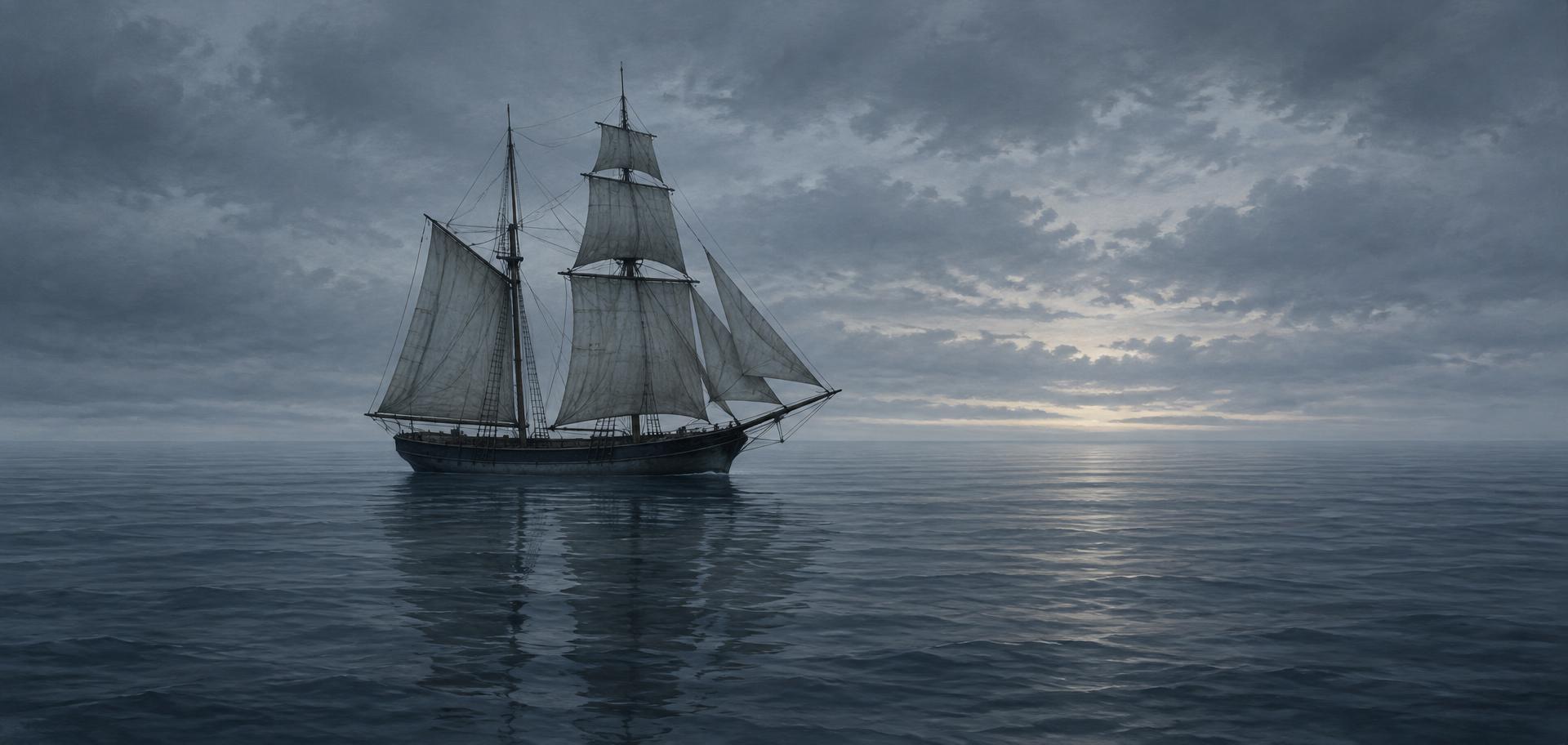
Illustrative reconstruction; not an archival photograph.
The Mary Celeste left New York on 7 November 1872, bound for Genoa with a cargo of 1,701 barrels of denatured industrial alcohol. She was a small brigantine of about 280 tons, ten years old, recently refitted, commanded by Benjamin Spooner Briggs — an experienced, sober, well-regarded captain who had invested in the ship and was making the voyage with his wife Sarah and their two-year-old daughter Sophia. Their seven-year-old son had been left at home with his grandmother. The crew was seven men, mostly Germans with good records. Ten people in all. About two weeks later a British brig, the Dei Gratia, herself eight days out of New York, sighted the Mary Celeste about four hundred miles east of the Azores, sailing erratically under shortened sail — and after watching her for two hours and receiving no answer to signals, sent a boat across.
What the boarding party found
The scene the Dei Gratia's men described at the subsequent inquiry is precise, and it matters because the legend has buried it. The ship was not abandoned in haste in a storm: the sea was calm, and much of her sail was still set. She was not sinking. There was roughly a metre of water in the hold — an amount her pumps could handle, though one pump was found disassembled. Her cargo hatches had been partly opened. The ship's single boat was gone, launched, the evidence suggested, in an orderly way. The chronometer, the sextant, the navigation book and the ship's register were gone; the logbook and the log slate remained, the last ink entry dated 25 November, nine days earlier, with the ship's position recorded near the Azores. The crew's personal belongings — clothes, pipes, oilskins, even a harmonium — were left behind. There was food and water for six months. There was no blood, no damage from violence, no sign of fire.
The famous details are nearly all later additions. No warm meal sat on the galley table. No cup of tea still stood warm. The captain's bed was not unmade with a child's impression in it. These flourishes entered the story through fiction — most powerfully through a young doctor named Arthur Conan Doyle, whose anonymous 1884 short story about a ship he called the Marie Celeste was so convincingly written that many readers took it as reportage. The real boarding party found something stranger than any of that: a ship abandoned calmly, competently, and for no reason anyone could see.
The Gibraltar inquiry
The Dei Gratia brought the Mary Celeste into Gibraltar, where a Vice-Admiralty Court convened to decide the salvage claim. The attorney general, Frederick Solly-Flood, was convinced from the start that a crime had occurred — mutiny, murder, fraud — and the inquiry spent months hunting for evidence of it. There was none. Cuts on the bow that he suspected were deliberate proved to be ordinary sea wear. Marks on a sword found under the captain's bed, tested for blood, were rust. In the end the court awarded the salvors about £1,700 — a fraction of the ship and cargo's value, the reduced sum a quiet mark of the court's lingering suspicion — and formally closed the case without a finding. The ten missing people were never found, and no trace of their boat was ever identified.
What could make a captain leave a sound ship?
Every theory of the Mary Celeste has to clear the same bar: Benjamin Briggs knew his ship, knew that abandoning her in a small boat in the open Atlantic was the most dangerous choice available, and made it anyway — or was made to. The most-discussed modern explanation concerns the cargo. Nine of the 1,701 alcohol barrels were found empty, and those nine were made of red oak, a more porous wood than the white oak of the rest. A slow leak into a sealed hold could have built up vapour; a small pressure release or flash when a hatch was opened — one modern reconstruction suggested a harmless, smokeless 'whoosh' rather than an explosion — might have convinced a captain already uneasy about his cargo that the ship was about to blow. The orderly evacuation, the open hatches, the missing navigation instruments and the otherwise untouched ship all fit a crew that intended to come back: towed behind on a line, the boat separated from the ship, and the weather or a parted rope did the rest. It is a coherent hypothesis. It has never been proven.
The alternatives each explain something and fail on something else. Piracy fails on the untouched cargo and belongings. Mutiny fails on the absence of blood and on the crew's records — and on the awkward fact that the mutineers vanished too. A waterspout or seaquake could have flooded the pumps' sounding rods and made the ship appear to be sinking, and has never been ruled out; but it requires Briggs to misread his own ship. Insurance fraud was proposed later and fits nothing: the insurance was modest, and nobody benefited from the disappearance of ten people. The most honest sentence in the file is the court's own — no conclusion was ever reached.
The ship that outlived her crew
The Mary Celeste herself sailed on under new owners for twelve years, an unlucky ship by reputation and a poor investment in fact. In 1885 her last captain, Gilman Parker, loaded her with an insured cargo of worthless goods and deliberately ran her onto a reef off Haiti in a fraud so clumsy that the insurers refused to pay and Parker was prosecuted. The wreck rotted on the reef. In 2001 an expedition announced it had found her timbers; later analysis of the wood raised serious doubts, and the identification is not accepted. So even the ship's grave is disputed. What survives intact is the image the Dei Gratia's men brought into Gibraltar: a good ship, under sail, on a calm sea, with her boat gone and no one at the wheel — and ten people, including a two-year-old girl, swallowed by the Atlantic without leaving a single confirmed trace.
Sources & record
- 01Record of the Vice-Admiralty Court salvage inquiry, Gibraltar, December 1872 – March 1873 (the Dei Gratia testimony and findings).
- 02Logbook and log slate of the Mary Celeste, last entries 25 November 1872, as transcribed in the inquiry record.
- 03Charles Edey Fay, Mary Celeste: The Odyssey of an Abandoned Ship (Peabody Museum, Salem, 1942) — by a member of the owner's family.
- 04Brian Hicks, Ghost Ship: The Mysterious True Story of the Mary Celeste and Her Missing Crew (Random House, 2004).
- 05Arthur Conan Doyle, 'J. Habakuk Jephson's Statement' (Cornhill Magazine, 1884) — the fiction that fixed the legend's false details.
- 06Andrea Sella (UCL), 2006 replica experiment on a pressure event in an alcohol cargo hold, reported in contemporary press.
Online citations