Left at Sea: The Divers a Boat Forgot on the Great Barrier Reef
An American couple went into the water on an ordinary afternoon dive at the Great Barrier Reef. The boat counted heads, got the number wrong and sailed home. Nobody realised they were missing until two days later, and their bodies have never been found.
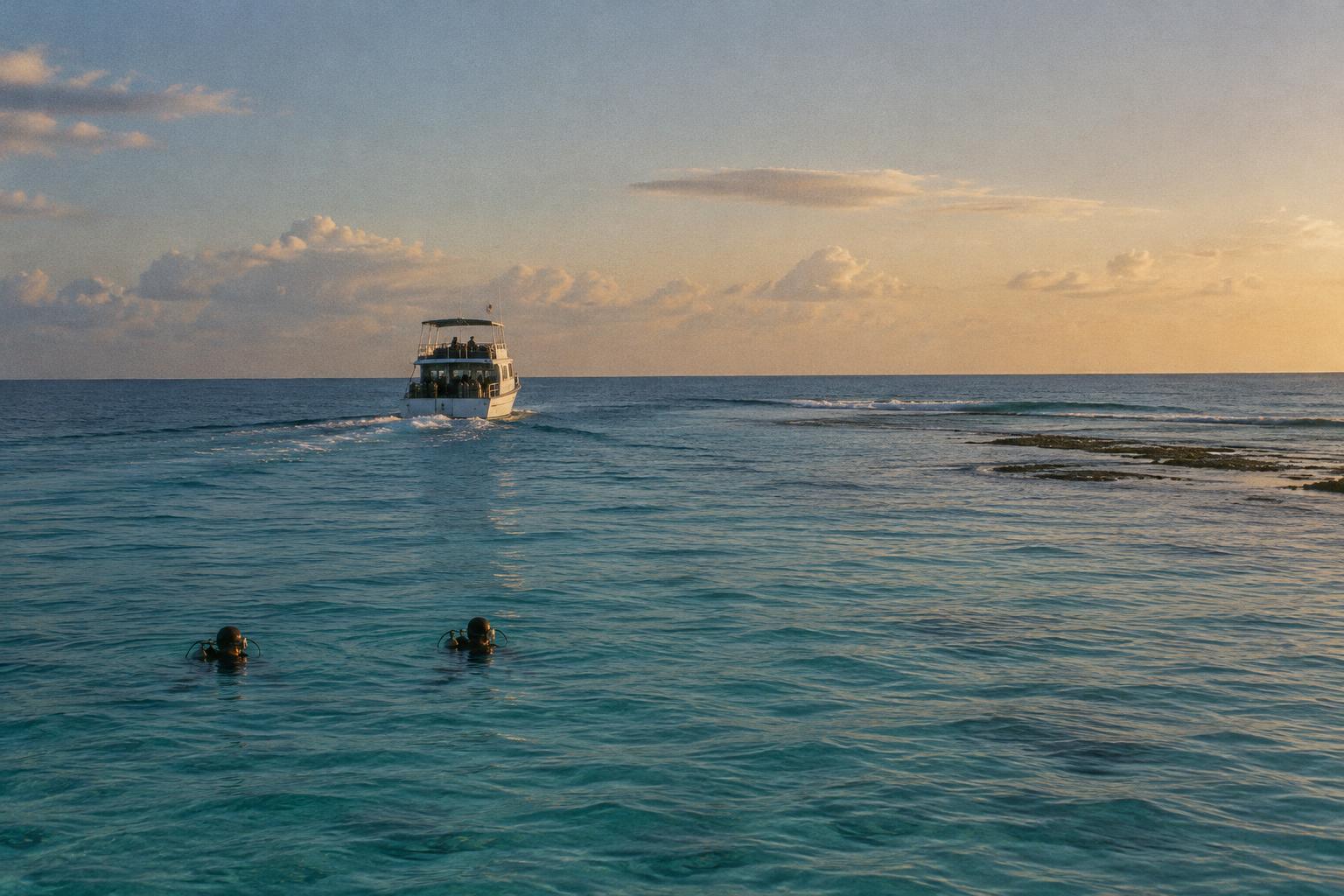
Illustrative reconstruction; not an archival photograph.
Who the Lonergans were
Tom and Eileen Lonergan were Americans from Baton Rouge, Louisiana. They had spent time as Peace Corps volunteers in the Pacific, in Tuvalu and Fiji, and were travelling in Australia before heading home. Both were certified divers. In late January 1998 they booked a day trip on the Outer Edge, a dive boat operating out of Port Douglas in far north Queensland.
The afternoon at St Crispin's Reef
On 25 January 1998 the Outer Edge carried a group of passengers out to St Crispin's Reef, on the outer Great Barrier Reef, roughly 40 kilometres offshore. The Lonergans took part in the final dive of the day. According to reports of the later inquest and trial, a headcount was done before the boat left the site, but the count was wrong — passengers had moved around, and two people re-entered the water briefly after the count. The boat returned to port with the couple still in the sea.
There was no second check. No one on board reported two passengers missing, and no one at the dock flagged an unclaimed bag. It was only on 27 January — when the boat went out again and a bag with the couple's belongings was found aboard — that crew realised something was wrong. By then the Lonergans had been in the water, or lost, for around two days.
The search
A large air and sea search followed. It did not find the couple. Over the following weeks and months, items of their dive equipment washed up along the coast to the north, including buoyancy control jackets, fins and a tank. A dive slate — the small writing board divers carry — was reported to have been found with a written plea for help on it. Its authenticity and meaning were debated, and it was never treated as proof of how long the couple survived.
Experts who gave evidence noted that the equipment showed no clear signs of a shark attack. The working assumption was that the couple drifted, became exhausted and dehydrated, and drowned, perhaps after deliberately shedding heavy gear. That is a reconstruction, not an established sequence; no remains were ever recovered.
Rumours, diaries and the coroner
Because no bodies were found, rumours grew. There were claims of sightings of the couple alive, and theories that they had staged their own disappearance. Extracts from the couple's diaries, which some read as showing unhappiness or a wish to die, were raised in media coverage and at the inquest. These theories were examined and not accepted as an explanation; the coroner found that the couple had been left at the reef and presumed they had died there.
The trial of the skipper
The skipper of the Outer Edge, Geoffrey 'Jack' Nairn, was charged with unlawful killing — Queensland's equivalent of manslaughter. In November 1999 a jury in Cairns acquitted him. His company was separately fined over safety failures and later went out of business. The case still prompted change: Queensland tightened its rules for dive operators, including stricter and repeated passenger counts with signed records.
Open Water and the story that outlived the case
In 2003 the low-budget film Open Water told a fictionalised version of a couple left behind by a dive boat. It was inspired by the Lonergan case but invented its characters and events, including the shark scenes. For many people the film is now how they know the story, which is one more reason to keep the documented record separate: two people were left behind because of a counting error, nobody noticed for two days, and the sea kept the rest.
What remains unknown
How long the Lonergans survived, whether they tried to swim for a reef or a passing boat, and exactly how they died are not known. What is documented is narrower and, in its way, harder: a routine checking procedure failed, and the failure went unnoticed long enough to make rescue impossible.
Sources & record
- 01Wikipedia — Disappearance of Tom and Eileen Lonergan
- 02BBC News — coverage of the skipper's trial and acquittal (1999)
- 03Undercurrent — reports on the manslaughter charge and trial
- 04Brisbane Times — ten years on (2008)
- 05Outside — long-form account of the case
- 06Wikipedia — Open Water (film)
Online citations
- →Wikipedia — Disappearance of Tom and Eileen Lonergan
- →BBC News — Skipper cleared over divers' deaths
- →BBC News — Divers' disappearance coverage
- →Undercurrent — Skipper charged with manslaughter (1999)
- →Undercurrent — Australia's Lonergan trial (2000)
- →Brisbane Times — Ten years on, reef mystery remains
- →Wikipedia — Open Water (film)